
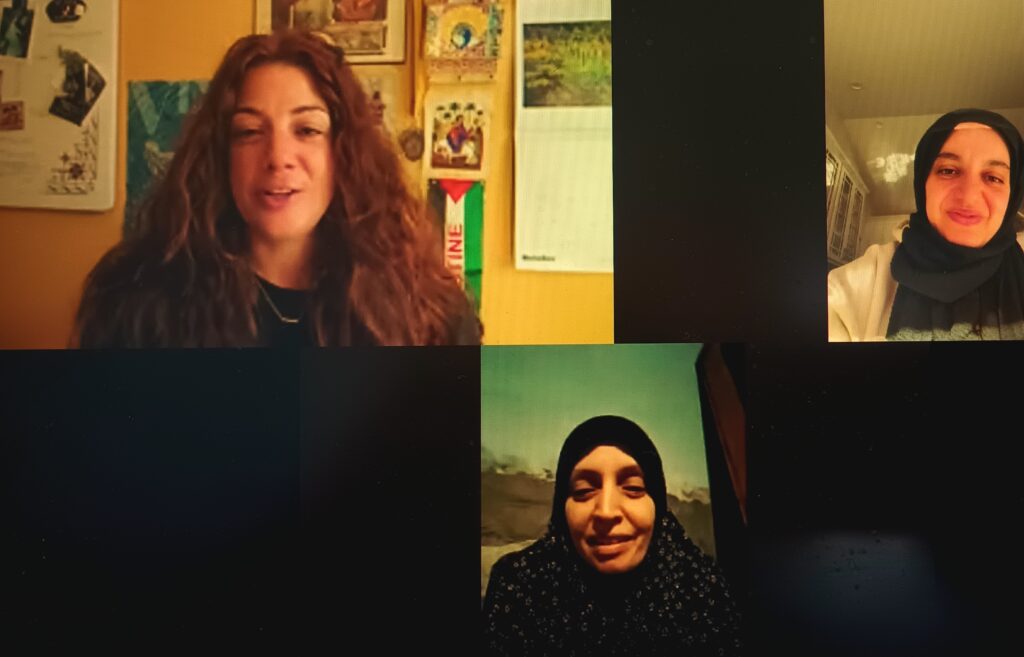
Screenshot of Zoom video by the author. Upper left: Jessica Clotfelter; upper right: Dua Aldasouqi; lower center: Asma
This is part one of a two-part article on friendship and solidarity during Israel’s war against Palestinians in Gaza.
Ear-to-ear smiles form on all three women’s faces when Asma appears on Zoom from 6,000 miles away in Khan Younis in the occupied Gaza Strip, Palestine. She and her family are still alive after more than 750 days of being bombed by Israel with weapons supplied by the United States. They are living in a crowded tent camp along the Mediterranean coast.
Asma waves at Jessica Clotfelter, a former Marine from Windsor, Illinois, who has just returned after being captured in October by the Israeli Defense Forces in the Mediterranean Sea, while trying to deliver humanitarian aid to Gaza by boat as part of the Global Sumud Flotilla. The boats did not reach Gaza. The closest vessel came within 25.5 nautical miles of its coast, but the mission helped amplify Palestinian voices for liberation.
Asma and Jessica have been friends since 2023. Jessica saw Asma’s call for help on social media after Hamas’s October 7, 2023 attack on Israel and Israel’s counteroffensive, which has been declared a genocide by the United Nations Independent International Commission of Inquiry on the Occupied Palestinian Territory.
The third smiling woman is Dua Aldasouqi, a founder of Champaign-Urbana Muslim Action Committee. Dua has volunteered to interpret Asma’s Arabic into English during my interview. Asma is a mother of five children between the ages of 7 and 23. “My dear, may God bless you,” Asma says to Jessica as our interview starts. “And we will never, ever forget your support.” Jessica’s mouth quivers and her eyes fill with tears as she hears the interpretation.
Jessica helped arrange my interview. “Asma is excited that someone has taken an interest. It’s just been her and me trying to get anyone to hear us,” Jessica texted before my interview. We are soon joined on Zoom by Asma’s two sisters, Sahar and Sahhar, who are living with their father in another part of Gaza. All three Palestinian women are eager to tell us about their living conditions, especially since the third so-called “ceasefire” was declared on October 9, 2025. “Look, we have had wars before,” Asma says. “And there were a lot of deaths and martyrs. But to starve people and create famine with death, that was the real tragedy and something we never expected.”
Israel has blocked foreign journalists from entering Gaza to report on the war. The mainstream press in the US relies on Gazan journalists who sacrifice their lives to report the truth. A total of 184 Palestinian journalists and media workers have been killed by Israel in Gaza since October, 2023, according to the Committee to Protect Journalists (CPJ) in its August, 2025 report. That compares to the 18 journalists and media workers killed so far in the Russia-Ukraine war, CPJ said.
Starvation as a Weapon of War
The family is often hungry. “Even though the media might be saying that the war is over, it is not,” said Sahar. “Even though there is some aid coming in in small amounts, it’s not enough for everybody.” The family typically eats once per day. Pita bread or lentils are what they can cook, though cooking gas is rare and firewood is used more commonly. The water they have is unfiltered, and the same water is used for drinking, bathing, and cleaning.
Sahar is holding Keenan, her two-month-old baby, in her arms. As she speaks, Dua listens and cries and then cries again while interpreting for us. “Sahar was nine months pregnant and she wouldn’t eat any of the bread. She would save it for her kids,” Dua said. “And so she ended up being hospitalized for malnutrition.” Sometimes the adults were so hungry they would scream at each other in rage while they saved their food for the children who have less patience with hunger.
Last October, Israel blocked UNRWA, the United Nations Relief and Works Agency for Palestine Refugees, from delivering humanitarian aid to Gaza. UNRWA had provided humanitarian aid to Palestinians in Gaza since 1949, just after the Israeli-Arab war of 1948, which Palestinians call the Nakba. The controversial Gaza Humanitarian Foundation (GHF), established in February, 2025 by the Israeli and American governments, replaced UNRWA. Israeli soldiers have killed more than 1,760 Palestinians seeking food at the GHF sites, according to an August report by the UN Office of the High Commissioner for Human Rights.
When I ask what they dream of eating when they are free, they all smile and the kids yell “chicken strips and soda!” Asma adds, “We don’t want aid because it doesn’t even reach a quarter of the population. We want them to open the [border] crossings like before to let things in.” Before Israel closed off the borders to Gaza, the family loved buying their cashews and fresh tomatoes. Their currency, the shekel, has become so devalued during the war that the family must rely on outside currency to survive.
Sending Money to Palestinians is Getting Harder
Jessica started a GoFundMe page for Asma and her family, and donations have reached more than $26,000. Jessica had been transferring money to Asma from the account each month to a bank in Cairo via an app. Lately the app has been denying these transfers due to the area being a “conflict zone.” A plan is underway to find an alternative source to transfer money, possibly via PayPal.
Foreigners Helping
Asma and her family are aware that most of the world’s people support Palestinians during this time of genocide. They watch reports of pro-Palestinians demonstrations on social media. “Listen, honestly,” Asma says, “the foreigners stood with us in an extraordinary way. We Arabs are afraid of our own governments. We’re afraid of the rulers. They might take us away and make us disappear. All the words of thanks are not enough to express our gratitude to you as foreigners. You made us feel that you are our brothers and sisters more than anyone else.”
Jessica is now a member of Asma’s family and Asma a member of hers. “No words of thanks are enough for her,” Asma says. “She lived with us moment by moment, hour by hour, and crossed oceans just to come and bring diapers and milk for our children. We longed to see her, and it hurt us so much when she disappeared and we couldn’t find her.”
Jessica mostly listened while Asma and her sisters answered my questions and Dua interpreted. After the Zoom call, Jessica told me, “I’m beaming and my heart just blossomed. I think that’s the first time I’ve seen her back on video since I got back. And it was just so good to see them. It’s just smiles and energy and it’s just like warm family, you know? It’s just family.”

Kimberlie Kranich is an independent journalist based in Champaign. She retired after three decades in commercial and public media, and now writes about grassroots resistance to injustice.