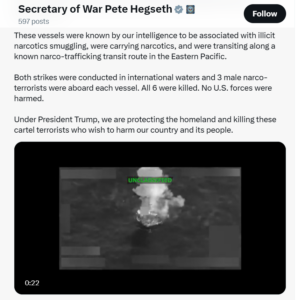
The Pentagon doesn’t bother to substantiate the claims against its targets in the Caribbean, and boasts of the executions in international waters. Image from Defense Secretary Pete Hegseth’s X account
Trump notified the world of his intended campaign against “narco-terrorist cartels” on Inauguration Day, but the reality of this summer’s naval buildup and military strikes in the Caribbean still took Americans by surprise. Analysts have been working overtime to decipher White House intentions. Is this about the security of the Panama Canal? About redirecting Venezuela’s oil to reduce European vulnerability to Russia? About removing a regional ally of Cuba?
No, the logic of the War on Venezuela can’t be found in the normal geopolitical arguments, but it is literally staring us in the face. The coastal waters off Venezuela, where a US aircraft carrier, a guided missile destroyer, a floating Special Operations Command Center, and other warships have joined jets, drones, helicopter gunships, and thousands of US troops, is the stage for Trump’s most martial PR stunt yet. Venezuelan lives will get shattered in the process, but this isn’t about Venezuela or cartels at all. The brazen show that is Operation Southern Sphere is selling the US public a new kind of war here at home.
Delegitimizing Governments: The Venezuela Edition
The campaign to delegitimize Venezuelan President Nicolas Maduro with charges that he is a drug kingpin running the Tren de Aragua cartel is familiar to those who remember the overture to the Iraq invasion in 2003, and it should produce the same skepticism. All the classic scripts (the War on Drugs, the regime-change libretto, and the ever-accommodating War on Terror) have been trotted out, but they fail the logic test.
First, if the Venezuela campaign were really about ending the drug threat, the US would do better partnering with governments, as it did with Colombia before Trump’s latest spat, rather than sinking vessels in international waters. Confronted with contrarian reports (the US State Department regards Venezuela as a transit country, not a major source of fentanyl or cocaine, and the US intelligence community reported no cooperation between Maduro and Tren de Aragua), Trump responded with new charges that Maduro was the leader of the Cartel of the Suns. Unfortunately, the Cartel of the Suns might not even exist. The term has been slang for military-linked corruption for decades (Venezuelan military officers bear a sun symbol on their epaulettes).
White House claims that Maduro is a cartel boss and that the targeted boats are running drugs build on convenient US typecasting, not evidence. And sadly, the more than 70 killed as of November 12 are unwilling extras in this production.
By contrast, Trump’s justification for continuing to cripple Venezuela’s economy with sanctions because of Maduro’s human rights record is supported by data. The 2025 Human Rights Watch report charged Maduro with manipulating elections, repressing opposition voices, and using the courts and militias to eliminate dissent. But many of our best-buddy allies (El Salvador and Egypt, among others) earn equally miserable human rights scores and end up not threatened with regime change, but on the US payroll.
The US government has too long of a history in the regime-change business to believe in the fairy tale of a happy ending if Maduro is deposed by force. Regime changes historically spiral into violence, the expansion of criminal networks, and increases in refugee flows during the turmoil that ensues; the Venezuelan casualties are likely to be in the tens of thousands. Nor is this 1989, when the US invaded Panama to depose President Manuel Noriega and preserve US control over the Paname Canal. Then the US enjoyed unchallenged global dominance as the USSR imploded. Today states alarmed by US bullying have many options, and are likely to balance out the US threat by building alternative partnerships. Forced regime change, whether through US military action or simply US pressure on local actors, promises more insecurity than the security it offers.
From Terrorism to Narco-Terrorism Abroad and at Home
Rebranding cartels as narco-terrorist organizations reveals the third familiar narrative, the Global War on Terror (GWOT), despite some marketing problems. First, traffickers are not terrorists. They may be grotesquely violent criminals, but they are not waging war on US territory or against our government, and the appropriate place to fight them is in court, not on the battlefield. Second, Trump’s 2024 campaign built on American disillusion with the unending wars on terror and promised an end to overseas adventurism.
Despite the marketing challenges, Trump has found a formula for resurrecting convenient features of the GWOT. The terrorist label, for example, is still handy for branding targets as irrational savages beyond legal protections, and Trump has been happily wielding the term against opponents both at home and abroad since January. And while a war risking American lives would be highly unpopular, nearly two decades of drone strikes blowing alleged terrorists out of existence from afar have raised little public condemnation. Trump didn’t invent the art genre that transformed targeted killings into snuff videos with the aesthetics of a video game, but he has brought “over-the-horizon” warfare into prime-time social media.
Trump isn’t just drawing on the GWOT, however; the videos coming out of the Pentagon echo the “smart bomb” videos of the Kuwait War in 1991. The poor quality was useful then and now for obscuring the human carnage on the ground (smart bombs were not so smart after all), but Trump might also be thinking of how they bewitched the American public and opened the door to a new era of high-tech defense investment. Operation Southern Spear’s promise to deploy robotic air and sea surveillance tools presents a similar opportunity to market-test the new generation of defense toys that will soak up defense funding and then trickle down into local police forces in the years ahead, just as earlier GWOT technologies have done.
Out of the Darkness and onto the Streets of Chicago, LA, and DC
Trump isn’t really doing anything in the Caribbean that hasn’t been done by other US administrations in the past 200 years, but his social-media strip show is new. Whereas Congress, journalists, and policy watchdogs used to fight to access records of covert actions or drone strikes, Trump shares videos of US navy attacks on vessels on the White House X page and confirms ongoing CIA operations in interviews. When Congress begs for justification of White House directives to murder dozens during peacetime in international waters, Trump ignores them and posts evidence of his crimes. He invoked the walking zombie that is the 2001 Congressional Authorization of Military Force (AUMF) against terror to shut down Congressional objections, then dispatched a Department of Justice minion to lecture Congress that US actions do not rise to the level of a war and thus require no Congressional mandate. The White House turned the formality of briefing the Senate Intelligence Committee into an old-boys night when it broke tradition and hosted a secret Republicans-only briefing on Venezuela.
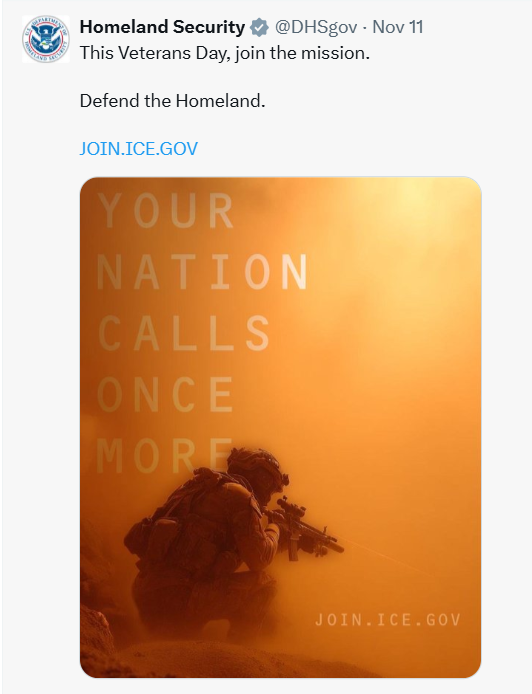
The Department of Homeland Security ad for ICE recruitmentment posted on Veteran’s Day erases the line between foreign and national military action. From the DHS X account
The exploding-boat posts shared by the Pentagon are not acts of government transparency but part of this calculated campaign of Congressional humiliation. They are inseparable from the larger campaign to portray Trump and his legionnaires as the personification of the thin blue line between savagery and civilization. Masked Border Patrol units in combat regalia prowling Chicago appear in Department of Homeland Security posts for the same reason. Video shorts of shackled detainees presented only as the targets of military-style raids feed Trump’s portrait of an America suffering from an “infestation” of “the worst of the worst.” ICE recruitment ads promise weapons, vehicles, and action, and sneak into Spotify feeds by setting their scenes of mayhem to the music of popular artists. It wasn’t enough to send 300 agents and Black Hawk helicopters to storm a Chicago apartment building, the raid had to be filmed, professionally edited, and set to a Hollywood-style soundtrack. These are the domestic versions of the grainy images of exploding boats and lives off Venezuela.
Trump’s martial show in Venezuela and in American streets is a virtual war with real deaths. He provokes tragedies to create viral posts celebrating dehumanization and defying constitutional limits on his actions. The goal was never just Venezuela, narcotics, or the undocumented; the real objective is the establishment of expanded executive powers. Anyone unlucky enough to be in the line of fire in the Caribbean or the streets of Chicago is just collateral damage in the virtual war playing out on the nation’s phones.
