Both this and the previous article were submitted before the killings of
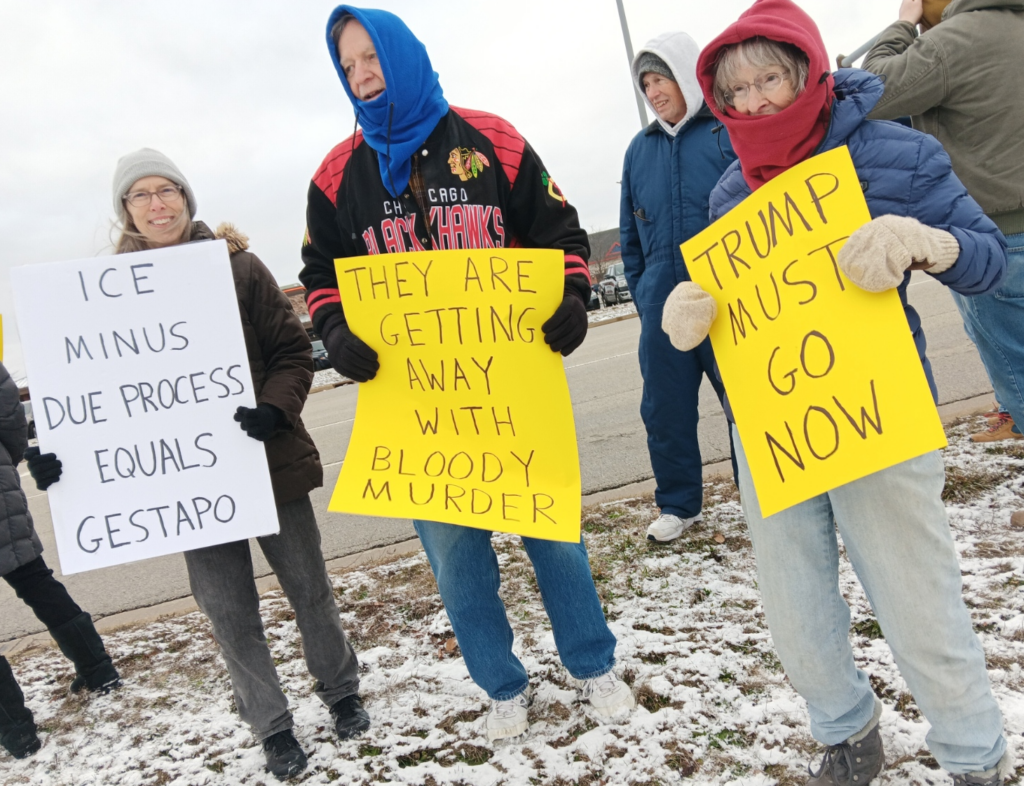
Renée Good and Alex Pretti by ICE agents on January 7 and 24,
respectively. Here local demonstrators protest Good’s killing
on North Prospect Ave. on January 11, following a car caravan
from Lincoln Square Mall in Urbana to Lowe’s in Champaign.
Photo by Marci Adelston-Schafer, used with permission
For more than three months, the Chicagoland area has been under invasion by an outside armed force. At a cost estimated between $70 and $100 million, Trump has ordered an occupation of the city by federal agents, most of them with faces covered and in full riot gear—armed with guns, rifles, tear gas, pepper spray, and handcuffs, used to abduct immigrants but also to detain and harass protesters.
Undocumented persons of brown or dark skin color are the target, though a number of US citizens have been arrested as well. Street vendors, landscapers, roofers, workers lined up waiting for temporary work outside of Home Depot, immigrants going to court to renew legal green cards or work permits or even to become citizens, parents picking up their children at school—no one is safe, and fear is everywhere. One person in Franklin Park seeking to evade an Immigration and Customs Enforcement (ICE) abduction was shot and killed by an ICE agent. The justification by ICE for the killing has been disproved by the actual camera footage.
On September 30, federal agents rappelled from helicopters and dropped smoke bombs in the middle of the night onto the roof of a Chicago South Side apartment building. They broke through windows, smashed down doors, zip-tied many residents, and arrested 37 alleged Venezuelan gang members. To date, no evidence has yet been presented of any criminal activities by anyone in the building. Following the raid, every resident was given an eviction notice during the recent Christmas holiday.
ICE is prevalent not just in Chicago but also in suburbs like my town of Oak Park. Here in Oak Park, one member of our rapid response team who continued honking his horn to warn residents of ICE’s presence near his daughter’s school was stopped in his car by ICE, had a gun pointed at him, was threatened with breaking his car window, and was taken into custody by ICE, despite being a US citizen.
In November, uniformed ICE agents followed a cleaning crew to an Oak Park apartment building. They were met at the door by the resident who asked them their business and then for a warrant. ICE placed its own homemade administrative warrant on the door, which the resident knew was not an official judicial warrant signed by a judge. She refused to let the agents in. At that point, ICE began ringing other apartment buzzers hoping someone else would let them in. The resident called 911, and fortunately the Oak Park police came and informed ICE they needed to leave due to insufficient cause for their being on private property.
What was Homeland Security’s stated goal of the so-called Operation Midway Blitz?
It was stated repeatedly that the objective was to clean up crime in Chicago and capture the “worst-of-the-worst” criminal elements, the most violent criminals who were in this country illegally.
What is the reality of the operation?
Of the more than 4500 abducted, the analysis made by the Chicago Tribune shows that 1.5 percent—or 67 persons—had been convicted of violent crimes. The only real “crime” for most immigrants is trying to make a better life for their families—both here and back home.
While fear is everywhere, resistance has steadily grown. Neighbors and households that have never been active are blowing whistles, coming out to document and report ICE activities, and organizing support for families whose family members have been taken away—often quickly moved to Michigan, Texas, or any of several other states. Resistance and protest have increased to such an extent that new laws and regulations are being aimed at protesters who allegedly “interfere” with ICE through peaceful demonstrations, blowing whistles, or taking pictures of ICE agents and vehicles.
For many Chicagoans, this ICE invasion is a dreadful reminder of the past—it is not the first of its kind. It is not uncommon to hear African American residents note the similarities between current ICE terror and the slave patrols in the 1700s and 1800s. The Fugitive Slave Acts provided the legal framework to unleash domestic terror in targeted communities such as Chicago and Boston. The slave-catchers utilized constant surveillance, violence, and other brutal methods to recapture enslaved persons, in some cases abducting freed Black men and bringing them back to slave states. Just like today, people fought back by establishing safe houses, raising money, and providing other kinds of material resources to resist slave-catchers.
As ICE continues to carry out and expand its agenda over the upcoming months, expect that resistance here and elsewhere will only increase.
Bill is a former union member and staff representative. Now retired, Bill is a community activist—organizing resistance to ICE, volunteering for a local food bank, and working to elect truly progressive candidates.