Photo from Atlantic Council
Responsible economic development must balance financial benefits with harm and risk to the community. Many residents of Illinois feel like the risk of electricity rate increases, potential harm to health and quality of life, and noise and air pollution from data centers outweigh the promised tax revenues and temporary jobs.
AI data centers are large buildings (millions of square feet in some cases) filled with computer processors that are built to handle enormous amounts of data and computing power. These differ from traditional computer processors, possessing the graphical, analytical, and learning capabilities of the computer processors used for AI. These highly specialized processors generated more heat and use much more electricity and water than traditional processors.
So what is AI? First though, what isn’t AI? Doing a Google search, streaming a Netflix video, or even using a simple question-and-answer chatbot online are not necessarily using AI. Those applications have been in use for years without having AI data centers.
AI requires high-speed, parallel processing workloads that can generate graphics, write a book, analyze a brain tumor, and learn how to do a multitude of complex tasks. Driverless vehicles; facial recognition; analyzing massive amounts of data from financial institutions; and forecasting applications are examples of AI applications.
The risks and harms of AI data centers are complex. Data centers are using tremendous amounts of energy and are risking our water supply, while potentially increasing utility costs to consumers. This is all being done without educating the public about the risks and without sufficient transparency.
It’s an energy issue, a water issue, and several pollution issues: noise, light, and toxic emissions. In addition to those impacts, local governmental processes to inform the public of impacts and allow for public input about its concerns is severely lacking.
The cumulative effect of the amount of energy needed for new AI data-center projects is straining our energy grid and causing electric rates to increase. This is complicated as well, but it’s primarily a supply-and-demand issue, along with the cost of new infrastructure. While the demand for energy is increasing, the supply is not. This causes rates to increase. There is no simple answer to this without continuing (and even adding to) the burning of fossil fuels, thus continuing to impact our climate. Ameren customers in central and southern Illinois have seen large increases in their electric bills, attributed to an increase in data centers on our grid. An article from Citizens Utility Board provides the details.
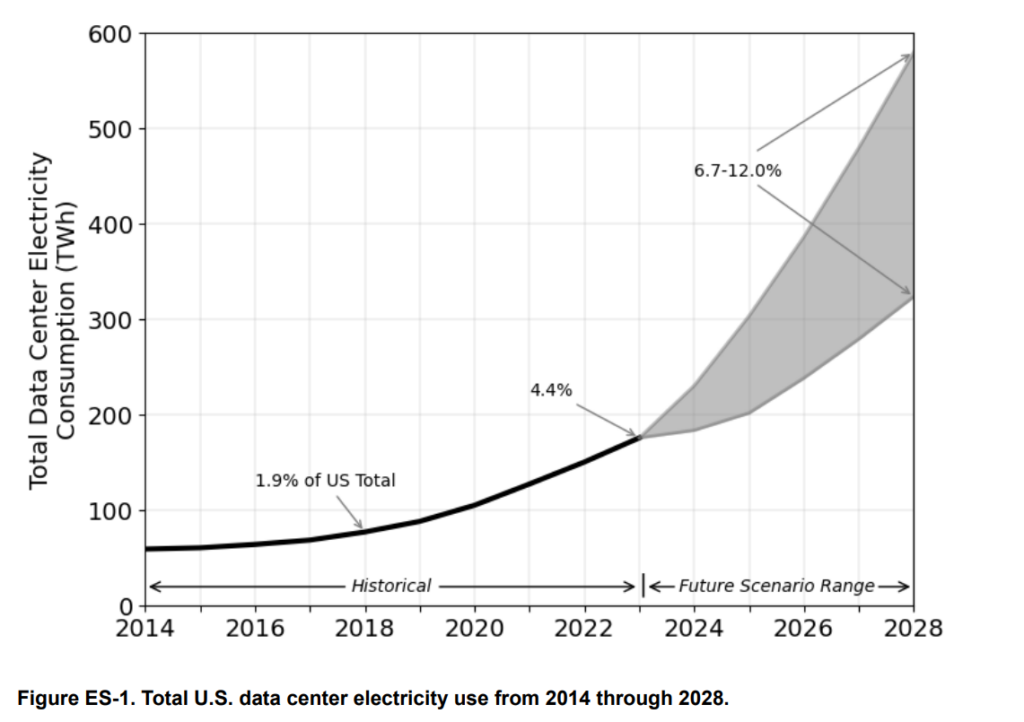
2024 United States Data Center Energy Usage Report, Lawrence Berkeley National Laboratory
Water usage by AI data centers comes from the need to eliminate the heat generated by the computer processors. AI data centers use one of two main types of cooling systems: open-loop and closed-loop cooling. Open-loop cooling uses tremendous amounts of water to eliminate heat by evaporation—millions of gallons per day, depending on the size of the data center. Closed-loop cooling resembles what happens in your car radiator or air conditioner. The closed-loop cooling system is filled once and circulates water through the system to eliminate heat. It doesn’t use as much water for cooling, but requires glycol and other toxic chemicals to maintain the system. While the initial fill of a closed-loop system is not an extreme amount of water, it takes much more energy to operate.
Noise, light, and toxic emissions can impact the health and quality of life of humans, domestic animals, and wildlife surrounding an AI data center. The fans on the cooling systems generate constant humming noises, equated to a refrigerator or dishwater running constantly. People living adjacent to AI data centers hear these noises in their yards and in some cases inside their homes. Low-frequency noises are not blocked by fences, berms, or other landscaping, and in open spaces can travel long distances. There are reports of inability to sleep, impaired cognitive performance, and physical and mental health problems in extreme cases.
Data centers commit to near-100-percent levels (99.999 percent) of availability to their customers. To meet this commitment, diesel backup generators are located on-site at AI data centers. When operating, diesel generator emissions contribute to smog and severe health risks. Nitrous oxides, carbon monoxide, sulphur dioxide, and particulate matters are released during testing and emergency operations. Storing diesel fuel on-site is required to meet these operating commitments. In Sangamon County, the proposed data center would have 420 backup diesel generators, with a total of 2.865 million gallons of diesel stored on location.
An immeasurable impact is the lack of transparency to the public around AI data-center projects. AI data-center operations are unprecedented in size and impact, and local zoning and transparency processes don’t work to the public’s advantage. Normal zoning regulations and governmental processes don’t account for the time and education required to educate our elected officials and the public about the risks around data centers. Many city councils require only 48-hour notice for meetings, and counties usually require a 15-day notice. It’s disrespectful to the public to allow these projects to be approved without adequate notice and education for the community. Municipalities and counties need to educate themselves prior to a permit application being filed by a developer to assess and implement zoning regulations appropriate to these projects. If necessary, a moratorium should be enacted to allow the time to implement changes to regulations.
Protections for the community are essential to integrate data centers into our neighborhoods and our rural areas: protection against risk; protection for our health and quality of life; and protection against financial and environmental risks.
Local grassroots groups are actively working to research data center impacts, improve local zoning processes, and increase transparency, but these are short-term solutions. The Illinois Clean Jobs Coalition (ICJC) and its members are working on legislation at the state level to provide these protections. The POWER Act: Protecting Our Water, Energy, and Ratepayers from Data Center Impacts SB4016/HB5513 was introduced in the Illinois General Assembly this legislative session. This bill will require data-center developers to build and pay for their own clean energy, preventing the risk of increased rates to consumers, and protecting our climate. There are many guardrails around reporting on water usage, use of diesel backup generators, and provisions for transparency to engage the public in the process. The Power to the People Act (S.3682) was introduced in the US Senate by Senators Dick Durbin and Tammy Duckworth, among others.
The bottom line: elected officials should be promoting responsible economic development that benefits the public without high risks and that creates permanent jobs. Data-center developers should cover their own costs and bring their own clean power to the grid to avoid electricity rate increases.

Lori McKiernan is a retired IT technician and manager in the travel industry. Since retiring and moving to Springfield, IL, she has become active in multiple environmental justice organizations, including Third Act IL. As a member of the Coalition for Springfield’s Utility Future, she has been persuading the Springfield City Council to transition the city’s coal burning power plant to clean energ;y and educating the public and the Sangamon County Board about the risks and harms of data centers.