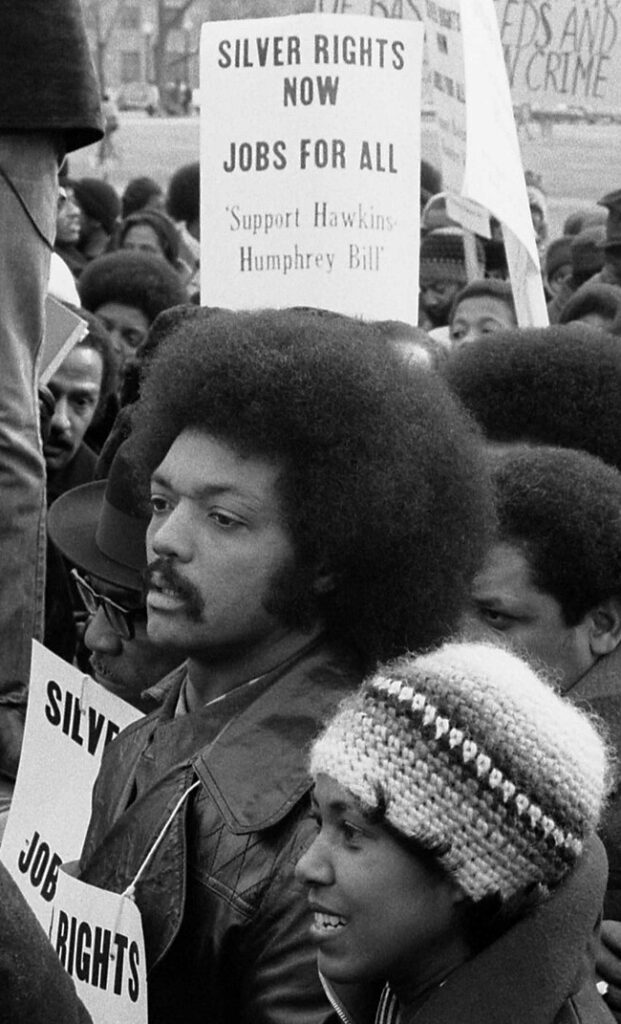
Jesse Jackson at a 1975 rally for full employment in Washington, DC. From the U.S. News & World Report collection at the Library of Congress
This article first appeared in the author’s regular column “Real Talk: A Black Perspective” in the Champaign News-Gazette, on February 22, 2026. It has been lightly edited for style.
On February 17, Jesse Jackson joined the ancestors. He now resides in our memories alongside our most revered warriors. He stands beside our most hallowed figures from the 20th century onward: Ida B. Wells Barnett, Dr. Martin Luther King Jr., and Malik Shabazz (Malcolm X) as one of our most brilliant and dedicated fighters.
Jesse Jackson was the last mass leader of the Black Liberation movement; he was the last national leader of Afro-America. He understood the drylongso—the everyday, ordinary working-class Black person. Perhaps more than anyone since Shabazz and King, Jackson channeled the aspirations, attitudes, and axioms of the African American people. He felt the people’s moods and shifted strategies to align himself with them.
And like King during his last years, Jackson took Black folk’s liberatory message to other oppressed darker nationalities, and even to working-class white folk exploited by global capital. He genuinely worked to build a rainbow coalition of “the desperate, the damned, the disinherited, the disrespected and the despised.”
Jesse Jackson was a world-historical figure.
Yet beyond the personal reminiscences, much of the commentary by pundits overemphasizes and focuses on the wrong strategic errors, and mischaracterizes Jackson’s political legacy.
Pundits reduce Jackson’s disagreements with Southern Christian Leadership Conference (SCLC) leaders after King’s assassination to his ego and ambition. While Jackson certainly made a series of poor decisions in the wake of the assassination, ideological, political, and strategic differences with SCLC’s aging leadership cannot be dismissed.
Pundits are unwilling or unable to see that Jackson, like King in his last years, had broken free of the constrictive civil rights frame. Born in 1941, Jackson was 24 when he joined SCLC’s staff in 1966. He was part of the generation that liberated themselves from liberalism and launched the Black Power movement. Kwame Ture (Stokely Carmichael), Maulana Karenga, Frances Beal, Huey P. Newton, Jamil Al-Amin (H. Rap Brown), Angela Davis, and Judy Richardson were all born between 1940 and 1945.
Jackson, like King, had to respond to the new terrain: the ideological, political, and strategic shifts generated by his contemporaries, the Black Power generation. As such, Jackson felt and responded even more so to his cohort’s policies and practices. Though born and bred in the South, Jackson was tasked with organizing Operation Breadbasket, SCLC’s economic arm, in Chicago.
Shortly after his arrival in 1966, Jackson launched a selective economic boycott of Country Delight Dairy. Militant economic boycotts became Jackson’s signature tactic. He argued, “We are the margin of profit of every major item produced in America, from General Motors cars down to Kellogg’s Corn Flakes. . . . If we’ve got his margin of profit, we’ve got his genitals.”
Jackson would combine his militant economic boycotts aimed to obtain jobs for the masses with the organization of “buy Black” campaigns to nurture and grow Black businesses.
In the wake of the 1965 L.A. Rebellion, Maulana Karenga and the Us Organization introduced Kwanzaa as a non-religious Afrocentric alternative holiday to Christmas. Before his assassination, King had crafted the Black Christmas campaign. The plan was to encourage African Americans to buy from Black-owned businesses during the holiday season. In 1968, Jackson introduced the Black Santa Claus during the Black Christmas Parade he organized. The campaign netted $57 million for Chicago’s Black businesses.
Three years later, in 1971, Jackson and Operation Breadbasket followed up the Black Christmas campaigns with the Black Expo, a three-day exposition of marketing and celebrating Black “products, literature and arts.”
By 1968, Jackson had grown an afro, and around that time began to wear dashikis and dress more like his Black Power generational cohort. And by 1972, he had adopted the Pan-African nationalist rhetoric of his peers. At the National Black Political Convention in Gary, IN, Jackson called for an independent Black political party. “There is a bomb . . . it will humanize white politics, there is a bomb, it will radicalize Black politics, there is a bomb, we are a mighty nation . . . when we form our own political party, what time is it? It’s nation time!”
Way back then, Jackson raised the question of reparations; he said, “We are not arguing about our constitutionality; we are raising a basic question: when will we get paid for the work we already done!”
Over time, Jackson shifted his emphasis from fighting for jobs to the Wall Street Project, designed to force corporations to grant “access to capital.” This move located him in Black Power’s conservative stream.
Yet during his finest years, the 1980s, when he piloted our ship through the turbulent waters of the arch-racist architect of neoliberalism, Ronald Reagan, Jackson took up King’s opposition to the triplets of evil: economic exploitation, racism, and militarism.
Jackson’s campaign for president was not simply an exercise in ego; he responded affirmatively to people’s cries, “run, Jesse, run!” And he did so on the most progressive platform in US history. Before the Occupy Wall Street movement, Jackson condemned the oligarchs and called for a more equitable distribution of wealth.
Unfortunately, we did not always get the militant, nationalistic, critic of capitalism. Jackson often wavered, grew cautious, paused, and sometimes retreated. But at his best, he was the only King disciple who dared follow him down that rough anti-imperialist path.
Jackson taught us that we are somebody!

Sundiata Keita Cha-Jua is a Black/Africana Studies scholar-activist who uses historical methodologies. He teaches in the departments of African American Studies and History at UIUC. He has been engaged with local and national Black liberation movement organizations since his teen years; he is currently an organizer for the Malcolm X Grassroots Movement (MXGM).