
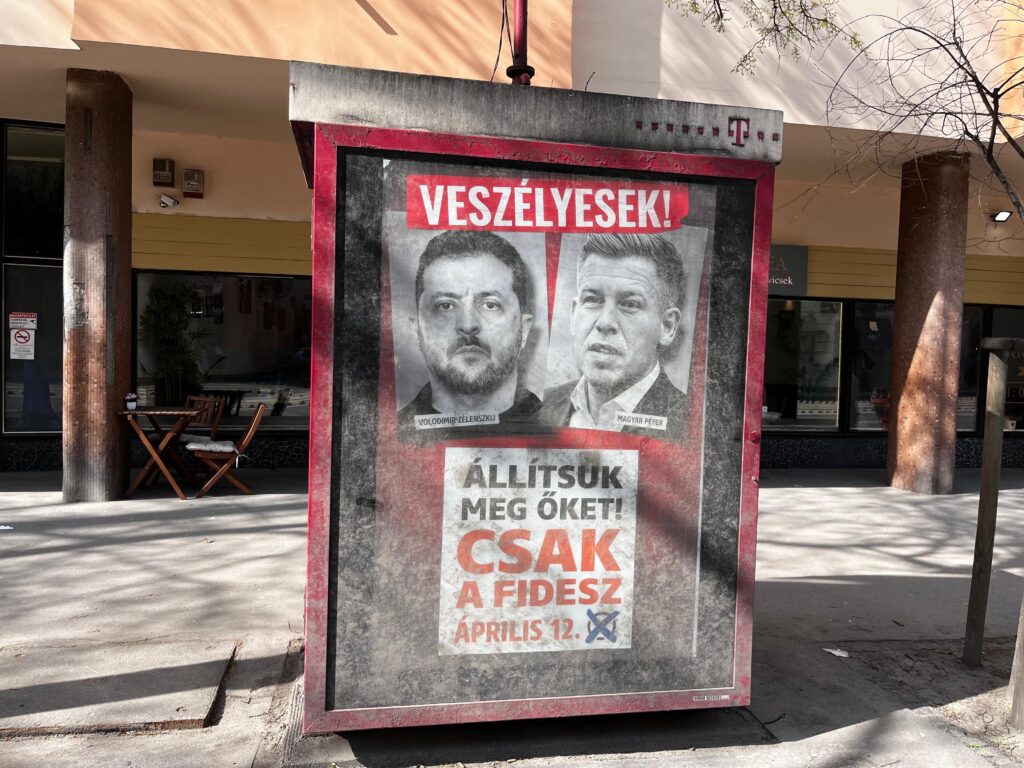
One of the ubiquitous Fidesz campaign posters, on a main Budapest avenue. It shows mugshot-type-photos of Ukrainian President Volodymyr Zelenskyy and opposition candidate Péter Magyar; the text reads “DANGEROUS!” above, and “LET’S STOP THEM! ONLY FIDESZ, APRIL 12 [the date of the coming election] below.” Photo by Ábel Esbenshade
Could a prospective Orbán loss be a turning point for the fight against the populist Right in Europe and worldwide? Or just another tilt of the ship on the current stormy economic and political seas, that will inevitably tilt back the other way somewhere else (or even in Hungary)? There is a narrative afoot that the populist wave has perhaps crested: first with the loss of Orbán’s protégé the Polish PiS party in 2023 parliamentary elections; then the victory of the centrist mayor of Bucharest over a Trump-aligned candidate in the May, 2025 Romanian presidential elections; the sharp drop in support for Geert Wilders’s favored anti-immigrant Party for Freedom in the Dutch parliamentary elections last October; and the triumph of the Portuguese Socialist António José Seguro over a right-wing populist in presidential elections last month. But the failure of the centrist Civic Platform candidate to consolidate that coalition’s control in the Polish presidential election last June is a cautionary tale, as are the victories of the right-wing Czech and Slovak prime ministers Andrej Babiš and Robert Fico last October and in September, 2023, respectively (both returning to office after previous stints). As far back as 2017, the Guardian felt compelled to headline an article “Populism Isn’t Dead”—so we’ve seen this movie before.
And this isn’t the first time the Hungarian opposition has had high hopes: in the elections four years ago, it united behind another independent conservative, Péter Márki-Zay, mayor of Hódmezővásárhely—a provincial town with a population barely bigger than the city of Urbana—only to see Fidesz win 54 percent of the vote, its highest total ever, enough for a(nother) two-thirds supermajority in Hungary’s weighted system. In the previous election, in 2018, cooperation between the liberals and the far-right Jobbik Party likewise spawned unfounded optimism across the opposition. Given the ruling party’s gerrymandering and other electoral manipulations, its almost full control of traditional media, and characteristic ruthlessness in using the levers of state power, Hungarians, never optimists, are right to have their doubts that Orbán and friends will be removed.
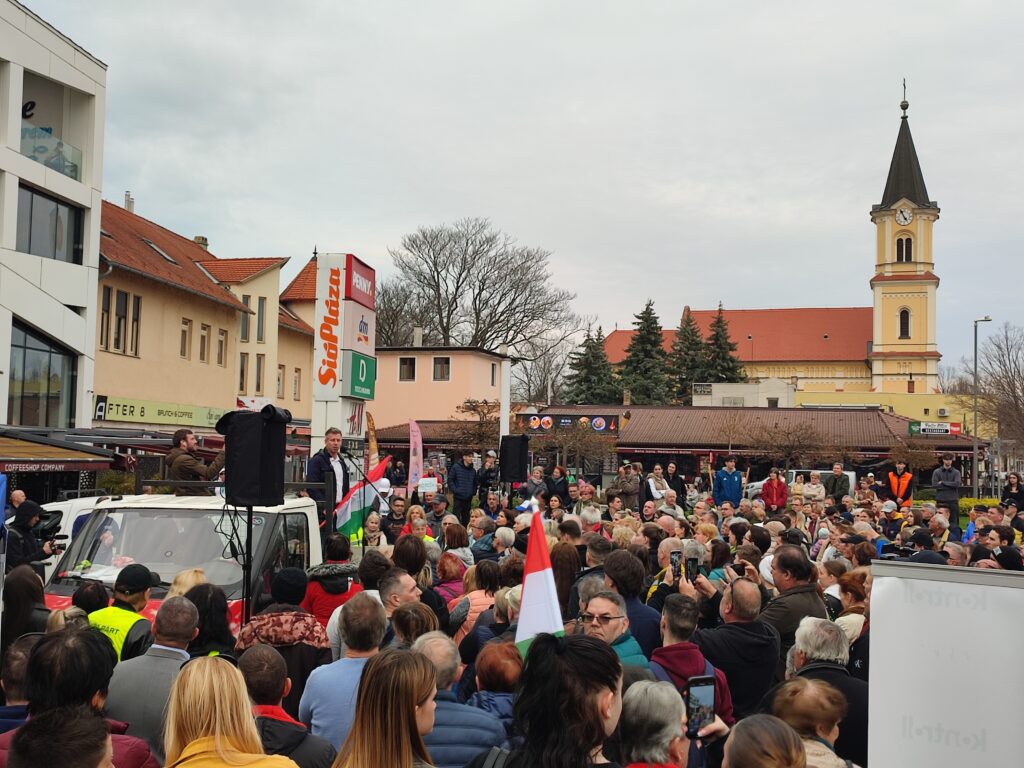
Péter Magyar campaigning in the provincial town of Siófok in 2025. Photo by SNRTZ, used by Creative Commons license CC-BY-SA 4.0
Magyar—whose family name (a common one in Hungary) means “Hungarian”—became nationally known when the “pedophile scandal” broke in early 2024: it emerged that the president of the republic had pardoned the deputy director of a provincial orphanage where young boys—one of whom subsequently committed suicide—were being sexually abused, after he had been convicted of coercion. Magyar very publicly broke with Fidesz; charged that his ex-wife, who was forced to resign as justice minister, and the president, also a woman, and also forced to resign, were being scapegoated by the leadership; and began speaking at large and repeated demonstrations against the government. He proved remarkably charismatic, and joined the Tisza Party—its name comes from a mash-up of the Hungarian words for “respect” and “freedom,” but also is the name of the country’s second-largest river, holding a special place in national mythology—which had been practically inactive. Just a few months later, Tisza eclipsed all the other opposition parties in the voting for the European Parliament. The liberals and socialists (in name only) that had governed in 1994–98 and 2002–10 had split into several competing and squabbling parties, none of which are expected to even make the parliamentary threshold for the coming cycle.
Magyar has hammered Fidesz hard on its corruption—billions of Euros of EU aid has gone into the pockets of Orbán’s family and his cronies; on its flouting of EU policies and norms in its ever-increasing control of the courts, the media, civic organizations, schools and universities, and practically every other institution, costing it billions more in withheld EU solidarity funds (meant to lift up lagging economies, especially in the former socialist states); and on the precipitous declines in state services (education, pensions, and especially health care) that have been the result. His dubbing of the prime minister’s walled-off family estate as “Orbán’s Versailles” echoes our “No Kings!” call.
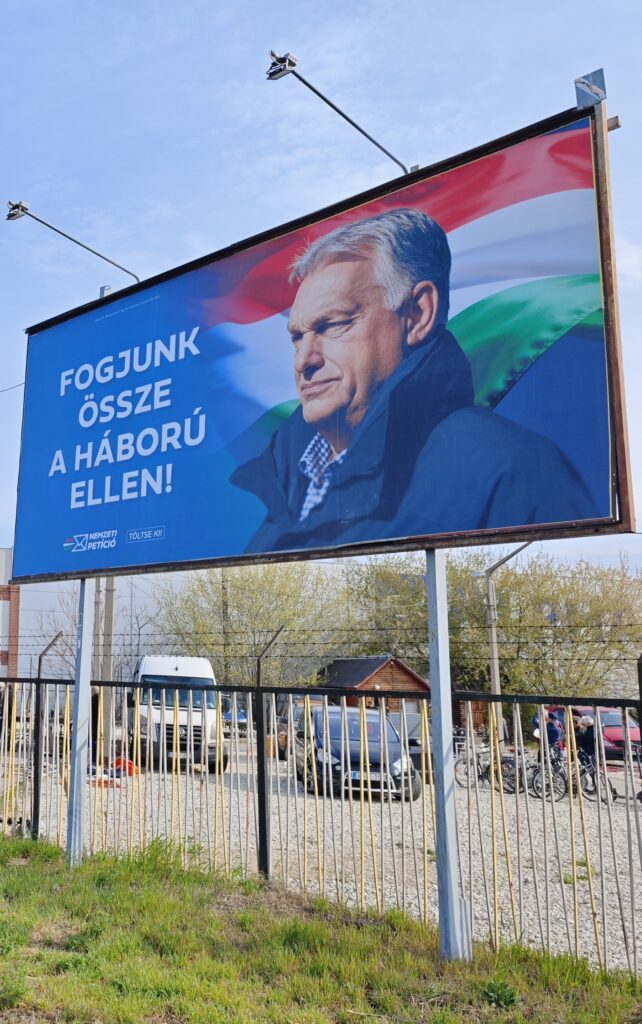
Roadside billboard urging the reelection of Prime Minister Orbán. The text reads “LET’S UNITE AGAINST THE WAR!” Photo by Ándor Elekes, used by Creative Commons License CC-BY-4.0
Fidesz has responded with baseless personal attacks, which have not stuck. But the main thrust of its campaign, propagated with billboards and placards that seem to be everywhere, is that it is the party of “peace.” Its defeat would drag the country into the war in neighboring Ukraine, and facilitate a huge drain on the treasury for EU-mandated reconstruction and support to bring Ukraine up to EU standards for its proffered accession. Orbán has indeed been the principal obstacle to EU aid for Ukraine and sanctions on Russia, further entangling the EU funds due Hungary. His achievement in getting an exemption from US sanctions for buying Russian oil and gas after a face-to-face with Trump in November lay bare the devil’s bargain that he is offering the electorate—a bargain that they went for four years ago, barely six weeks after the invasion, after a similarly focused campaign. Magyar has not trumpeted the Ukrainian cause—which Hungarians, despite substantial aid to Ukrainian refugees (see my article in the November 2023 Public i), are ambivalent about—but has promised reconciliation with the EU and an end to Orbán’s “war on Brussels,” while concentrating on domestic issues, and the miserable state of everyday life for most Hungarians (the country’s economy, once leading the pack of the newer eastern EU admittees, now trails even later arrivals Romania and Bulgaria, by most indicators).
Vanquishing Fidesz’s reign would remove a major thorn in the side of the EU, as well as a key point in the Trump-Netanyahu nexus: as well as aid to Ukraine and sanctions on Russia, Orbán has also blocked EU sanctions on violent Israeli settlers in the West Bank; and he invited Netanyahu for a friendly visit last year, despite the arrest warrants out by the International Criminal Court, of which Hungary is a member. But the disappearance of liberals and the (traditional) Left from the Hungarian political stage is representative of the bankruptcy of the centrist establishment parties across Europe, due to their failure to offer an alternative to neoliberal hegemony, especially in the face of the post–2008 financial crisis era of austerity. These forces—with certain exceptions on the Left—have left the economic transformation into an increasingly unequal society, with deteriorating social supports and the steady dwindling of well-paid employment off the table of political contestation, leaving cultural and identity issues as a flawed proxy. Leftist politics have been thoroughly discredited by the failed “state-socialist” experiment, and the elitism and haplessness of the postcommunist liberals; leaving the Hungarian masses to fall back on familiar cultural tropes and simple political answers—what Magyar is offering. This is the reason that the “resilience of populism” is (also) a recurring theme of mainstream discourse.
Like other European right-wing populist parties, Fidesz expresses solidarity with working people, as long as they are inside the boundaries of what it defines as the “national community”; and espouses state responsibility for their welfare. This goes against US Republican small-government ideology, leading some to see a contradiction behind the shared “anti-woke” rhetoric—and sparking interest among an emerging “pro-worker conservative” faction here. But Orbán’s fostering of domestic oligarchs, alongside exclusivist benefits that favor the middle and upper classes and regime supporters and an extractive labor regime for the rest, in its own way fits seamlessly with the current international neoliberal economic order.
So what would a Tisza Party victory mean for Hungary and Europe? Any government will still have to operate within the constraints of the now-permanent-seeming neoliberal crisis. But it would be an opening to dismantle the oppressive NER (National Cooperation System) in place, which is both anti-liberal and anti-democratic: the end of domination, clientelism, and corruption on massive scale. That could give space for a real homegrown resistance, to the Brussels bureaucracy, the corporate EU, and the unequal international system, to grow.
* I use the term “populism” with some unease, on both historical and political grounds. There have been many populist movements, both in Hungary and the US, as well as elsewhere, that have espoused economic equality and democratic practice, albeit often with a certain national romanticism. While the Orbán regime, like other kindred movements, revels in the latter, it exhibits none of the former. But the term is a convenient shorthand.

