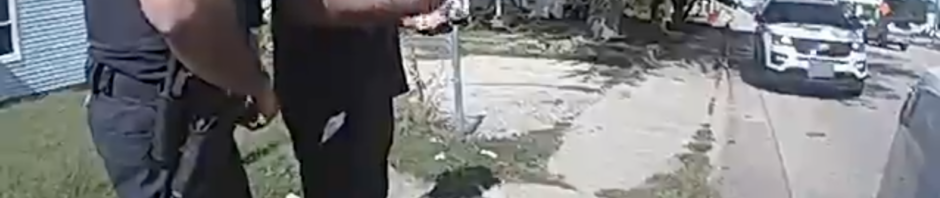

Champaign Police Officer Nicholas Krippel stands closely behind a man, who later filed a complaint against him for being threatening and discourteous.
Screenshot from Champaign Police Department bodycam footage
This story was originally published by Invisible Institute and IPM Newsroom on May 12. It has been edited for length and style. A full version, as well as more about the history and present of the Champaign Citizen Review Subcommittee, can be found here.
In 2021, shortly after she became the chair of Champaign’s civilian police review board, Alexandra Harmon-Threatt sat down to review records from investigations into civilian complaints that had been filed earlier that year.
In one case, a man had accused Champaign Police Officer Nicholas Krippel of being physically and verbally aggressive toward him and making physical contact without cause during a response to a verbal disagreement.
“Officer Krippel got in my face, in my space,” the complainant said. “His vest actually touched my skin, that’s how close he was to me.”
The man said Krippel had escalated the situation: “He only told me to stop talking and shut up, but he [said] nothing to the dude that threatened me.”
Harmon-Threatt’s review of bodycam video confirmed, in her mind, that both of these allegations had merit. But when she read Champaign Police Department (CPD)’s report, she found that it contradicted the evidence.
The ultimate finding of the complaint was that it was “not sustained.” The investigator said Krippel maintained close distance to the complainant to ease the situation, and that “if there was physical contact, it had been incidental and unintentional.”
But Harmon-Threatt’s conclusion after viewing the same evidence was that Krippel had escalated the situation. The investigator had also incorrectly written that Krippel did not curse at the complainant. CPD did not make officers available for an interview or respond to specific questions about this case.
The city of Champaign created its police review board, known as the Citizen Review Subcommittee (CRS), in 2017, after years of incidents involving police misconduct. Activists called for reforms to the CPD following the killing of Kiwane Carrington in 2009 and excessive-force lawsuits against former Officer Matt Rush.
The goal of the CRS is to ensure investigations into police officers are “complete, thorough, objective and fair,” according to a city ordinance.
But its structure has been criticized by former members and experts in civilian oversight of law enforcement. Harmon-Threatt and others claim the group has no power to hold police accountable for inappropriate behavior.
One major flaw, in her view, is that police officers investigating their own colleagues appear to not be swayed when CRS members call for reforms, policy changes, and more accountability for police officers who exhibit inappropriate behavior. Additionally, certain cases are not reviewed by the CRS at all, and police aren’t required to implement or even respond to CRS recommendations.
“We can sit here, and we can make all these recommendations, and we can have all these concerns about the investigation,” Harmon-Threatt said. “But the only people we’re complaining to are the people who did the investigation.”

Alexandra Harmon-Threatt is a founding member and former chair of the Citizen Review Subcommittee, Champaign’s civilian police review board. Photo by the author/Illinois Student Newsroom
Harmon-Threatt was first appointed to the CRS when it formed in 2017. She and four other board members, who are appointed by the mayor and approved by the city council, met roughly every other month to review complaint investigations filed by civilians against police officers.
When a civilian files a complaint, the department conducts an internal investigation, carried out by either the officer’s supervisor or the department’s Office of Professional Standards. The investigators present their findings and any other materials to the CRS, whose members work to determine whether they agree with the findings and what recommendations they’d like to make.
The CRS writes a letter to the police chief, who ultimately decides whether the civilian’s allegations against officers are sustained, and if so, what steps will be taken.
In the case involving Officer Krippel, Harmon-Threatt and the rest of the CRS disagreed with the findings of the investigation.
“The video footage clearly shows the officer initiates physical contact . . . For this to be not sustained suggests ignoring important video footage,” Harmon-Threatt wrote. “Lots of effort . . . [was] made to absolve the officer’s egregious actions.”
She and other members of the CRS lodged their dissent directly with Tom Petrilli, a longtime Champaign police official who was serving as interim chief, saying that Krippel’s behavior constituted misconduct and deserved further scrutiny. Petrilli never acknowledged the subcommittee’s questions about Krippel’s conduct or concerns about the quality of the investigation. No response from him was included in any of the records released by the city.
In a statement, CPD said that, per policy, the findings of the CRS are reviewed by the police chief, but the chief isn’t required to respond to CRS decisions.
This is a problem, said Sharon Fairley, a law professor at the University of Chicago. “In order for the community to feel like the police department is actually listening to community feedback on the work that they do, it’s important that the department respond in some way,” said Fairley.
Harmon-Threatt was not even aware that there were instances where CRS’s disagreements went unacknowledged by Champaign police—until this story.
But she said she’s not surprised; this lack of response to cases in which the CRS had lodged dissent “demonstrate[s] to us that we ha[ve] no power and that there [i]s not a commitment on the other side to improving.”
Emily Rodriguez was appointed to the CRS alongside Harmon-Threatt in 2017, and was the board’s first chair.
“I felt like our goal was to recover from the murder of Kiwane Carrington and to establish some kind of process that my neighbors could be proud of,” she said. “I think the goal was to make people feel like they had a voice among police policies.”
Under her leadership, the CRS released annual recommendations on a wide variety of policies, including recommendations to eliminate time restrictions on filing complaints, which were denied. When her term as chair ended in 2020, she hoped future CRS members would continue her momentum to make improvements to the subcommittee.
But the CRS has struggled in recent years to even meet consistently, let alone put out policy recommendations or make changes to its structure. According to Janel Gomez, the city’s liaison to the CRS, there were regular vacancies for months at a time, making it difficult to meet quorum and hold meetings. The board is now trying to catch up with the resulting backlog: the first complaint filed in 2023 wasn’t reviewed until mid-2024.
The city of Champaign has not been transparent about why the subcommittee was created with little enforceable power or influence on police department practices.
Former City Manager Dorothy Ann David, who was involved in the process of creating the subcommittee, refused to speak on this during an interview with IPM News in December. The office of current City Manager Joan Walls, who worked under David from 2013 to 2024, also declined to answer specific questions.
“As an advisory board, the Subcommittee can make recommendations concerning police practices and policies to the Human Relations Commission, but it must work within the parameters specified by City Ordinance,” her office said in a statement.
But those parameters were “manipulated” by the city manager’s office to limit the board’s power during the working group sessions that led to the ordinance, according to Laura Hall, a former assistant city attorney.
In an interview, Pia Hunter, the current chair of the CRS, said she felt Rodriguez made unfair assumptions about the CRS. She noted that a lack of disagreement by the CRS with Champaign Police in recent years could mean that the police department is doing a better job at investigating complaints.

Madison Holcomb reported this story as an investigative reporting intern with Invisible Institute and IPM News. She is a 2025 graduate of the University of Illinois at Urbana-Champaign, and recently completed a summer internship with Shasta Scout in Shasta County, CA.