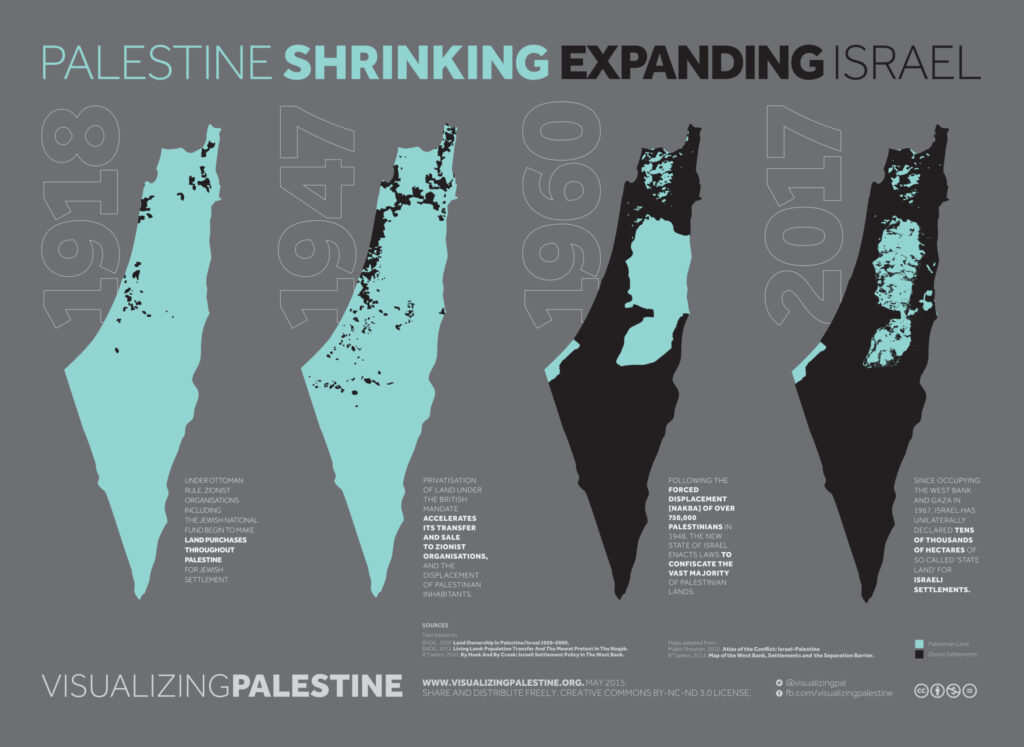
Graphic from visualizingpalestine.org. Used under Creative Commons BY-NC-ND 3.0 License
It’s been nearly four weeks since the start of “not a ceasefire” in Gaza. This “ceasefire,” like every previous one, means that Palestinians cease while Israel continues to fire, albeit at a slower pace—one more palatable to world leaders. Since the “ceasefire” came into effect, Israel has violated it hundreds of times, killing at least 230 Palestinians in Gaza as of this writing, including nearly 100 children. Israel has continued shooting Palestinians, and using tank shelling and even air strikes to target Palestinian men, women, and children, as well as their homes and hospitals.
These violations also include severely restricting the entry of aid and resources, with only about 10 percent of the “agreed-upon” trucks entering the strip, and the Rafah border remaining closed. Palestinians report a relative increase in the availability of high-calorie foods with low nutrient density, like chocolate and chips, rather than the needed life-saving nutrient-dense foods, sources of protein, and medication. One Palestinian reports it as “sugar everywhere, the illusion of nourishment, the mockery of life.”
Fifty-six percent of the Gaza Strip remains under Israeli military control following the withdrawal to the “yellow line.” Israeli soldiers and tanks regularly encroach on this boundary, with at least forty military outposts beyond it.
This does not include the violence engulfing the West Bank. Israelis have killed more than 1,000 people in the West Bank, and settler violence has skyrocketed. Israel has nearly 900 checkpoints across the West Bank, fully encircling multiple cities and villages by border walls, while continuing to expand its illegal settlements and simultaneously demolishing Palestinian homes, buildings, and other structures. The West Bank’s borders are violated just as we are openly witnessing in Gaza. Nor does it include encroachments on Syrian and Lebanese sovereignty, with Israel setting up checkpoints on Syrian territory and bombing southern Lebanon.
This should come as no surprise, though.
Prime Minister Benjamin Netanyahu’s claim to “greater” Israel—a concept that encompasses occupied Palestinian territory as well as parts of Egypt, Jordan, Syria, and Lebanon as a part of Israel—at a UN meeting in September, 2023 may have sounded blasphemous to the untrained ear, but to Palestinians, he is not an outlier. He may be more vocal than his predecessors, but since before the inception of Israel, the intention has been a “greater” Israel.
In 1918, David Ben-Gurion, one of the founding fathers of modern-day Zionism, described the future Jewish state’s boundaries as extending into parts of Lebanon, Syria, Jordan, and Egypt. Shortly after that, the World Zionist Organization submitted a map with those very borders to the post-World War I peace conference.
Twenty years later, in 1937, Ben-Gurion held firm to “greater” Israel, saying: “No Zionist can forgo the smallest portion of the Land of Israel. [A] Jewish state in part [of Palestine] is not an end, but a beginning.”
And since then we have witnessed this in action: from the ethnic cleansing of half of the Palestinian population from their homes starting in the Nakba—the Palestinian catastrophe that began in 1947 after the UN partition plan and resulted in more than 800,000 Palestinians being ethnically cleansed and around 15,000 killed, to the occupation of the Syrian Golan Heights and Egyptian Sinai Dessert in 1967 along with Jerusalem, the West Bank, and Gaza, until today with the Israeli genocide of Palestinians and the slow annexation of both the Gaza Strip and the West Bank, including Jerusalem.
Varying levels of this violence against Palestinians has occurred under every Israeli administration, and generally with the support of the Israeli population. In March of this year, 18 months into the ongoing genocide, an Israeli poll revealed just how widespread support for it is. The poll, conducted by an Israeli scholar at Pennsylvania State University in collaboration with the Geocartography Knowledge Group in Israel, revealed that 82 percent of Israelis support the expulsion of Palestinians living in Gaza, and 56 percent support the expulsion of Palestinians living in Israel who have Israeli citizenship (albeit as third-class citizens and without equal rights compared to Jewish citizens).
That is not to say there is no dissent among Israeli society. The military itself is facing a crisis of refusals. All Israelis are required to serve at least two years in the military. There is a growing number of Israelis refusing to serve in their military due to its practices, with a rising number of 18-year-olds burning their conscription papers and facing prison time. Since 2023, at least 20 of these young adults have been jailed. Military reservists are also not responding to calls for duty, with over 40 percent repudiating the last offensive in May of this year.
Not every Israeli supports the enduring violence, but all of Israel benefits from it.
In United Nations Resolution 181, the 1947 UN Partition Plan for Palestine, the UN recommended a partition of Palestine into two states, giving the Jewish state 55 percent of historic Palestine. This was despite the fact that only 10 percent of the citizens of Palestine were Jewish, though 30 percent of the overall population was Jewish due to both legal and illegal migration into Palestine, and at the time Zionist entities owned only 6 percent of the land. Yet in May of 1948, after the Nakba, Israel declared its independence and sovereignty over 78 percent of historic Palestine.
During the Nakba, more than 800,000 Palestinians were violently displaced from their homes, initially by Zionist paramilitaries and eventually by the Israeli military. Palestinians were massacred and over 500 villages, towns, and neighborhoods were fully depopulated of their Arab inhabitants. Some of the violence employed at that time included mass executions, as in the Tantura Massacre with more than 250 victims and the village fully depopulated. Witnesses report the field executions of dozens of young men, and women being treated for rape afterwards. This is just one example out of dozens. In other villages, Zionists employed biological warfare by poisoning town wells, leading to illness in villages and even a typhoid endemic in Akka.
This violence continues today for Palestinians throughout historic Palestine. Many live as third-class citizens on the lands of 1948, currently recognized as Israel, where they make up 21 percent of the population but only have access to 3 percent of the land, while facing 60 Israeli discriminatory laws. The Palestinians living in the occupied West Bank live under an entire apartheid system, where there are roads they cannot drive on and cities they cannot enter. They face constant threats and attacks by both Israeli settlers and the military, and they are subject to military law while (illegal) Jewish Israeli settlers are not.
By now, the world is familiar with the harsh reality Palestinians in the Gaza Strip endure. This ranges from the complete and total blockade in the early 2000s, to the “mowing-the-lawn” policy implemented via bombings every few years, to the now-ongoing genocide. Furthermore, Palestinians who remain in annexed Jerusalem are classified as “residents” rather than citizens, forcing them to repeatedly fight to renew their residency status while enduring constant home demolitions and the encroachment of settlers.
Violence is at the core of Israel and extends from it into every avenue of Palestinian life. So the next time you hear someone single out Netanyahu, do not let their scapegoating go unchallenged. To Palestinians, he is no different than his predecessors.
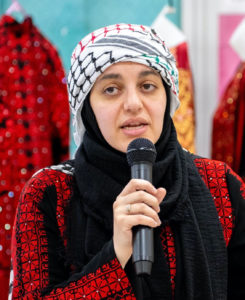
Dua Aldasouqi is a member of the Palestinian diaspora and CU Muslim Action Committee. She is dedicated to advocating for Palestinian rights and self-determination. She is a registered dietitian by profession and enjoys writing and performing poetry.