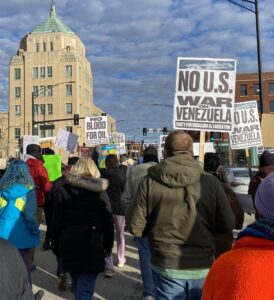
January 3 emergency demonstration in downtown Champaign against Trump’s military action. Photo by the author
Kidnapping the president of Venezuela was a showy move, to be sure. Having already attacked boats in nearby international waters and positioned dozens of naval vessels in the region, on January 3 the US deployed 150 aircraft from bases across the hemisphere to attack Caracas. US Cyber Command shut down the electrical grid of the capital before Special Forces stormed the presidential compound and kidnapped President Nicolas Maduro and his wife. “Audacious,” proclaimed the head of the US Joint Chiefs of Staff at the Mar-a-Lago press conference. Audacious maybe, but it certainly wasn’t lawful under international or domestic law.
The US raid on Venezuela has been described as a return to gunboat diplomacy, but it is even more dangerous than the racist, gunslinger imperialism of a century ago, both for the world and for those in the US. Welcome to the age of policy by prospectus.
Ghosts in the Machine of Regime Change
In the weeks since the raid, ghosts from past US regime changes have stirred restlessly, reminders of the long half-lives of supposedly decisive actions. In 1953 the US-British regime-change operation in Iran removed a popular prime minister to halt the nationalization of oil, but the brutal monarchy they reinstated led to anti-American revolution in 1979. In 1954 Guatemala the US engineered the removal of elected President Jacobo Arbenz. The land-reform program Arbenz had championed died, but so too did more than 200,000 Guatemalans in the decades that followed as the US-supported, military-dominated government waged a genocidal war against the indigenous population. And, of course, who can forget the grand winner for miscalculating the long-term human cost of an external military coup? In 2003 President Bush proclaimed “mission accomplished” only six weeks after the US invasion of Iraq, but the death toll for the region spun into the hundreds of thousands over the years of war that followed.
The raid on Venezuela has produced the same early boasts as other US-sponsored coups. Ignoring critics in the streets and in Congress, the White House stayed on message, highlighting the tactical feats and basking in the fait accompli of Maduro’s ouster. The Trump circle has the smug air of a real estate developer standing over the demolished ruins of a once-protected historic site. It isn’t just Maduro’s presidency (certainly no Gandhian idyll) that was shattered in the raid, but the twentieth-century hope for a better international system. The post–World War II system had better rhetoric than follow-through, but will a world without even the pretense of respect for sovereignty, multilateralism, and human rights be better?
Trump isn’t the first president to violate those ideals, or prioritize business over national interests, or even to deceive Congress—but he is the first to boast about it at press conferences. Compare, for example, the way the White House manipulated intelligence to mislead the US public and Congress in 2003 and blackmailed members of the United Nations Security Council to get the legal fictions it sought for the regime change operation in Iraq. Criminal? Yes. But Trump behaving as if UN and congressional obligations don’t exist is worse.
Similarly, the US has been carrying out shadow wars with legally questionable drone strikes and renditions abroad for twenty years. Since taking office Trump has continued the pattern, carrying out attacks on at least seven countries, but there is nothing hidden about Trump’s violence. He has brought the shadow war into social-media prime time with gloating posts of military kills and humiliating images of President Maduro in restraints. This is not transparency; it is the normalization and celebration of unrestricted state violence.
It’s too early to measure the long-term consequences of the raid in Venezuela, but the new rulebook isn’t promising.
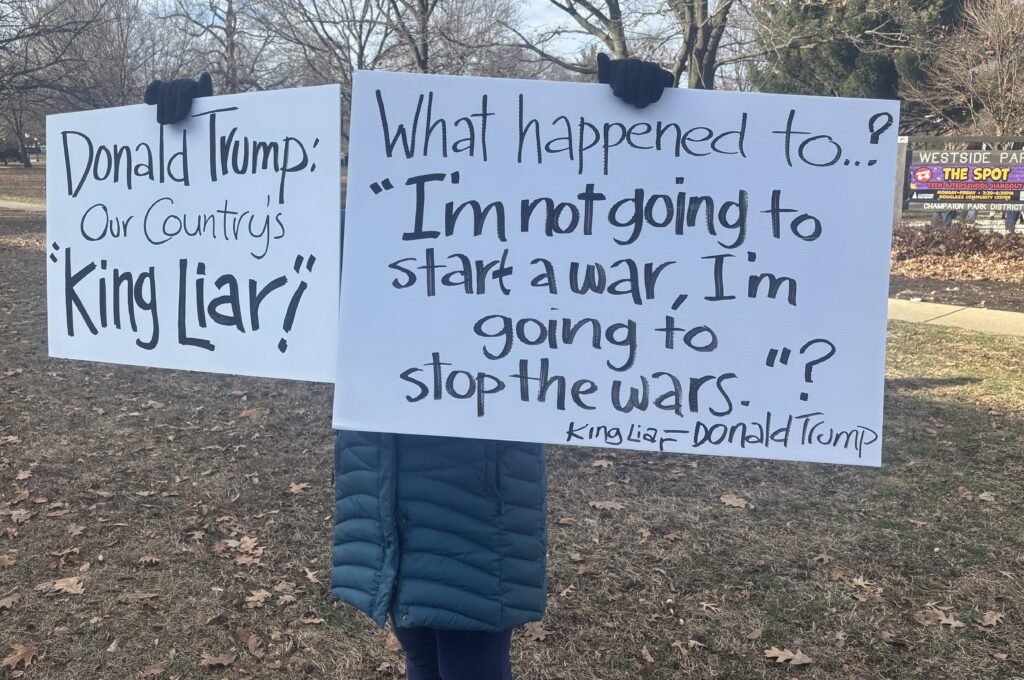
The Party for Socialism and Liberation sponsored a “No War on Venezuela” demonstration at West Side Park in Champaign on January 3. Photo by Paul Mueth
Fogging the War
Trump’s wrecking-ball approach to constitutional and international law was on display long before the Venezuela attack. He shattered the global trade system with unilateral tariffs, reneged on international treaty obligations and partnerships (he pulled the US out of an additional sixty-six international organizations on January 7 this year), and is currently bullying NATO ally Denmark with military threats in his new obsession with Greenland. Still, kidnapping a foreign leader and pretending it is not an act of war seems extreme. While there have been protests and some outrage among congressional members (although not enough to pass a resolution limiting further military action), overall the public response has been muted compared to 2003. Discontented citizens certainly have many topics on their list of concerns, but there are other dynamics at work as well.
To start with, Trump has had a tremendous advantage in heading off criticism of the war. In the past year he has gutted the ability of the diminishing number of professional journalists to cover his presidency by manipulating press pools at the Pentagon and White House and threatening legal action against outlets that challenge him. Jeff Bezos, a sometimes Trump ally and owner of the Washington Post, knows which side his bread is buttered on. On the day after the raid, the Post’s editorial board celebrated “one of the boldest moves a president has made in years” and gloated that “what happened in Caracas was a clear reminder that America’s military, intelligence, and cyber capabilities are second to none.” The White House itself could have written the copy.
The administration also actively shaped coverage of the raid (watching social media numbers in the situation room during the operation) and the terms used to describe it. Even while praising America’s “warfighters,” the White House presented bombing Venezuela as a policing action, allowing it to avoid running full tilt into congressional war-declaration authority. “Extraction,” used to describe the seizure of the Venezuelan president by Special Forces, is a word usually used for the rescue of victims, not for their kidnapping by hostile powers. And while the administration openly admits to plans to “run Venezuela” and control its policies through economic pressure and the threats of new military strikes, it studiously avoids the phrases “regime change” or “nation building.” In contrast, the Trump circle embraces the adjective “transactional.”
It’s Not Foreign Policy, It’s a Prospectus
The business rhetoric is apt: “transactional” is a palatable name for the unapologetic pursuit of interests over values; and from Venezuela to Gaza to Saudi Arabia to Ukraine and now on to Greenland, it is the interests of Trump’s corporate allies that predominate.
The Trump administration sees the world through the perspective of a 1980s-style corporate raider willing to split the potentially profitable beachfront real estate or petroleum deposits off from the human liabilities. The message is clear: the US isn’t even attempting to build nations anymore, it is merely building investment portfolios.
