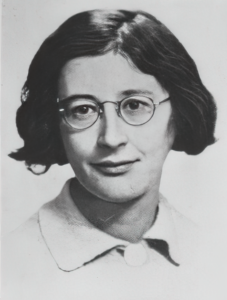
Simone Weil, 1942. Image from Wikimedia Commons
“To be rooted is perhaps the most important and least recognized need of the human soul. It is one of the hardest to define. A human being has roots by virtue of his real, active and natural participation in the life of a community which preserves in living shape certain particular treasures of the past and certain particular expectations for the future.”
Simone Weil
Born in 1909 to a secular Jewish family in Paris, Simone Weil is known for her independence of mind and resistance to ideological conformity: “estranged but not alienated, devout but not obedient, philosophical but not a systematizer,” according to an essay by Christy Wampole.
In her posthumously published book The Need for Roots—commissioned by the Free France government to help plan for the renewal of Europe after the scourge of Nazism; and written in 1943 shortly before her death of heart failure, brought on by refusing to eat more than the citizens’ rations allowed for German-occupied France—she wrote,
“Uprootedness occurs whenever there is a military conquest. . . . It reaches its most acute stage when there are deportations on a massive scale . . . or where there is any brutal suppression of all local traditions . . . Even without a military conquest, money-power and economic domination can so impose a foreign influence as actually to provoke this disease of uprootedness. . . . For people who are really uprooted there remain only two possible sorts of behavior: either to fall into a spiritual lethargy resembling death . . . or to hurl themselves into some form of activity necessarily designed to uproot, often by the most violent methods, those who are not yet uprooted, or only partly so. . . . Whoever is uprooted himself uproots others. Whoever is rooted . . . doesn’t uproot others.”
Our society today is characterized by almost total uprootedness. Our president and his followers represent this uprootedness that seeks by violent means to uproot others; and all those who fail to speak against him, whether from a lack of moral backbone or from sheer exhaustion and disillusionment, represent the uprootedness that manifests as “spiritual lethargy.” Both varieties of uprootedness can be attributed to the domination of money-power, by which our society has both prospered and sickened, and which now finds its ultimate personification in our current government. Weil continues, “Money destroys human roots wherever it is able to penetrate, by turning desire for gain into the sole motive. It easily manages to outweigh all other motives, because the effort it demands of the mind is so very much less.”
If we are to help one another take root, we will need more than a simple redistribution of wealth. In order for such a redistribution to succeed in deepening our roots, we must first deepen our understanding of the effects of money-power and critically examine our own relationship to money—only then can we disentangle ourselves from the paradigm that has enabled the billionaires’ rise to power.
Money is a convenient technology; but where it ceases to be a tool for facilitating action and becomes the motivating force behind action, then its poison sets to work. Even those of us not driven by the desire for gain feel its insidious effects in the anxiety for security. We want the people we care about to be safe and comfortable; we feel motivated by love, by survival, by the desire for autonomy. And yet this is precisely how money insinuates its terrible convenience, as the instrument of an economy designed to fuel our fears and desires, not to alleviate them; and in so doing, it clouds our ability to discriminate between, in Ursula K. Le Guin’s words, “what is necessary, what is neither necessary nor destructive, and what is destructive.” Money’s circle of effective care rarely extends far beyond an individual household. It renders superfluous the need to trust one another—and those in power profit by our lack of trust.
I am not suggesting that we abandon the use of money—but that we transform our relationship to it. Speaking as a young person with a chronic disability, I perceive in universal basic income a resolution to the painful conflict between the obligation to earn money and the urgent claims of my body and creative spirit. But I know such a redistribution of wealth is only the beginning, the solution that is easiest to understand because it functions within the existing paradigm of money-power where money is the only conceivable incentive to work. Thus, opponents of universal basic income and other forms of social aid would have us believe that we will fall into idleness and chaos, if no longer provided with a rigid structure and compelled to earn our existence. Quite the contrary: I assert that the universal fulfillment of basic needs will infuse our social organism with a sorely absent sense of human dignity; and that freedom from the compulsory pursuit of capital will liberate incredible resources of time, energy, and creativity—just the tools we need to begin healing our humanity and our planet.
But in order to effectively wield and direct these newfound resources, we must learn to recognize which tasks call forth the greatest energy, and to follow where that energy leads. This is the opposite of what we are trained to do throughout our schooling and working lives: trained to ignore our bodies’ cues to rest and to forcibly apply our energy to whatever arbitrary task is set before us. We learn to scrape by with the bare minimum of effort, because our tasks—when motivated solely by money, praise, or punishment—evoke the bare minimum of energy. In Weil’s words,
“No action is ever carried out in the absence of motives capable of supplying the indispensable amount of energy for its execution. To want to direct human creatures—others or oneself—towards the good by simply pointing out the direction, without making sure the necessary motives have been provided, is as if one tried, by pressing down the accelerator, to set off in a motorcar with an empty petrol tank.”
We are not lazy by nature. We all need more rest, sleep, and unstructured leisure time; but equally we crave meaningful work, and above all the energy that is inseparable from meaningful work, an energy that cannot be supplied by rest alone. We need new paradigms of labor in which the needs of the human body, mind, and heart can take root.
Let us seize this moment to reimagine work as the fulfillment of the human need to be useful. Our present conception of work is little more than servitude to the profit-machine, which exists only to fuel itself—and which not only frustrates our need to be genuinely useful, but which makes our right to basic survival contingent upon our participation.
Imagine instead a society rooted in the necessities of rest and labor alike, in which all basic needs for food, housing, and medical care are met, and in which people of all ages, abilities, and identities are fully initiated into the rhythms and needful tasks of daily life. This is how we bring the world back to life. This is how we take root.

EBGM is a poet-philosopher, librarian-cataloger, and Urbana native.