
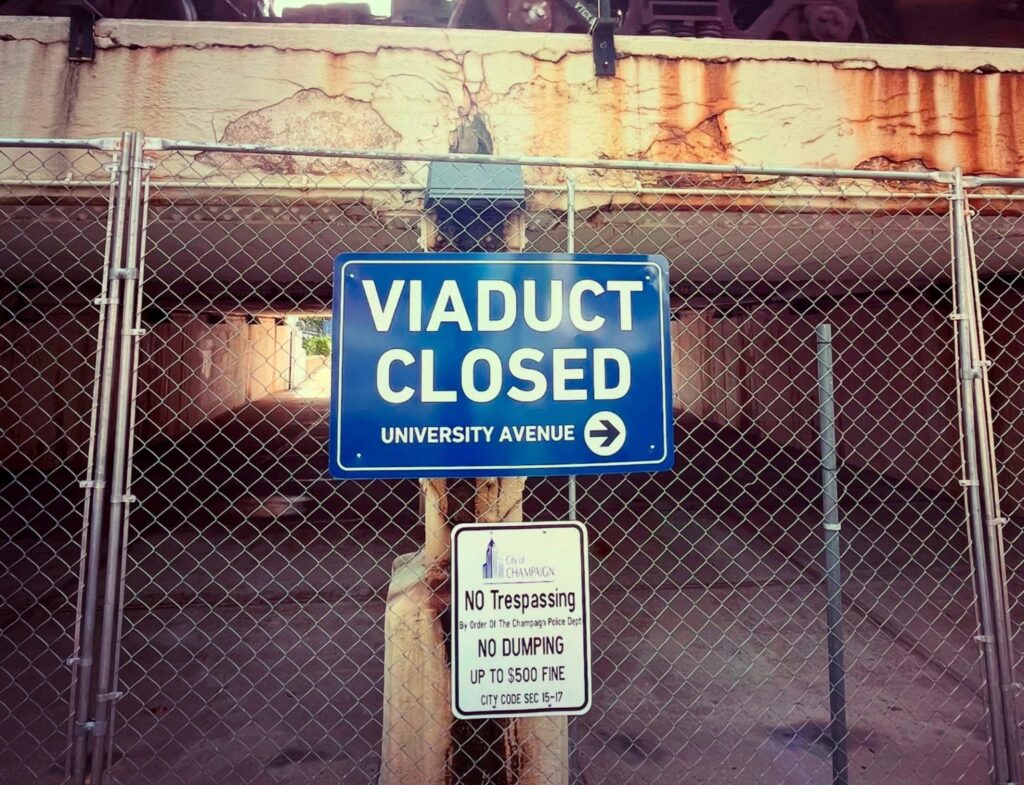
The closed downtown Champaign viaduct. Photo by the author
This is an edited version of an article originally published in Smile Politely on January 26, 2026.
On December 2, 2025, after two and a half hours of public comment from some 40 community members, Champaign City Council voted 9-0 against an ordinance banning public camping, with Mayor Deb Feinen admitting defeat at the end of the night.
The Champaign Continuum of Service Providers to the Homeless (CSPH), made up of over 40 organizations, including the City of Champaign, prepared a statement saying they had no “prior communication” about the ordinance, and were “shocked and dismayed” to find out about it the day of the vote.
What the public witnessed as a last-minute vote on December 2, just before the holidays, was actually a plan six months in the making, according to nearly 200 pages of emails I obtained through a Freedom of Information Act request.
The issue came to a head last summer, when a homeless encampment grew under a viaduct in downtown Champaign. On July 3, the viaduct was fenced off and closed, just a day before the 4th of July parade.
Several local downtown business owners had started to complain about the homeless in early 2025. Behind the scenes, Champaign city staff were directed to research the legality of tearing down homeless encampments, tracking the issue in other cities throughout Illinois, and crafting an ordinance.
Although feigning concern for the plight of the homeless, Champaign leadership tried to push through a hard-line ordinance—and failed.
Under the Viaduct
Emails indicate that meetings between downtown Champaign business owners, the city manager’s office, and city staff go back to February 10, 2025, when they met together in council chambers at the Champaign City Building. While several business owners were vocal about the growing problem of the homeless in downtown, the charge appears to be led by Alan Nudo, downtown property manager, former Champaign county board member, and one-time Republican candidate for Illinois state senate.
On May 9, Nudo thanked Joan Walls in an email for her “assistance and attention to this issue.” The two of them had had a follow-up conversation “several weeks ago.” Champaign police had stepped up patrols downtown during February and March, leading to 15 arrests. Nudo and several others had a meeting with State’s Attorney Julia Rietz, who was “very supportive.”
As early as June, six months before the ordinance came before council, Mayor Feinen was compiling information about an ordinance. An email to the mayor was sent by Brad Cole, chief executive officer for the Illinois Municipal League, based in Springfield, with the subject, “Model Ordinance Regulating Public Camping.” It included a link to a model ordinance created by the organization. On June 6, Mayor Feinen forwarded the message to City Manager Joan Walls and City Attorney Thomas Yu.
On June 30, Nudo sent an angry email to Champaign city staff and Mayor Feinen. “If you go through the chain to the end of these emails,” Nudo wrote, “you will see we requested and had a meeting with city staff and police on February 10 . . . so this has been going on for 5 months.” A primary concern was the homeless encampment that was set up in the viaduct under the train tracks at Main and Chestnut streets in downtown Champaign.
Nudo claimed he wanted to help the homeless. “This is not only creating unsafe conditions for all downtown businesses and patrons, but it is unhealthy and unsafe to let the homeless be exposed to subfreezing conditions in the winter and 90-degree weather in the summer. Who are we helping here?”
A day before the 4th of July parade in downtown Champaign, the homeless encampment under the viaduct was torn down and the area fenced off. As the News-Gazette reported, the city issued an emergency order.
At least one downtown business owner sent an email that hailed the closure of the viaduct as having an “overwhelming positive impact.” Regardless, homeless residents were displaced only to set up encampments at other places throughout downtown.
“The Homeless Have Taken Over”
In August, the owner of a condo at the M1 complained in an email to the city about a homeless encampment along the 400-500 block of North Neil Street. “The homeless have taken over downtown Champaign,” he wrote.
By October, city staff were collecting information and sharing news stories from Peoria, Springfield, and Pekin, other cities in Illinois that had tried passing anti-camping ordinances.
Meanwhile, city officials were meeting behind closed doors to draft their own anti-camping ban.
When Champaign City Council met on December 2, 2025, a proposal was on the agenda. The ordinance levied a $75 fine for the first ticket for setting up an encampment (which could be levied each day), with an increased fine for each repeated violation reaching up to $750.
Interestingly, a report to council prepared in October by City Attorney Thomas Yu recommended, “No fines, criminal penalties, or incarceration for homeless individuals.”
An earlier memo from the legal department mentions that the city should take progressive steps to anticipate “public backlash.” It recommends that the city wait until other anti-camping ordinances survive legal challenges before moving forward.
Still, city leadership pushed ahead. Mayor Feinen was most certainly aware it was a political hot potato.
“Nefarious Political Masterminds“
An article appeared in the News-Gazette the morning of the meeting. Mayor Feinen downplayed the ordinance, telling the newspaper it was “not to criminalize,” but to get people “better living situations” in the interest of “safety and cleanliness.” She said the city was making sure “people are offered services,” but, again, local service providers said they were not contacted about the ordinance.
Letters from community members opposing the ordinance filled the inboxes of city council members, and a boisterous crowd showed up at the council meeting.
“Let’s not carewash this ordinance,” said Danielle Chynoweth, Cunningham Township supervisor and chair of CSPH, in her statement to council. This bill is “based on deep misunderstandings of homelessness. You are misinformed because you are not connected to the CSPH in a way that is meaningful. If you want data-driven results, you have to look at the data and research—that is what we have but you are not hearing [it] from us.”
Mayor Feinen defensively addressed the audience, having the final word before the ordinance was voted down.
“I’m sorry that you had to come and scream at us, because it didn’t feel good to be screamed at.” Feinen said those who created the ordinance were not some “nefarious political masterminds.” She pitted the issue of the homeless against downtown development, what she called “the need for a vibrant and thriving downtown. Because without that, we don’t have any funds to pay for anything.”
The truth is, even with a thriving downtown, Champaign continues to neglect supporting services for the homeless.

Brian Dolinar has reported on criminal justice issues in Champaign-Urbana for almost 20 years.
