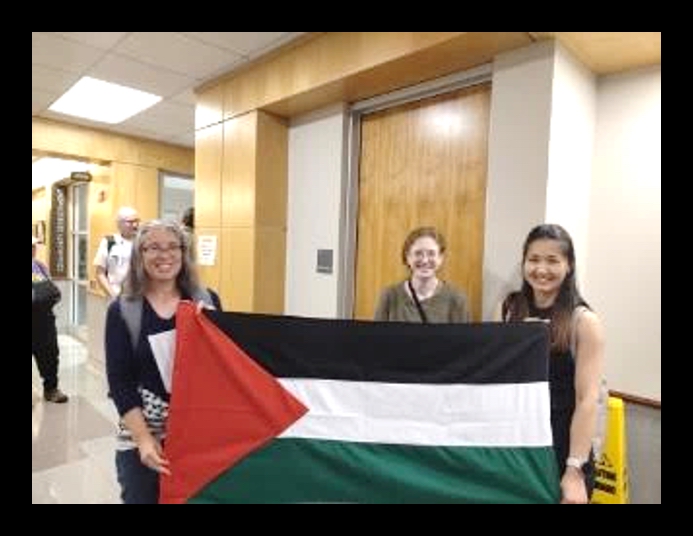
Activists celebrate the passage of an ethical divestment policy by the Urbana City Council in June. Photo by the author
Almost three years into Israel’s genocide in Palestine, the US federal government continues to double down on support for Israel. Despite Israel ranking last in global perception surveys for three years in a row. Despite over 60 percent of all Americans opposing Israel’s actions. Despite the UN adding Israel to the list of countries committing sexual violence in war zones, Israelis violently detaining a member of Congress, and Israel kidnapping and torturing Americans on a humanitarian trip in international waters.
But despite our government’s failure to do the right thing, the movement to end the genocide continues. Electoral organizing has had recent successes removing pro-Israel members of Congress from office. Dr. Abdul El-Sayed last month won Michigan’s primary for US Senate, which would be the highest office claimed by the movement. El-Sayed calls for a full arms embargo on Israel.
No doubt these federal wins help the movement, but changing the corporate imperialist nature of the US Congress is a long-term project. Many aren’t waiting around for their federal representatives to do the right thing, focusing instead on local wins. And there are wins to be had. Hundreds of millions in Illinois state tax dollars are invested in Israel Bonds, and a 2015 Illinois law penalizes American companies that boycott Israel. Many cities have investments in companies profiting from the genocide. This article highlights some of the most recent wins of local organizers in CU and Illinois.
Urbana Divests from War and Genocide
In June, Urbana became the first city in Illinois to pass an ethical investment policy divesting from companies profiting from war and genocide. It follows similar ones passed by cities, universities, and pensions around the country, including nearby Iowa City and St. Louis. The policy moves the city away from any corporate bonds or funds that include companies profiting from war and genocide.
The ethical investment policy uses two reference lists of companies which the city is now barred from investing in. The first, compiled and maintained by the Stockholm International Peace Research Institute (SIPRI), contains the leading 100 weapons manufacturers. The second is the Boycott, Divestment, Sanctions (BDS) list, compiled by the American Friends Service Committee (AFSC), of companies profiting from Israel’s genocide and illegal occupation of Palestinians. Despite initial hesitation by some Urbana city council members to include a list that singled out Israel, local organizers and allied council members made sure the final policy included the BDS list. An ethical investment policy wouldn’t be legitimate without targeting an ongoing genocide for which the US is the top arms dealer and source of foreign investment.
The divestment win was over a year in the making. Local organizers began meeting with city council members in early 2025. City staff were helpful in explaining Urbana’s investments. Months of research showed that its holdings in the Illinois Funds included several BDS targets, such as Honeywell and Caterpillar. The Illinois Funds is managed by State Treasurer Michael Frerichs, who has used hundreds of millions in state tax dollars to purchase Israel Bonds.
Urbana’s historic divestment now lays the path for other cities around the state to follow. It wouldn’t have been possible without the work of organizers with CU Muslim Action Committee, UC Jews for Ceasefire, the Party for Socialism and Liberation, and CU for Palestine. These groups hosted a virtual webinar to teach others around the state how to do the same. The historic divestment also received a major boost from recently elected Mayor Deshawn Williams, who encouraged city staff to move forward with creating the ethical investment policy. The new policy resulted in moving over $30 million in city tax dollars away from the Illinois Funds.
Illinois Townships Rally for Right to Boycott
Organizers around the state are also using Illinois’s township system to push for an end to the state’s anti-BDS law. Back in 2015, in response to the growing BDS movement, Illinois passed a law punishing American companies who choose to boycott Israel. Illinois was the first US state to pass an anti-BDS law. Over 30 states have followed suit. A recent bill sponsored by Rep. Abdelnasser Rashid would repeal the Illinois law.
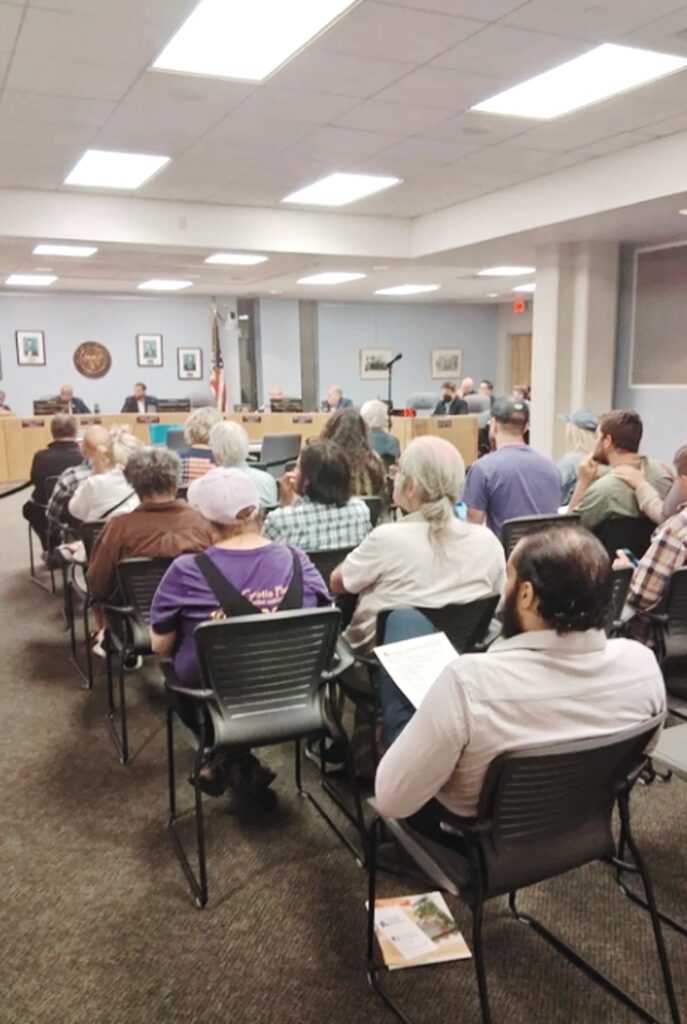
The Cunningham Township (Urbana) annual meeting on April 14, 2026. Photo by the author
How does this relate to the Illinois Township Code? The code allows registered voters to collect signatures to put a referendum on a township’s ballot during the November general election. Voters are required to collect at least 15 signatures from township voters and win a majority vote at the annual township meeting. Such a referendum is non-binding, but it provides one of the few pathways for direct democracy on important issues. In 2024, three townships in Illinois petitioned for a referendum calling for an arms embargo on Israel. Cunningham Township (covering Urbana) was the only township to get the referendum on the ballot. It was then approved by over 70 percent of voters.
Building on the success of 2024, CU organizers began working with allied groups around the state late last fall. The goal was to push for BDS at the state level, and grow the number of townships getting a referendum on the ballot. CU organizers again hosted a series of webinars explaining the process and coordinating to agree on a shared target for the referendum. The consensus was to push for the repeal of the state’s anti-BDS law.
In 2024, the movement petitioned in three townships and succeeded only in Cunningham. Two years later, the movement petitioned in 13 different townships in Springfield, Normal, Peoria, Champaign, Savoy, Naperville, Aurora, and Wheaton. Seven of these succeeded in getting the referendum on the November ballot, including the townships covering Urbana and Savoy. Voters in these townships will see the following question on their November ballot: “Shall the State of Illinois repeal amendments to the Illinois Pension Code that penalizes American businesses for boycotting the State of Israel?”
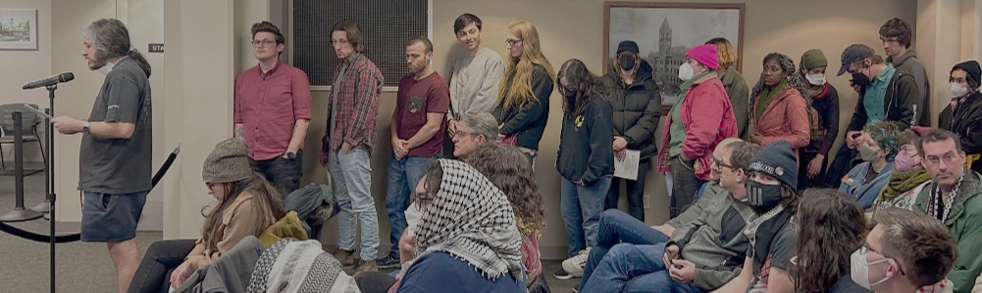
Cunningham Township residents line up to speak about the proposed referendum on repeal of Illinois’s anti-BDS law; the proposal to place the referendum on the November ballot passed by a vote of 62-11. Photo by the author
In three of these townships, township officials blocked the referendum from even being considered by voters. This includes the township that covers most of Champaign (City of Champaign Township), which rejected the referendum on the grounds it didn’t relate to township business. Local community members are now challenging Champaign’s decision in court, and have retained legal counsel.
How You Can Help
We are challenging the City of Champaign Township in court for denying voters an enumerated right granted in the township code. We know we have a strong case and will win, which is why we invested in legal counsel. The legal ruling in this court case won’t just help get this referendum on the ballot in Champaign. It will set a precedent for voters around the state to reliably use the referendum process. Townships frequently use the same argument Champaign has used to deny voters the right to petition for a non-binding referendum. We want to prevent this from happening in the future. You can donate to our legal fund, or contact us for more information.
Lastly, our campaign for the referenda in Urbana and Savoy will kick off later this month. We will be tabling at markets, flyering, door-knocking, canvassing, and talking to the community about why they should support Americans’ right to boycott. If you’d like to get involved in our campaign, please reach out.

Bryan Maxwell is a local community organizer with Champaign-Urbana for Palestine and World Beyond War.