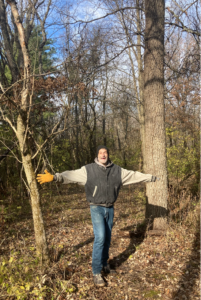
Bill in his natural element, on his farm out by Allerton Park, 2020
If there were a draft, would you go?
It is likely an easy “no” to most of us now—especially in the context of the Vietnam War, with decades of hindsight and a clearer understanding of its brutality. But in the late 1960s, the propaganda machine was powerful, dissent was dangerous, and refusing the draft came with real consequences—social and legal.
This is part of Bill Taylor’s story that some might not know. Many in our community know Bill, my father, in other ways: as a founding engineer at WEFT Community Radio; through radio projects across the US and Central America; as “the Kalyx Center guy,” the builder of magnificent bonfires; or as the person who quietly rewired your porch or fixed your water heater. All of that is true. But he is also this guy.
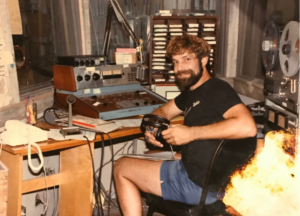
Bill in the WEFT Community Radio Station booth, 1980s. Family photo
Bill has always been the kind of person who believes rules matter—and that when they stop making moral sense, they must be challenged carefully, persistently, and without spectacle.
In the late 1960s, Bill was a rule follower. He still is. He was also a committed pacifist who knew with clarity that he could not participate in a war that demanded obedience to violence and dehumanization—especially as the conflict in Vietnam intensified and Americans slowly, painfully began to grasp the scale of devastation carried out in our name and by our hands.
Many things were shifting at once in those years—in the world, in the United States, in Champaign-Urbana, and in the interior life of a young Bill trying to live ethically in a time of moral crisis. Many details are lost to time, but the contours remain, and their ripples are still with us in the ways we organize, resist, and imagine a better world.
Bill is uneasy being centered in any story. I understand this instinct; I share it. He believes nothing meaningful is done alone. Where we differ is in my belief that naming individual contributions matters—especially when fear and inundation are being used against us, to make us forget the strength we have and what we inherit from those who came before us. Our activist elders have legacies and wisdom worth learning from.
By 1967, the draft was in full effect. Bill’s anti-war convictions led him toward conscientious objector (CO) status—a viable legal option in theory, often denied in practice. Most conscientious objector applications were rejected, and those that succeeded typically required years of documentation, persistence, and institutional backing. Finding a sponsor was difficult. Proving conviction required evidence. At the time, Bill was working at the Channing-Murray Foundation, the Unitarian Universalist campus center at UIUC. To apply as a CO, he needed an organization to formally support him. He sought sponsorship from the Unitarian Universalist Association (UUA) in Boston. This was before email or online applications. Calls went unreturned, letters unanswered.
The UUA had never sponsored a conscientious objector before.
Determined, Bill got into his red Morgan sports car and drove from Urbana to Boston. He simply showed up. What happened next feels a bit like a small miracle—or a reminder of what persistence can do in the face of institutional hesitation. The UUA agreed to sponsor him, making Bill their first conscientious objector. He completed his alternative service over the next two years by continuing to run Channing-Murray and, notably, the Red Herring Coffee House—an irony not lost on anyone who knows about coffeehouses. The Red Herring would become one of the most important anti-war, civil rights, and free-speech hubs in Champaign-Urbana during that era.
To understand the Red Herring, you have to understand the climate that produced it. The Clabaugh Act, passed by the Illinois legislature in 1947, restricted so-called “subversive” speech and organizations on public university campuses. A Cold War artifact, it became a flashpoint for student activism at the University of Illinois. Students for Free Speech met in the basement of Channing-Murray to plan protests, host speakers, and challenge the law.
When the Clabaugh Act was quietly withdrawn in the summer of 1967, students did not want to lose the community they had built. Coffee houses—then still new—were emerging as informal centers for conversation, art, and organizing. They asked if they could start one in the Channing-Murray basement.
What followed was less a business and more a social experiment. Bill ran the Red Herring loosely, intentionally so. A calendar hung on the wall for volunteer shifts. If someone wanted to host an event, they wrote it in. If someone wanted to help, they showed up. The space was imperfect and improvised—long trestle tables painted with scavenged paint, including one infamous white paint that never fully dried, leaving patrons with sticky elbows and a story to tell. Imperfections that would be a lawsuit today were simply part of the character of the project.
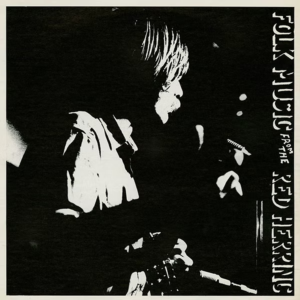
Bill Taylor on the cover of Dan Fogelberg’s Folk Music from the Red Herring Coffee House, Urbana, Illinois, Fall 1970. Bill is on the album playing a banjo piece he wrote called “The National Guard Waits”
Music was at the center: folk on weekends, jazz early in the week, bluegrass another night. Some performers were polished; others were terrified and delightfully off-key. Future luminaries like Steve Goodman, Tom Paxton, and Dan Fogelberg passed through, alongside countless local musicians and experimental artists. Rock bands played upstairs. Avant-garde jazz found a home downstairs when few other venues would host it.
Some nights were electric, others chaotic, and some strange—but people kept coming. They learned to expect the unexpected, and to trust that community sometimes meant discovering joy, connection, or meaning in whatever unfolded there.
But the Red Herring was more than music. It hosted civil rights meetings, community organizing efforts, mutual aid, films, lectures, and late-night conversations that helped shape a generation. One evening, for example, a blind, elderly rabbi arrived with an out-of-tune guitar and led the room in Hebrew song, eventually drawing people into a slow, circling procession as tables were pushed aside. No publicity. No calendar. Just openness.
This was what alternative service looked like: tending a space where democracy, dissent, art, and community could coexist. It was not glamorous. It was exhausting. When Bill’s CO service ended, he was ready to step away. But the imprint remained—on the town, on the campus, on the people who found belonging there.
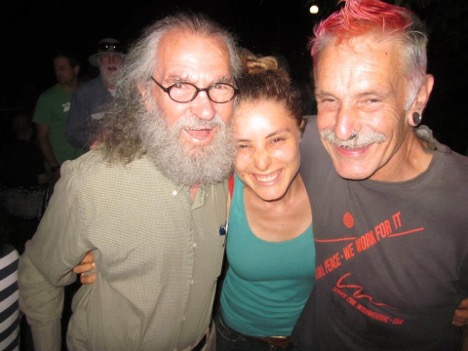
Bill, circa 2010, at a community potluck gathering in Urbana with his daughter Adrienne and David Monk
In 2023, I traveled to Ho Chi Minh City as part of my graduate studies. Vietnam calls the conflict we call the Vietnam War the “American War.” Walking through museums and streets still deeply marked by it, I felt the weight of what Bill had refused to participate in—and the violence he had chosen not to normalize. Its psychological, ecological, and generational impacts are ongoing.
When I returned home and talked with him about the trip, I understood more clearly how decisions made quietly, locally, decades ago ripple outward. Refusing the draft did not undo the war’s damage. Running a coffeehouse did not dismantle empire. But these acts were threads in a broader resistance—a counterculture that insisted on humanity, creativity, and care in the face of violence and repression. They were acts of refusal, yes—but also acts of creation.
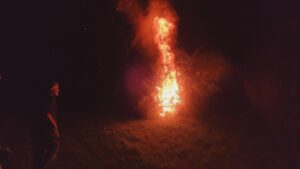
Bill with one of his huge bonfires out at the Kalyx Center for Sustainability, 2024
If there were a draft, would you go?
The question still matters. Not because history repeats itself neatly, but because moral clarity is always contested terrain. My father’s story is not one of heroism in isolation. It is a story of community, of institutions pushed to grow, of spaces made available for voices that would otherwise have been silenced. It reminds us that the work of building a better world often looks small up close: a basement room, a calendar on the wall, a door left open.
Those small acts, woven together, are how movements endure.
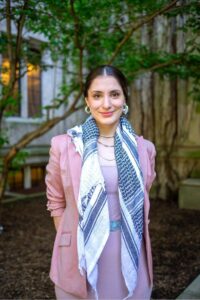
Maya Bauer is a cultural worker, nonprofit leader, and artist. She works with nonprofit, arts, and social sector organizations. She prioritizes mutual aid, community, and building towards equity and liberation. Maya was raised out on the farm in rural Illinois and is one of Bill Taylor’s daughters.