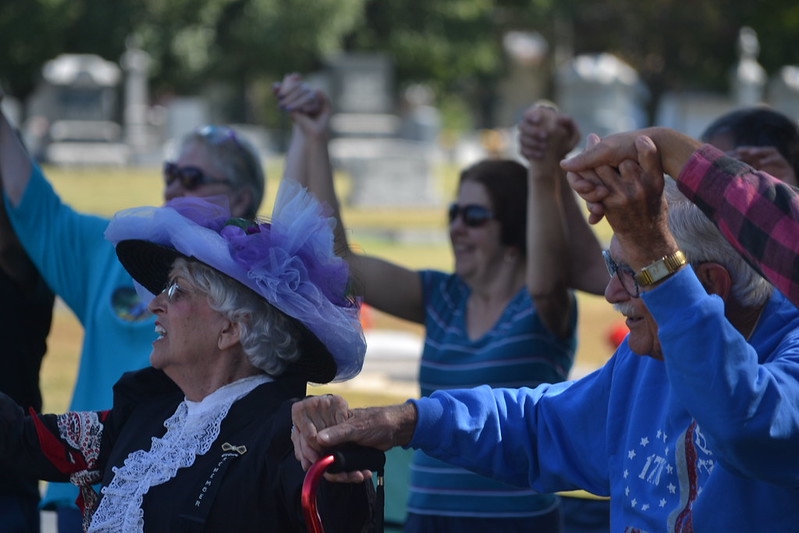
“Mother Jones” (Loretta Williams) and fellow unionists sing “Solidarity Forever” at the 2026 Union Miners’ Day at the Union Miners’ Cemetery in Mt. Olive, IL on October 11. Photo by the author
No US state has a richer labor history than Illinois. From Chicago’s Haymarket Square to southern Illinois coal fields, Illinois workers shaped not only the US labor movement but also the world.
The Illinois Labor History Society (ILHS), founded in 1969, is a popularly focused organization that documents and celebrates this rich workers’ history through education, public events, research, and community involvement. The ILHS mission is to educate workers and the broader society, on labor’s struggles and contributions.
Before the 1860s Civil War, Illinois workers organized to reduce the workday from twelve to ten hours. Craft workers—carpenters, shoemakers, tinners, and others—gathered locally to establish their wages and conditions.
After the war, Illinois passed an early but ineffective eight-hour-day law. Workers continued to organize around the length of the workday, with the slogan of “eight hours for work, eight hours for rest, eight hours for what I will.” They noted that their active participation as citizens was limited because long hours thwarted their civic participation and education.
In 1884, the small Federation of Organized Trades and Labor Unions, which became the American Federation of Labor (AFL) in 1886, called for nationwide eight-hour strikes on May 1, 1886. In Chicago, trade unionists, the Knights of Labor, socialists, and anarchists all embraced this cause. When the date arrived, workers walked out in many workplaces, and 40,000 marched down Michigan Avenue in protest.
On May 3, workers were protesting outside the McCormick Reaper works. Chicago police drove wagons into the crowd and shot two. The heavily German immigrant anarchist movement called for a mass rally the next night, May 4, in Chicago’s Haymarket Square, to “protest the brutal acts of the police.” Mayor Carter Harrison gave permission for the rally.
It was a cold, windy evening, and the crowd was less than 2,000. After 9 p.m., the crowd dwindled, and the mayor departed, instructing the awaiting police at the Des Plaines Street station to leave. Disobeying the mayor, 176 police officers marched toward the rally, stretching from sidewalk to sidewalk. As they reached the speakers’ wagon, an unknown assailant threw a dynamite bomb into the police ranks. Eight officers died, many possibly from friendly fire. Five protesters were killed.
Chicago was placed under martial law; eight activists—six German immigrants, English immigrant Samuel Fielden, and US-born Albert Parsons—were accused of a conspiracy to throw the bomb, on the principle of one guilty, all guilty. Trial decorum was ignored, and seven were sentenced to hang. Protests against the sentence erupted globally. Governor Richard Oglesby granted clemency to two who asked for mercy. On November 11, 1887, execution day arrived at the Cook County Jail. The night before, Louis Lingg, who might have made the bomb, was given a cigar with a dynamite cap in it, blowing his face off. The remaining four were executed the next morning.
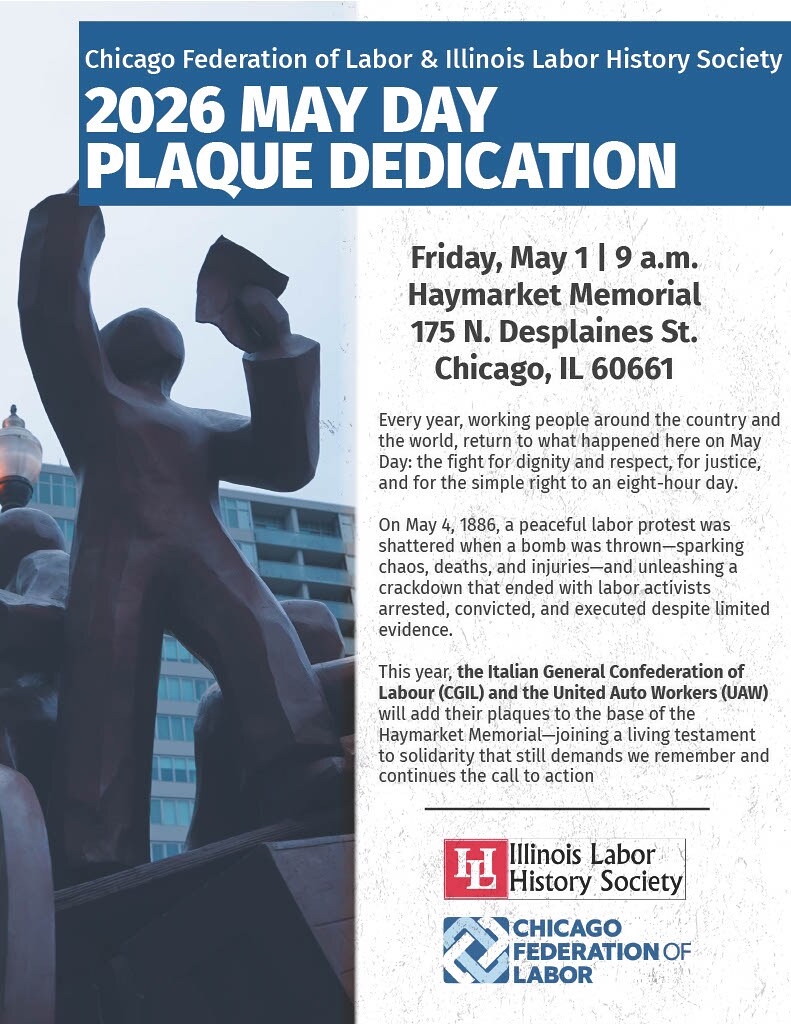
Poster for the 2026 Haymarket plaque dedication
The ILHS maintains the 1893 Haymarket Martyrs’ Monument at Forest Park’s Forest Home Cemetery. The day after the monument’s dedication, Governor John Peter Altgeld, a German immigrant, pardoned the remaining three in prison and wrote a scathing article about the trial’s conduct, which doomed him politically. The ILHS regularly offers tours and commemorations at the cemetery monument. Every May 1, a rally is held at the City of Chicago’s Haymarket memorial at Randolph and Des Plaines Streets. A delegation from an international labor movement adds a commemorative plaque to the monument’s base annually, on May 1.
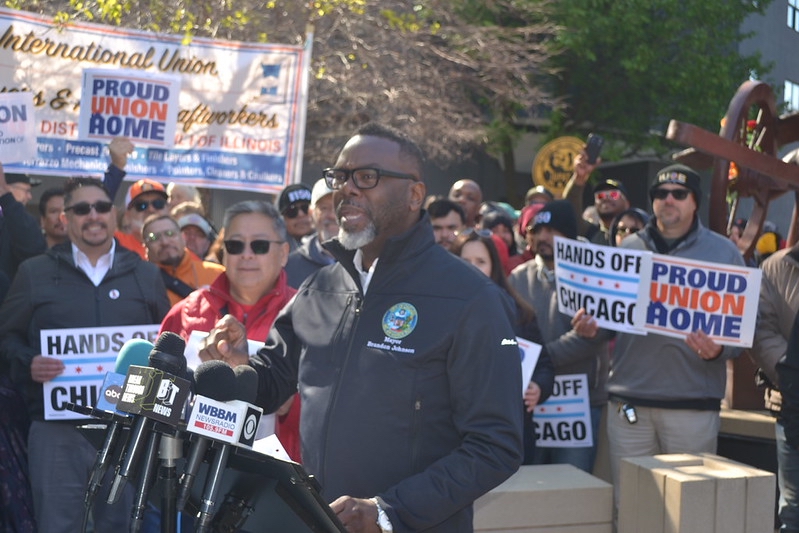
Chicago Mayor Brandon Johnson addressing the 2026 Mayday Haymarket rally. Photo by the author
Governor Altgeld was central to another national struggle, the 1894 Pullman boycott and strike. In 1880–81, George Pullman built his model town south of Chicago, where he manufactured his deluxe railroad sleeping cars. The pristine town featured solid brick houses, indoor plumbing, a church, school, and markets—but all owned by Pullman. Workers had everything but democracy. When the world plunged into recession in 1893, Pullman cut wages and hours but refused to lower the rents. Supported by the new American Railway Union, led by Eugene V. Debs, railroad workers across the nation refused to move trains. Federal troops and marshals were dispatched to reopen the rails. Altgeld unsuccessfully protested to his fellow Democrat, President Grover Cleveland, to keep federal troops out of Illinois. As 12,000 federal troops roamed the railyards, the strike and the union were broken.
Today, the National Park Service’s Pullman National Historical Park at 111th Street and South Cottage Grove Avenue in Chicago preserves the Pullman works, and private homeowners maintain the 1880s housing. The ILHS is a formal partner with the National Park Service in its efforts to share the Pullman story.
These are just two significant Illinois labor stories that reverberated nationally. The ILHS actively helps interpret and share these significant labor events. In conjunction with the University of Illinois School of Labor and Employment Relations’ Climate Jobs Institute, the ILHS convened a “Salute to Illinois Coal Miners” in West Frankfort (Franklin County) on August 29. This included a commemoration of the December 21, 1951 Orient Mine No. 2 disaster, where 119 miners were killed; the induction of two mining leaders into the ILHS Union Hall of Honor; and a readers’ theater based on mine workers’ oral histories, performed by local high school students.
On October 11, the ILHS participated in the annual Union Miners’ Day at Mary “Mother” Jones’s gravesite in Mount Olive. December 3 is the annual Chicago Union Hall of Honor, honoring firefighters and workplace safety advocates.
Dr. Stephanie Fortado [a longtime writer for the Public i—eds.] at UIUC’s Labor Education Program is an ILHS board member and has done extensive research on union struggles and efforts in CU and other corners of Illinois. The ILHS is a dynamic organization that seeks new venues, both live and electronic, to share Illinois’s impactful labor history. To learn more, go here.

Mike Matejka lives in Normal and is the president of the Illinois Labor History Society. He also serves on the boards of the McLean County Historical Society and the Friends of Pullman National Historical Park. He is a popular historian and an Illinois Humanities Council “Roads Scholar,” and has an Illinois labor history book pending with University of Illinois Press that should be available next summer. He encourages a trip to the McLean County History Museum in Bloomington to view the latest exhibit he guest-curated, “Deadly Deception: The Asbestos Tragedy in McLean County.”