
The “Fighting Technofascism” workshop brought together hundreds of organizers from across the country. Photo by Donté Carnell Winslow, used with permission
On September 19, 2026, a delegation from UCIMC participated in the one-day workshop “Fighting Technofascism: Power, Surveillance and Resistance, jointly organized by MediaJustice from Atlanta and Mijente’s Chicago office. They joined hundreds of participants from Chicago to New Mexico exchanging ideas on educational and organizational campaigns to counter the expanding political power of the technology sector in the US and around the world.
Naomi Klein and Astra Taylor set the tone for the day by leading an open discussion of their recent book, End Times Fascism and the Fight for the Living World (2026). Klein and Taylor emphasized that they did not use the term fascism lightly. The technology sector–state power nexus that has accelerated under the Trump administration, the cultivation of cultural visions featuring in-groups and out-groups, and the switch from rights-based values to discourses centered on social control all fit the markers of fascism. In addition, Klein and Taylor find echoes of the eugenic ideas that justified Jim Crow regimes, ethnic cleansings, genocide, and apartheid-like repression in the worldview of the current technocracy, which reduces humans to data points to be managed and surveilled. The leaders of these industries, they argue, have shown their disdain for human agency, democracy, and the public good in their focus on designing data infrastructures convenient for their own goals of national and planetary management. The authors encouraged attendees to push back against this dehumanization as well as against the expansion of the infrastructure enabling these technofascist campaigns.
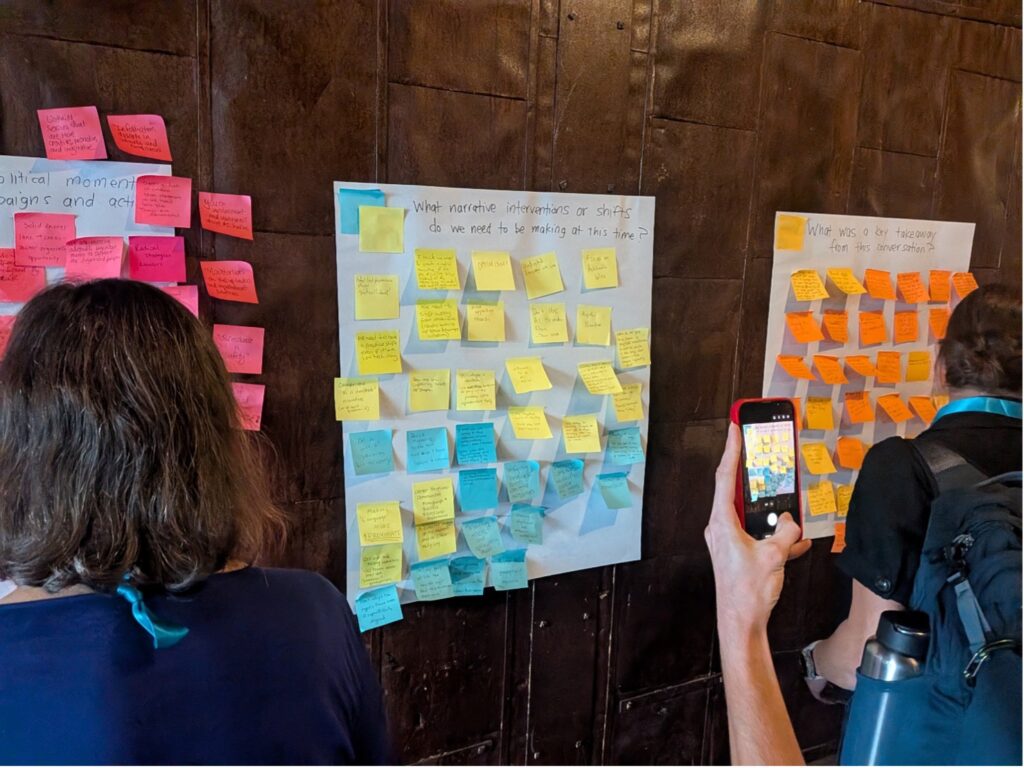
In between panels attendees shared ideas on key takeaways, ideas to change the current tech narrative and strategies for building political action. Photo by Donté Carnell Winslow, used with permission
“No Tech for ICE!”
Attendees also heard from Mijente on the role of technology in systems of human surveillance and control within migration enforcement. The current tech-driven ICE campaigns are just as lethal as were the helicopter and SWAT-team-style assaults on immigrant neighborhoods the US witnessed in Minneapolis and Chicago in 2025. ICE now relies on data harvested from government records and private data brokers to target individuals, many of whom have been dropped into vulnerability by administration legal reclassifications. For example, the one million immigrants who have had their Temporary Protected Status removed by Trump can be traced through biometric, social media, and license plate reader data, among other means. These ICE dragnets attract less media attention than earlier operations, but the numbers of those arrested, detained, and deported is higher now than in 2025, with almost 80,000 in detention as of October, 2026.
Mijente warns that the technology underpinning ICE’s deportation campaigns is already furthering the militarization of domestic policing, just as the dehumanizing rhetoric characterizing immigrants as terrorist and criminal threats is being repurposed against administration opponents. And the model of large-scale data-driven arrests and detention as social control policy has already been spread beyond the US, most notably to El Salvador’s megaprison, but more recently to Honduras, Costa Rica, and other countries who have adopted the US model. And, just as in the US, these costly data collection tools, data management systems, and megaprisons divert funds from social programs, but are lucrative for the tech sector and convenient for politics based on controlling, not governing, populations.
“Brobots vs the People”
Most attendees were already familiar with the negative environmental and energy impacts of data centers on local communities, but MediaJustice’s new educational and action campaign, “Brobots vs the People,” stresses the need to see these local struggles as part of the national transformations underway in the rise of a tech sector-dominated state. The campaign draws attention to the way the “broligarchy” (the media-justice label for technology sector leaders) partners with “brobots” across society. For example, “brobots” at research universities and in private industry distance themselves from ethical and political debates as they pursue prestigious partnerships with the tech sector. Public safety “brobots” contribute to harvesting personal data and eroding privacy by embracing technologies like biometric scans, automatic license plate readers, and social media extraction in the name of protecting the public, but ignore the way harvested data renders subjects vulnerable to state control. And finally, just in time for the midterms, MediaJustice highlighted the heavy involvement of the broligarchy in cultivating compliant, brobot elected officials with money hidden in cryptocurrency and AI superPACs driven by tech leaders like Elon Musk.

Image from MediaJustice Brobots vs the People Toolkit, used with permission
Local political offices are also targets of manipulation. Attendees shared many stories of astroturfing, or the creation of fake grassroots support for AI center construction. In some communities the industry bused in paid counterprotesters, in others it made financial contributions to local groups (churches, youth sport teams, etc.) contingent on their public endorsement of data center construction. The industry frequently uses non-disclosure agreements to limit public debate, and has hired spouses of local officials as “consultants.” Some of the attendees had discovered that their opposition to data center construction had been shared with local police, who then regarded them as possible extremists.
Although it was not a major focus at the conference, MediaJustice has worked to expose the ways the tech sector threatens democracy by controlling information flow. Their report, Media Capture: Who Controls the Story Controls the Future, details how the sector has bought controlling interests in media outlets and has used AI to generate its own narratives by flooding the news space, buying influencers, and shaping algorithms. Most recently, the tech industry flooded the media with scare stories on China’s AI industry as justification for blocking efforts to regulate the US AI industry and instead giving the industry a place in writing US policy on AI. As do Klein and Taylor in their book, MediaJustice emphasizes that the goal of organizing should not just be countering the immediate environmental and economic costs of data centers and the AI buildout, but also noting the extraordinary power the “broligarchy” is gaining in the administration, in the economy, and over the public sphere.
One surprising insight for the IMC attendees was the realization that Illinois is one of the most active national battlegrounds over data center expansion. An abundance of unincorporated land and the ample water supplies of the aquifers and Lake Michigan make Illinois a desirable location for centers, and the industry has spent accordingly to lobby the state and local communities. This was no surprise to Rep. Delia Ramirez (D-IL), who joined the panel “Resisting a Technofascist State.”
A National Resistance Movement is Emerging
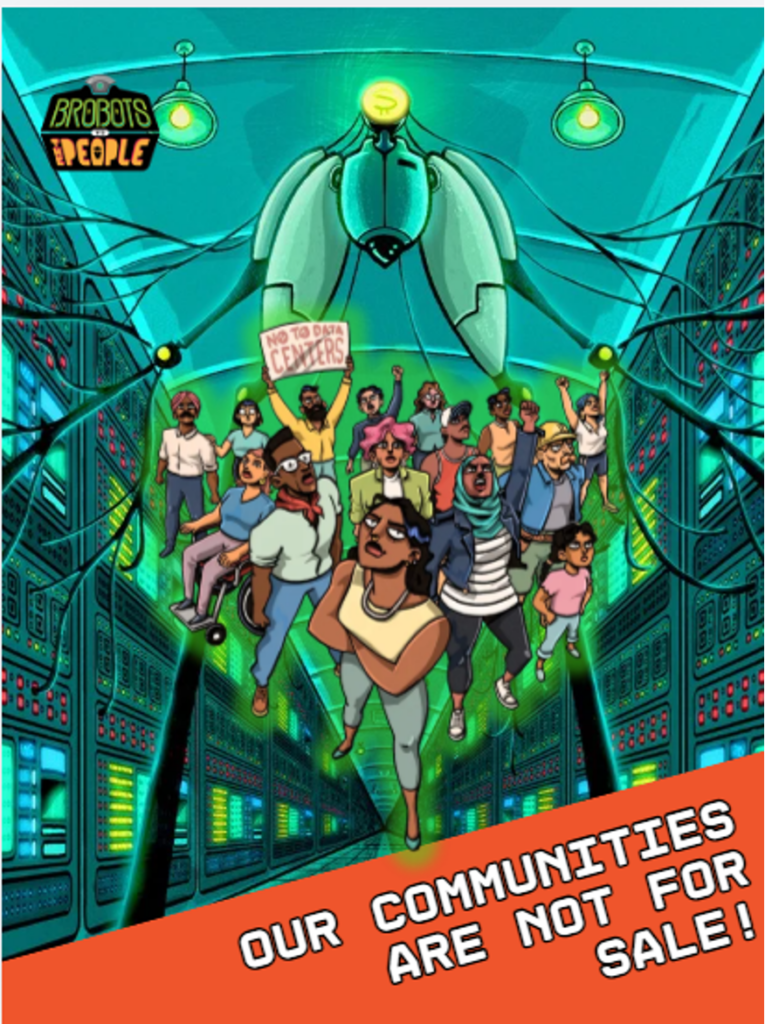
Image from MediaJustice Brobots vs the People Toolkit, used with permission
Despite the sobering overview of the technofascist challenge, the conference was ultimately a hopeful experience. Attendees heard from communities who (like Champaign County and Mahomet) had pushed back against big-tech plans for expansion of data centers and surveillance tools. They heard about the National Nurses Union, which recently organized a strike in eight US cities to protest the mandatory use of Palantir data harvesting in medical recordkeeping at hospitals. A representative from the Chicago community organization Southside Together described how the loss of a well-utilized community hospital to the consortium (which includes UIUC) building the Illinois Quantum and Microelectronics Park has galvanized local voices to push back against technocracy.
Most importantly, the conference organizers stressed that the rise of a data-driven technocratic political system is neither inevitable nor politically neutral. Local movements need to challenge this larger vision while simultaneously working to stop the data center and surveillance buildout. Those who would like to know more can visit MediaJustice or Mijente.
