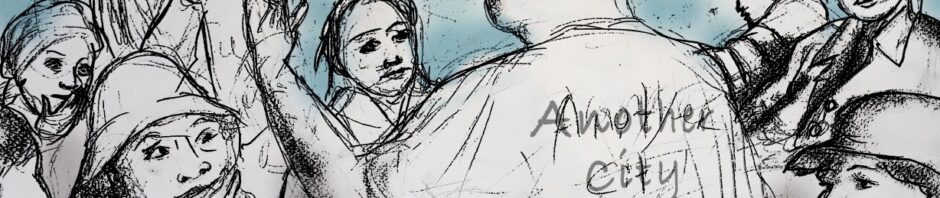

A sketch by participant Anastasya Elissevah from Ken’s August 2 Cape Town workshop to produce a manifesto for a just city with urban movements occupying abandoned buildings and land there
This article is a distillation of a recent conversation with UIUC-based urban justice educator Ken Salo and his Cape Town, South Africa-based comrade Bevil Lucas by the Public i’s Rick Esbenshade. Ken and Bevil are veterans of the 1976 student- and worker-led struggles against white-monopoly capitalism in apartheid South Africa, and now work with movements of the urban poor resisting displacement and dispossession by black-elite-managed neoliberal capitalism in South Africa. Their current collaboration centers on an intergenerational political educational project, the Humane Urbanisms Project, that aims for working-class activists to situate their daily struggles for dignified livelihoods and decent housing as rooted in earlier struggles against politically and economically polarizing and privatizing Cape Town. Their collaboration works to uncover and amplify the resistance stories of movements occupying vacant public land and abandoned buildings as strategies for survival and dignified urban livelihoods. Their Cape Town project is a local node within a larger transnational network of land and housing justice collectives in the Global South that includes the Landless Workers’ Movement in Brazil and our local FirstFollowers reentry project. Bevil also works with Reclaim the City to build city-wide connections with shack dwellers, as in the Intlungu YaseMatyotyombeni Movement, via shared projects to address gender-based violence, childcare, after-school homework support, gardening and food sovereignty, building cooperative movements, and “every aspect of people’s lives.” These projects allow Bevil to repurpose skills learned as an advocate for workers’ rights in international trade union networks like the International Labour Research and Information Group. Similarly, they allow Ken opportunities to repurpose skills honed as a veteran [Brazilian educational philosopher] Paolo Freire-inspired political educator working to recover the humanizing and emancipatory epistemologies of the urban oppressed in the Global South.
Bevil lives in an occupation in the Woodstock neighborhood in the city of Cape Town. He and 500 families have been occupying an abandoned public hospital for the past eight years. Since 2017, through self- and social caring throughout the global COVID-19 pandemic, they have built a community of sharing, democratic decision-making, and collective responsibility and accountability.
Donald Trump recently welcomed 45 white Afrikaner so-called refugees for resettlement in the US. Instead of focusing on the bogus idea that white South Africans are being victimized, this discussion centers on recovering and amplifying the voices of the historically displaced and dispossessed in urban South Africa. White South Africans make up about 10 percent of the population but they still own 97 percent of the land. The negotiated settlement of the early 1990s between the departing apartheid regime and the African National Congress (ANC)—implemented under ANC rule since 1994 and, since last year’s election, the so-called Government of National Unity (GNU)—promised not to disturb this colonial dispossession. The problem is rooted in the nature of the negotiated settlement itself that ended the apartheid system, the compromise that upheld the fundamental nature of the neoliberal economic system with its emphasis on private property. There has been a big debate around expropriation without compensation, which of course the Trump administration is distorting to mean dispossession of and genocidal violence against white South Africans. But the general consensus is that there are no legal obstacles for the state to redistribute land in the public interest, but bureaucratic obstacles have instead forced the displaced and dispossessed to squat and occupy illegally in the inner city. As Bevil stated, “the chickens are coming home to roost.”
Up to now, the state has not addressed land hunger and the housing crisis. There is a crisis within capitalism itself. People are now reclaiming land through the social movements on a collective basis via occupation. They are building a different kind of accountable democracy through active participation. One limited success was the passage of the Expropriation Act by the new post-election parliament, which was signed into law in January. It was a compromise to replace the 1996 Constitutional Clause on land redistribution. There are varying and many interpretations, and the ANC is “between a rock and a hard place.” Its more conservative GNU allies, and the Right outside of the coalition, put out overblown fears of expropriation (which plays into the “persecuted Afrikaner” narrative); the ANC defends the Act as legal under the constitution; but the popular movements and Left have no faith it will lead to real improvements. Young people right now are unable to find industrial or working-class jobs, because South Africa and in particular Cape Town is shifting from industrial to financial capitalism. There is pressure on the ANC from the radical youth, but it is also under pressure to maintain neoliberal policies to attract foreign direct investment. And now South Africa has been hit with the 30-percent Trump tariffs, so the government is subsidizing much of the corporate agriculture and wine industry, particularly in the Western Cape—rather than putting sufficient resources toward social needs. The upcoming municipal elections are going to be a kind of litmus test for the ANC.
The coalition government tried to initiate a national dialogue on how to implement the Expropriation Act, but it was rejected by all sides. It was meant to be community-led but turned into a state-led process. The social movements are calling instead for people’s assemblies. People are not going to wait on the state to deliver, but will rather engage in activities such as protests, resistance, and the exercise of occupation. And so that has happened across major cities, and it was done not only with the purpose of providing a solution to the housing crisis, but also to get people to participate in the making of those occupations as collective spaces that people have reclaimed, and engage in democratic practices that build solidarity. Communities have taken ownership of spaces and have organized themselves in collective forms to address all kinds of issues—such as gender-based violence, drug abuse, and how to improve the quality of living in those spaces.
Perhaps predictably, the nationalist project of the ANC has run its course: it has “failed to deliver.” There are factions within the ANC that are seeing the need to turn towards more anti-colonial or anti-capitalist critiques. But there’s also a bureaucratic elite that is now vested in maintaining the system. These tensions are playing out, but the current ruling elite has lost vision. The (Nelson) “Mandela moment” of a liberatory vision has evaporated and the youth are actively seeking alternatives. The long-standing Tripartite Alliance between the ANC, the South African Communist Party (SACP), and the Congress of South African Trade Unions (COSATU) has disintegrated. The SACP now runs its own elections, and the union movement is now free to engage in more radical politics. The ANC is left with the impossible choice of staying with this GNU, which is an alliance with white monopoly capital (mainly the liberal Democratic Alliance), or reach out to the more radical forces like the Economic Freedom Fighters. Bevil stated that the social movements must rebuild organization, and the ANC is not going to be part of it. It has betrayed its mandate for the past three decades.