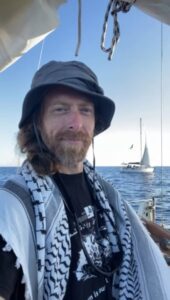
Paul Reid
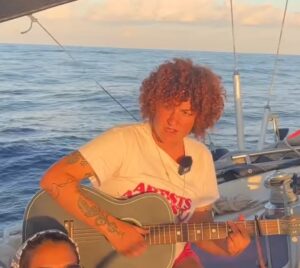
Carsie Blanton
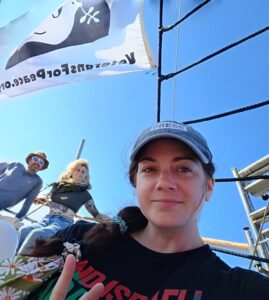
Jessica Clotfelter
A longer version of this article appeared on Kimberlie Kranich’s Substack page on November 21, 2025.
The Three Americans
Paul Reid, a graphic designer based in Portland, Oregon; Carsie Blanton, a songwriter based in New Jersey; and Jessica Clotfelter, a former Marine based in rural Windsor, Illinois: I interviewed them after they sailed for Gaza on boats in the Mediterranean Sea last September. They were part of the 2025 Global Sumud Flotilla, which was organized to bring attention to the humanitarian catastrophe in Gaza during the Israeli war on Gaza that began following the October 7, 2023 Hamas attack. Nineteen Americans made the full journey and were part of a fleet of more than 40 boats and 500 participants from around the world carrying food, medicine, and diapers to the Palestinians of Gaza. Their boats were intercepted by the Israelis and everyone was arrested and imprisoned in Israel. While held captive, Israeli forces physically and psychologically abused them before releasing and deporting them after holding most participants for five days.
Why They Risked Their Lives
Paul lived in the Middle East for almost five years studying Arabic. He was inspired by the civilians who sailed on the Gaza Freedom Flotilla in 2010. They were sailing to Gaza after Israel had cut off the movement of people and goods three years earlier, isolating the strip from the rest of the world and other Palestinian occupied territories. When the 2010 flotilla passengers refused orders not to breach the Israeli naval blockade, Israeli soldiers raided the flotilla, killing nine passengers and injuring 30 more. One Israeli soldier was seriously hurt.
“And I always thought, wow, what an incredible thing to do. I wanted to meet the people that were doing those actions,” Paul told me in a Zoom interview last October. “The goal was to bring aid into Gaza. It was also about changing the political reality. And to do that, you have to change people’s minds. And that’s where I felt the flotilla really had a lot of potential.”
Carsie is a songwriter whose music spans folk, swing, punk, and protest songs. Her October tour was postponed due to her capture and imprisonment by Israeli soldiers. Each participant made a video to be released in the event of their capture. In Carsie’s video, posted on her Instagram account, she says: “I am an American citizen. I am a Jewish person. And I’m a musician. And for all of those reasons I consider it my duty to try and make a problem for my own government because my government is enabling a genocide in Gaza.” She hopes viewers of her video can “also make a problem for your government. You can try to organize with many other people and try to make it politically impossible for them to keep supporting the genocide.”
Jessica is a former Marine who joined the military when she was 17. She lives in a rural town in south-central Illinois with a population of 1079. I interviewed her in person and on Zoom for this story. Jessica says she grew up in a climate of Islamophobia and serving in the military was a way for her to become a patriot. “Especially in rural areas, you know, military service is a really honorable thing,” she said. “And I think you’ll find a lot of people who join the military have a heart for service.” Much of her Marine combat training involved watching hours of suicide-bomber videos. And like all Marines, she was trained to be a killer. She left the Marines in 2012 and stopped her work as a defense contractor in Kuwait in 2015. Her studies in anthropology at the University in Illinois exposed her to a wider range of perspectives and challenged her. And on campus, for the first time, she met Muslims. Eventually, it was Jessica’s friendship with a Muslim mother in Gaza, Asma, that inspired her to join the Global Sumud Flotilla. When Asma pleaded for help on social media during the start of the genocide, Jessica reached back and they became friends.
“Treated Like Scum” by Israeli Prison Guards
An earlier flotilla boat, the Madleen, was intercepted by Israeli forces in July, 2025, and the participants were detained and deported. All participants in the September 2025 flotilla were also captured by Israeli soldiers at gunpoint between October 1 and 3. Prior to their capture, drones attacked two ships, causing damage and temporarily jamming communications. Participants posted videos describing their treatment by Israeli guards after they were deported.
“I’m a Jewish American in Israeli detention, I was treated like scum in a way like you read about in books about the Holocaust,” Carsie said in her Instagram video. “I was held in a cage with 57 other women and someone really, really needed a medic. And a guard came to us and said if you keep asking for a medic, we’re going to gas you. So I just want you to understand when we say they’re like Nazis, it’s not a difficult comparison to make. They are fascists.”
Upon detention, Israeli soldiers zip-tied the hands of the flotilla participants, blindfolded them and made them kneel on concrete for hours at a time.
Jessica tells me about an interaction she had with a guard while she was being processed into prison. “As soon as he saw that I was an American, he was disgusted,” Jessica said. “And he looked at me and said ‘You’re an American.’ I just stood there as we were taught in Barcelona at our training and did not look him in the eye. And he said ‘We usually like Americans, but we hate you. We hate your kind.’” He slammed his fist down demanding that she look at him and she did so with confidence. But as she recalls this moment with me, she chokes up. “I was calm throughout the whole process. And he said that I’m going to rot in prison. He said I was a terrorist and was supporting terrorism. He said there was no starvation in Gaza.”
Of the guards, Paul said “They treat you like animals at every turn. They would wake us up every couple of hours at night. Turn on the lights in prison. Open the door holding their guns and gizmos.”
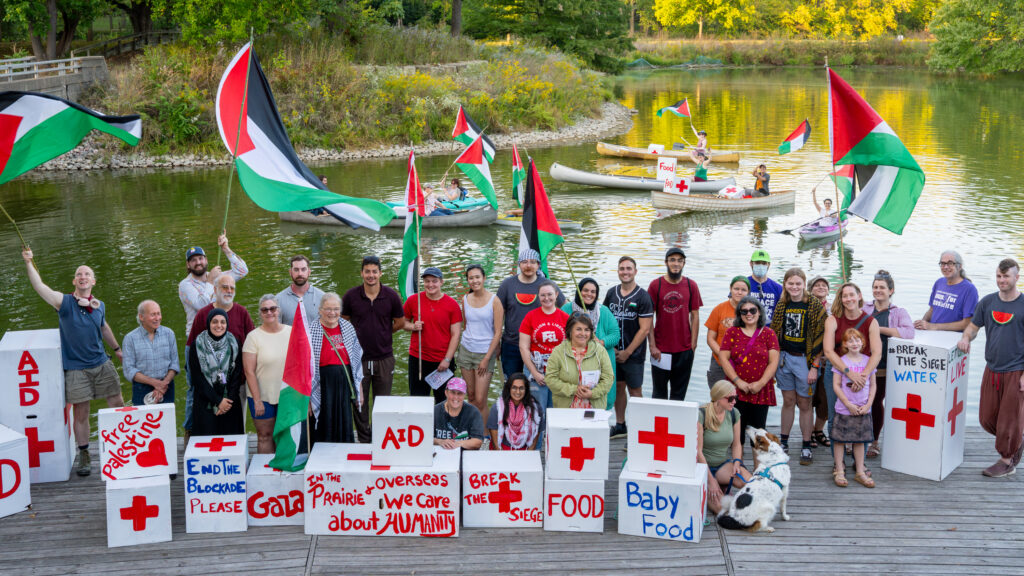
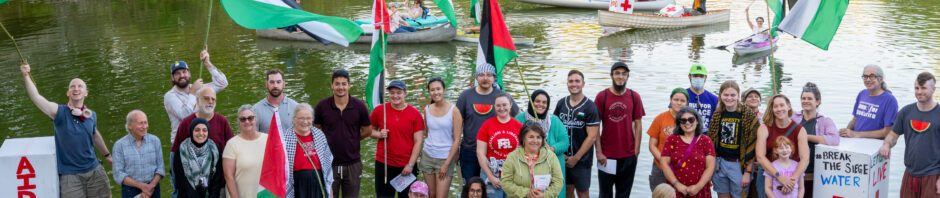
Solidarity event supporting the 2025 Global Sumud Flotilla at Crystal Lake Park in Urbana on September 29; there was also a car-and-float caravan through town. Photo by Jeff Putnam, used with permission
Caring for Each Other While in Israeli Custody
Most of the members of the flotilla were incarcerated at Ketziot Prison in the Negev desert. In an email reply to my questions, Carsie wrote, “The environment in prison was pretty consistently caring and supportive! There were songs, conversations, hugs, dance lessons. One or two of us would be let out each day to distribute food to all of the cells, and when we did that we would pass things between cells—pads, underwear, the two pens we collectively owned. (One was in the cell when we arrived; the other was snuck in by one of our comrades when they were allowed to visit their consulate).”
Jessica shared a cell with Carsie for part of her imprisonment as well as with women from around the world who spoke Arabic. These women would read the Arabic on the prison walls and translate it into English. “Some would be poetry,” Jessica said. “So many would be motivational things like, ‘This is the darkest day, but it’s not always dark and the light will come.’ There were calendars written and marked off. People were locked in here, you know, for how long? And just think of the countless horrors they suffered, and then seeing some of this beautiful, uplifting, hopeful resistance really moved a lot of us.”

Kimberlie Kranich is an independent journalist based in Champaign. She retired after three decades in commercial and public media, and now writes about grassroots resistance to injustice.