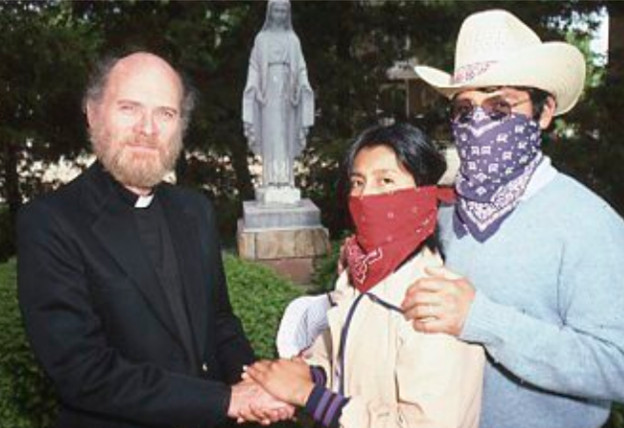
The late Father Tom Royer with refugees hosted by CUECOS in 1984. Source: papers of Father Tom Royer
The Urbana-Champaign community has a long history of making national and even global matters topics of local debate. Apartheid in South Africa, the US war in Vietnam, and nuclear proliferation are among the many issues that galvanized residents in past decades. This legacy isn’t just for local history buffs, however; it’s a reminder that policymakers revise stances when pressure from tens of thousands of community movements across the US works to educate the public and channel concern into campaigns for change. Today’s locally rooted campaigns against surveillance technology, data centers, and US complicity in genocide in Gaza continue in this tradition.
The National Sanctuary Movement of the 1980s
One issue with a long history of local activism is the rights of immigrants and refugees. In the 1980s Champaign-Urbana joined other cities across the country in organizing a Sanctuary campaign to draw attention to the interrelated issues of human rights in Central America and civil rights here in the US. At the time the US was in the final grip of Cold War fever. While many analysts questioned the ability of the Soviets to sustain their own system, let alone undertake global expansion (the USSR did in fact break up just a few years later, in 1991), the Reagan presidency fanned fears of Communist expansion on the election trail; and, once in office, doubled down on military aid to Central America. The counterrevolutionary militias Reagan funded to undermine the Sandinista Revolution in Nicaragua and the authoritarian governments he bankrolled in the rest of the region became the US’s first line of defense against the so-called cancer of Communism.
The results were tragically predictable. Unrestricted military aid with little to no oversight resulted in the use of terror tactics by Nicaraguan Contras; brutal military methods in El Salvador modeled on Vietnam War-style counterinsurgency, and a campaign of state-led ethnic cleansing in Guatemala that reached genocidal levels. Hundreds of thousands fled the violence, creating a refugee crisis that stretched from Costa Rica to the US. While the Reagan administration treated Nicaraguan refugees in the US as the US had long treated Cubans, as political refugees with protection from deportation, it ignored the evidence of government abuse by its partners in anticommunism and handled Salvadorans, Guatemalans, and others as criminals for violating immigration laws. Summary arrest and deportation, a virtual death sentence for many, followed.
It was in this context that a new form of political activism arose to challenge US foreign policy. In March, 1982 Southside Presbyterian Church in Tucson, AZ publicly declared itself a site of sanctuary for Central American refugees. Within two years more than 300 other churches followed the Tucson example. The Sanctuary movement was often likened to the Underground Railroad of the 19th century, but while there were networks of volunteers that quietly helped some refugees transit the US to Canada just as abolitionists had once done with those fleeing enslavement, that parallel obscured the most important tactic of the movement. The 1980s Sanctuary movement centered around acts of formal, public noncompliance with federal immigration law. It cultivated opportunities for media coverage and knowingly provoked federal legal responses. Sanctuary churches used the publicity around their work to educate the public about US complicity in funding and enabling violence in Central America. They argued that it was not Sanctuary churches that were in violation of US immigration law, but the Reagan administration itself, which ignored the United Nations refugees protocols that had been incorporated into US Law in 1980.
The Sanctuary Movement Comes to Champaign-Urbana
Champaign-Urbana already had several groups protesting US military aid to Central America. The People’s Alliance on Central America, C-U Central America Solidarity Committee, Illinois Disciples, St. Mary Catholic Church, and Champaign-Urbana Peace Initiative were among the most active in organizing teach-ins, film discussions, and letter-writing campaigns to bring attention to the impact of US policies. While all these activities were allied with the principles of Sanctuary, formally declaring themselves part of the movement would carry significant new legal risks. The Reagan administration was charging individuals affiliated with the Tucson church with harboring and transporting fugitives and imposing fines of thousands of dollars and up to ten years in prison.
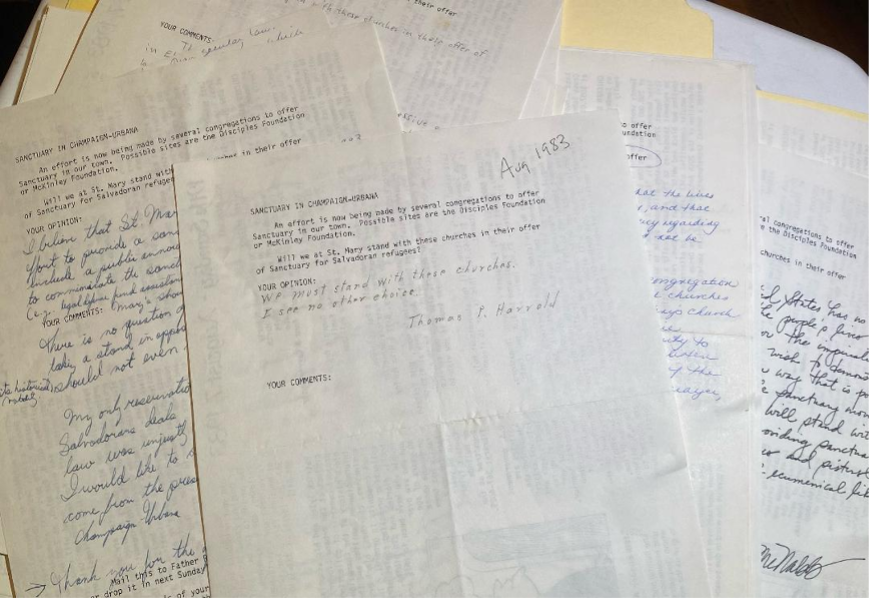
St Mary Church followed teach-ins on the topic of Sanctuary and Central America with a formal poll of parishioners on whether to join the local movement. Source: Father Tom Royer papers
Two local pastors, James Holiman of the Illinois Disciples Foundation and Tom Royer of St. Mary, became the most visible faces of the local movement and the contacts with the Chicago Religious Task Force, which coordinated Sanctuary sites in the region. The two emphasized the democratic process within the churches they led, as they held workshops to prayerfully study the moral challenges of the moment, as well as the potential legal and financial risks of joining the movement. St. Mary followed this process of “discernment” with a formal poll of parishioners. Although given the option of anonymity, most signed their names in support of the initiative. As one parishioner, Tom Harrold, wrote, “We must stand with the other churches. I see no other choice.”
In 1984, the Champaign-Urbana Ecumenical Committee on Sanctuary (CUECOS) was founded by St Mary and the Illinois Disciples, and joined by the McKinley United Presbyterian Church, The Society of Friends, the Community United Church of Christ, and the United Church Foundation. They hosted their first refugees, a family fleeing El Salvador, in May, 1984. In addition to providing for the material and medical needs of refugees, they organized emergency phone chains and planned for a human “fence” to deter police raids, while acknowledging the likelihood of FBI surveillance.
Over the next few years CUECOS hosted several refugees, some of whom they later helped to join family elsewhere in the US or in Canada; but the impact of the movement was not confined to the individuals it hosted. In addition to sheltering refugees, CUECOS organized speaking engagements in CU and in surrounding communities, to bring a human face to the tragedies taking place in Central America. They hosted refugee caravans passing through Illinois to Canada, and issued constant press releases about their activities. CUECOS members never hid their intentions. They filled one full-page ad in the News-Gazette with hundreds of signatures of local residents willing to go on the record supporting the Sanctuary movement’s violation of federal law. They wrote public officials, including the US Attorney General, to announce their planned civil disobedience. They pointed out that it was the federal government, not the movement, that was breaking the law by ignoring the 1980 Refugee Act and failing to keep Congress informed of military assistance consequences. They questioned the civil rights overreach of the FBI in monitoring regional peace organizations.
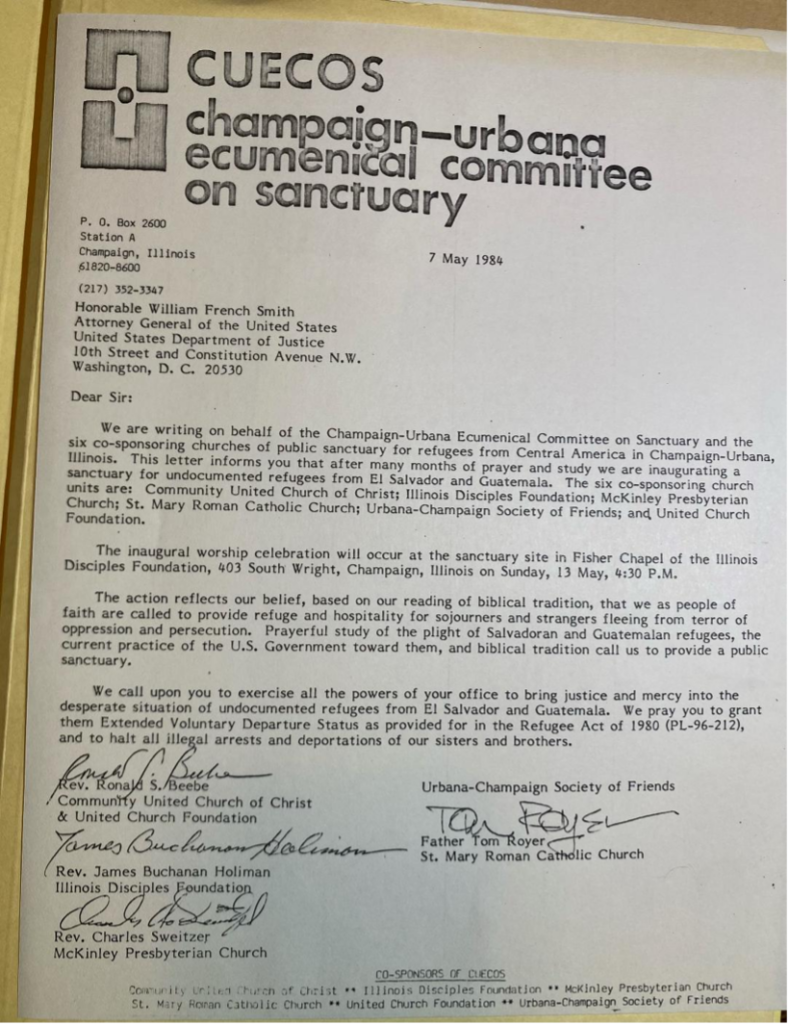
CUECOS, like other Sanctuary movements, chose public acts of civil disobedience to challenge the legality of US government actions—here declared in a letter to the US Attorney General. Source: Papers of Father Tom Royer
In 1985 and 1986 the local campaign turned its attention to passing a formal resolution declaring Urbana itself a city of refuge. Tense city council meetings, letters to the editor, and testimony from UIUC legal scholar on international human rights, Francis Boyle, kept the link between the refugee issue and US foreign policy in the public eye.
By the time Urbana finally passed a City of Refuge resolution in 1986, the national debate had begun to shift. Congressional debates over US military aid to Central America and US immigration policy led to significant changes in aid oversight and to the Immigration Reform Act of 1986. Neither were as extensive as the national grassroots movement desired, but they were an improvement over the free hand that Reagan had in Central America in the early years.
A Legacy of Community Action
The legacy of the 1980s Sanctuary movement remains institutionalized in the fabric of CU. Urbana renewed its commitment to being a city of refuge in 2016, and Champaign became the first Illinois town to win certification as a “Welcoming City” in 2023. Most importantly, CU’s residents still regard the local level as the proper place to debate national and global issues. By educating the public, taking public stances, and working to influence policy through community advocacy, the CU community continues to drive change on topics from data centers to Gaza.