This is an edited version of a talk given at the Illini Union, June 6, 2026 at “Divestment and Reflection: 40 Years Since the University of Illinois Anti-Apartheid Protests and Arrests.”
Colonialism poured poison into the soil of South Africa for 400 years. The poison was the idea of the legitimacy of racial hierarchy. In daily life that meant convincing people that race is real, that white people are good and deserving humans, while black people are only fit to be like livestock—used and managed. And in that line of thinking, the strong (white people) have a duty and a right to dominate (and probably to despise) the weak (black people).
South Africa’s first one-person-one-vote democratic elections were held in 1994, and have been held every four years since then. Given 400 years of poison in the soil, what has grown? We have to expect that the things that will grow out of that soil will be twisted and deformed for quite some time.
One recent example is the idea that because they have lost preferential access (please note—not access, but preferential access) to all resources and services, white South Africans are the victims of genocide.
Crime is another example. Everyone knows that crime is a huge problem in South Africa. But if you relentlessly pound on the institutions of family and community until they crack and keep pounding them into fragments, it is tremendously difficult to put personal morality and collective accountability back together again.
How do you neutralize centuries of poison? Only deracialization policies can do that, applied consistently over time: policies that reinforce the ideas that race is a nasty fiction and no one is innately better than anyone else.
The new South Africa is 32 years old. Here is its report card.
With a Grade of A
South Africa has been successful in equalizing access to services like grants and pensions. The apartheid laws have been removed from the books. Black and white workers in the same job are paid the same, for example. There are no legal restrictions on who you can love, who you can have sex with, where you can live, and where you can travel.
South Africa ended its military campaigns against its neighbors—it is no longer the regional military aggressor. It has been successful in supporting and upholding the rights of other oppressed people, notably in charging Israel with crimes against humanity and genocide. South Africa has paid a high price for those acts of solidarity with the Palestinian people.
South Africa maintains a healthy, vibrant and skeptical political atmosphere; hard-earned freedom of the press is battered, but it remains.
The constitution of the new South Africa gets an A.
Note that South African scientists were at the forefront of identifying COVID–19 variants, and recently the hantavirus strains.
With a Grade of B
Demonstrating the richness and generosity of African culture and the range of capabilities of African people.
With a Grade of C
Coming to grips with the political atrocities and abuses of the past through the Truth and Reconciliation Commission in the late 1990s: a praiseworthy attempt that did not go far enough or last long enough. History teaching in the schools gets a C.
With a Grade of D
Redistributing material resources: land, jobs, economic opportunity. Despite, or perhaps because of, a set of only mild affirmative action-type policies, South Africa is now the most unequal (not the poorest) country on the planet. The gaps between rich and poor are the widest of any country on earth. Millions of South Africans are desperately poor, a few are fabulously rich, and these divisions are still largely along racial lines. Most residential areas are still extremely racially segregated.
With a Grade of F
Government officials are not resisting the temptation to mimic the deep corruption of the old South Africa. Personal enrichment at the expense of the vulnerable and disenfranchised is running rampant.
Gender-based violence—an expression of the concept that the strong have the right to dominate the weak—is overwhelming in South Africa.
Disregarding the needs of the most vulnerable continues as a government tradition.
Unearthing legacies of hatred and despair, and twisting South Africa’s praiseworthy traditions and talents for community organization into violent campaigns against immigrants from other African countries, is a clear and horrible example of twisted things growing from the soil.
Winnie Madikizela-Mandela once surveyed the new South Africa in dismay and asked, “Is this the country I ruined my life for? It cannot be.” Painful disillusionment is everywhere. But the hard slog—to reorient every aspect of society away from ensuring entitlement and toward ensuring equality—grinds on even if it often loses its way.
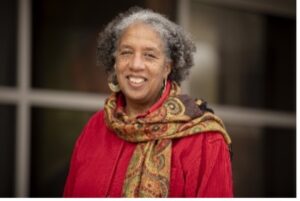
Teresa Barnes is professor of history and gender & women’s studies at the University of Illinois Urbana-Champaign. She lived in South Africa from 1991 to 2008.