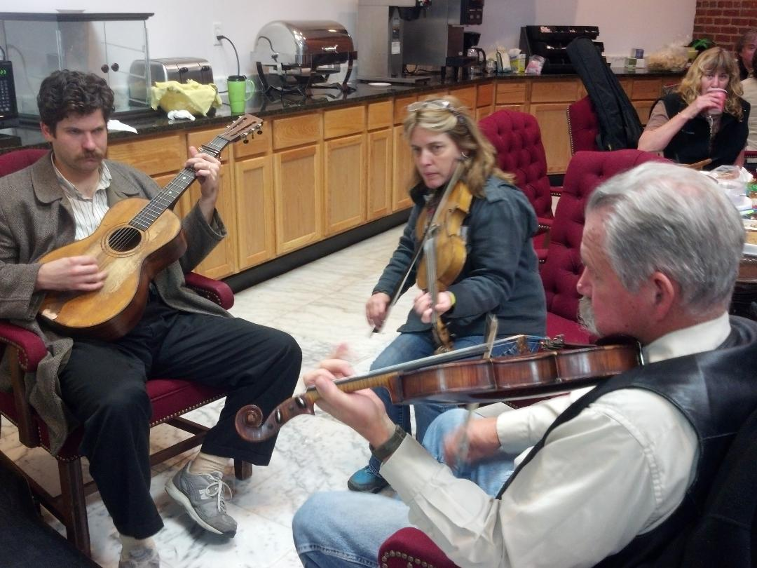
The author (center) at a jam in the Green Room, 2014, with performer Frank Fairfield (left), volunteer Wayne Logue (right), and another volunteer, Sue Hansen (top right), looking on in the background. Photo by Drew Phillips
In early 2009, I set out to create a weekend community folk festival that was all volunteer-run, participatory, and focused on energizing the existing or nascent grassroots organizations, clubs, and unofficial gatherings that were happening off the radar around central Illinois. Pete Seeger once said “I want to put a song on people’s lips, not just in their ears.” This is what I wanted the Champaign-Urbana Folk and Roots festival to be about: breaking down the barriers of passive consumption and building a space where people, no matter their talent level, background, or who they knew, could come together and dance, make music, and create and/or strengthen friendships.
My first inspirations were the folk festivals I attended with my mother as a Gen X kid (primarily around Albany, NY), summer camp sings, the PBS series Zoom, the Foxfire book series, and front porch jams during my undergraduate years at Indiana University. After moving to Chicago, I started playing old-time fiddle and helped organize or attended dance weekends and festivals like Sugar Hill dance weekend in southern Indiana and the University of Chicago Folk Festival. At these events, everyone lent a hand setting up the spaces, cooking, and providing beds in their homes for visiting attendees and musicians. Bands signed up to play for free, often jamming between sets and making new combinations of folks or generating new material. The reward never was, and still never is, monetary. It was the creativity that emerges when money (or power) isn’t the goal, and the deep friendships and fulfillment of being part of a community.
At the same time, I was hanging out at the Old Town School of Folk Music on Armitage Avenue, and the leaders of groups and ensembles encouraged fledgling musicians to get involved, to form bands outside of class, to launch their music-making into the world. Living in Chicago in the 1990s was like living in an incubator for community building in the folk arts.
The CU Folk and Roots festival was my attempt to recreate this scene. So much of my focus over the eight or nine years I worked on the festival was to tap into my existing relationships with the disparate folk communities that were already doing this kind of work: shape note singers, backyard sea shanty circles, Irish sessions that met informally at people’s homes or bars, bagpipers who learned in church basements, Morris dancers, etc.
This is a different kind of festival model than most are used to, a different way of being in the world, and it can be exhausting. It would have been much easier to just book artists and set up venues and sell tickets. At the time I was working on the festival, my husband and I were raising three children and we were sometimes struggling to put food on the table.
It still amazes me that others from the folk community answered my call for help and joined the steering committee in those first few years; several worked just as hard as me to get the festival off the ground. The Urbana Country Dancers sponsored and presented the first CU Folk and Roots Festival in 2009.
The most memorable moments of the 2009–16 festival years for me were those that in some way subverted the passive consumption and distance usually set up between artists and audience, or sparked new collaborations and ideas in the community. For example, after a festival gig, Jerron Paxton pushed a spinet piano into the middle of the room and started in on a dozen or so improvised “bawdy” (i.e. “naughty”) songs for the folks who were still just hanging out. We gathered around the piano and laughed and blushed, and rolled our eyes, and sang along.
Another year, I asked local singers to lead a soundscape circle where everyone was invited to vocalize different harmonies. This created an amazing and haunting acoustic moment. There must have been something like a hundred people in the room!
Another moment was when the Chicago jug band Sanctified Grumblers (or some combo of their friends) decided they weren’t thrilled about the stage at the Rose Bowl having a wooden rail around it, and set up directly on the floor with everyone. I remember sitting on the floor next to the upright bass and almost crying, it was that intense for me.
I also believe, to paraphrase journalist Joan Kirner, that “not being political is a political decision.” Apolitical stances support the status quo and allow others to determine political direction. So when money or fear make people reluctant to book artists that speak truth to power, it’s a deal with the devil, because you are trading perceived safety and/or social status for the loss of your humanity. At the 2017 festival singer Steve Poltz boldly declared that nobody could take our democratic ideals away, and ripped into one of the most moving singalongs of “This Land Is Your Land” I had ever experienced. We need artistic leaders to have courage; Poltz’s courage was the spark needed to fill the entire room with voices of anger and hope. As they say, it was fire.
Some memories happened in the green room; the food area was open to all volunteers, and it was a beautiful thing to see jams erupt, or stories and jokes told, and relationships develop. I think this warmth and inclusivity helped fuel people’s desire to be part of the festival.
I think my greatest fault (among many) during the early years was just trying to pack too much into a few days. I really owe a lot to all the year-round volunteers who just kinda went with me, with absolutely spot-on concerns about all this, and let the crazy just come out anyway. I think I counted 73 distinct events at one of the early festivals, maybe around 2011 or so. We had school visits; street dances; parades; campfire singalongs next to the Iron Post; Simon and Garfunkel singalongs; jug band jams; dulcimer, harmonica, and penny whistle workshops; protest song sessions; body percussion demos; a bagpiper walking the streets; square, contra, Yiddish, swing, and Cajun dances; flat footing/clogging workshops; folk songs of Illinois and cowboy song sessions; try-a-folk-instrument events; learn to play harmonica and ukelele sessions; history of the accordion in the US; panels with 6–8 different types of instruments; the student-led Pickin’ Illini jam sessions; storytelling sessions (entire afternoons at the Urbana Free Library)—the offerings were insane.
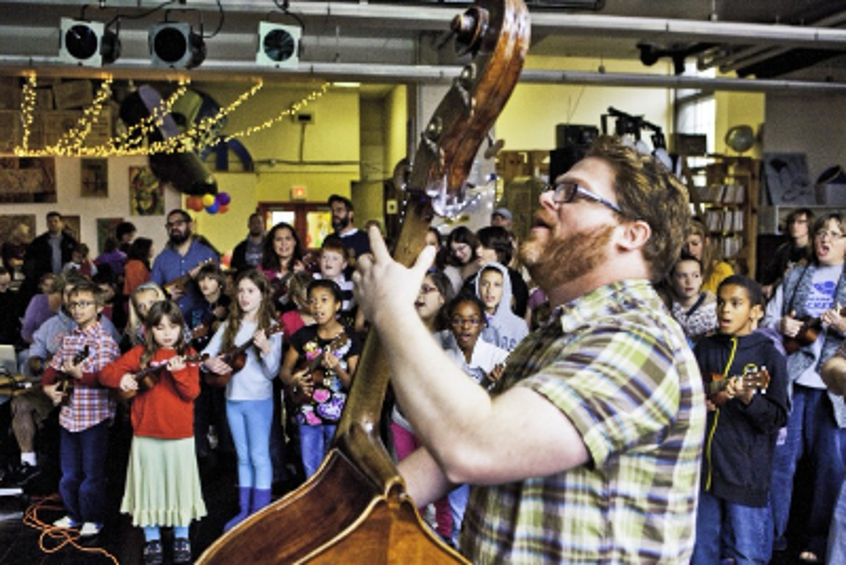
Ukelele group led by their teacher in a performance at an early festival. Photo by Joel Dexter
At the same time, putting together a music festival made me acutely aware of the bias against women in music scenes or how women with vision in general can be maligned (by men and women alike—nobody escapes cultural indocrination). Sometimes, you don’t live up to people’s expectations, you are too direct/honest and/or impatient, or you make mistakes, all of which for a guy isn’t a big deal. For middle-aged women however, these attributes come at a steep cost. I spent a good part of an hour at some point each festival on the concrete steps behind the IMC or in the alley behind the Iron Post crying. When Trump won the election in 2016, it was a gut punch to my soul, to my belief that people would rally against him, and I was angry at the world for allowing that to happen (us women who have experienced male violence already knew what the future held, which has ended up to be fairly accurate).
In the end, the origin of the festival was a product of two histories, my personal history as a folk musician and the history of Urbana as a creative community. I stepped away after 2016 as new community members stepped up to bring their own energy to the event.
These days, my husband and I still play music locally, organize house jams, and attend folk festivals and jam campouts. We live part-time abroad, where we organize an Americana jam at the local bookstore. It’s been difficult to encourage people to join the circle, language barriers notwithstanding. Yet I still assure people all they need is three chords on whatever instrument is available to them, and with that they can start to jam and sing with others. For me it will always be about creating opportunities in the community for people to connect and then eventually walking away, hoping they will continue the work, and knowing you may never see them again.

A longtime resident of central Illinois, Brenda Koenig is a writer, musician, and outdoor enthusiast. She recently retired as a research information specialist at the University of Illinois, and now spends more of her time in her kayak and playing the fiddle.