
The crisis of Trump’s second term in the White House is increasing the suffering of communities at home and abroad. In few places is this crisis felt more severely than for those living in Cuba. The people of Cuba are enduring food shortages, lack of medicine, and power grid blackouts, all driven by US sanctions that the Trump regime has made more cruel.
The current US sanctions are some of the worst Cuba has seen, largely due to the cutoff of oil shipped from Venezuela. Venezuela was one of the last countries willing to ignore US sanctions on Cuba, and this vital flow of fuel ended after the illegal kidnapping of Maduro by the US government. The current sanctions are especially harsh, but are only an escalation of the economic warfare Cuba has endured for more than 60 years.
Cuba under Blockade
You cannot understand the economic and humanitarian crisis in Cuba without understanding the central role of US sanctions. Cuba claimed its independence from the US-backed Fulgencio Batista dictatorship via an armed uprising in 1959. Just a few years later President John F. Kennedy began sanctions on Cuba, and the country has lived under some degree of this blockade ever since.
Most Americans do not understand US sanctions for what they are: economic warfare, a form of warfare that is just as devastating as bombs and bullets. Early last year, The Lancet published a study that unilateral sanctions around the world have been responsible for over half a million deaths on average every year since 1970—roughly the same number as have been killed in actual wars.
This happens because sanctions limit a country’s ability to get food, fuel, and medicine to its people. US sanctions aren’t simply an issue of being cut off from trade with the US. It’s a matter of restricting all imports and exports, as other countries and dollar-backed international banks won’t risk penalties to do business with Cuba. You can imagine the crisis if Trump suddenly chose to limit all imports into Champaign County: if the gas stations ran dry by the end of the week; if we were cut off from the state power grid; if Carle couldn’t stock syringes, medications, or ventilators. And you can imagine the gaslighting if Trump and corporate media then blamed local leadership for the suffering that followed. This is the reality of the blockade endured by Cuba for six decades: economic crisis due to a siege imposed by a foreign government, while that same country blames the island’s leaders for its crisis.
It’s worth considering the moral depravity of blocking a country’s access to food and medicine, while still operating a globally condemned torture prison (Guantanamo) on its shores. For over 30 years a majority at the UN has voted in favor of ending these sanctions.
Global Role in Liberation and Health Care
Cuba’s pivotal role in anti-racist independence movements explains why the US, as an empire, would want to strangle Cuba through a blockade, with the goal of replacing the country’s government. Under Fidel Castro’s leadership following the revolution, Cuba, itself a country with deep African roots, became a key ally to independence movements across Africa. Cuba provided military support, both bodies and ammunition, to independence movements in Algeria, Congo, Ethiopia, Guinea-Bissau, and Mozambique. In many of these conflicts, Cuba also supported the struggle by supplying much-needed doctors and medical aid.
Cuba’s most impactful intervention in the African movement for decolonization came in Angola. Its military support was critical in pushing back the apartheid army of South Africa. The US government pressured the apartheid government to put down the Angolan fight for independence. The defeat of South African forces in Angola, with the help of Cuban fighters and military strategists, set off a cascade of events across southern Africa. It not only led to Angolan independence from Portugal, but the independence of Namibia and the end of the apartheid movement in South Africa in the early 1990s. Western history overemphasizes its role in ending apartheid. The anti-apartheid movement and non-violent protests in the US and UK had been going for nearly 30 years before apartheid ended. It was only a few years after the apartheid army’s decisive defeat by Angola and Cubans at Cuito Cuanavale that the violently racist system of apartheid in South Africa was dismantled. After his release from prison, Nelson Mandela traveled to Cuba to personally thank Fidel Castro.
Cuba’s international role in human liberation has not only been through armed struggle. Cuba has the most trained doctors per capita of any country, and provides more medical personnel to developing countries than all the G8 countries combined. The country was instrumental in controlling Ebola outbreaks in West Africa in the 2010s, and was an early leader in responding to the HIV/AIDS crisis in southern Africa when there were still high rates of denialism and controversy. Cuban doctors were deployed to over 30 countries during the COVID-19 pandemic, and routinely serve rural and underserved populations across the world that otherwise go neglected. In 2005, over 1500 Cuban doctors were assigned and ready to be dispatched to New Orleans after Hurricane Katrina. Members of Congress and the Louisiana government admitted there was a need for more medical personnel as thousands died in the hurricane and its aftermath. But the George W. Bush administration refused to accept the offer for help.
The US is a country built and sustained by racist imperialism, and stands as an outlier among developed countries in failing to provide guaranteed health care to its citizens. It’s no wonder, then, why such a country would try to break the revolutionary idealism of Cuba, an island nation so central to anti-racist sovereignty and global health care.
Local and National Fundraising
For most Americans the idea of sanctions might be abstract, but for Cubans they are very concrete. Generators run out of fuel. Scarce food spoils as refrigerators lose power. Infant deaths go up as hospitals can’t get access to medicine that is available to children just 90 miles from their shore.
Back in November, CU community members connected with the National Network on Cuba to fundraise for Containers for Cuba, sending shipping containers of medicine and energy supplies. In February we held a teach-in fundraiser at Channing Murray Foundation, along with Chicago Cuba Coalition and Black Alliance for Peace, to talk about the impact of these sanctions and raise funds. In April we held a second fundraiser at Gallery Art Bar for Art Roots Mambi, an LA-based organization that raises funds for musicians and artists in Santiago de Cuba and their cultural exchange program.
The fundraisers raised several thousand dollars to send material aid to Cuba, which is orders of magnitude short of what Cubans need. Cuba doesn’t need suitcases full of medicine or to survive off the charity of its neighbors. It needs entire cargo ships and to operate as a sovereign country with free trade, no different than any other. At the end of May I’ll be traveling to Cuba by plane with another local comrade to bring more aid into the country, and learn more about what we can be doing in the US to support the Cuban people in their struggle for sovereignty and freedom from US sanctions.
Bryan Maxwell is a local community organizer with Champaign-Urbana for Palestine and World Beyond War.
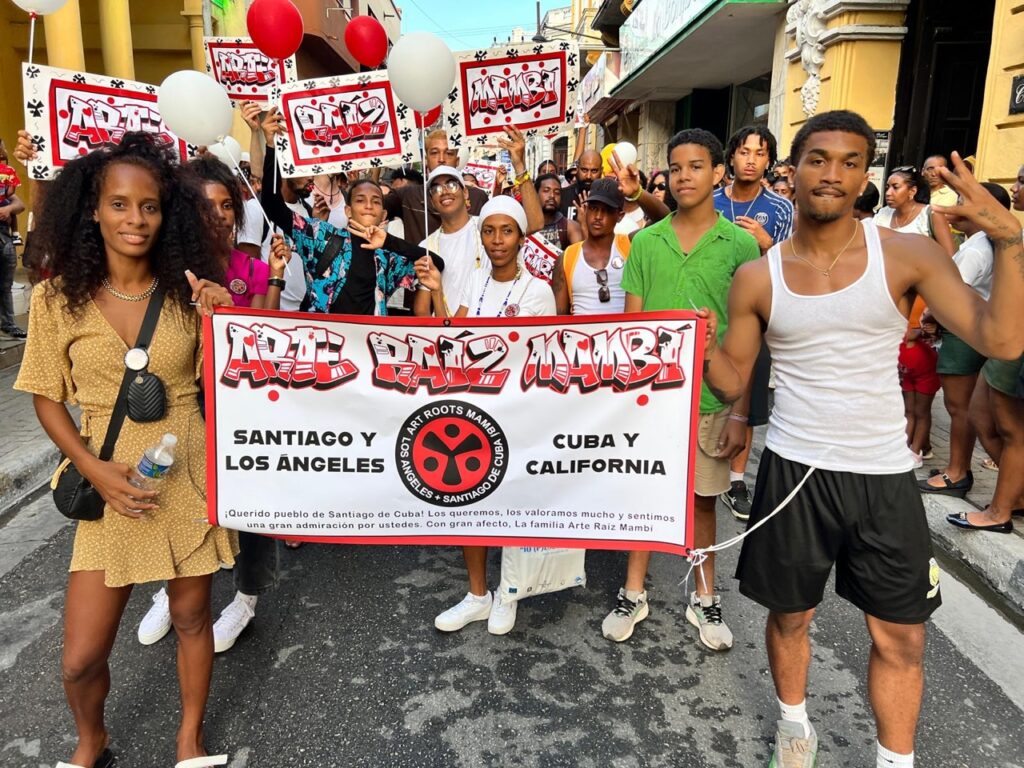
The Art Roots Mambi contingent at the annual Festival del Caribe (Caribbean festival) in Santiago de Cuba, July, 2025. Photo by Lili Bernard
In February, CU activists organized a fundraiser to support Art Roots Mambi, a Lili Bernard and Alberto Lescay family project building bridges between artists in Santiago de Cuba and Los Angeles. Through material aid, cultural exchange, and collaborative art projects, they support artists living in economic crisis in Cuba, and host personal presentations of creative works by Santiago artists in L.A., and vice-versa.