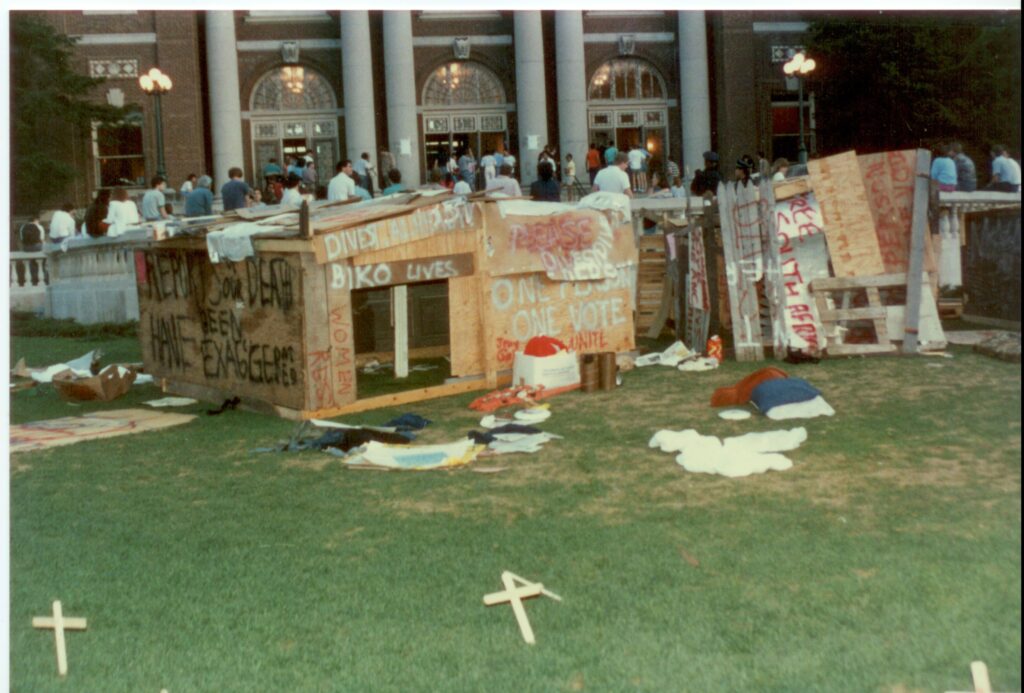
The protest shantytown erected on the UIUC Quad in spring, 1986. Photo by the author
Former members of the Divest Now Coalition (DNC) gathered in Champaign on June 6, 2026, to mark the 40th anniversary of student-led divestment protests at UIUC. The reunion brought together former student activists, community members, and others to reflect on the campus movement against apartheid in South Africa.
The event opened with former UIUC student and DNC activist Lawrence James raising his fist and leading the chant, “Amandla!” The audience, without prompting, answered, “Ngawethu!” Many had chanted those words, along with other anti-apartheid slogans, during protests and meetings in the mid-1980s. “Amandla Ngawethu,” a phrase from isiZulu and isiXhosa, is commonly understood as “power to the people.”
The reunion centered on April 10, 1986, when 60 people were arrested and charged with trespassing after demonstrating at the Illini Union during a board of trustees meeting. Participants were calling on UIUC to divest from companies doing business in apartheid-era South Africa.
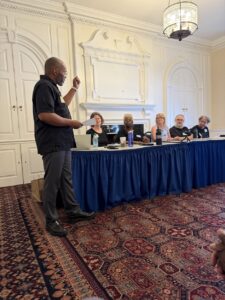
Lawrence James on the panel at the 40th-anniversary meeting on June 6. Photo by Shelley Washburne Masar, used with permission
Organizers framed the reunion as both a commemoration and a chance to place the protest within the larger global anti-apartheid movement and its lasting impact.
More than 25 people who had been present in 1986 attended, along with about 25 guests. The program included a panel on what drew students into the movement, why some chose civil disobedience, and how the experience shaped their lives.
The gathering took place in Room 201 of the Illini Union—the same room many participants entered during the 1986 trustees meeting. Photographs and a display traced the DNC’s actions, South African resistance, and the campus divestment movement.
Panelists included former UIUC students and DNC members James, Lisa Dixon, Sia Lindstrom, Jeff Machota, and myself. Professor Terri Barnes, a UIUC scholar of African history, joined the discussion to provide historical context.
Machota outlined the roots of the divestment idea, explaining that anti-apartheid advocates called for institutions to withdraw funds from companies doing business in South Africa. After the 1976 Soweto Uprising, international outrage grew. In 1977, UIUC students and community members formed the Champaign-Urbana Coalition Against Apartheid (CUCAA) as part of a national divestment activism wave.
By spring of 1985, township uprisings in South Africa and mass detentions had intensified pressure abroad. At UIUC, a new progressive student-board majority supported divestment, and, Machota stated, the DNC formed as a CUCAA offshoot focused solely on that goal. That June, 16 students and community members, including Machota, were arrested at a trustees’ meeting.
By spring of 1986, Machota said, “things started to pick up.” DNC members targeted the April 10 meeting, told local press there would be “no business as usual,” built a makeshift shantytown on the Quad, and held rallies. On April 9, they staged what Machota called the “biggest rally [on a college campus] since Kent State in 1970,” drawing “a thousand-plus people.”
After the April 9 rally, hundreds marched into the Illini Union and occupied the South Lounge overnight, holding teach-ins and planning. Machota recalled, “So the next day, we shut down the board!”
More than 200 students marched to Room 201, where the meeting was underway. Sixteen entered first, including James, sat down, then stood and chanted, “Divest now! Divest now! Divest now!” before being arrested. DNC leaders then negotiated for three more students to read the resolution. Lindstrom recalled that after the board returned to its agenda without voting, “the three of us looked at each other” and began chanting. Hundreds in the hallway joined in the chant, creating what she called “really amazing” power. The three were arrested, and the board terminated the meeting.
Hundreds remained in the hallway chanting “Divest now!” I recall several people sitting down in resistance as police warned they would be arrested if they did not leave. Forty-one more people were arrested there, including me, bringing the total to 60. As I was led out with my hands zip-tied, hundreds outside the Union cheered as we were placed in paddy wagons.
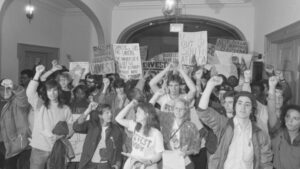
Protesters chanting in the hallway outside the Board of Trustees meeting prior to the arrests on April 9, 1986. Photo courtesy of the Champaign County Historical Archives, News-Gazette collection
Afterward, the DNC kept pressure on the trustees through demonstrations, shantytowns, guerrilla theater, funeral marches, press conferences, and editorials in The Daily Illini.
Arrested students faced disciplinary meetings. Trespassing charges were dropped for all but three of the sixty arrestees; after a mistrial, Lindstrom, Joseph Moag, and Sterling Sullivan reached a plea deal.
Machota said that in January, 1987, “while the students were away,” the trustees voted to divest in a largely symbolic move. Although the board divested only “$3.3 million [out of the $18 million we sought],” he said, “we still had a victory!”
Barnes connected the U.S. divestment movement to the eventual dismantling of apartheid laws, noting that groups such as the DNC helped build public awareness and pressure Congress to pass the Comprehensive Anti-Apartheid Act of 1986.
Audience members then shared memories and questions, including why more African American students were not visibly involved. Dixon and James recalled trying, as African American students, to encourage broader participation. Dixon noted that Black fraternities supported the struggle by “stomping” at several rallies.
The discussion also clarified why some students stepped back after the arrests.
One example was Lori Westerfield, whose arrest photo—showing her being lifted by the neck—appeared in The Daily Illini and was distributed by the Associated Press.
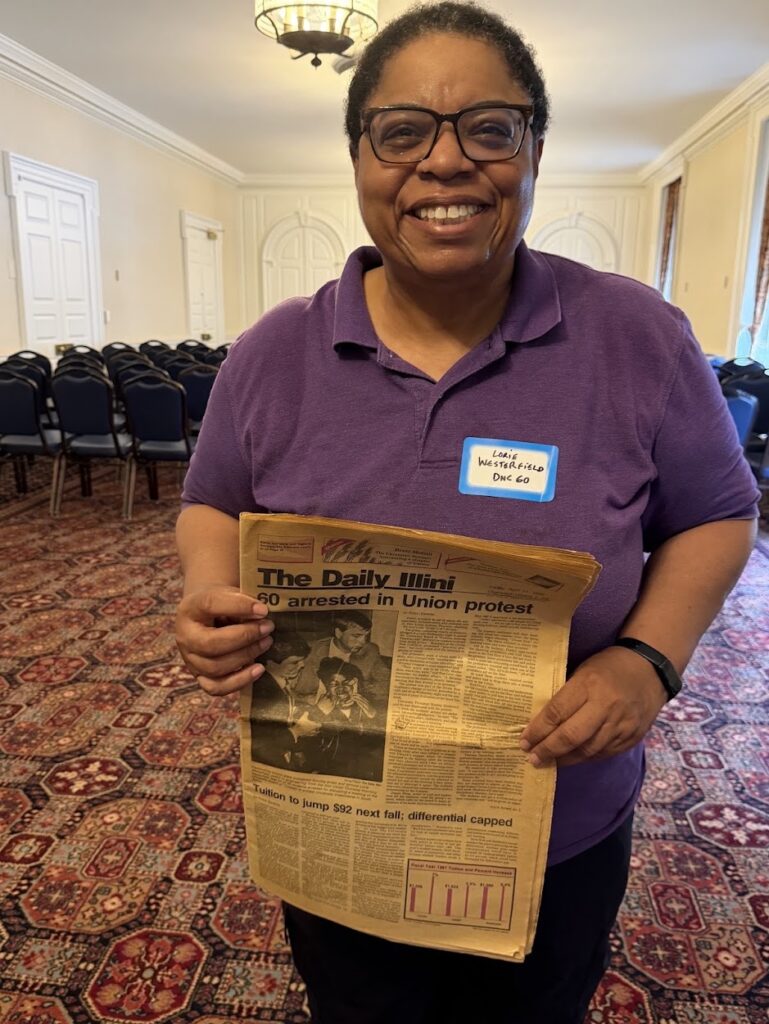
Lori Westerfield at the 2026 reunion with the 1986 photo of her arrest in the Daily Illini. Photo by the author
Westerfield, then an African American junior in engineering, said “many of us were called to the carpet by our college deans.” She was placed on probation that “had nothing to do with academics” but limited her campus involvement. Others noted that many Black students faced racism, depended on scholarships, and were cautious about risking their education. Dixon said some also carried “invisible labor,” as first-generation students taught by elders from the civil rights era not to “rock the boat.”
The discussion closed with reflections on the movement’s lasting impact. For many, the reunion was a chance to revisit a formative moment, reconnect with fellow activists, and consider how student organizing contributed to a larger call for justice.
James said the movement taught him that “each of us in our own small ways can have an impact.”
Dixon said her involvement led to lifelong friendships “built in activism, in love, in caring,” and changed how she understood being “a good citizen of the world,” by being “involved in it, not looking at it.”
Lindstrom emphasized that the DNC’s success grew from “standing on the shoulders of a decade of student organizing” by CUCAA and others: “we had the benefit of all that work that had been done.”
Machota said many participants told him “their lives were altered by this,” and that the movement remained important to them. He has donated materials to the Champaign County Historical Archives, and plans to continue collecting oral histories “so we are able to pass it on.”
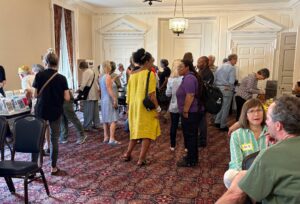
During a break at the gathering. Photo by Shelley Washburne Masar, used with permission
For me, the greatest legacy has been passing the importance of activism to my daughters by exposing them to the histories of marginalized communities, and watching them grow into outspoken critics of government policies here and abroad.
The reunion also echoed more recent UIUC demonstrations against the war in Gaza and the treatment of Palestinians, when students faced arrest, expulsion, and, for some international students, deportation. It raises the question: how far have we really come?
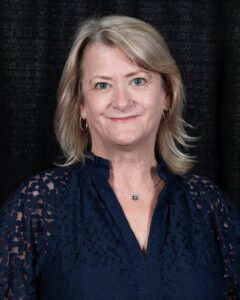
Susan Lacy-Ryan graduated from UIUC in 1988 with distinction with a BA in anthropology and a minor in African studies. She went on to complete her MA in history with a focus on women’s political participation in East Africa. Susan is a marketing consultant assisting locally owned businesses and non-profits. She currently lives in Rogers Park, Chicago.