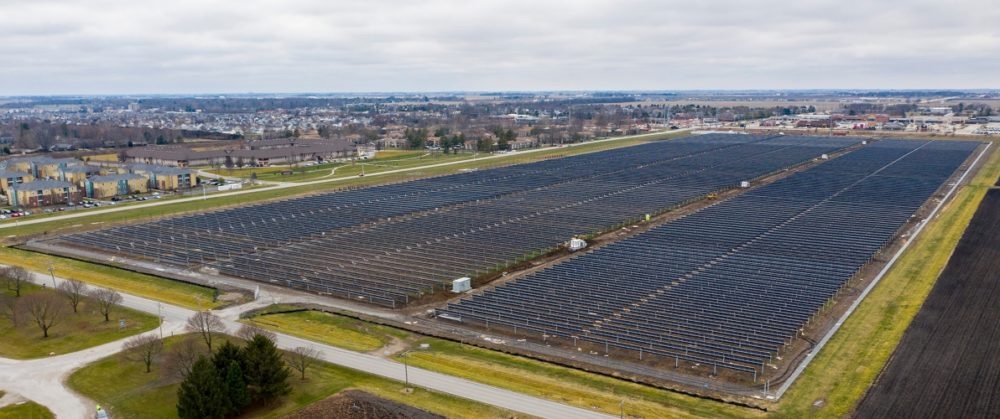
Solar Farm 2.0 on the South Farms of UIUC, which produces approximately 20,000 MWh per year. Photo from Illinois Climate Action Plan (iCAP), UIUC
With people being so divided these days on nearly every issue in society, it’s hard to get accurate information, and even harder for people to accept facts that don’t align with their preexisting beliefs. People say that it’s ten times more effort to fight incorrect information than to generate it. While that may be true, it doesn’t mean that it’s not worth the effort. Today’s topic is really about grid stability, and it applies to any large, inflexible consumer of electrical power. The most relevant example at the moment is AI data centers, so we’ll use those as our exemplar of a power user.
At a glance, it might seem as if a company were to bring 50 megawatts (MW) of solar power online and use 50 MW of energy that it would all balance out. Unfortunately, it’s not that simple, for a number of reasons. The most obvious problem is that solar panels only work during daylight hours, while the data center runs 24 hours a day. A second issue is that solar panels never produce as much as their nameplate power rating. How much would be enough?
In order to answer this question, we need to know how much energy is needed. The 50 MW is the rate of power usage, similar to the speed of a car. We don’t just need to know how fast its going, we need to know how far. This is simple on the demand side: 50 MW times 24 hours equals 1200 megawatt-hours (MWh) per day. A 50 MW solar installation in our area will produce an average of 175 MWh per day. Ouch! This means it would take about 350 MW of solar in order to offset the amount of power used.
It gets worse. These are annual averages. In the winter, production is going to be even shorter, by far, of needs. There’s just not much daylight at that time of the year. In Urbana-Champaign, you can expect to get about 25 percent of that 175 MWh per day.
So where does that leave us? In order to actually offset a 50 MW inflexible power consumer, such as an AI data center, it would mean bringing online 1400 MW of solar panels. To give an idea of the cost involved here, a 1400MW solar farm would run somewhere around $600 million. The price tag for a 50MW AI data center would be around $500 million. This would mean their costs more than double. They’d be spending more money to become a power company than they would doing the actual work they set out to do. Even rich companies like Google, OpenAI, and the others aren’t going to want that level of “extra” costs.
What is the answer here? Some will say it is to never build AI data centers. That is an easy retort, but it ignores the fact that some people genuinely do want to use AI chatbots to summarize information rather than spend the time reading it. Some people want to use AI programming tools that allow them to make little applications that they could have never made on their own. Not everyone will agree with these views, but it’s reasonable to acknowledge that there is a demand for these services.
The question at the heart of the debate is whether there is some way we can let them have what they want, not add to humanity’s carbon footprint, and also not put a strain on our power grid or other shared resources. Yes, there is. There are a number of options, some better than others.
Meta is playing accounting games to claim that it’s paying for nuclear power from the Clinton, Illinois power plant. By this logic, they’re using carbon-free energy that operates 24 hours a day, 365 days a year. The problem with this deal is that it doesn’t add any additional supply to the grid to match the additional demand, so it doesn’t solve the problem of rising electricity prices at all.
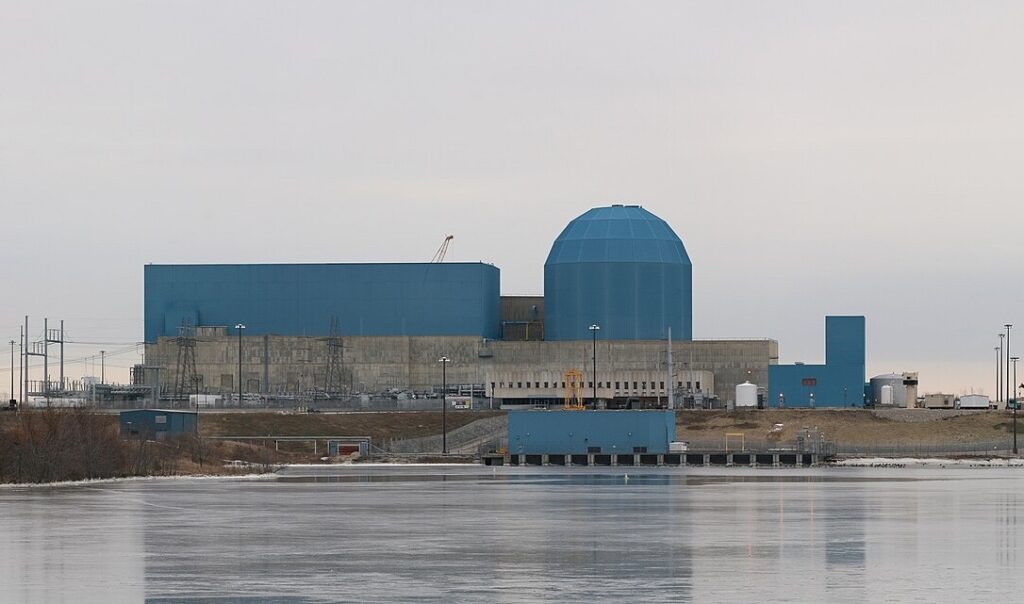
The nuclear power plant at Clinton, IL. Photo by Daniel Schwen, used under Creative Commons license CC BY-SA 4.0
The modified version of this plan is to build new nuclear power plants, or restart existing ones that are currently offline. Microsoft is restarting a reactor at Three Mile Island. Google has hired Kairos Power to build a fleet of reactors. Amazon is paying X-Energy to build nuclear reactors. Meta, in addition to its aforementioned accounting shenanigans, is also having TerraPower and Oklo build new reactors.
From a pure engineering standpoint, nuclear makes a lot of sense. It’s a supply of power that matches constant energy production with a constant energy usage. As for the concerns about incidents like Chornobyl, Fukushima, and Three Mile Island, nuclear proponents will tell you that new reactor designs are much safer. They’ll say that we can ship radioactive waste across the country and store it in Yucca Mountain, Nevada; or that we’ll find some way to recycle the waste that isn’t expensive, messy, and dangerous. They’ll ignore the billions of fish that are killed each year by the river-powered cooling systems, along with the other problems. I’m unconvinced that this is progress.
Fortunately, there are also non-nuclear solutions. If the AI data centers were flexible consumers of power, instead of being inflexible, this could help with the grid strain, instead of causing it. Doing this would also encourage them to locate themselves in areas where there is energy which is currently being wasted. Understanding how this works requires a little background about how our power grid operates.
Currently, when there’s more solar energy available than people are using, that solar power gets wasted. The same is true for wind power when it’s too windy, or hydroelectric power when the water spills over the top of the dam. Putting that power on the grid would cause power surges, so it’s curtailed instead.
If AI companies were willing to go where this power was, and only operate when there’s an excess of power, they wouldn’t be competing with anyone for that energy. Their new data centers would not cause electricity prices to rise.
The flip side of that coin is that when there’s not enough power, they’d have to shut down. The companies could in the meantime rely on another data center, in another region, just as they do now when there’s an internet outage. Voluntarily shutting down when there’s high demand isn’t hypothetical, it’s something other companies already do, via “demand response” programs.
There are solutions here. The question is whether there’s a will to implement them, or even discuss them as part of the public discourse. These new data centers could get the world closer to net zero carbon emissions by bringing solar power online instead of just using gas turbines. They could engage in demand response programs to stabilize the power grid. They could be built with cooling systems that use little or no water. It’s all absolutely possible, and anyone telling you otherwise either has an agenda or is ignorant of the facts.
If people know what’s technically possible, they’ll be able to advocate for better permitting rules or other regulations. We can protect our power grid, water, and air, not only from AI data centers, but from anyone who intends to exploit us.
Adam Ludd is an environmentalist with a bachelor’s degree in Computer Information Systems. He is also an active member of multiple cooperatives, including The Bike Project and the Artisans Co-op.