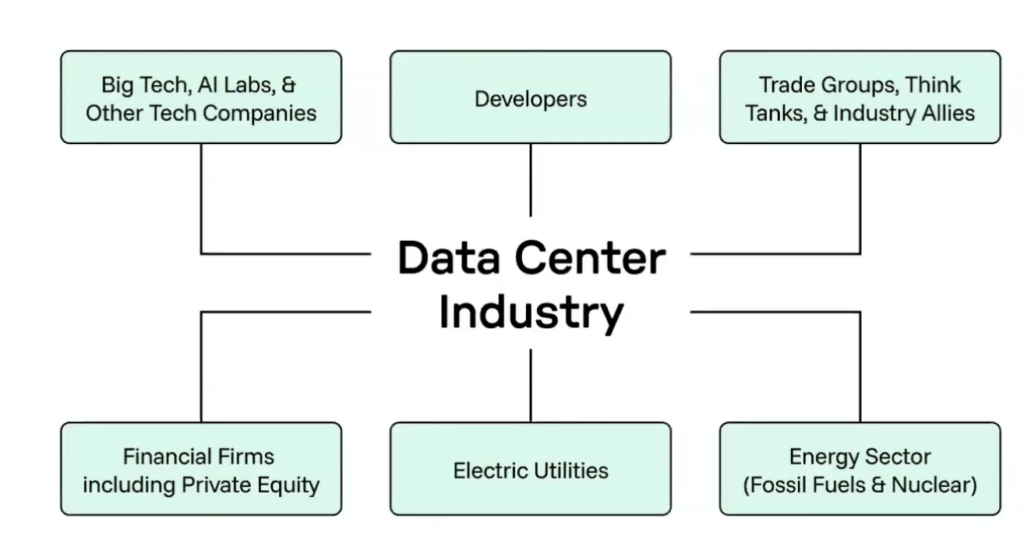
Visualization by Little Sis and PnP (2026), presented by AI Now
The growth of data centers across the globe has been astonishing. According to datacentermap.com, there are currently over 12,000 data centers worldwide, with over 4,700 in the United States. AI (artificial intelligence) hyperscale data centers, or “hyperscalers,” account for a portion of these numbers. While AI and data centers have been around for a while, recent technological developments like Chat GPT, CoPilot, and Claude—which are used to answer questions and solve problems; create memes, graphics, and videos; and surveil us as we go through our everyday lives—have increased the demand for these hyperscalers in order to store and process massive amounts of information.
Hyperscalers are much larger than traditional data centers: they can house over 5000 computer servers and take up millions of square feet of space. According to Cleanview, a market intelligence firm, there are 100 hyperscale facilities currently in operation in the US that consume at least 100 megawatts (MW) of power at peak capacity (100 MW is enough to power 80,000 US homes). Many of the new hyperscalers use between 200 and 500 MW, enough to power a medium-sized city. The largest example of a hyperscaler that is currently under construction is probably the Stratos Project in Utah: once completed, it will cover 20,000 acres (it was originally slated to be 40,000 acres) and, according to The Christian Science Monitor, will consume 9 gigawatts of energy, which is more than twice the amount of electricity used to power the rest of the entire state of Utah.
The backlash against the construction of these huge campuses has been swift and strong. A March, 2026 Gallup poll showed that 70 percent of Americans across the political spectrum oppose data centers. Reasons for the opposition are numerous:
- Hyperscalers require massive amounts of land. Hundreds and sometimes thousands of acres, including prime farmland, is being taken out of production. Once the topsoil is removed and concrete poured for these immense structures, it can never be used for crop production again. While data center developers often dangle the promise of increased property tax revenues, they often negotiate reduced taxes or other monetary incentives, offsetting much or all of the revenue gain that a community might reap.
- Hyperscalers use massive amounts of power and drive up electricity prices for communities. Lawrence Berkeley National Laboratory reports that data centers could use 12 percent of all the electricity consumed in the US by 2028. Electricity prices have jumped 267 percent over the past five years in areas near data centers, according to a Bloomberg analysis.
- Hyperscalers can potentially use millions of gallons of drinking water to cool the thousands of servers they house. Citing EPA estimates, Consumer Reports magazine states that a data center can use up to five million gallons of water every day, as much as 16,000 average US households. Food and Water Watch has produced a report on the misleading promises of “novel liquid cooling systems” to reduce the massive usage of water: these systems rely on the use of highly toxic per- and polyfluoroalkyl substances (PFAS), will massively increase the production and use of these forever chemicals, and will release PFAS into our lives through multiple pathways. We cannot depend on the EPA to protect us anymore. Under this administration its mission has been to demolish the very protections we have trusted for decades to protect our air and water from such aggressive industry trespasses and abuses.
- Hyperscalers run 24 hours a day, 7 days a week, resulting in inescapable noise. Unrelenting low-frequency humming, constant uncomfortable high-decibel noise levels of electronics and cooling systems, and testing of and reliance on back-up diesel generators have the potential to penetrate homes and surrounding areas for long distances. Such sounds and vibrations are not easily mitigated. Persistent, sustained noise pollution leads to multiple health- and life-debilitating illnesses for humans, pets, farm animals, and wildlife. Added to the din are lights that never shut off, ruining our night skies and affecting humans and animals and our sleep.
- As the backlash to the spread of hyperscalers grows, so do the warnings that uncontrolled, unregulated AI is becoming a threat to our very existence. Developers of AI systems themselves are sounding the alarm (see box quote below), citing an increasing lack of privacy; expansion of intrusive surveillance powers; replacement of human jobs with AI; robots taking warehouse jobs; AI-driven war plans and weapons; and warnings that there is a greater than 10 percent chance that AI could kill all humans in the next decade in “a Chornobyl-sized catastrophe,” as quoted in The Guardian. Jacob Coxon, who resigned from OpenAI, said these companies are “gambling with our lives.”
“Mitigating the risk of extinction from AI should be a global priority alongside other societal-scale risks such as pandemics and nuclear war.” Center for AI Safety
Locally, the Resist AI Data Centers Champaign County grassroots group was co-founded by Ruth Yontz and Antonia Herbstreit after rumors surfaced about a potential hyperscale data center coming to Champaign County. Freedom of Information Act (FOIA)-obtained emails dating back to 2025 revealed that the Champaign County Board had indeed been approached by two different data center developers: Clean Cloud Energy and Abei Energy. A Data Center Activities Task Force was appointed by the board in the spring of 2026 “to examine issues related to data center development and to develop recommendations regarding potential amendments to the Champaign County Zoning Ordinance,” according to the Champaign County government website. With a standing-room-only audience largely speaking out against data centers, a 12-month moratorium was approved by the board on April 23, 2026. Since then, Resist AI Data Centers Champaign County has been holding regular teach-ins; organizing and supporting several working groups; encouraging public participation at county board meetings (including task force meetings and subsidiary board committee meetings); creating and purchasing “No Data Center” yard signs and buttons for public distribution; and creating a Facebook page to share information and further organize local residents to resist hyperscale AI data center construction in Champaign County.
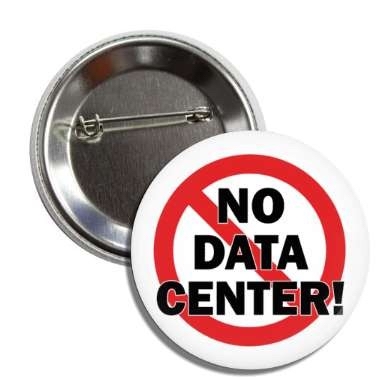
Button design for Resist AI Data Centers campaign
In September the Mahomet Daily and the News-Gazette reported that Mahomet (in Champaign County) had been in talks with data center developer Clean Cloud Energy. Dani Tietz of the Mahomet Daily reported, in a subsequent article entitled “Mahomet’s ‘Preliminary’ Data Center Talks: 10 Months, NDAs, and a $17 Million Draft Deal,” that “[a] month after Mahomet Village Administrator Patrick Brown told the Mahomet Daily he had never heard of a data center being proposed in the area, he and two other Village staff members signed nondisclosure agreements with a data center developer.” A community meeting was held on October 3 in Mahomet, attended by more than 250 people, which resulted in an announcement released two days later saying Mahomet ended talks with the developer, citing community opposition.
The village of Tolono has also been in talks with data center developer Abei, according to documents obtained via FOIA and posted on the Resist AI Data Centers Champaign County Facebook page. These documents state that Abei is under contract to purchase a parcel of land on the north end of Tolono, about a mile south of the Fieldstone subdivision in Savoy, and are interested in more land directly north and northeast of that parcel. The documents also include discussions about the annexation into Tolono of that tract, which is currently in what they call their “extra-territorial jurisdiction,” to circumvent the current moratorium and any regulations that might be set by the Champaign County Board.
The data center situation in Champaign County continues to develop. To get involved with the movement to fight AI hyperscale data centers, check out the Resist AI Data Centers Champaign County Facebook page.

Nancy Dietrich is a 30-year resident of Urbana and became concerned about environmental issues after reading central Illinois native Sandra Steingraber’s book Living Downstream in 1999. She is a member of Sierra Club Prairie Group and Champaign County Audubon Society, and is currently involved in Resist AI Data Centers Champaign County.

Lois Kain is a member of the local Sierra Club Prairie Group. She has joined with other local environmental organizations on many issues, from demanding Dynegy “move your ash” off the Middle Fork to protecting the Mahomet Aquifer, and now stopping AI hyperscale data centers.