
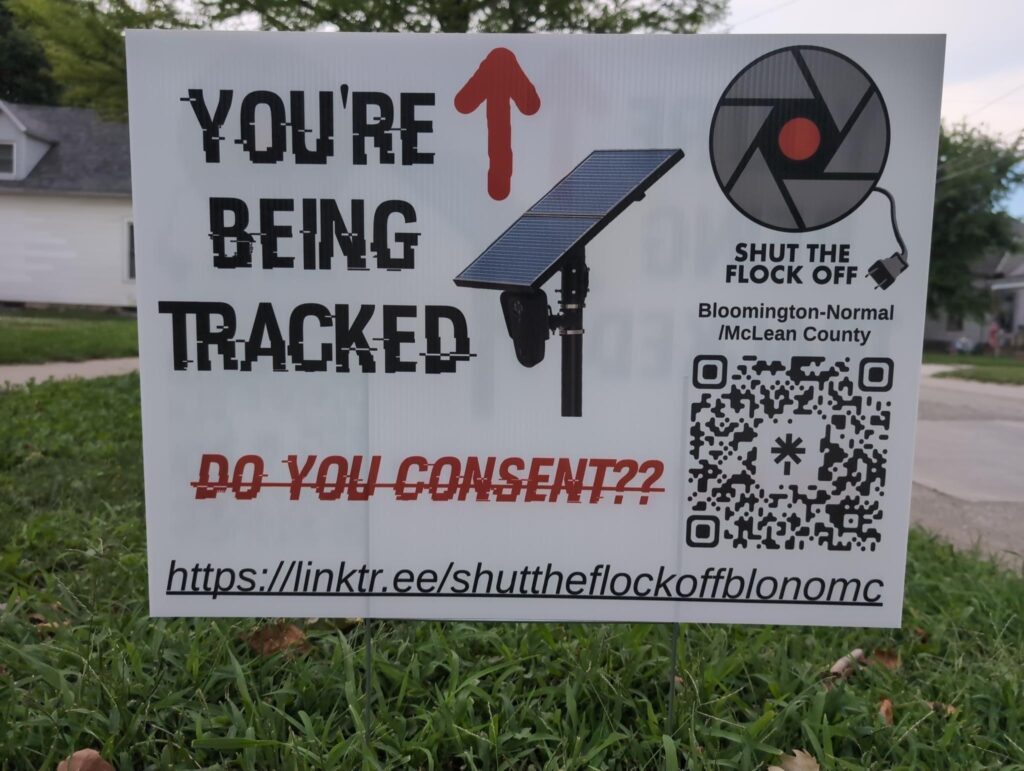
“You get some really weird crossovers of culture on anti-Flock that I just have not seen in community organizing elsewhere,” observes Ryan Gale of Tazewell County, who is part of an anti-Flock organizing campaign in downstate Illinois that has won supporters from across the full political spectrum of local residents concerned about surveillance and civil liberties.
De-Flock is a movement to end local governmental contracts with the notorious AI-driven surveillance camera company, Flock Group Inc. Flock produces, distributes, and maintains AI-powered cameras that monitor the movements of cars, bicycles, and, increasingly, pedestrians via a massive nationwide database. Opposition to Flock is currently the most successful bipartisan issue in our country. According to DeFlock.org, over 150 city and local governments have voted to end, not to renew, or to reject Flock contracts. Major news outlets have been forced to acknowledge that an anti-Flock position is not just a far-left concern. This is an issue for Black, Brown, and white working-class people of all political stripes.
What strategies are working to bring Flock down? I spoke with organizers representing three counties across Central Illinois–Champaign, McClean, and Tazewell—to learn more.
Shut the Flock Off!
Bloomington-Normal, Illinois, is home to anti-Flock group Shut the Flock Off. Shut the Flock Off began on a “random Monday” in December of 2025, said member Brad Bell: “There literally was just a day where I saw multiple people complaining about Flock, and I was like, ‘Why do we not have a group?’ And then I thought, ‘Oh hey, wait! I can reserve rooms at the Unitarian Universalist church, and I can design and print flyers. So let me just pick a random day and put some flyers out and come up with a punchy name!”
For those starting an anti-Flock group he emphasized knowing your own locale’s conditions. “Maybe you . . . live in kind of a small town, like where people just talk to [decision-makers] and bring facts . . . like they’re doing in Pekin right now [where Flock renewal had been delayed], but that was never going to work in Chicago.” He continues, “So, figuring out what can work, what the landscape is, identifying what is your rough game plan. And then you kind of work backwards from there.”
For Shut the Flock Off, the game plan was a public pressure campaign and public education. That meant group branding and identity and getting the word out through zines, flyers, social media, and hosting events. Bell suggested people adjust their strategy based on their skills, “Maybe . . . you’re more of a public figure. Maybe you have your own audience. Maybe you can get on podcasts. Whatever it is, however it is, you get your word out there, and start building up the group, trying to build pressure.” He also cautioned against micromanaging and overcomplicating. “Kind of just try to keep some sort of organization without getting too organized.”
From Data Centers to Flock
Pekin, with a population of 31,158, located in Tazewell County—south of Peoria and an hour and a half west of Champaign—has a unique anti-Flock organizing history, originating from an anti-data center group. According to Gale of Bird Dog Anti-Surveillance, “[We] have not had an organized or had a consistent movement against Flock up until fairly recently. It’s a much smaller population of people, but outside of that, we’ve had a lot more issues with data centers.” In particular, residents had been fighting a proposed data center until a recent victory. “Then that anti-data center group [Tazewell County Data Center Opposition] became an anti-Flock group [Central Illinois Against Flock Cameras]. The overlap is fairly strong [between] anti-data center folks and anti-Flock folks.” He added, “Central Illinois Against Flock is the most rapidly growing group in Tazewell County, but unaffiliated community protests [such as by Bird Dog Anti-Surveillance, originating from Peoria, and De-Flock Tazewell County] are active and present in the surrounding communities.”
Gale warns against abstract fears like those inspired by George Orwell’s 1984 and The Terminator’s AI threat, Skynet. Instead, he suggests asking everyday people, “Do you like being recorded?” Gale also spoke to Tazewell County’s conservatism. “They won’t care about civil rights violations, they won’t listen. You have to approach it from the direction that a legal reckoning will be coming from this.”
Another strength has been using Freedom of Information Act (FOIA) requests. Gale remarked that the process can be “scary” because you’re asking the government to confess wrongdoing. When FOIAing, he suggests, don’t ask for specifics, but for broad data points, such as day, week, and shift, because the government doesn’t “want [you] to know what you’re asking.” Importantly, police are advised by Flock on how to avoid releasing information through FOIA: “There’s been some leaked documents that have shown this, that they’re given specific PR statements. They’re given specific strategies to avoid FOIAs. They’re given deliberate advice on how to not have accountability.”
How to Hack a Flock Camera
In Champaign-Urbana, Stop Flock Champaign-Urbana, according to Sam Grayson, began when a small group of friends researched how local law enforcement agencies were using Flock. After finding discrepancies and abuses, they were motivated to organize around the issue.
For Grayson, talking points and optics are important. He pointed to the issue of budget and policy violations being generally uninteresting to the non-government citizen, but working well to appeal to members of local government. One of his favorite talking points is cybersecurity: Flock has been hacked through the physical devices, the network, and bad password security on the part of those using the devices. Flock cameras have a “button on the back. If you press it a certain number of times . . . you can connect to it using the default password. You can install stuff on it once you do this.” All three hacking methods have been dismissed by Flock as irrelevant or not their fault. He also emphasizes knowing your locality: “Your community, will they care about ICE? In many cities, [concern about] ICE is a winning argument. But say your community is conservative, you need to do the police stalking stuff.” Flock cameras, according to Grayson, should be described not as ALPRs (automatic license plate readers), but as “AI surveillance cameras.” This pairs with his concern over how we even talk about the company behind the cameras: “Don’t call them Flock Safety, their name is Flock Group Inc.”
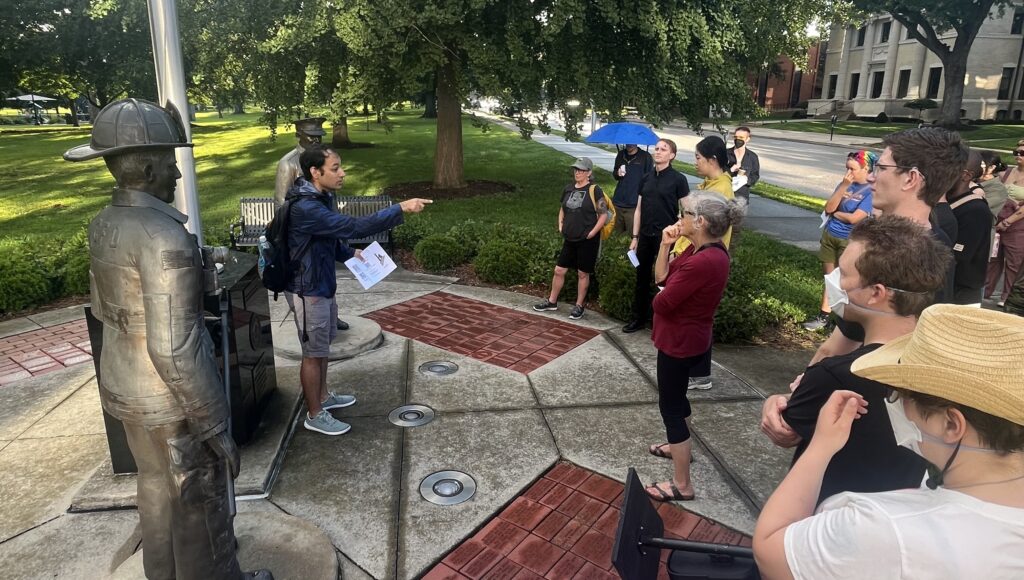
Stop Flock CU held a “Flock Walk” in downtown Champaign this summer
Getting the message out has been a strong point for Stop Flock CU, which have been leaving lawn signs around town. “The signs are far more powerful than I imagined they would be. We made a stencil with a laser cutter out of cardboard and spraypainted a bunch of signs.” Grayson also suggested using MuckRock.com and 404Media to get ideas for successful FOIA requests based on what has worked elsewhere, then connecting it to HaveIBeenFlocked.com and looking at when the data has been utilized for immigration purposes.
Grayson also connected Flock to data centers: “Everybody, left, right, middle, up, down, hates data centers. Why do you think we need new ones? They need [data centers] to power surveillance, to surveil everyone.”
Get the Flock Out
Now that you’ve read three case studies, I encourage you to join up with your local organizations, offering your particular skills and interests. If there is no movement against ALPRs in your locale, take the lessons from here and get going!