GloHeart, A Displaced Lullaby: A Play on Immigration Asks Questions About Language

By Al Schneider

Al Schneider is a performance maker and theater researcher currently living in Urbana. Information about their work can be found here: alanddog.co.uk.

What are they doing here?

Dressed in plaid, blue jeans, a ball cap, and boots, a laid-off, Born-in-Beardstown, down-and-out sort scratches his head, and asks the questions we might be asking ourselves. Or maybe it’s our uncle who’s asking the questions, or our mother-in-law, our co-worker, or just somebody we heard on the nightly news. Whichever way, the protests of those who see themselves as suffering from the arrival of migrants to the United States—and central Illinois in particular—are not approached warily in Susan Parenti and Mark Enslin’s play on global and local immigration.

Rather, GloHeart, A Displaced Lullaby makes a point of provoking a conversation around immigration which is sticky and requires its audiences to remain thoughtfully present throughout. Based on the book Global Heartland: Displaced Labor, Transnational Lives, and Local Placemaking by University of Illinois Professor Faranak Miraftab, GloHeart takes its questions from Miraftab’s analysis of a meat processing plant in Beardstown, Illinois and its recruitment of migrant laborers. “What brings these diverse people to this part of the country?,” Miraftab asks in the introduction to her book. Pork slaughtering is neither easy nor pleasant work, and after Oscar Mayer closed in the 1980s over disputes with its unionized workers, the plant—subsequently under the ownership of Cargill, and now owned by JBS USA—was able to reopen without a union, and with far lower wages.
Continue reading

Posted in Immigration, labor | Comments Off on GloHeart, A Displaced Lullaby: A Play on Immigration Asks Questions About Language

Air Pollution in Champaign-Urbana

By Jacquelyn Potter

Why Should We be Concerned?

Our most immediate necessity for life is breathing.  It’s the process of taking in life-giving substances and releasing metabolic by-products; therefore, clean air is vital for survival.  It’s only when substances are introduced artificially that this process becomes degraded.  There are hundreds of air pollutants; some of the common types include: particulates from industry and agriculture that are linked to cardiopulmonary diseases, especially fine particles at 2.5 um (micrometers) or less; heavy metals such as lead, mercury, arsenic and chromium from power plants, industry and agriculture, known to cause brain damage, cancer, autism and birth defects; volatile organic compounds (VOCs) like toluene and benzene, formaldehyde, chloroform and methanol produced by industry and known to cause cancer, neurological, developmental, immune, cardiopulmonary, gastrointestinal and reproductive problems; phosphorus used in electronic, plastic and agriculture industries is linked to skin ulcers, renal malfunction and arteriosclerosis; and nitrogen oxides and sulfur dioxide produced in petrol and metal refining, power plants, vehicle exhaust and agriculture are linked to cardiopulmonary diseases.
Continue reading

Posted in Environment | Comments Off on Air Pollution in Champaign-Urbana

IMC Co-founder Danielle Chynoweth Wins McKinley Social Justice Award!

By Public i editors

Danielle Chynoweth, IMC co-founder and current Cunningham Township Supervisor, won a 2018 Social Justice Award from the McKinley Foundation. She donated the $500 award to the Public i. We extend our deepest gratitude to Danielle for supporting the Public i! At the awards dinner on April 7, she accepted the award and gave the below one-minute speech. Congratulations Danielle on all your amazing work to make CU a better community!

I only have one minute, but
she sleeps just down the street, in a storage unit,
and she calls one day to tell me how lonely she is.
Continue reading

Posted in homeless, Immigration, safety net | Comments Off on IMC Co-founder Danielle Chynoweth Wins McKinley Social Justice Award!

ICE on Main Street: Undocumented Immigrants Arrested in Urbana


When Juan showed up for work one morning at Siam Terrace on Main Street in downtown Urbana, two men were waiting for him in the parking lot. They were dressed in plainclothes, but wearing guns on their hips. They asked him his name and put him in handcuffs. Juan had lived in Urbana for eight years, but this was to be his last day. He was picked up by two agents from Immigration and Customs Enforcement (ICE) and sent to a remote jail in Southern Illinois to await deportation proceedings.

A year ago, Urbana proclaimed itself a sanctuary city, but ICE agents are coming through town to sweep up local immigrants without challenge. We often hear in the news about ICE raids in big cities, or along the border. But in Midwestern towns like Champaign-Urbana, ICE is expanding its presence, a sign that the war on immigrants is intensifying under President Trump. Indeed, in 2017, arrests of undocumented people went up by 30 percent. According to obtained documents, last year ICE visited Champaign County on 28 different days, on some days going to several residences.
Continue reading

Posted in Immigration | Comments Off on ICE on Main Street: Undocumented Immigrants Arrested in Urbana

The Sad Closing of Milo’s Restaurant

The social life in Urbana is not going be the same without Milo’s. It was much more than a restaurant. It was a gem of a social institution, a place where one could go, whether alone, as a couple, or as a group, and know that you would have the pleasure of seeing other friends and neighbors. The warm greeting from Jane when one walked in the door, the pleasant service at the table, and the fine food made it a unique place. It will be difficult, if not impossible, to replicate that. And Milo’s was very good to the Public i, having been one of its original sustainers.

But in our sadness over Milo’s demise, we are pleased that owners Jane and Obdulio will be able to live their lives with much less stress. We wish them a very happy and healthy future, and do look forward to seeing them as friends and neighbors for as long as they remain in Urbana/Champaign. And we thank them profusely for having given so much pleasure to our community.

The Editorial Collective of the Public i


Posted in Uncategorized | Comments Off on The Sad Closing of Milo’s Restaurant

History Matters: Remembering Two “Dangerous” Labor Union Women

By Stephanie Fortado

Dr. Stephanie Seawell Fortado is a Lecturer at the University of Illinois Labor Education Program, providing workshops and extension programming for unions and the general public on the Champaign-Urbana campus and throughout Illinois. Before joining the University, Stephanie served as the Executive Director of the Illinois Labor History Society (ILHS), the oldest state-wide labor history not-for-profit in the United States. She is currently a board member for ILHS. She completed her PhD at the University of Illinois, where she studied African American working class and social movement history. Stephanie is currently working on her first book, with the working title Race, Recreation and Rebellion, which looks at struggles over public space during the Civil Rights Movement in Cleveland, Ohio. She is a past President, Treasurer, Bargaining Team and Strike Committee member of the Graduate Employees Organization 6300, of the Illinois Federation of Teachers, and former delegate to the Champaign County Labor Council. She is currently a steward and organizing chair of the newly formed Non-Tenure Faculty Coalition, IFT Local 6546.

We are living in the midst of a rising wave of protest politics. From Black Lives Matter and the Women’s Marches to protests for immigrant’s rights, environmental justice, gun control and fair working conditions, people are taking to the streets.

It seems that with every protest, there quickly comes the chorus of nay-sayers, the “not now” crowd that rises up to warn that such action for social justice is not only untimely, but possibly even dangerous.

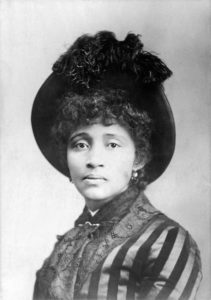
Calling protestors “dangerous” is nothing new. Consider the histories of two of the leading figures of the US labor movement, Mary Harris “Mother” Jones and Lucy Gonzales Parsons. Both women were declared dangerous in their day.

Mother Jones

The lives of these two women share some striking similarities. Mary Harris Jones was born in Cork, Ireland in 1837. Her family came to Canada and the United States when famine swept their homeland. She moved to Memphis, where she found work as a dressmaker. She married a union man and iron molder, George Jones. The Jones family fell on hard times when, after the Civil War, an economic downturn caused rampant layoffs among workers in the city. Then, in 1867, yellow fever ravaged poor and working class sections of Memphis and claimed the lives of George and all four of their children. In the wake of this unfathomable personal tragedy, Jones came to Chicago, where she opened a dressmaking business with a partner.

Her work gave Jones a window into the great disparity between the poor and wealthy Chicagoans. In her autobiography, she wrote, “We worked for the aristocrats of Chicago, and I had ample opportunity to observe the luxury and extravagance of their lives. Often while sewing for the lords and barons who lived in magnificent houses on the Lake Shore Drive, I would look out of the plate glass windows and see the poor, shivering wretches, jobless and hungry, walking along the frozen lake front … My employers seemed neither to notice or care.”

But Jones noticed and cared. And a few short years later, when tragedy struck again and she lost everything in the Great Chicago Fire, she turned to the growing movement of working people building in Chicago. As her involvement and stature in the labor movement grew, she took on the mantle of “Mother” Jones. She spent the rest of her life crisscrossing the nation, fighting for the rights of miners, child laborers and other working people until her death in 1930.

In 1902, Mother Jones was arrested for her work organizing mine workers in West Virginia. At her trial, the West Virginia District Attorney argued, “There sits the most dangerous woman in America. She comes into a state where peace and prosperity reign, crooks her finger [and] 20,000 contented men lay down their tools and walk out.” Of course, peace and prosperity did not reign in West Virginia coal country and the miners were far from contented. But the reputation of Mother Jones as the “most dangerous woman in America” stuck.

Lucy Parsons

Lucy Parsons was another woman who worked in Chicago as a dressmaker, meaning she too saw first-hand the great gulf between the haves and the have nots in that city. Parsons was born into slavery in Texas. An African American, Native American, Mexican American woman, she fell in love with a white man, Albert Parsons. He too was a union man, a member of the typographical union. Lucy and Albert moved to Chicago to flee the persecution faced by an interracial couple in the postbellum South and in search of new opportunities. There they became involved in the labor movement, and Albert served as the editor of the newspaper The Alarm, one of the leading newspapers for working people in the city. Lucy was a regular contributor to the paper. On May 1, 1886, Lucy and Albert were at the head of a march of workers down Michigan Avenue, part of a national day of action for the eight-hour work day that saw more than a quarter-million workers take to the streets across the country. Three days later, when a bomb went off at a worker’s rally at Chicago’s Haymarket Square and several policemen were killed, Albert was one of eight men who were blamed. He was executed by hanging despite the lack of any evidence tying him to the bomb. After her beloved Albert’s death, Lucy continued to stand up for the rights of working people until she died in 1942. Because of her radical organizing and writing, Parsons came to be known by the Chicago police as “more dangerous than a thousand rioters.”

Both Mary and Lucy experienced a depth of hardship and personal tragedy in their lives, including famine, disease, slavery, fire and the death of those they loved most dearly. These fires of tragedy forged in these two woman a steel of determination and a sharpness of will to confront those who would prop up inequality and injustice. In other words, it made them dangerous.

Mother Jones and Lucy Parsons exemplified the profound importance of unwaveringly speaking out against injustice. Mother Jones travelled tirelessly to support workers, and wherever she went, she spoke her mind. In one speech she declared, “I asked a man in prison once how he happened to be there and he said he had stolen a pair of shoes. I told him if he had stolen a railroad he would be a United States Senator.” Another time she explained, “There is something wrong in our social make-up, when we make criminals out of the youths, put them in jail, hire wardens and guards and pay them to take care of them and tax the people. Your whole system, my friends, is wrong.” Mother Jones named injustice where she saw it, and there is power in such naming.

So did Lucy Parsons. She once said, “Passivity while slavery is stealing over us is a crime.”  She was not speaking abstractly. Lucy Parsons had experienced the brutality of slavery first-hand. It is a word she chose to use often in her speeches and writings about the exploitation of working people, and especially the exploitation of women. She was issuing a warning that passivity can allow exploitation to grow. She was exhorting us to action.

Both Mother Jones and Lucy Parsons were considered dangerous because they were willing to transgress what were considered the acceptable lines of behavior for women of their day. Every time Lucy Parsons gave a speech on a street corner, every time Mother Jones visited a mining camp, these were dangerous acts. And because of these acts these women endured prison more than once. They knew the potential consequences of their actions, and yet they acted anyway.

If we want to be dangerous like Mother Jones and Lucy Parsons, we must get out of our comfort zones and show up where the most vulnerable are fighting for their rights. And right now we could use more dangerous people.

This article is adapted from an address given at the annual Mother Jones Dinner in Springfield, Illinois on October 14, 2017.

Posted in African Americans, Feminism, labor, Labor/Economics, Women, Women | Comments Off on History Matters: Remembering Two “Dangerous” Labor Union Women

Interview with Kristina Khan

Interviewed by David Prochaska, February 20, 2018. Edited for clarity.

Kristina Khan is a local activist, mother of three married to Tariq Khan, and the primary author of “Young Fascists on Campus: Turning Point USA and its Far-Right Connections,” Truthout (February 5, 2018).

David Prochaska: Talk about Turning Point USA (TPUSA).

Kristina Khan: It’s important to make a distinction between the wealthy donors and between the different student members, because there are plenty of students across the country involved with TPUSA that absolutely believe that it just stands for things like free markets. Some members are so young, and they really think that it’s this cool version of conservativism, which is the point: that’s what TPUSA wants.

So, you do have some students that I wouldn’t lump in with the alt-right. But then you have students that are paid staff, getting training on how to sue the university, getting training on how to go right up to the line of what is illegal but without breaking the law, training in harassing and stalking people, how to push Zionist propaganda and vilify Muslims. And the training is open to kids as young as fifteen.

Then you have people, the higher-ups, that definitely have agendas, and who I would consider neo-fascist, and you also have the kids in the street like “Proud Boys,” who are very much neo-fascist, beyond alt-right, very neo-fascist. Traditionalist Workers Party, which identifies itself as fascist, Vanguard America—these are all really young men, too. But they’re more willing to be violent.

TPUSA “TOKENIZING”

DP: What do you mean by “tokenizing”?

KK: By tokenizing I mean TPUSA using the few members of color that they do have, and propping them up as mouthpieces for the organization. Their whole strategy is to not look like they’re affiliated with the alt-right or hardcore white supremacists. So they don’t want to miss any opportunity to showcase what little diversity they have.

Joel Valdez (left) appears on far-right commentator Gavin McInnes’ show (right), November 21, 2017, talking about Valdez’s confrontation with Tariq Khan on November 16. McInnes founded the “Proud Boys,” an alt-right “pro-Western fraternal organization” for men.

It’s hard to tell how wedded one is to an ideology at such a young age. If I’m honest, I could see there being political development as you get older, and less impulsive, and more aware of consequences. But there is strong evidence now, it’s been reported that there’s actually a large number of Latinos, in particular, that are in the “Proud Boys” sharing Islamophobic, anti-Semitic and anti-Black views. There is also support by the Hispanics-for-Trump coalition for the local TPUSA group, so there’s a connection there as well.

DP: What about gender? Identity politics?

KK: What’s really interesting to me is that when a TPUSA member, who is a student, is running in a student election, it is a very different approach than when they’re tabling on the Quad, or doing a free speech event, or an “affirmative action” bake sale. They’re much tamer, and for a lot of them, it turns out, part of their campaign is to address sexual harassment! Which is super-interesting to me. This is intentional, as if  “we care about diversity.”

When I found out that most of them have the same sort of election platform, it’s just to get people in. And their campaign funding from TPUSA helps, too. But it’s very different from their actual practices.

GENDER AND DIVERSITY

For example, the president of the local TPUSA is a woman. But I’ve never seen any of the women – and there are multiple female members of Turning Point USA – show up to do the filming, or the stalking. So when you look up our chapter you would think that it’s all women and run by women, but it’s not. I mean, these guys are absolutely making the narrative, taking control, making decisions, doing the paid reporting for Campus Reform.

It goes back to the point I was making about tokenizing. If you can put on display all your women, all your people of color, all your gay kids, then you look like you’re not an alt-right organization, and you look like you’re not associated with any kind of “despicable, deplorable” people.

Facebook post, November 21, 2017. Tariq Khan (right) and Joel Valdez (left) at November 16 confrontation. A respondent offers to attack Khan, “I’ll beat his ass for you bro,” to which Valdez replies, “Do it ASAP.”

Same with diversity, which we also see in the Office of Student Conflict Resolution (OSCR) and the Office of Diversity, Equity and Access (ODEA). “Look at all this diversity,” but is it really making impactful changes on the ground? It doesn’t look like it, but it is definitely – and I’ve talked to some people about this, too – so manipulative. It’s using people, and while at the same time criticizing stuff like identity politics – which I’ll be critical of, too – the irony of that is just amazing to me, because what you’re doing, you’re taking people based on their identity, and saying, okay, let’s preview about how to speak to the media, because this looks really good. It’s a publicity game, absolutely.

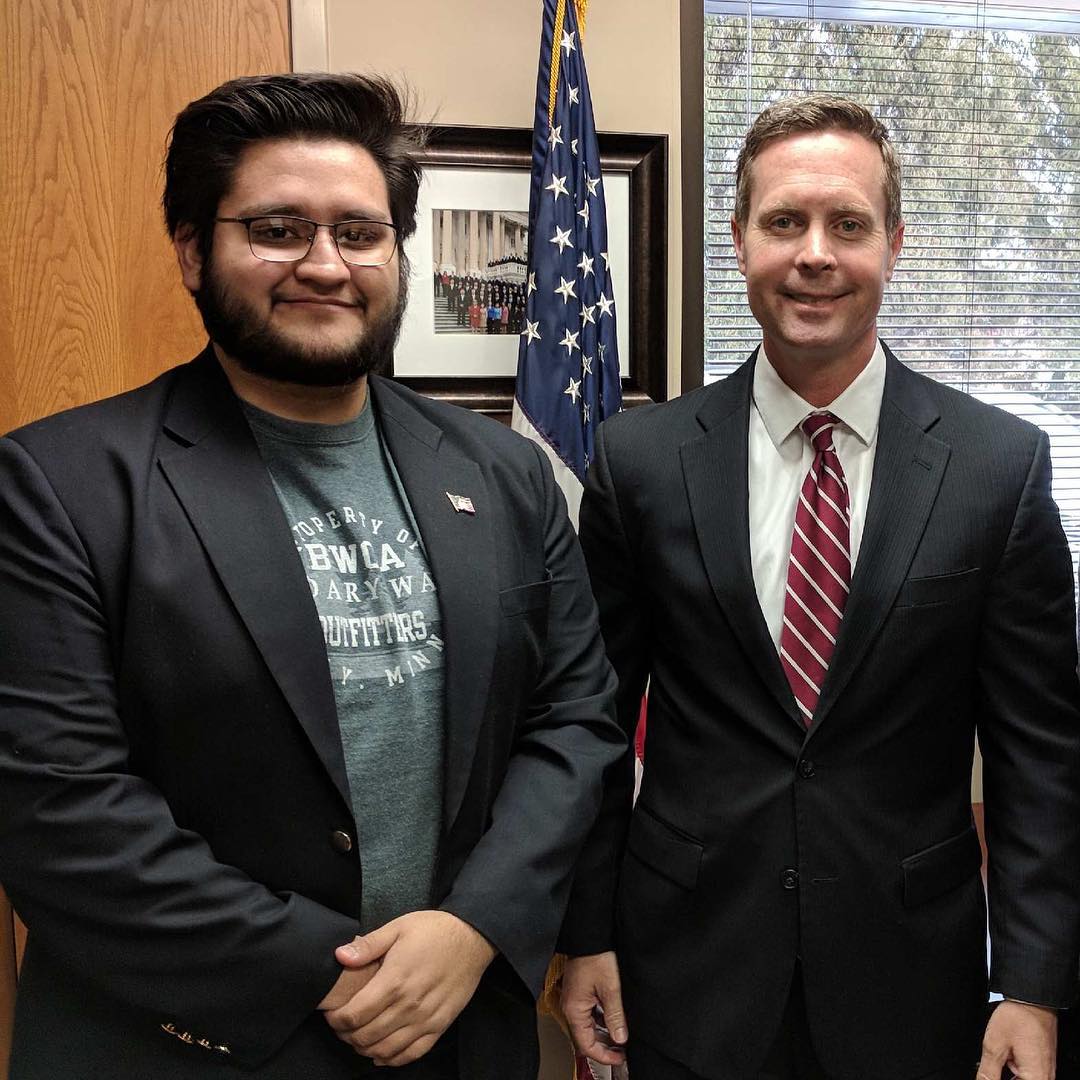
Joel Valdez (left) meets with local Congressman Rodney Davis (R-Taylorville), February 22, 2018

DP: What about responses, about community self-defense as an option?

KK: I actually think that community self-defense is our only option in a lot of ways. For a lot of people, people of color and black people in particular, there are no other options. As people start realizing that, oh, I’m going through the proper channels for dealing with these threats. I went to the University to file a report, I called the police over and over and over again, and nothing happened. Or we’re still being stalked, or we’re still dealing with these threats on campus, or in the community.

So, one example of putting this into practice was myself, Tariq [Khan] and some other community members called for a community strategy session. We tried to get as many people representing as many different groups on and off campus as we could, from student activists to women in ministry to staff at the university. We were able to identify threats to the community and brainstorm a variety of responses and solutions.

I think what’s really important for people to know about community self-defense is that there’s a long tradition from marginalized communities that we can look to for examples. It also differs from town to town based on what our needs are, and can involve a wide range of people and tactics.

BACKLASH OCCURRING?

DP: Nonetheless, you see a backlash beginning to occur?

KK: TPUSA, I think, has pushed too far. I think they’re now beyond alt-lite and more into alt-right territory. Or people are seeing them that way, which is fantastic. Before they started to get media coverage about their relationships with this more extreme alt-right, they would say, “No, we’re the good kind of conservatives, we’re not these crazy alt-right people.” But I don’t think that’s working for them anymore.

I thought, and some people that I had talked to sort of predicted that this was going to happen. I’m surprised it’s happening sooner rather than later, because the TPUSA kids are really aggressive, because they’re being promised careers, and they’re going all in. Yet despite the training, now it’s kind of imploding. And I want it to keep imploding.

Posted in Alt-Right, bigotry, University of Illinois | Comments Off on Interview with Kristina Khan

The Alt-Right Comes to Town

by David Prochaska

TARIQ KHAN INCIDENT

Last November 16, on the one-year anniversary of Donald Trump’s election, Tariq Khan, a 39-year-old Ph.D. student in history, was just finishing speaking at a rally when hecklers, including Joel Valdez, called out, “No one’s scared of you, 50-year-old man! Don’t you have kids to look after?,” according to multiple sources.

Facebook post, November 21, 2017. Tariq Khan (right) and Joel Valdez (left) at November 16 confrontation. A respondent offers to attack Khan, “I’ll beat his ass for you bro,” to which Valdez replies, “Do it ASAP.”

Khan knew who they were. Jose Valdez, Andrew Minik, and Blair Nelson are all members of the UIUC chapter of Turning Point USA (TPUSA), a far-right campus group favoring “limited government” and “free speech.” Funded by secretive, deep-pocketed right-wing donors, including Bruce Rauner, Betsy DeVos, Foster Friess, and Richard Uilhein, in practice TPUSA  aligns itself deceptively closely with Alex Jones’ Infowars, “Proud Boy” Gavin McInnes, the Traditionalist Workers Party, and other alt-right, including neo-Nazi, individuals and groups.

How TPUSA went after Tariq Khan sheds light on how they operate, and how the response of  institutions—in this case UIUC—fall short.

Khan confronted his hecklers verbally; they say also physically. They filmed him. Tariq grabbed Valdez’s previously-cracked phone and tossed it on the ground. TPUSA called the University of Illinois Police Department (UIPD), and uploaded an edited version of their video to their affiliated site, Campus Reform, where it went viral.

Khan was cited for “criminal damage to property,” but later all charges were dropped; he was not required to pay anything for Valdez’s phone.

That was not the end of it, however. The UI Office of Student Conflict Resolution (OSCR) decided that Tariq had “chest bumped” Valdez, put him on “Conduct Probation,” and issued a no contact order between him and Valdez, Minik and Nelson.

Tariq provided OSCR with a thick binder of background information detailing TPUSA, alt-right groups they were involved with, and incidents targeting him, his family, and fellow activists. It documented a pattern of what his wife and fellow activist, Kristina Khan, and others term “alt-right alt-lite” intimidation and harassment. OSCR’s response? Khan says they told him,“context doesn’t matter.”

For Tariq, context is everything. Not an isolated incident, this case concerned a three-year-long pattern of threats and attacks.

For TPUSA, everything went according to a scripted plan. They had egged on Tariq Khan and gotten OSCR to discipline him. Their claims of “instructor assaults conservative students and steals student’s phone” ricocheted around the right-wing echo chamber. And the UI continued its pattern of inaction faced with the “alt-right alt-lite.”

JAY ROSENSTEIN INCIDENT

Besides TPUSA’s sister website, Campus Reform, it runs Professor Watchlist, which “document[s] college professors who discriminate against conservative students and advance leftist propaganda.”

Jay Rosenstein was named to Professor Watchlist when he was arrested January 22 for allegedly filming in a State Farm Center (SFC) restroom during a basketball game. Although UIPD officers were not present at the time, their police report states, “[SFC] Security reported a subject was recording another person, without consent in the men’s restroom.”

Police guarding Chief Illiniwek changing out of costume in Assembly Hall hallway, 1/18/15. Photo credit: Jay Rosenstein. © 2015 jay rosenstein

However, Jay says, “I believe I was wrongfully detained because of my efforts to investigate whether employees of the SFC are taking an active role in facilitating the appearance of the unapproved Chief Illiniwek.”

Never one to miss a “crime” story, News-Gazette reporter Mary Shenk just hours later uploaded Rosenstein’s mugshot alongside her story based on former Chief Illiniwek Ivan Dozier’s Facebook post.

The following morning, Rosenstein was released, because state’s attorney Julia Rietz dropped all charges, saying, “The criminal justice system is not the place to gain an advantage for one side or the other on a public debate.” Clearly, she decided there was no prurient interest on Jay’s part.

But Chancellor Robert Jones and the UI administration put Rosenstein on “paid administrative leave” the same afternoon he was released, saying, “If the allegations against Prof. Rosenstein are accurate,”  they would be “an unacceptable violation of personal privacy under any circumstances.”  This echoed what can be termed the News-Gazette’s “potty story.”

In emails, comment threads, and on Twitter and Facebook, Jay was accused of being a pervert and pedophile.

Rosenstein worked “to turn the narrative around.” He was most upset with what he contended was the News-Gazette’s blatantly biased, unprofessional journalism. “As a journalist, what is most important is accuracy and fairness … Fairness means giving me the chance to respond.”

He was just as upset that Jones had sided with Dozier, rather than taking into account his highly distinguished 17-year teaching record.

Simply put, Rosenstein is one of the most distinguished faculty members at Illinois. His many films, including In Whose Honor? (1997) on the Chief Illiniwek controversy, have won numerous awards, including a Peabody.

Ivan Dozier (B.S. 2013, M.S. 2016), Chief Illiniwek portrayer 2010-2015, was arrested March 1, 2013 by UIPD for “aggravated battery.” According to the police report, “Subject battered female in lot C16.”

UIPD police report of March 1, 2013 for arrest of Ivan Dozier, whose name is listed on second page of the report.

After several days, Rosenstein succeeded in turning the News-Gazette’s “potty” narrative around, while Jones and his administration were increasingly criticized from several directions.

A former UI staff member with contacts in the upper administration reports that some questioned the decision to put Rosenstein on paid administrative leave, saying, “What’s the aim in doing this? What’s the end game here?”

After a month of back-and-forth jockeying, Rosenstein was reinstated February 23 without discipline or penalty.

When I spoke to Jay in February, I asked what he made of the whole affair. “Bullshit. And you can quote me on that.”

By focusing narrowly on the “potty” incident, what was left unresolved was the Chief Illiniwek issue that constituted the larger context of why Jay was doing what he was doing.

In this regard, UI continued its pattern of inaction concerning the racist mascot.

INCIDENTS IN CONTEXT

The cases of Tariq Khan and Jay Rosenstein raise a whole host of interconnected issues that cannot be discussed here due to space limitations, but which include the following.

Joel Valdez Facebook post with Ivan Dozier, February 26, 2018. TPUSA and Students for Chief Illiniwek jointly produce, distribute, and demonstrate with a small poster in violation of State Farm Center regulations.

TPUSA and the Honor the Chief Society combined forces for the February 26 basketball game to “Paint the Hall Chief.” It was a perfect metaphor for how the network of right-wing groups combine, interact, and overlap with each other, both locally and nationally. The alt-right alt-lite comprises a range of right-wing groups from Republicans and conservatives to far-right, alt-right, and neo-fascist.

Many, such as TPUSA, seemingly follow a script. 1. Stake out and stalk. 2. Engage by harassment and threats. 3. Without authorization, film encounters. 4. Selectively edit video and upload to the Internet. 5. Watch it ricochet around the right-wing echo chamber, then wait for the interview invitations. 6. Rinse and repeat.

Following are the characteristics of groups such as TPUSA. They are cult-like. They use stealth, which masks routine, massive lying.

They succeed when what looks like one thing to an objective observer is the exact opposite, like their dishonest claims about “free speech.”

Such groups use social media to their advantage: trolling, doing it for the lulz, provoking outrage.

They game unsuspecting institutions (UIUC, OSCR) and individuals (Chancellor Jones).

The News-Gazette is complicit. So, too, is UIUC.

Risk-averse UIUC claims that it cannot do more, but it can. According to a retired high administration official, trained as a lawyer, there is much that UIUC, and UIPD, can do. Evidence of plans to chalk the Quad with hate messages constitutes, for example, “probable cause” for an investigation.

Slide from College Republicans meeting agenda, February 16, 2017, announcing intention to chalk Quad February 20. Later in 2017, TPUSA members de facto took over the College Republicans.

Unresponsive institutions engender vigorous pushback, up to and including militant protest.

Mobilizing support locally and nationally is key. Both Tariq Khan and Jay Rosenstein accomplished this.

Another tactic is to organize collective response and community self-defense. A February 6 community gathering jump-started this process.

One key site of contestation is “free speech.”

The still larger issue concerns community, what it means both locally and nationally.

On the plus side, more people are learning more about these groups, and are pushing back.

In conclusion, the alt-right alt-lite has come to town, but it finds a ready response and welcoming support. It takes root in fertile soil prepared by a deep culture of far-right extremism dating back over one hundred years, from sundown towns and the Ku Klux Klan to the original 1940s America First movement.

March 10, 2018

First in a series.
Posted in Alt-Right, bigotry, Free Speech, Indigenous, News-Gazette, University of Illinois | Comments Off on The Alt-Right Comes to Town

Abused: Working Women Face Widespread Harassment and Violence

By Pat Simpson

Pat Simpson, Emerita Professor, Loyola University, formerly taught in the Labor Education Program, UIUC. A longtime labor and social justice activist, she is  currently a member of the Chambana Democratic Socialists of America (DSA) and of the Quintessential Poets.

It’s been a long time comin’. Not since the Clarence Thomas hearings has so much national attention been focused on sexual harassment and violence. Gratifyingly, with the rise of the “#MeToo” and “Time’s Up” campaigns, multiple female accusers have avoided the fate of Anita Hill, Thomas’s accuser.  They’ve been believed and as a result, powerful men have suffered consequences. Where redress has occurred, however, it has centered on the circumstances of professional women in high-powered media and entertainment fields. Demonstrating awareness of the dangers of a myopic focus, the Hollywood actresses who initially organized the “Time’s Up” movement created a Legal Defense Fund designed to help women across all sectors of the economy who experience sexual harassment. In a public letter announcing the launch of this $13 million fund and other efforts, the “Time’s Up’’ organizers stated: “We also recognize our privilege and the fact that we have access to enormous platforms to amplify our voices … that farmworker women and countless individuals employed in other industries have not been afforded.”

While the successes and durability of their efforts remain to be seen, “Me Too’s” extension of advocacy efforts to working-class women in low-paid, low-status jobs in agriculture, manufacturing and service sectors of the economy is laudable. The specific sources of extreme vulnerability for women in these jobs both overlap and vary. Poverty and income inadequacy undergirded by low wages are major factors in almost all of these jobs. At the rise of industrial manufacturing, for example, female factory workers felt compelled to submit to the sexual advances of foremen who held the exclusive power of hiring and firing employees, a power that only began to be tempered with the successful organization of modern industrial unions. Widows and wives of disabled husbands with young children at home were especially desperate to find and hold jobs.

Today, manufacturing accounts for 11.7% of sexual harassment claims, the third highest proportion across all industrial sectors (Center for American Progress). One of the major sources of vulnerability in manufacturing is the minority status of women on the shop floor within many factories and plants. Such women are viewed as outsiders, interlopers and, perhaps most importantly in a period of manufacturing decline, a new source of competition for the decreasing number of relatively high-paying, often unionized, blue-collar jobs.

The highest number of sexual harassment claims derive from the service sector. The accommodation and food services industry, including restaurants, coffee shops, hotels and hospitality establishments, accounts for 14.2% of claims; while retail makes up 13.4%. A recent The Nation article highlights multiple sources of vulnerability in food service jobs. Employees are often young and unaware of their rights; the repetitive, unskilled nature of their work means they are easily replaced if they challenge their working conditions; alcohol serving fuels inappropriate customer behavior; and a reliance on tipping to supplement inadequate hourly pay reinforces a fear of challenging the groping, lewd comments and worse that waitresses and bartenders regularly face.

The PBS series Frontline recently featured a documentary recounting the horrors faced by immigrant women working as after-hours cleaners in hotels and business establishments, including physical assault and rape. For women in these industries, working alone at night contributes to their victimization by supervisors. Furthermore, the fact that the women are often undocumented creates a circumstance where they are reluctant to expose their predators, and the predators themselves know this. In one case covered in the documentary, a supervisor taunted his victim: “What are you going to do, report me?”

(Photo by Joe Raedle/Getty Images)

Relying on sexual harassment claims alone as a measure of harassment is extremely problematic. Nowhere is this more apparent than for agricultural workers. The percentage of claims this industry accounts for is only .83%, yet investigative reports and surveys suggest that the use of formal claims is a flawed measure: harassment in this industry is much higher. “The history of agriculture in the U.S. has always been one of sexual violence,” states Monica Ramirez, President of Alianza Nacional de Campesinsas. “On farms, conditions are ripe for it.” Several studies support Ramirez’s charge. A 2012 Human Rights Watch report found that nearly all of the women interviewed had experienced sexual harassment or violence or knew someone who had.  A 2010 study by the Southern Poverty Law Center of 150 Mexican women working in California’s Central Valley found that 80% of them had been victimized. Undocumented status plays a major role in the abuse of these women. Language barriers also make it more difficult for female farm workers to know their rights, not only because they do not speak English, but because even where material is printed in Spanish, many women speak only one of the Mayan or other indigenous languages.

As mentioned earlier, unions brought some relief to women in manufacturing early in the 20th century by limiting the control of supervisors over hiring and firing. How are unions and worker advocacy groups doing today in fighting sexual harassment? In agriculture, the Coalition of Immokalee Workers has successfully sued growers for back pay and damages in cases involving abuse of female farmworkers, and through their Fair Food Program the Coalition has secured commitments to new policies and procedures for deterring and reporting instances of sexual harassment.

After surveying 500 members in Chicago hotels and casinos and discovering that 58% of maids and 77% of casino workers reported being harassed, UNITE HERE Local 1 spearheaded a successful drive to pass a city council ordinance mandating the provision of panic buttons to all workers whose duties require them to be alone with a guest. The law also requires businesses to articulate and enforce clear sexual harassment reporting procedures that protect against retaliation. Seattle UNITE lobbied to successfully pass a similar law in 2016.

AFSCME and SEIU have long included anti-sexual harassment clauses in union contracts and done considerable steward training on how to handle harassment grievances. Online materials are also available to members informing them about channels available to them in the event they are sexually harassed.

Especially In manufacturing plants where a kind of “macho” shop floor culture can predominate and women are in the minority, ambivalence about taking up harassment grievances is a real possibility. Given that it is often male bargaining unit members that are the perpetrators of harassment, in taking up such grievances local union staff are put in the position of facilitating disciplinary action against “one of the boys”—perhaps even a local leader himself—against women with few bargaining unit allies. For union leadership, the potential repercussions of such underlying power dynamics come election time can be considerable. They also go far in explaining why women involved in a recent EEOC anti-discrimination case against management of two Chicago-based Ford plants were also outspokenly critical of their UAW union locals in stories covering the civil suit (New York Times, Chicago Sun-Times).

As the press coverage of the Ford case clarify, failure to take forceful action against sexual harassment, including pressing hard against managers who ultimately bear legal responsibility for hostile work environments, opens unions to criticism and condemnation. In a period when unions are under attack on multiple fronts, such inaction becomes another point of exposure. More importantly, fighting sexual harassment is an essential mobilizing issue for unions. Lastly, in the fullest spirit of social unionism, the labor movement’s goal is to ensure that all workers are treated with dignity and respect both in the workplace and in the wider society.

Posted in labor, Labor/Economics, Sexual abuse, Women, Women | Comments Off on Abused: Working Women Face Widespread Harassment and Violence

Ban Fracking in Illinois this Year

By Lois Kain

Lois Kain lives in Urbana and is a member of Food and Water Watch and Sierra Club.

Illinois has so far avoided the damages that inevitably result from horizontal, or directional, High Volume Hydraulic Fracturing (HVHF), known as fracking. The first HVHF permit was stopped in its tracks in Fall 2017 by organized and determined citizens in Southern Illinois, supported by over 5,000 letters to the Illinois Department of Natural Resources. Woolsey Operating Company, deciding the process had become too lengthy and costly, pulled their application. But there are others that would frack our state, and the Hydraulic Fracturing Regulatory Act of 2013 will not protect us. Now is the time for Illinois to join New York, Maryland, and Vermont, and ban fracking.

While we regularly read about climate change, and environmental and health issues associated with fracking, this destructive extractive industry also causes striking increases in societal burdens and financial harm. Since the fracking boom kicked off in 2005, there has been mounting evidence of miserable consequences wherever fracking has been welcomed into communities with the promise of wealth and jobs. That promise has come with a much larger price tag of violent and organized crime, sex crimes, drug and alcohol abuse, infrastructure damage, social pressures, unfulfilled job creation, environmental devastation, ruined farmland, property devaluation, and reduced royalty payments to landowners. From all over the country, studies and reports tell similar stories of communities wrecked by the fracking boom-and-bust cycles. But while people and planet lose, the fracking industry rakes in billions in profits and taxpayer subsidies.

The influx of out-of-state, transient, predominantly male workers, often create “man camps” that drive human trafficking that includes children, sex workers and prostitution, sexual assault, and the rise of STDs. Violent crimes against women, homeowners, businesses, and community members, as well as drug-related crimes, increase. Methamphetamine, heroin, and alcohol use spikes. Numbers of DUIs, crashes, injuries, and deaths can be linked to increased fracking activity. Driving on rural roads becomes more dangerous, with heavy trucks hauling frack sand, water, and chemicals on damaged roads that were never meant for such traffic. Overweight trucks with safety violations compound the dangers. Speeding trucks banging along country roads spewing diesel fumes disrupt normally quiet countrysides.

The surge in population, crimes, and general “hell-raising” strains emergency agencies, municipal services, and infrastructure. Police and fire departments, first responders, emergency rooms, hospitals, and social services are forced to deal with heavier demands, often without increased staff or funds. The road and bridge damages leave municipalities holding the bag for millions of dollars when fracking companies do not cover repair costs. Demands on water and sewer infrastructure stretch the budgets of local governments, and fires from eruptions and explosions can require responses from multiple fire departments. We know that fracking activities can cause frequent earthquakes that severely compromise or destroy buildings and infrastructure, not to mention frightening local populations. Southern Illinois sits in two primary seismic zones: the New Madrid Seismic Zone and the Wabash Valley Seismic Zone. This does not bode well.

Exaggerated job numbers persuade communities that fracking will bring opportunities to their citizens. But oil and gas companies are notorious for wage theft and breaking wage laws. Workers have been forced to go to court to recover lost wages. Withheld overtime compensation keeps workers from making even minimum wage. And those overtime hours are often enabled by rising methamphetamine use to help workers stay awake for two or three days to grind through long shifts. There is also evidence that the lure of big paychecks for low-skilled labor entices male high school students to drop out. When the bust comes these young men have no high school diploma, which can have consequences throughout their lives.

Farmland around drill sites will probably never be suitable for farming again. Fracking “accidents” contaminate once-productive land, and farmers are confronted with industrial waste and trash. Fracking often pits farmer against farmer, and against a ruthless wealthy industry for access to clean water. The industry knows that inherent hazards and risks in fracking practices are so great that some banks will not issue mortgages, and property insurance can be impossible to get. Gas companies that are significantly reducing royalty payments to landowners with leases is becoming a widespread complaint. Property values decrease greatly for homes that rely on well water located near drilling sites, for fear of groundwater contamination, even to the point of making them unsellable. Who wants to live near a frack site anyway? Certainly not ex-Secretary of State Rex Tillerson.

Industry officials like to tout that there are no recorded harms from fracking. But homeowners and landowners who have brought lawsuits and won have been forced into gag orders and non-disclosure agreements that prevent the details from reaching the public. A settlement in Pennsylvania from 2013 has FORBIDDEN the two children of the plaintiffs from ever discussing fracking for the rest of their lives!

When gas production falls and the bust comes, communities are left with empty hotel rooms and residential developments, shuttered businesses, late or ceased car loan and mortgage payments, foreclosures and repossessions, negative impacts on property values, and depressed local tax revenues.

When the price of oil hit bottom in 2016, the bust cycle of fracking hit communities across the country hard, but kept frackers out of Illinois. With oil prices on the rise and the Trump administration being the most anti-environment, pro-industry administration of all time, our country is in for rough times. Trump, Ryan Zinke, and Scott Pruitt seem hell-bent on laying open vast swaths of our lands for sacrifice zones for extreme energy extraction, offering up our coastlines and public lands to all the horrors of fossil fuel extraction.

Fracking operations near and on public lands, national and state parks, and natural and wildlife refuges will cause not only heartbreaking ecological degradation but also may chase away nature and wildlife lovers from beloved natural areas. Our wild and beautiful Shawnee National Forest could get fracked, using millions of gallons of our freshwater and millions of tons of sand blasted and mined out of the hills around Starved Rock State Park. Gorgeous vistas made ugly by fracking wells, flaring stacks, storage tanks and ponds, illegal dumping, and unbreathable methane-filled air will change our forest forever.

Illinoisans have the chance right now to stop fracking from bringing irreparable harm to our state. The Illinois Coalition Against Fracking is building a strong resistance against the fracking industry. Three bills have been introduced in Springfield this legislative season. HB5743, introduced by Representative Scott Drury, is a ban that will prohibit fracking in our state. If this passes we’re home free. There are two more bills to protect landowners. HB5716, introduced by Representative Will Guzzardi, would offer protection for property owners and would require “written consent from each owner affected by the removal of minerals.” SB3174, introduced by Senator David Koehler, is a “sunshine” or transparency modification that removes any confidentiality clause: the length and direction of fracks, and the nature of the chemicals used, would no longer be confidential and hidden from the public. Illinois is still regulating under the 1951 Oil and Gas Act!

Time is short. Pick up your phones. Pick up your pens. We need to tell our lawmakers: NO FRACKING! It will be so much better for Illinois if we keep the frackers out than to have to fight them once they are here.

For more information see the Food & Water Watch Facebook page: https://www.facebook.com/FoodandWaterWatchMidwest/; or their website at www.foodandwaterwatch.org.

Posted in Economy, Environment, Environment, health, Land, social services | Comments Off on Ban Fracking in Illinois this Year

Remembering Ursula K. Le Guin

By Jane Valentine

Jane E. Valentine, Ph.D., is an engineer and applied mathematician who is interested in the intersection of science, literature, and social issues. A native of Pittsburgh, she now resides in Champaign.

Ursula K. Le Guin, one of the most respected and decorated science fiction authors ever, died in January at the age of 88. While she is rightfully lauded for her outsized and transformative impact on science fiction and fantasy literature, those who view her as merely a genre author are missing out on a compelling body of work—novels, novellas, short stories, poems, essays, and speeches—that both subtly and deeply explores what it means to be human, as an individual and as part of a broader society.

Born Ursula Kroeber in Berkeley, California in 1929, Le Guin was the daughter of a writer and an anthropologist, and the influences of both disciplines are clearly evident in her writing, which delves deeply into alternative cultures, traditions, and ethnographic systems. Le Guin’s science fiction and fantasy worlds are not Western cultures with added technology or magic; they are fully conceived societies with their own histories, taboos, traditions, and cultural practices. In her 2014 acceptance speech at the National Book Awards (where she was awarded the Medal for Distinguished Contribution to American Letters), Le Guin celebrated visionary science fiction authors she called “the realists of a larger reality,” whose work, unfettered by the traditional conventions of the Western literary establishment, spoke to freedom, to humanitarianism, to hope. Le Guin herself was foremost among these realists, using invented worlds and cultures to write about what makes us human and how society shapes us. Her stories are anthropological and psychological explorations of the human condition and the intrinsic value of human life; of the damages of war, poverty, and oppression; and of reasons for optimism amidst fear and strife. Her work is deeply humanist, egalitarian, feminist, philosophical, and compassionate—and fundamentally hopeful.

A good example of the author’s talents is the first Le Guin story I ever read, “Buffalo Gals, Won’t You Come Out Tonight,” about a young girl who gets lost after an accident, falling into the fantastic world of the folktales of the American West, and living with the trickster character, Coyote. It is a deft and nuanced allegory about the impact of human civilization, especially in its industrial form, on wilderness and on individual humans. With quiet subtlety and surety, Le Guin turned the tale of a lost little girl into one about the losses we suffer when we turn our backs on nature, a characteristic achievement for the author.

Le Guin’s oeuvre is unusually broad-ranging, including children’s books; short, light fiction; epic novels; contemporary literary fiction; and quiet, thoughtful essays. The upshot is that there is a Le Guin book for everyone.

The Left Hand of Darkness explores an androgynous human society from the perspective of a gendered outsider; it won both the Hugo and Nebula Awards, the two biggest awards in science fiction. Her other novel to win both awards, The Dispossessed, which Le Guin described as an “anarchist utopian novel,” contrasts an anarcho-syndicalist society with authoritarian and capitalist ones. Both novels are part of the Hainish Cycle, a collection of tales set in human societies on mostly isolated planets, all of which have developed their own socio-political systems and cultures. The works of the Hainish Cycle all explore deep anthropological concepts via compelling stories about individuals.

For those looking for briefer and less involved anthropological explorations, Changing Planes is a collection of short stories and vignettes set in alternative societies (some human, some not), and includes fictional ethnographic studies along with more traditional narrative tales.

The Catwings books for young children (about a family of winged cats), the Annals of the Western Shore series for pre-teen and teenaged readers (three loosely linked novels about individuals with psychic gifts, living in a pre-industrial society), and the Earthsea series for young adults and adults (a high fantasy series comprising six linked novels and several short stories) provide young readers with ample beautiful prose and even more beautiful stories. Many of the ideas in these books are subtle and difficult, yet compelling, and challenge readers to think carefully about power, grief, love, loss, and choices.

Those who prefer their reading free of the devices of science fiction and fantasy may enjoy The Orsinian Tales, contemporary literary fiction set in a fictional country reminiscent of Soviet Europe; or Dancing at the Edge of the World, a collection of essays, reviews, and talks on four broad topics: feminism, social responsibility, literature, and travel. Missing from this collection is Le Guin’s excellent aforementioned acceptance speech, available online at https://www.npr.org/sections/thetwo-way/2014/11/20/365434149/book-news-ursula-k-le-guin-steals-the-show-at-the-national-book-awards.

Finally, I must recommend my first-ever Le Guin story, and my favorite still: “Buffalo Gals, Won’t you Come Out Tonight,” bundled with other nature stories and poems in Buffalo Gals and Other Animal Presences. Like the child protagonist who crosses over into the world of folklore, anyone who reads Le Guin is transported for a while from our world to one of the author’s imagination; one which, despite having been invented, is no less real or rich than our own.


Posted in Feminism, Literature, Science Fiction | Comments Off on Remembering Ursula K. Le Guin

Is Chancellor Jones in the ‘Sunken Place’?

by Kurtis ‘Sunny’ Ture

Kurtis ‘Sunny’ Ture is a music producer, organizer, and graduate student at UIUC. As a founding member of Black Students for Revolution and the Speak Truth Collective, Sunny seeks to raise political consciousness, celebrate Black culture, and empower Black institutions both on campus and in the community.

Reprinted from Drums!, a publication of the University of Illinois Black Student Association, February 8, 2018

Is Chancellor Robert Jones trapped in the ‘sunken place’?

His reaction to a petition, signed by each of the ethnic studies departments during a campus senate meeting in spring of last year, would indicate that this is the case.  This petition called Chancellor Jones out for his administration’s poor response to the ongoing white supremacist violence on campus. In a telling response, the departments’ critique that the university’s actions thus far equated to “tolerance” for racist violence was called “offensive” by the chancellor.

Yes, you read that correctly.

Chancellor Jones claimed he was offended that the ethnic studies departments on this campus—the very academic departments that specialize in race and racism-related issues—urged him to do more to address the racist violence on campus.

It is no surprise that UIUC cannot publicly admit its inability and unwillingness to meaningfully address the racist violence of its white student body and alumni. Because racist violence is endemic to white amerika, meaning that it is part of the social and political fabric of this country, white institutions such as UIUC cannot sufficiently protect Black people from violence (or speak truthfully on the issue), because to do so requires an indictment of and confrontation with the capitalist system that it, in part, constitutes.

Since the oppressive nature of this system infects every interaction we have with its institutions, we shouldn’t be surprised that the agents of this system, whether they are presidents, police officers, or university chancellors, defend and protect this oppressive system through their actions and words—no matter their race.

Chancellor Jones’ words, actions, and inactions on the racist violence on this campus show clearly his effectiveness in fulfilling the role of a friendly, yet patronizing representative of white amerika’s interests.

Take for example Chancellor Jones’ collaboration with pro-“chief” supporters during his time here. Despite decades of student-led campaigning for a new mascot to replace the racist caricature of the “chief,” Chancellor Jones declared in February 2017 that finding a new mascot wasn’t even a “priority” for his administration.

Last semester, during the Fall 2017 homecoming parade, the Chancellor chose to ride alongside his partner in the backseat of a convertible driven by ardent pro-“chief” supporters.

Students that were present, led by the Illinois Student Government, protested the inclusion of the “chief” caricature within the parade by halting it in the street near the intersection of Green and Wright streets just before the car carrying the Chancellor could pass. The chancellor’s car came to a complete stop in front of student protestors before the driver rammed them aggressively several times—all of which was caught on video.

With a strained smile, the Chancellor had to comfort the angry, old white driver and convince him not to continue his assault on the students present, while white onlookers in the crowd screamed for him to “run them over!”

Luckily, no students were seriously injured in this exchange, although several students had significant bruising and soreness. The events of that night did however more clearly show the contradictions between Chancellor Jones’ claimed support for vulnerable students and his actions.

Chancellor Jones has yet to publicly apologize to students for the assault he played a role in, and is still unwilling to support the election of a new mascot—prolonging the racist “chief” caricature even longer. (ISG recently voted to support the banning of the “chief” logo from being displayed on campus property, a small step in a long fight that NAISO [the Native American and Indigenous Student Organization—the editors] is leading on campus.)

In Jordan Peele’s 2017 classic Black horror film Get Out, the “sunken place” is the visual representation of the rejection of Blackness one must make to be truly accepted within white amerika. While in the film this rejection is symbolically forced on the protagonist through hypnosis and a teacup “trigger,” it is through our socialization within white amerika that this rejection of Blackness is urged of us—with many “triggers” and incentives to assimilate even further into white amerika pressuring us daily.

The amount of white supremacist violence on this campus the past three years alone has been staggering. Physical assaults, torn-off hijabs, death threats against student activists by alt-right UIUC student groups, student protestors rammed with vehicles by white alumni, hateful imagery posted publicly around campus, a noose hung in the communal work area of university staff, reporting of undocumented students to ICE, attempted invasions of private POC (People of Color) reading groups by white students, vandalizing of Black Lives Matter signs, and other actions have been carried out by white UIUC students and community members hell-bent on promoting and carrying out a white supremacist agenda.

There is no righteous neutral position to have in this situation, yet Chancellor Jones seeks to hold one regardless.

Chancellor Jones, if you are reading this, please ask one of your assistants to break President Killean’s tea cup. It is white supremacist ideology and violence that has brought this country to the brink of implosion, and any public figure worthy of their platform should have the courage to say so openly and act on that truth—if indeed an honest conversation and movement against racism is what they truly support.

Posted in African Americans, bigotry, Indigenous, Voices of Color | Comments Off on Is Chancellor Jones in the ‘Sunken Place’?

Women and the Environment

By Jacquelyn Potter, Sierra Club Prairie Group

About a month ago I had the “great” idea to write an article in honor of Women’s History Month about women in the environmental movement. I soon realized the futility of this. Writing mini-biographies about even the most famous champions of a particular era exceeds my word limit, and, most importantly, the role of women as environmental caretakers goes back much further than the 21st and 20th centuries, and should be validated. Well … here goes.

It Goes Way, Way Back

Placing value on our natural world is not a recent phenomenon born out of the troubles we’ve found ourselves in the mid-20th/early 21st century. The precedent for valuing nature reaches back millennia to the ancient hunter-gatherer cultures made keenly aware that respect for nature was required for survival. It was in these ancient cultures that women were respected as nurturers and protectors of the natural world, and where the status of men and women was more equal than in post-agricultural periods. However, the role of women in nurturing and protecting the environment remained intact even during time periods when it was not recognized and women were considered inferior. This is primarily because women and the environment have always been closely interconnected, as women are the bearers and conservers of life who traditionally have cared for family and home, interacting at a very basic level with the surrounding natural environment, and as a consequence are also the ones (along with children) usually the most vulnerable to environmental degradation in and surrounding the home. Furthermore, women traditionally have had the role, alongside men, as farmers who must understand natural cycles and respect the natural limits of the land in order to sustain survival. Herein is a solid foundation for why women have long served as environmental caretakers, and therefore also for our present-day participation at local, regional, national and international levels on environmental issues.

The Green Thumb

There is a vivid herstory that connects women with the environment not only in terms of traditional domestic and agricultural life, but also as preservationists of nature even in times we tend to stereotype as being male-dominated. For instance, it is commonly thought that Western women didn’t have a role with regard to the environment before the 19th century. However, there is perhaps one niche that’s been overlooked: that of horticulture and the landscape garden. The landscape garden differs from the agricultural or subsistence garden grown for food. A landscape garden was a concept originally promoted by the wealthy as a means of displaying status, and although early on it drove the influx of exotic plants into native terrain, it also ended up sowing the seeds of a long-term, widespread preservation ethic for the native landscape, which gave rise to the concept of the larger preserve or park. Although the landscape garden was mostly a male creation, women had already rolled up their collective sleeves and involved themselves. Two notables of this era were Mistress Thomasin Tunstall, a well-known avid gardener in Lancashire in the early 17th century, and Lady Anne Monson, who in the 18th century was such a gardener extraordinaire that Linnaeus named the rare geranium relative Monsonia speciose after her. The European landscape garden movement proved a great influence on American colonial gardens and landscape design.

Champion Conservationists

From roughly the same period through the 19th century, explorers of the American frontier returned with epic stories and beautiful pictures of the wild. From this, an appreciation grew for our wilderness areas and wildlife, which, along with many disasters and lessons hard-learned, served to turn the tide toward a sensibility of protection rather than continual unchecked exploitation. This gave birth to the conservation movement. Also during this time, cities became more crowded, and the consequence of this growth was the threat to health via pollution, which gave rise to anti-pollution activism as well as the search for peaceful retreat and outdoor recreation, bringing leisure activities and conservation ideals together. The conservation movement greatly affected government policy and laws were passed establishing national parks, national forests, and policies for protecting fish and wildlife. One of the earliest female conservationists was Harriet Hemenway, who began the movement to end the feather trade (via the Weeks-McLean Bill), saving countless birds from being killed to extinction for their plumes. Further legislation during this period established Yellowstone and Yosemite National Parks. The subsequent Progressive era ushered in environmental protection via the conservation movement, women’s suffrage, and food and drug safety regulation. Women became involved in spreading awareness about their rights, and launched a movement protecting natural resources. One notable woman working in conservation during that time was Hallie Daggett, who worked for the U.S. Forest Service and, in 1913, became the first woman hired as a fire lookout, at Eddy’s Gulch Station on Klamath Peak in the Klamath National Forest of California.  The American conservation movement, with its sense of public responsibility for the protection of wild areas and wildlife, reflected the social consciousness of the Progressive Era. Middle- and upper-class women who participated in the reform efforts were important to the movement. Through women’s clubs and conservation organizations, women became involved in conservation campaigns ranging from planting trees to creating national parks.

Fierce Green Protectors

By the mid-20th century, increasing awareness about pollution and other changes post-WWII caused a growing wave of public outcry about environmental issues, ushering in the modern environmental movement and landmark legislation (e.g. the Clean Air Act, Clean Water Act, Endangered Species Act). Although there were more women in the workforce after World War II, it was often the time and energy of housewives that provided the backbone of local environmental activism. Since that period women’s’ involvement in environmental issues has grown exponentially. Just a tiny sample of the women who’ve made significant contributions includes Marjorie Stoneman Douglas, who wrote the book The Everglades: River of Grass, representing a twenty-year effort to educate the public and politicians about the importance of the unique ecosystem and bringing about the establishment of Everglades National Park. In 1962, Rachel Carson published her seminal Silent Spring, which exposed the impact of pesticide use and radioactive fallout from atomic bomb testing on humans and the environment. The book launched a new era of growth in environmental awareness and activism. From 1973 to 2000, Margie Richard fought and won a battle with Shell Oil over a refinery whose emissions were slowly killing community members in Norco, Louisiana, and became the first African-American to win the esteemed Goldman Environmental Prize. In 1978, Lois Gibbs and other Niagara Falls residents formed the Love Canal Homeowners’ Association, fighting against toxic contamination by the Hooker Chemical Corporation, ultimately winning a clean-up and compensation for area residents and inspiring grassroots environmental activism across the country. From the 1970s to the 1990s, JoAnn Tall, a Lakota environmental activist who founded the Native Resource Coalition, worked to end nuclear weapons testing in the Black Hills, prevent uranium mining in the Pine Ridge Reservation and stop the creation of landfills for hazardous material on Pine Ridge and Rosebud Reservations. And in 1993 Erin Brockovich helped build a successful landmark case against Pacific Gas and Electric Company of California for contaminating the drinking water of Hinkley, CA with the carcinogen hexavalent chromium.

It is easy to see that throughout herstory, women have played significant roles in caring for the environment. The champions mentioned here are just a few of the thousands of women who have devoted, and currently are devoting, their all to environmental causes.  Look no further than our own Urbana-Champaign to celebrate the many women involved as environmental caretakers and fierce green protectors.

Posted in Environment, Environment, Women, Women | Comments Off on Women and the Environment

A People’s Hearing: Bringing the Public’s Voice to The Middle Fork Coal Ash Decision

Middle Fork of the Vermilion River: IL’s only National Scenic River

by Pam & Lan Richart, co-directors of Eco-Justice Collaborative

Eco-Justice Collaborative is a Champaign-based non-profit that uses education, advocacy and action to address urgent environmental issues, while integrating its work with ongoing struggles for social and economic justice.  


“If the IEPA will not hold a public forum, we will”

Later this year, the Illinois Environmental Protection Agency (IEPA) is likely to decide on a proposal by Dynegy Midwest Generation that would leave 3.3 million cubic yards of coal ash immediately next to the Middle Fork of the Vermilion River, Illinois’ only National Scenic River. Its decision will be made without any public input. We think a determination by a state agency that leaves behind a legacy of toxic waste without hearing from the affected public is unconscionable.

The concept of incorporating stakeholder input into decision making for major public actions is not new. It is an essential part of the process outlined by the 1970 National Environmental Policy Act covering significant actions by federal agencies, and is a principle enshrined in the Rio Declaration of 1992. On its most basic level, the principle of public participation holds that those who will be most affected by a significant governmental decision have the right to participate in the decision-making process.

The people of Vermilion County and others who use and rely on the river for recreation, tourism and economic development deserve to have their voices heard. Unfortunately, the statutes that will guide the IEPA’s decision-making process do not provide for public participation. The Governor and IEPA have so far declined to hold a hearing, stating that only technical comments related to Dynegy’s groundwater violation can be forwarded to the agency for their consideration.

If the IEPA will not hold a public forum on the long-term impacts of the proposal, then we will. And we invite you to join us.

The Problem with Dynegy’s “Cap and Leave” Plan

It Won’t Stop the Pollution – Capping the coal ash pits will reduce infiltration of rainwater and floodwaters into the ash from above. However, covering the pits will not separate the ash from the groundwater, nor prevent the lateral flow of groundwater through the ash from the west toward the river. The IEPA will review Dynegy’s groundwater modeling after it is completed in June to determine whether a cap will reduce pollution below Class I Groundwater Standards. But Dynegy won’t be required to stop the discharge of coal ash contaminants—just to reduce them to acceptable levels.

Erosion is Worse than Expected – Riverbank erosion continues to move the river channel toward two impoundments that hold 2.8 million cubic yards of toxic coal ash. A November 2017 report by one of Dynegy’s consultants says erosion is happening at the North and Old East pits at rates that are 2.5 to 9 times greater than previous estimates.

According to that report, 775 feet of the 1,700 feet evaluated have already eroded to a point where there no longer is room to accommodate construction equipment required to stabilize the banks. Another 550 feet may be inaccessible due to deteriorating gabions (wire baskets filled with rock) installed by Illinois Power in the 1980s. The natural forces of the river shredded these gabions in just 30 years.

Reinforcing the bank will offer some medium-term protection, but it is not likely to permanently stop erosion. This is because the bluffs and topography near the coal plant direct the river toward the ash pits. When the river is at high flow, boulders, downed trees, and ice flows forcefully scour the banks. There is no other route for the river to take.

Not Compatible with the Wild and Scenic Rivers Act – Emergency riverbank stabilization was required in 2016, when the protective bank next to the New East Pit eroded 20 feet in just six years, threatening its stability. At that time, the National Park Service (NPS) explained in its Evaluation and Determination Letter that they believed the emergency stabilization was necessary “until such time as the fly ash storage ponds are removed.” The NPS concluded that the stabilization now in place is not consistent with Section 10(a) of the Wild and Scenic Rivers Act, and that the three coal ash pits present a water quality hazard and obstruction to the free-flowing conditions of the Middle Fork. It recommended removal and relocation of all of the coal ash.  Dynegy hopes to be able to install the same design on up to 1,700 linear feet, upstream from the New East riverbank stabilization project. 

Has an Alternative for Moving the Ash been Considered?

Dynegy submitted costed proposals for closing the ash pits in December 2017. All but one are variations on their proposal to cap the pits, stabilize the banks with rip-rap, and leave the ash in the floodplain of the Middle Fork. Their analysis for ash removal comes with a $192 million price tag. This is four to six times higher than costed options for their “cap and leave” proposals, but no details are provided to assess the reasonableness of the estimate—including the ultimate destination of the coal ash. In fact, no backup has been provided to the IEPA for any of Dynegy’s cost proposals.

River advocates have been calling on Dynegy to move all or part of the coal ash away from the river to a lined, onsite location, away from the river. Recent conversations between Eco-Justice Collaborative and IEPA representatives indicate that the IEPA does not intend to ask Dynegy to pursue this option, even though its September 11, 2014 letter to Dynegy included the agency’s request to evaluate both feasibility and costs of relocating the ash on its property.

If IEPA Won’t Hold Public Meetings or a Public Hearing, We Will!

The IEPA said that they will not hold a public hearing. Eco-Justice Collaborative is now making plans to host a People’s Hearing in Vermilion County, later this spring.

This forum will include testimony from experts on the risks of leaving the ash in place, and from residents affected by the TVA and Duke Energy coal ash spills. We will provide opportunities for the public to testify, and will invite Dynegy. Comments collected will be hand-delivered to the IEPA and Governor’s office. Read more on our website (www.ecojusticecollaborative.org), including how to support the forum financially.

What We All Need to Do

Now is the time to get involved in the campaign to relocate Dynegy’s coal ash. Visit our website for campaign updates and a comprehensive FAQ document.  Click on the ACT NOW tab to send customizable electronic letters to local and state officials, the Governor and IEPA Director, and the National Park Service. Use these letters to insist that the IEPA give due consideration to a plan that moves the ash from the floodplain of the Middle Fork onto its property.  And be sure to attend the People’s Hearing, planned for April (date to be determined)!

Residents of Vermilion County have a right to be informed about and comment on a decision that could leave them with the risks associated with a toxic waste dump in their backyard. A People’s Hearing will help provide an important bridge between a scientifically defined solution and the values and rights of those most affected.

Posted in Environment | Comments Off on A People’s Hearing: Bringing the Public’s Voice to The Middle Fork Coal Ash Decision

FAIR TAX NEEDED in ILLINOIS NOW!

by Germaine Light

Germaine Light is a retired high school biology teacher, Illinois Education Association-Retired member and activist, and member of the Responsible Budget Coalition, who lives in the woods on the Vermilion River in Vermilion County.

The state income tax system in Illinois is antiquated, unjust, and regressive: antiquated in that we are among only eight remaining states in the United States that still have a flat income tax rate, and only four states that are constitutionally required to have a flat tax; unjust in that it puts the biggest tax burden on the people who can afford it the least, the working class; and regressive in that it taxes those at low income levels at the same rate as those at high income levels. It needs to be changed, and soon! Citizens should put pressure on their state senators and state representatives as soon as possible to create a graduated state income tax system.

Illinois has two major problems with its flat income tax: 1) citizens are unfairly taxed, and 2) it doesn’t provide enough revenue for Illinois’ budget needs. The change that is being proposed will greatly alleviate both problems. Illinois income tax should be changed from its current flat-rate system, where everyone pays the exact same rate, now 4.9%, to a graduated income tax system, where those with high incomes pay a higher income tax rate than those with medium and low incomes. With a graduated tax, the lower 80-90% of taxpayers will not have a raise in tax payments. It is only the wealthy that will experience a tax hike.

A flat tax is known as a regressive tax because it burdens lower income citizens unfairly. A graduated tax, on the other hand, is known as a progressive tax because it burdens the people who can best afford it, the higher-income citizens, more. Some argue that a flat tax is fair because the wealthy pay a higher total tax amount since their incomes are larger. But even so, it still is unfair to the working class since it leaves them with the biggest tax burden. An economy won’t be healthy if the working class cannot afford to buy products and services. An economy will grow more if the majority of the consumers, the working class, are thriving and can truly be consumers. Thirty-three states in the United States and the federal government have a graduated and progressive tax. Why not Illinois?

Here is an analogy for the flat tax: if a person on low income gets a speeding ticket of $75, that can be a sizable penalty for a person that is living paycheck to paycheck, and now has to give up buying food or paying utility bills in order to pay the ticket. But if a wealthy person gets a $75 speeding ticket, it’s virtually a drop in the bucket! They don’t even notice a difference. Well, it is similar with taxes. 4.9% is a considerable amount for a low- to medium-income family, but to the rich, it’s easy in comparison. They have so much to spare, they don’t have to give up necessities.

Further, it is the upper-income citizens that have enjoyed the biggest economic growth in Illinois in the last several decades, while the working class has lost financial ground in wages and benefits when adjusted for inflation. A flat tax does not take much advantage of the large economic growth of the higher income citizens. A graduated tax would make much better use of this potential source of revenue, thus providing much needed services for the state.

Everyone knows the state of Illinois has been in financial trouble. Public schools at times have had to wait for months and months for state payments, and, as a result, many school districts have really been hurting financially and have had to cut education programs, hurting our children. What kind of society are we, that we can’t keep essential programs for students? Poor! The young are the future of our state. They must have only the best. We need a better source of revenue.

Medicaid payments have been so slow that in some cases doctors have had to drop patients or not accept new ones. And all kinds of human services for the disabled, the elderly, and the mentally ill have been compromised. State parks have been shut down and even the Illinois State Museum was closed. We need a better source of revenue!

Legislators turned toward public pension funds as a temporary but foolish source of revenue. They reduced and put off required payments to public pensions more than once, calling these episodes “Pension Holidays.” This ratcheted up the state’s debt to dangerous highs. So then the legislators looked at the public pensions again and drooled. They tried to reduce promised pension payments to retired employees and were finally shut down by the Supreme Court on the grounds that this is unconstitutional, thanks to a suit filed by the public sector unions like the Illinois Education Association, Illinois Federation of Teachers, American Federation of State County and Municipal Employees, and the Service Employees Union.

Meanwhile, there have been several attempts by visionary citizens through the last several decades to obtain a graduated tax in Illinois. Ralph Martire, Director of the Center for Tax and Budget Accountability, a not-for-profit organization, has been touting a graduated income tax literally for decades! In his efforts Mr. Martire has spoken at public events and for organizations all across the state over and over again. He has spoken to governors and both houses of the General Assembly. Two former state senators in the Urbana-Champaign area, Republican Senator Rick Winkel and Democratic Senator Michael Frerichs, worked hard for a progressive income tax. In the early 2000s, there existed a Committee for School Funding Reform which consisted of teachers, administrators, school board members and parents, mostly from Urbana, Champaign, and Mahomet schools, and also Farm Bureau members. They worked for a graduated income tax because they knew it would generate more revenue for schools. Farm Bureau members were also concerned that, as the state reduced its payments to public schools from 51% of the schools’ expenses down to less than 30%, the burden for school funding through the years was pushed more and more heavily onto property taxes—which, by the way, are regressive.

Finally, after all these decades of struggle, sweat, and tears, a bill may be introduced during the 2018 Spring Session of the General Assembly that will direct us toward a progressive income tax for the State of Illinois. Finally this state that has greater wealth than most of the states in the United States and greater wealth than many countries of the world will have its chance to be brought up to date and to have a dependable, just and progressive system for collecting revenue for all of its many needs.

It is time now to call your state senator and your state representative and ask them to support such a bill. Even better, ask them to be leaders in the effort and co-sponsor this bill. Meanwhile, talk to your family, friends and neighbors and convince them to do the same. Bring up the topic at clubs and organizations and places of worship. Spread the word!

We need a fair, graduated income tax in the State of Illinois now!

For more information about a Fair Tax for Illinois, and other ideas to keep our state running without cutting vital services, see responsiblebudget.org, and The Responsible Budget Coalition Facebook page.


Posted in Community Forum, Economy, Illinois taxes | Comments Off on FAIR TAX NEEDED in ILLINOIS NOW!

Turning Lemons Into Lemonade! Attacks on Unions & Fighting Back

Turning Lemons Into Lemonade!

Attacks on Unions & Fighting Back
Sun. Feb. 18 at 1 pm
Champaign Public Library
200 W. Green St., Champaign
Speakers from Wisconsin join local discussion about the
devastating impact of legal changes to workers’ rights,
soon to be nationwide,
and how our communities can fight back.
All are welcome. Free admission. Refreshments served.
Sponsored by Central Illinois Jobs With Justice.

Posted in Uncategorized | Comments Off on Turning Lemons Into Lemonade! Attacks on Unions & Fighting Back

Our County Nursing Home for Sale

(Belden Fields is the Chair of Friends of Champaign County Nursing Home)

At its January 9, 2018 meeting, the Champaign County Board decided to put the Champaign County Nursing Home up for sale. All the Republicans voted in favor, and they were joined by three Democrats: Patsi Petrie, Shana Jo Crews and Board Chair Pius Weibel.

Many Republicans have pushed for the sale of the nursing home as far back as 2002, when there were two referenda, one to fund the construction of a new building and an additional tax for its operation. Both of those referenda passed. Unfortunately, during the construction of the building wood was exposed to rain, resulting in a mold problem that cost about $3 million to remedy. Only $1 million was recovered from the contractor. The other $2 million was levied by the Board against the nursing home itself! Of course, the nursing home and its management had nothing at all to do with that loss. So when one reads in the press that the nursing home owes “more than $2.4 million … to various county funds” (Tom Kacich, News-Gazette, 1/9/18), the $2 million is due to the Board’s decision to make the home pay for the construction deficiency that was the fault of the contractor and county officials who were supposed to oversee the construction.

It is true that among the problems the nursing home encountered were an ineffective administrator for several years, and then a less-than-stellar private management firm that was brought in to guide the home. But the big financial hit came when the state of Illinois fell so far behind in accepting and processing Medicaid claims. The county home has a disproportionate number of Medicaid patients who either came in with no financial resources or spent down all their finances as they resided there. That prompted a serious cash-flow problem for the home, putting it in arrears in paying vendors, and necessitating its borrowing from the county to fill in the state payment time gap. It is only recently that the state has hired about 1200 more people and opened a new office in Chicago to accept and process downstate applications. So there has been positive movement on that front, which was probably part of the reason that the home showed a $30,000 profit in November 2017, the last month for which figures are available as of this writing. Another reason is that last summer the county hired a different management firm, SAK, that has brought in more efficient management and financial practices.

Onslaught Against the Home

While some of us in the county have had direct experience with the home and prize it as a public asset with a very long history of caring for the most vulnerable and destitute, there has been an onslaught of negativity from the Republicans, the News-Gazette and County Board Democrat Patsi Petri. In April 2017, there was another referendum on the home. Voters were asked to raise the property tax rate, the proceeds of which were to go to the nursing home, but also to give the County Board the authority to sell the home. This was not a mandate to sell, just giving the Board the ability to sell without going to the public again for permission. Unfortunately, the property tax increase failed. It did so on an urban/rural split. Voters in Champaign/Urbana supported the tax, while rural voters opposed it in sufficient numbers to kill it. There was also an urban/rural split on the authorization to sell. A large majority of the urban voters opposed the authorization to sell (69% in Urbana), while 67% of the rural voters, overwhelmingly Republican, supported it.

There was a more recent attempt by Gordy Hulten, the Republican County Clerk who is now running to become the newly created County Executive, to demonstrate that opinion in the mostly Democratic districts had shifted since last April in favor of selling the home. So he commissioned a telephone poll in which people who answered were told:

“As you know from published reports, the Champaign County Nursing Home is losing hundreds of thousands of dollars every month, and two residents died this year due to alleged negligence. To remedy the situation, the county board must now decide between cutting services—such as laying off police officers and eliminating some early voting locations—or selling the home to a privately funded company prepared to provide better care. We’d like to know whether you support or oppose the sale of the Champaign County Nursing Home in an effort to solve the problems?”

According to Hulton, about 53% responded that they favored sale. Note that this is a push-pull poll, one in which you first feed responders a lot of good or bad information and then ask them to respond in a way that you want them to. Moreover, those cuts might not be the choices that would be made if there were no sale. And why privilege a private company over a nonprofit one? Indeed, the sale of the public Vermillion county home to a private firm has not resulted in better care. That home has a one-star Medicare rating, lower than the two-star rating of the Champaign County Nursing Home. That did not stop Tom Kachich from devoting a full-length article in the News-Gazette (11/12/17) to Hulton’s push-pull poll. Indeed, between Kacich’s reporting and the News-Gazette’s anti-public nursing home editorials, it would be hard for people who rely on this as their news source to avoid feeling that the sky is falling on the nursing home and that privatization is the only savior, despite all the research findings that not-for-profit nursing homes are better than private ones.

Stipulations for the Sale

The County Board has been advised by its broker that it can reasonably expect $11 million for the home. That is the base price in its request for proposals to buy. But money is not the only stipulation. There are others, including that the purchaser must agree to maintain a skilled nursing facility with 220 beds until 2028, a set-aside for 10 years of 50% of the beds for Medicaid residents, and some employee retention provisions. Another provision is that the buyer would assume the existing collective bargaining agreement with AFSCME until the contract terminates at the end of 2018, but with no obligation for union recognition after that.

It would be preferable if the county would also (1) seek out, or give priority to, non-profit buyers because of their better records nation-wide; (2) exclude from consideration corporations engaged in “related property transactions” that do business only with their own separate companies for services (according to Kaiser Health News, quality of care is worst among this kind of private company, New York Times, 1/7/18); and (3) exclude from consideration any buyers, private or public, whose nursing homes average less than a 2-star rating, which is the rating of our nursing home now.

We have to consider the welfare of the residents of our nursing home. Whatever the problems our home is presently confronting, we cannot in good conscience deliver the residents to a worse situation as a result of a sale. Fortunately, an actual sale would require affirmative votes by 15 board members, two more than just approved putting the home up for sale. If we reach a point where we advocates cannot prevent a sale, then at least we can pressure members of the board to act in the best interests of present and future residents.

Posted in Champaign County, Nursing Home, social services, the elderly | Comments Off on Our County Nursing Home for Sale

Announcement

[DAVE-please put this announcement on the same page as the article on the artist Nika if possible]

ART THROUGH THE GENERATIONS

ART EXHIBIT AT CHAMPAIGN COUNTY NURSING HOME

500 S. Bartell Road, Urbana

SUNDAY, FEB. 25, 1-5 PM

Come to an exhibit by 13 talented local artists, as well as poetry readings, beer and wine tasting and making by Riggs Brewing and Wildwood Cellars, snacks, and music by Dorothy Martirano and the Almost “A” Trio.  All free!  For more information, call Kay at 708-417-2911.

Posted in County Nursing Home Art Exhibit, Uncategorized | Comments Off on Announcement

Poland: Following in Hungary’s Footsteps

Second of two parts.

On December 20, the European Commission—the executive arm of the European Union (EU), consisting of one representative from each of the 28 member countries—launched the “nuclear option” of EU politics against Poland: a proposed formal warning that “fundamental values” of democracy were at risk because of actions by the ruling Law and Justice Party government (PiS in its Polish initials). If corrections were not made within three months, it could lead to the deprivation of the country’s EU voting rights—never before attempted—under Article 7 of the basic EU treaty. The immediate trigger for the action was new laws facilitating government control over the Polish judiciary; but the European Parliament vote the previous month initiating the process was also based on moves against the independence of the media and the civil service.

New Polish Prime Minister Mazowiecki (R.) meeting Hungarian PM Orbán in January in Budapest, with backdrop of ceremonial “Hussars.”

In early January, the new Polish Prime Minister Mateusz Morawiecki—who had taken office several weeks earlier as part of a PiS cabinet shake-up—made his first bilateral visit abroad, to Prime Minister Viktor Orbán’s Hungary. He was looking for assurances that Orbán’s government would block any final Article 7 vote, which could be foiled by just one dissenting country. But the visit, greeted with great fanfare, including a Hussar band (the Hussars were legendary light cavalry soldiers, prominent in freedom struggles over the centuries in both Hungarian and Polish history and memory), also had strong symbolic importance. Since winning a “supermajority”—one large enough to make constitutional changes on its own—in the 2010 elections, Orbán’s conservative nationalist party, Fidesz, has gained and consolidated complete power in Hungary. Since then, with the help of a massive and virulent anti-immigrant campaign (see my article “‘Anti-Refugeeism without Refugees’ in Eastern Europe” in the November 2016 Public i) and constant propaganda against the EU’s allegedly anti-national, anti-Christian, even “anti-European” bias and policies, he was reelected in 2014, and is almost certain to be elected again this spring for four more years. PiS, elected by a narrower plurality of voters (37%) in late 2015, aspires to match that example of power and control, as well as securing a solid ally within the EU.

There is growing fear, in Brussels and across the Bloc, of what one observer has called an emerging “Authoritarian International.” Such a formation would be anchored in Hungary and Poland, but also potentially extend to Slovakia and Croatia, both sites of increasingly nationalist governments; the Czech Republic, where a Trump-like businessman, Andrej Babis, recently became Prime Minister and the fiercely anti-immigrant Milos Zeman was just reelected President; and even Austria, where the hard-charging conservative 31-year-old Sebastian Kurz took over as Chancellor in December. Orbán’s conception of “illiberal democracy,” with Turkey, Russia, Singapore or even China as models, rather than Germany, France or Scandinavia, has gained credence on the populist Right. He has been working through the Visegrad Group, a regional policy grouping that includes Poland, the Czech Republic and Slovakia, to consolidate and strengthen anti-immigrant, “pro-(Christian) European identity” forces within the EU. But many doubt that the EU machinery, already confronting Brexit and the rise of the extreme Right outside of government (for the time being) in its core member countries, is up to the task of disciplining a determined member-state government, no matter how far it goes against “European values.” (Exhibits A and B are the failure to act effectively against the entry of the far-Right Austrian Jörg Haider into his country’s governing coalition in 2000, and against Orbán since 2010.)

A map of the Visegrad countries overlaid on the EU flag.

The concerns of the Eurocrats and Western punditry about the rule of law, media independence, democracy and all the rest are valid: in Hungary, over the past seven-plus years, I have seen the deterioration of public culture, cherished institutions, the educational system, and even individual freedom, in the case of, for example, teachers and nurses afraid to speak out or organize. But what they miss is the sense of dislocation and disappointment among many European citizens, not only in “the East,” who feel left behind and without a voice in the neoliberal “democratic consensus” of EU institutions.

Poland was the site of perhaps the most massive and dynamic union movement in history, Solidarnosc (Solidarity), which mobilized 10 million workers, out of a total population of 35 million, against a repressive and exploitative state within a few months in 1980. Jaroslaw Kaczinsky, the powerbroker within PiS, and his late twin brother Lech were both active in the movement; when the (US-made) “shock therapy” program of the 1990s devastated much of rural and working-class Poland, especially in the southern and eastern regions, and splintered the Solidarnosc forces, the brothers were able to reap the benefit by purveying a politics of cultural resentment to those many losers in the transition to capitalism. The Great Recession, though less severe in Poland than elsewhere in the region, only deepened this discontent, with the neoliberal orthodoxy, including labor concessions and government austerity, coming from Brussels and both Western and local elites. Over two million Poles, and hundreds of thousands of Hungarians, especially young college graduates, have left their home and families for better wages—working mostly in service, retail and construction—in Western Europe (an ironic development, given both governments’ hostility to economic migration from Asia or Africa). PiS’s measures against economic insecurity, including substantial child support payments, the bolstering of welfare payments and wages at the bottom, and the rollback of a previous raise in the retirement age, have been popular and strikingly effective. There is thus a surprising amount of union support, for example among steelworkers, for this program (less astounding is its wide support among farmers).


A PiS poster, superimposing the party’s logo onto a famous image from the 1980s’ Solidarity era, featuring Gary Cooper from the film High Noon.

Political scientist and Poland expert David Ost has looked back to the politics of the 1920s and ‘30s for models of the PiS phenomenon, calling it “Left fascism”: ultranationalist and authoritarian, but also attentive to the needs and insecurities of its core, grassroots constituents. Both PiS and Fidesz have successfully channeled legitimate resentment against the EU, and Western European domination of it, against a multi-culturalism and “political correctness” that they say threatens national traditions and identity, and leads to terrorism and never-ending migration crises.

Polish women demonstrating in 2016 against proposed new abortion law.

Although the party-level liberal political opposition, in Poland as in Hungary, is discredited, divided and weak, there are signs of hope at the grassroots. Massive protests and a daylong women’s strike in late 2016 by what became known as the “women in black” movement—mourning their loss of rights—managed to turn back an attempt to harden Poland’s abortion laws, already the most restrictive in Europe, into a total ban. Last summer, after more large protests, President Andrzej Duda, though he had been PiS’s candidate, declined to sign into law two of the most damaging measures against the judiciary (although he did sign equivalent laws in December). Counter-demonstrators to the November 11 rightist rally (see part 1) marched under the historic sloganFor Our Freedom and Yours,” showcasing the universalist side of the Polish independence movement. There is, according to Ost, a “small but growing new left in Poland,” exemplified by the new party Razem (Together), which gained 3.6% of the 2015 parliamentary vote despite having been founded only a few months prior.

Razem activists take to the streets.

But in order to really turn around the ship of state, PiS’s opponents will have to go beyond defending liberal causes and the rule of law. They need to recognize those left behind by the imposition of neoliberalism—by liberal elites, ex-Communists and EU institutions from the mid-‘90s on—on Poland. Resistance to PiS’s rightist consolidation must incorporate an economic vision—and a broader sense of inclusion—that reaches beyond the EU status quo.

Counter-protesters at the November 2017 nationalist demonstrations; their banner reads “For Your Freedom and Ours. History is Happening Today.”

Posted in International, Poland | Comments Off on Poland: Following in Hungary’s Footsteps

ARTIST SPOTLIGHT: Nika Lucks

“Inspiration” by Nika

Local photographer Nika Lucks

A column curated by staff of the Urbana Public Arts Program

Nika Lucks is a local photographer originally from the Chicago Southside. Her most recent work, People of Speech: Part I, draws inspiration from parts of speech: nouns, verbs, adjectives, and so on. In this photography series, subjects were invited to embody the parts of speech that exemplify who they are. People of Speech: Part I is a series of images of Black and Brown people expressing the words that represent their unique identities. The People of Speech series will premier parts II and III in 2018.

For this issue, Public Arts Coordinator Rachel Lauren Storm met with local artist and photographer Nika Lucks, to learn more about her artistic process.

R: Tell me a little about yourself and your past creative work.

N: Well I’m from Chicago—the Southside. I went to four different high schools when I was younger. Which sucked! I was always the new girl. We moved a lot. Just being poor, we couldn’t afford things. I’ve always been into creative things. Art has been an outlet for me. It started with poetry in 5th grade. I was an odd kid and didn’t really have friends, so I read and wrote my own poems.

I did spoken word here in Champaign-Urbana at Speak Café [the poetry open mic at Krannert Arts Museum]. It was a great outlet for me. I still write but my poems can be too happy sometimes. Sometimes it feels like people don’t really want to hear about the happy life or the good times. I feel like I need to find another audience.

R: What inspires you as an artist?

N: Because we moved a lot we lost a lot. Baby photos, photos of the past, and things that really mattered. It really bothered me. I saw Sabrina, with Audrey Hepburn and Humphrey Bogart. It changed my life! I saw myself in the main character. We had so many things in common. These two experiences inspired me to become a photographer.

R: What do you hope your work inspires in others?

N: I like to call what I do photo art. Not the “sit still, look pretty” kind of work.

With this collection People of Speech: Part I, my goal is to see more people of color and elderly people represented in art. And not in a “homeless,” “poor,” “depressing,” “thug life” representation. It sends a message that that is all there is to us.

 I want to do more upbeat, fun artwork—sort of like my poetry. There is sadness and depression all over the world and I’m not saying we shouldn’t acknowledge this, but this isn’t all we are.

R: What can we expect from you next as an artist?

N: Well, next you will see People of Speech II and III. The second series will feature Asian and Pacific Islanders and the third will feature people 60 and over. I’m working on photo greeting cards from the first installment of People of Speech.  

I’m definitely a Nerd girl! I volunteer at conventions, horror cons and comic cons—and I’m getting into it more. I think in the future that I’ll also make horror art!  I love the fake blood and gore and cosplay photos.

To view more of Nika Lucks’ photography work visit @NikaLucks on Instagram.

Editors note: Nika’s work is currently exhibited at the Independent Media Center at 202 S. Broadway, Urbana. Nika will also be one of the 13 artists exhibiting at the “Art Though the Generations” exhibit at the Champaign County Nursing Home on Sunday, February 25, 1-5 pm. Her work is also currently exhibited at the Independent Media Center.


Posted in African Americans, Arts | Comments Off on ARTIST SPOTLIGHT: Nika Lucks