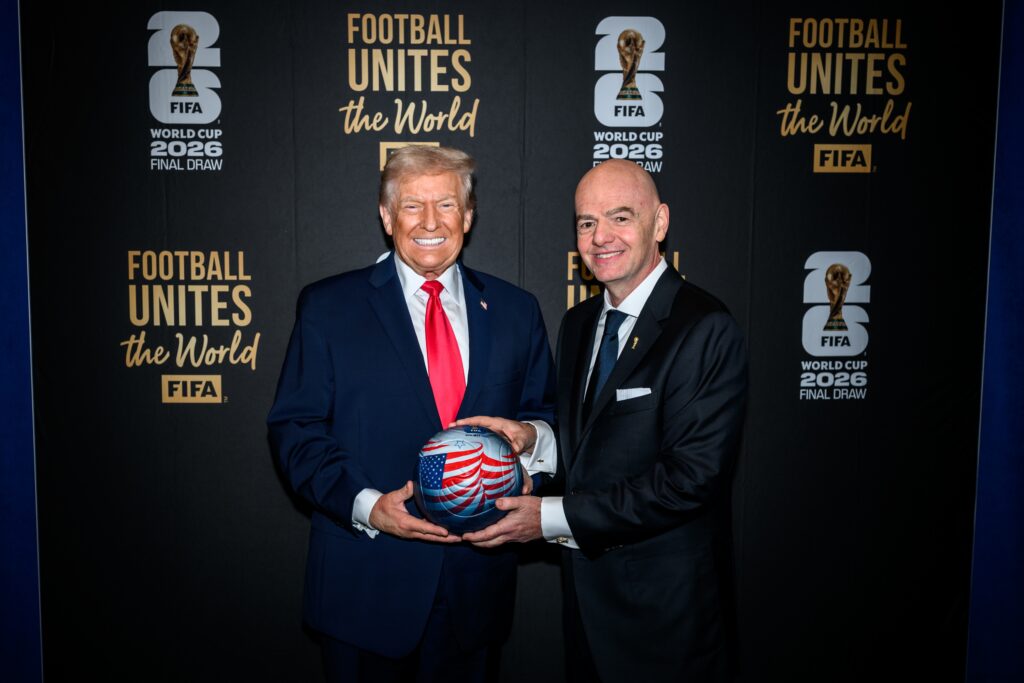
President Donald Trump poses for a photo with FIFA President Gianni Infantino at the John F. Kennedy Center for the Performing Arts in Washington, D.C. on Friday, December 5, 2025. (Official White House Photo by Daniel Torok)
Ahead of the 2026 football (soccer) World Cup, there was much doom and gloom among commentators and fans across the globe. Extortionate ticket prices and onerous visa requirements in place in the US, where the great majority of matches would be played, made it impossible for the vast majority to even contemplate attendance. The expansion of the tournament from 32 to 48 national teams, combined with the wear and tear on top players during their increasingly packed and lengthy club seasons, had many worrying that the quality of play would be diluted, producing a lackluster experience. The crude farce of FIFA President Gianni Infantino creating the “inaugural FIFA Peace Prize” for Donald Trump, to curry favor by assuaging Trump’s ego after being snubbed for the Nobel Peace Prize, encapsulated the ethical gutter that the governing body of world football had sunk to. Critics such as Lefty sports journalist Dave Zirin warned of a “joyless World Cup.”
FIFA has a long tradition of bedding down with dictators and authoritarian regimes, who could use the ever-increasing prestige and attraction of the game—and, often, manipulation of conditions of play—to reap legitimacy at home and abroad. The 1934 World Cup was awarded to Benito Mussolini’s Italy; the Italian team’s victory was celebrated as a victory for fascism. The 1978 event was held in Argentina in the midst of the military junta’s “dirty war,” and that national team’s triumph was sullied by allegations of match-fixing. More recently, Vladimir Putin’s Russia, under sanction for the 2014 seizure of Crimea from Ukraine, hosted in 2018; as did the repressive petro-state Qatar in 2022. Thousands of migrant workers paid with their lives building the stadiums for the latter (see Janice Jayes’s article “Labor Abuse as Product Placement at the World Cup” in the December 2022 Public i, in which she discusses the term “ballwashing” for such reputation-cleansing).
Especially during the last decade under Infantino, FIFA has turned into a global money machine. It declared a $15 billion haul from the summer Cup: from media deals, corporate sponsorships, and ticket sales—including “dynamic pricing,” which used real-time algorithms to push every ticket price to the maximum; and taking a 30 percent cut on the secondary market, where prices ranged into the tens of thousands and more for prime seats . FIFA’s “hyper-extractive business model” (Zirin and Jules Boykoff) takes 100 percent of stadium concessions revenue, while states and municipalities are stuck with costs in the hundreds of millions for security and infrastructure. FIFA even prevailed upon Mexico to cancel taxes on its revenues there (the US and its other cohost, Canada, did collect them). As a nominal nonprofit, FIFA must distribute its income to national associations worldwide, though no one really knows how much is siphoned off into exorbitant executive salaries, luxury perks like Infantino’s personal jet, consultants and other high-priced associates, and out-and-out corruption up and down the line. But even this undeniable redistribution function fits well into the existing system, what Counterpunch calls “football neocolonialism,” in which talent from the Global South (and underdeveloped regions and neighborhoods in the Global North) is vacuumed up to fill the coffers of the top, mostly European, leagues and clubs—the latter however increasingly owned by Russian oligarchs, Arab petro-states, and US hedge funds (the “financialization” of global soccer).
The Trump regime’s anti-immigration offensive was never going to yield significantly to the FIFA motto “Football Unites the World.” Although widespread fears of stepped-up ICE enforcement at and around venues did not materialize, ICE ramped up its repression in other jurisdictions, and took two further victims’ lives during the tournament, in Maine and Texas. Several African nations whose teams played in the US were among the 50 subject to visa bonds of $10,000 to $20,000, while citizens from Haiti and Iran were barred altogether. Although previous hosts had been prevailed upon by FIFA to ease their immigration restrictions for fans, Infantino pleaded powerlessness vis-à-vis Trump. The case of the Somalian referee Omar Artan, chosen for the tournament but denied entry—surely not unconnected to the administration’s vilification of Somali Americans—evoked much anger and dismay, as did the maltreatment of the Iranian team: they were forced over the border to train in Mexico, although all of their games were in the US; they had to leave the US immediately after each game, impeding physical recovery; and many of their staff were denied entry altogether.
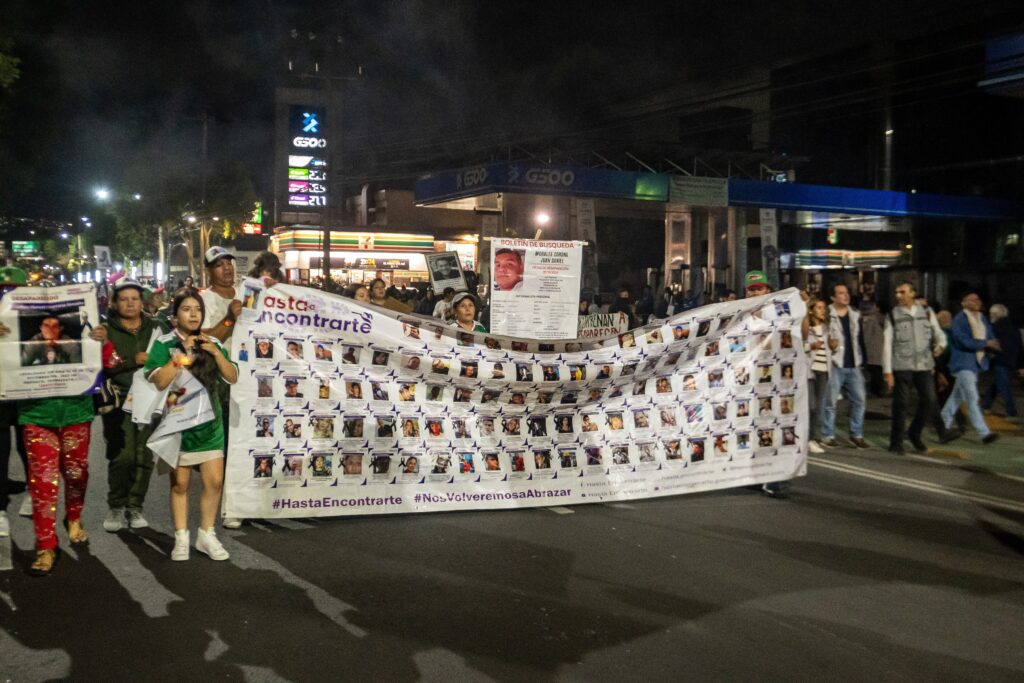
Protest by mothers searching for missing family members, and by other social groups, against the start of the 2026 FIFA World Cup, near Azteca Stadium, Calzada de Tlalpan, Mexico City. Photo by ProtoplasmKid, used under Creative Commons license CC BY 4.0
There was pushback against all of these outrages, both political and (inter)personal, in ways small and large. Mexican President Claudia Sheinbaum gifted her VIP ticket to the opening match to a young female indigenous athlete, decrying the prices. New York City Mayor Zohran Mamdani negotiated a deal to provide $50 tickets to 1000 New Yorkers. While these actions hardly dented the overall structure, they provided symbolic resistance. Mexican teachers and relatives of the disappeared staged protests; others demonstrated against the more direct economic and social effects (debt, “turbocharged inequality,” social cleansing around venues) of the enterprise with the slogan “futbal si, capitalismo no!” Many civil groups collaborated to put out a “World Cup Travel Advisory,” explaining and exposing the many barriers for entry to the US for fans. In the US, stadium workers in Los Angeles used the leverage of the upcoming Cup contests to win the right to go on strike if ICE raids materialized; workers in Cup sites Philadelphia and Seattle acted on other grievances.

Norway fans performing the “Viking row,” which became the hit of the Cup and was adopted by other teams’ supporters, during France vs. Norway on June 26, 2026. Photo by Bryan Berlin, used under Creative Commons license CC BY-SA 4.0
But the biggest rebuke to the execrable politics, corporatization, and corruption was the football and the fandom, in and around the stadiums. There all the joy, competition, unlikely fraternity, color, and passion of the “beautiful game” was on display. The games were, given the fears, surprisingly competitive and exciting, with global minnows like Cabo Verde, Uzbekistan, Curaçao, and even Iran challenging traditional powers. The African teams impressed, with nine of the ten qualifiers reaching the knockout stages, and several only losing out to European and South American giants after unlikely reversals in the closing minutes. The fervent and in many cases massive support—taking over whole stadiums—of immigrant communities in the US for their native teams demonstrated how diverse and multicultural the real existing America is. And diaspora zeal was not limited to the hosts: who knew that Dutch cities were so full of football-mad Cabo Verdeans and Moroccans (both communities heirs to colonization by other powers)? Fans were able to express their anti-system views: there were many appearances (in the stands, but also wielded by players and coaches) of Palestinian flags—a slap to Infantino’s collaboration with Trump’s ridiculous Gaza Board of Peace. Infantino, surely the most hated man in global sports, was roundly booed whenever he appeared on the Jumbotron, as was Trump when he deigned to attend the final, and as were the “hydration breaks” instituted midway through each half—an obvious cover for valuable extra TV commercial time rather than player safety—which became a standing joke.
So whither FIFA, whither football? The huge scandal that broke in the days after the final dramatically shook Infantino’s position as unassailable tsar of his empire. He announced an up-to-$20 billion private investment venture, selling off 20 percent of FIFA’s tournament operations, in partnership with Joshua Kushner, brother of Trump son-in-law Jared. It was presented as a fait accompli, with national associations pressured to approve it quickly or lose their extra ($20 million per country) funding. UEFA, the European football federation—already incensed after Trump intervened with Infantino to engineer the cancellation of a one-game red-card suspension to US star Folarin Balogan (who is, ironically, an Englishman of Nigerian background and only a US citizen because of birthright citizenship) for a knockout game against Belgium—threatened to boycott international competition and called for Infantino’s replacement. The Europeans were joined by the Asian confederation, and even CONCACAF (North and Central America and the Caribbean) nations, which unanimously supported the resistance.
Can the laudable FIFA official values of fair play and, more recently, anti-discrimination—apparently hollow, but alive in the hearts of billions of fans—survive the sordid reality of the global machine? Journalist Pablo Torre has coined the term “sports fracking” to denote an evolution of sportswashing, in which, rather than just being used for prestige and ablution, sport is plundered for short-term gain and its essence hollowed out in the process. Counter to this is the magnificent triumph of world champion Spain: one of discipline, collectivity, and total team spirit over the star-based spectacle that advertising heroizes. Politically, it was seen by many as a rebuke to its opponent Argentina’s President and Trump buddy Javier Milei, and a boost to Spanish Prime Minister Pedro Sanchez’s social-democratic, immigrant-welcoming, multicultural Spain. Perhaps global football can still be, as journalist Alex Shephard postulated, a “pageant for a better world.”

