Cooperatives and Socialism

Colin Dodson is IT coordinator at the Common Ground Food Co-op.

The last two years have given us plenty of reason to grow weary of “politics” and lose faith in the political structures around us, but as a cooperative, Common Ground is inherently a political organization as much as it is an economic one, and, in my opinion, it’s high time that we engage politically with our owners.

As we look toward a new year amidst political and economic turmoil, I want to look back to our cooperative roots. Common Ground is a cooperative, but what does that really mean? Let’s start with a simple question with a not-so-simple answer.

Are Cooperatives Socialist?

To get an idea of what answers this question might have, I’ll provide a little bit more context. What is a cooperative? When and where do cooperatives come from? And how are co-ops related to socialism?

There are many kinds of cooperatives, rooted in several traditions, but I’m going to focus on the lineage that Common Ground and most co-ops come from.

For this purpose, I’m going to start right around 1800. Revolutions in nearly every aspect of human life marked the turn of the century as the Industrial Revolution, the dying years of monarchy and feudalism, the rise of capitalism, liberal democracy and the enlightenment dramatically transformed society.

While developing capitalism and technology were able to create an abundance of material goods, they also created their own new forms of oppression and suffering—artisans’ guilds (and skilled trades generally) lost a great deal of agency as human skills were replaced with automation, mass manufacturing and low-skill repetitive labor, and, at the same time, working conditions became more and more dangerous as working hours drew out ever longer in order to maximize the profits of factory, mine and mill owners.

At the same time, enlightenment-era idealists, philanthropists and philosophers saw this suffering, and a few tried to do something about it. This gets me to the intersection of socialism and the cooperative movement.

Robert Owen

Born in Newtown, Wales in 1771, Robert Owen came to manage textile mills in Lincolnshire, and eventually to co-own the textile mill in New Lanark, Scotland in 1799-1800. Working in and managing textile mills, Owen developed his own spiritual, social and economic approaches to labor and community, which ultimately led to reducing working hours, providing free education to all workers and their families and emphasizing the needs and well being of labor when he gained the power to do so.  Owens came to describe himself as both a socialist and a proponent of the cooperative movement, and later went on to found a planned utopian socialist/cooperative village in New Harmony, Indiana in 1825. This later experiment ultimately failed economically, in 1827, but the legacy Owen left continued into the Rochdale movement, and this is where socialism and the cooperative movement in Britain begin to part ways.

The Rochdale Society of Equitable Pioneers

In 1844, a group of 28 people who were largely displaced skilled tradespeople founded a cooperative enterprise known as the Rochdale Society. In the beginning, it was a very small worker-owned and -managed retail business which carried only a few bare essentials such as butter, sugar, flour and candles. Over just a few years, business boomed, and their selection expanded to include most consumables, and even tobacco and tea. From such humble beginnings, they’d built a business that became renowned for its high quality, unadulterated goods.

What the Rochdale Society also produced was a set of guiding principles which has evolved into the Rochdale Principles that we still hold to this day. To put this into historical perspective with the development of socialism in the sense we know it today, Karl Marx and Friedrich Engels published the Communist Manifesto in 1848.

This is not to say that Marx and Engels held wholly positive views toward the emerging cooperative movement—indeed, both offered tremendous criticism of both “utopian socialism” and emerging cooperatives as largely out of touch with material history and as isolated experiments in a sea of capitalism which did not directly challenge the structure and order of the prevailing mode of production in their day. All of this aside, Marx and Engels did rightfully credit Owen and the Rochdale Pioneers  for their developments and recognition of the material conditions of the working (or proletarian) classes.

Okay, so what does all of this mean?

The cooperative movement and socialism are distinct from each other, but they are close cousins. Socialism demands a wholescale transformation of society’s productive forces, and to immediately end capitalism. Cooperatives are a little different: they seek to do the best they can democratically within whatever economic system is present. So, cooperatives aren’t necessarily socialist, but they share a common root and are, in some cases, fully compatible with a socialist society.

Cooperatives come in many different forms—from worker co-ops and consumer co-ops to producer-, secondary- and hybrid co-ops—but each form shares critical features laid out in the principles by which they operate and the general structure of decision making and governance within and between co-ops. For example, Common Ground does not have “shareholders,” but “stakeholders,” and decision-making power is ultimately rooted in a democracy of consumers. That means you, as the consumer/stakeholder, are in charge.

If you’d like to learn more about how to exercise power as an owner of Common Ground or how to become an owner, reach out to the Common Ground board of directors (board@commonground.coop) or marketing team (marketing@commonground.coop ). The co-op belongs to its consumer-owners, and their participation keeps our collective faith in a better business model alive.

Posted in Cooperative, socialism | Comments Off on Cooperatives and Socialism

RED HERRING VEGETARIAN RESTAURANT CELEBRATES ITS 50TH ANNIVERSARY

The Red Herring Vegetarian Restaurant, a project of the Channing Murray Foundation, is celebrating its 50th Anniversary with a Golden Birthday Party on Feb. 17th.  The event will include live music, local food, storytellers, a memorabilia exhibit (LPs, poetry books, posters, etc.), a raffle, and musical performances by Paul Kotheimer, The Merry Travelers, Dewclaw, and other local folk and jazz groups. Founding participants Bill Taylor and Vern Fein are among the scheduled storytellers. The event runs from 4:30 to 10:30 pm at the Channing Murray Foundation, 1209 E. Oregon St., Urbana. There is a $10 suggested donation at the door, but the organizers will accept “more if you can, less if you can’t.”

The Golden Birthday Party is just one of a week-long series of activities running from Feb. 16 to Feb. 22, including contra dancing, cooking classes, and an open mic night.  For more information, call (217) 367-2340 or see www.channingmurray.org.

Posted in Uncategorized | Comments Off on RED HERRING VEGETARIAN RESTAURANT CELEBRATES ITS 50TH ANNIVERSARY

The Honduran Crisis: Not Quite Your Father’s Oligarchy…

By Janice Jayes

At first glance the political crisis in Honduras seems depressingly familiar: a military coup against a left-leaning President in 2009, continued repression of opposition groups, and now a Presidential election so full of irregularities that demonstrators refuse to leave the streets. But the crisis in Honduras is much more than a reprise of past injustices; it’s a new story of globalization in all its uncomfortable contradictions:  environmental and indigenous rights activists, War-on-Terror advisors, eco-tourists, miners, and tilapia farmers. This election scandal is a thoroughly 21st century event.

Days after the November 26 election Honduran protesters demanded the resignation of President Juan Orlando Hernandez

An “Irregular” Election Rooted in a Military Coup   

The protests that have engulfed Honduras since the November 26, 2017 election really began back in 2009, when the army deposed President Manuel Zelaya. His unanticipated turn to the left had alarmed his opponents. And it was that same Left that marched on and blockaded key highways, demonstrated in public squares, and sometimes was shot at or disappeared in the months and years after the coup.

Zelaya hadn’t created this movement so much as it had created him. During the early 2000s, activists in Honduras concerned with working conditions in maquiladoras, environmental degradation, and the loss of indigenous control over collective lands began to share concerns with a worldwide network of organizations fighting similar campaigns. Social media allowed them to share strategies for forcing investor and government compliance with community demands.  

The Honduran business and agrarian elite were themselves feeling the effects of a changing world. Older paths to wealth, like exporting coffee, were facing increased competition. Then, in 1998, Hurricane Mitch killed thousands, displaced more than 2 million, and destroyed 80% of crops. Mitch’s devastation led to a profound transformation of rural life and politics, as those with capital diversified into new fields such as tilapia, shrimp, palm oil, and mining ventures. Unfortunately, the regions they proposed to develop were held by communities resistant to the environmental degradation and land alienation that would result. Activist campaigns to attract international attention to the land grab also attracted Zelaya to ally himself with this new political base.

Land Grabbing in Post-Coup Honduras

The coup which removed Zelaya in 2009 moved quickly to reverse the environmental and community protections he had enacted. The moratorium on new mining concessions was lifted; aid for education, fuel costs, and food was reduced; and utility companies were privatized. Roads were carved across indigenous land, opening the way for export agriculture and mining investment.

One of the most insidious new developments was that of Charter Cities, legalized in 2011. Charter Cities were designed to spur investment by attracting foreign investment to undeveloped regions. They offered the familiar tax and trade incentives often found in Special Economic Zones, but also promised legal and regulatory incentives in the form of streamlined paperwork. Investors would be able to avoid onerous paperwork related to environmental impact statements, indigenous land tenure, labor conditions, and even the Honduran judicial and security systems. In short, investors could cease worrying about investing in Honduras because the Charter Cities would effectively be removed from Honduran government control.

While Charter Cities haven’t yet rolled out as expected, since 2009 the landscape of Honduras has become a battleground where land grabs by investors are met with community resistance. Mining, tourist enclaves, hydroelectric dams, and commercial agriculture ventures are all protected by legal structures that disenfranchise the traditional residents. Company paramilitaries abound: the Honduran NGO, Observatory of Violence, estimates there are 700 private security companies in the country. The units don’t just safeguard sites from vandalism, they also evict populations newly demoted from residents to squatters.

After the coup many activists gave up on formal politics and instead invested their energy in attracting international attention to Honduran human rights, labor, and land access issues. They opposed the 2014 U.S.-Honduran initiative to reduce gang violence, narcotics trafficking, and emigration to the U.S., in part because it relied on developing rural areas without consulting local views. Activists also publicized the danger of the plan’s reliance on the militarization of police in a country with a poor human rights record. The campaign to protect the Garifuna people of Honduras’ northern coast from the expansion of shrimp farms and eco-lodges is a good illustration of the contradictions in this era: connections with the global indigenous rights movement helped protect a local community from the global expansion of the tourist and food industries.

“A Death Trap for Environmental Activists”

Not surprisingly, violence skyrocketed after 2009, and Honduras is now one of the deadliest countries in the world. While the government blames the violence on narcotics-linked gang violence, Human Rights Watch notes that many victims have been opposition activists or farmers who were simply inconvenient to these new land grab initiatives.     

The 2016 assassination of well-known Honduran activist Berta Caceres shocked the environmentalist community around the world.  

The March 2016 murder of Berta Caceres, recipient of international awards for her work opposing the construction of a hydroelectric dam in the territory of the Lenca people, was the most famous example of the lethal conditions activists face. In frustration, Amnesty International called Honduras a “death trap for environmental activists,” and Global Witness lamented that Honduras was “the most deadly place on the planet to defend the environment.”

Global Witness recorded 120 murders of environmental activists in Honduras since the 2009 coup.

The Surprisingly Competitive 2017 Election

The indignation following Caceres’ murder contributed to the unexpected outcome of the 2017 presidential election. The opposition candidate, Salvador Nasralla, ran on an anti-corruption platform and pledged to shut down Charter Cities and defend community land rights. Nasralla is charismatic, but expectations were low and few expected the incumbent, Juan Hernández, (a key architect of the 2009 coup) to permit a serious challenge to his reelection.

And then, on election day, Nasralla unexpectedly pulled ahead with a five-point lead. The election committee suspended the count completely for 24 hours, and after two weeks of irregular updates declared Hernández the winner with 42% of the vote to Nasralla’s 41%.

By the time the results were announced, several protesters had already been killed. The government imposed a curfew but it did little to calm the situation, and two months after the election opposition groups continue to face off against riot police in the streets. Several countries joined the OAS in calling for new elections, but the U.S. congratulated Hernández on his victory instead. The U.S. State Department had already certified on November 28th (in the midst of the election scandal) that Honduras was compliant with anti-corruption and human rights requirements, clearing the way for continued U.S. security assistance to the same units confronting the ongoing protests.

Protesters have been confronted by Honduran police and military units who have benefitted from U.S. financial assistance and training.

An Environmentalist Spring?

Overall, the political crisis in Honduras does sound familiar, but it’s firmly grounded in the inescapable globalizations of the 21st century. Environmental activists are using new technologies to access like-minded groups across the globe and share strategies for preserving community control against outsiders. The chaotic streets of Tegucigalpa resemble scenes from the Arab Spring for similar technology and strategy reasons. The globalization of food has made Honduran land suddenly desirable for those who would farm shrimp or tilapia for U.S. consumers, while the ease of travel allows outsiders to vacation in scuba villages that advertise proximity to exotic local culture while simultaneously dispossessing it. And the military aid that allows Hernández to keep his administration afloat? It’s a byproduct of the U.S. pursuit of security from refugees, drugs, and extremists through the militarization of far borders.  

Hernández, with his ham-handed election fraud, may try to resurrect the ghost of an older oligarchical world, but his opponents are as globalized as he is now, albeit with different visions of the future. What kind of world will be built, and who will control the corners of it, is something that won’t be determined in the aftermath of one election, but it’s clearly something Hondurans are willing to fight for.

Posted in Economics, Environment, Honduran Election 2017, Human Rights, International, Land, military | Comments Off on The Honduran Crisis: Not Quite Your Father’s Oligarchy…

The Power of a Word

(Eleanor Clark Ray is a 93-year-old resident of Champaign who taught school in Monterey, California.)

Having a very long past to remember, I find that bits of that past rise into conscious memory unbidden and usually not welcome. For example, . . .

A question from a boy in my third grade classroom reminded me of how profoundly we Homo sapien types are led, and often misled, by language.

In the Christian calendar the Wednesday 46 days before Easter is Ash Wednesday, the beginning of Lent. On the Ash Wednesday of this incident, Jerry had been to Mass and on his forehead was a streak of ashes. One of the other boys said “your face is dirty,” and tried to wipe it off. Jerry avoided the attempt and announced that the ashes were because the Jews were going to kill Christ. He followed that with a nine-year-old’s screed against Jews.

I jumped in with what you might expect: acknowledgment that a few Jews are not good and kind just as a few Catholics and Methodists and Baptists are not good and kind. But almost all Jews, like almost all Christians, are very kind and good and would be sure to help you if you were having trouble.

And Jerry asked me, “If they are not bad, then why are they called Jews?”

Posted in anti-Semitism, bigotry, children | Comments Off on The Power of a Word

New Bill Takes Effect Cutting Cost of Calls from Illinois Prisons

FOR IMMEDIATE RELEASE

January 8, 2018

FOR MORE INFORMATION:

Brian Dolinar, Program Director, Independent Media Center, (217) 621-5827, briandolinar@ucimc.org

The Urbana-Champaign Independent Media Center (UCIMC) is proud to announce that as of January 1, 2018, a new state law took effect reducing by half the cost of phone calls from Illinois prisons. We would like to express our deepest gratitude to State Representative Carol Ammons for championing HB6200, The Family Connections Bill, passed in mid-2016.

The bill sets the cost of phone calls from Illinois prisons at a maximum rate of seven cents per minute. A 30-minute phone call, which used to cost four dollars, will now be about two dollars. This bill is already having immediate impact for thousands of people with a loved one in prison.

Wandjell Harvey-Robinson, whose parents were incarcerated when she was in the third grade and who grew up talking to them on the phone, is pleased to see the new rates in place: “We did it! I’m elated with the joy this victory brings to families who might be burdened with the expenses of phone calls from a loved one who is incarcerated. We must work together to make policies that help these families―they are a part of our community!”

State Representative Carol Ammons reacted to the passage of HB6200: “In a time where private companies are pushing more and more into our public services, I am proud to sponsor a bill that ensures profit does not take precedence over basic human dignity.”

Brian Dolinar, UCIMC Program Director, who provided educational support for the bill, said: “The campaign for prison phone justice in Illinois shows that reform is possible even as we see the rollback of industry regulations by the FCC under Trump. With implementation of HB6200, Illinois becomes a leader in providing affordable phone calls for those incarcerated and their families.”

UCIMC continues to work with national partners in the Campaign for Prison Phone Justice, and their assistance has been essential to this victory for those living in Illinois. We are also grateful for funding provided by the Media Democracy Fund to support our efforts. Lastly, we want to thank those incarcerated and their families for being willing to advocate on their own behalf.


Posted in Justice, Prisoners | Comments Off on New Bill Takes Effect Cutting Cost of Calls from Illinois Prisons

Water as a Human Right

By Jacquelyn Potter

Jacquelyn Potter has an MS in Biology and serves on the Executive Committee of the Sierra Club Prairie Group. Her environmental interests range from water and air quality issues to land and wildlife issues.

Water is essential for life, and as drought and desertification have increased, it is projected that major conflicts in future years will be over water. In 2010, the United Nations adopted Resolution 64/292, recognizing “the right to safe and clean drinking water as a human right.” Water rights are often thought of in terms of scarcity or quantity. Visions of armed guards patrolling water sources in the Middle East or public shaming during the California drought come to mind. In such cases, the right to water sounds good until one tries to make good on it without harming one’s neighbor, and without help from nature. If an area is naturally scarce in water, equitable solutions are few, regardless of what we believe is a “right.” And the idea of artificially shipping or pumping water where it doesn’t naturally occur (e.g. the California Water Project) inevitably hastens water scarcity in source areas. The most sustainable way to deal with water scarcity is by respecting natural limitations and living responsibly within those limits. Although there have been improvements in the public use of water (water conservation initiatives and self-enforced water limits), consumption and pollution by industry continues. For example, in California in 2015, the fracking industry used nearly 70 million gallons. Remember, California is a semi-arid state with a history of water disputes that was, at that time, in the grip of a multi-year drought.

But what about areas where water seems plentiful?  Should we worry about water rights in such areas? After all, such areas can afford to supply a growing population and many industries, right? When looking at rates of usage, one gets a clearer picture of the inflated situation. For example, Pennsylvania and Illinois, both thought “water rich,” have millions of gallons withdrawn daily, and billions yearly, by industry (especially thermoelectric – oil, coal, gas). But proponents argue that the water is returned back to the environment, so no harm done, right?  This is the standard logic behind attitudes on industrial scale water use.  But something else needs to be considered: that is, water isn’t simply used by industry and replenished in the same condition it was removed. It is often tainted by industrial use, even when supposed safeguard procedures are in place. So although water scarcity or quantity may seem less a concern in such states, the issue of concern that remains is water quality.

Just because Illinois is gifted with substantial sources of fresh groundwater doesn’t mean we should squander it or allow industrial contamination. Illinois water rights laws include the Water Use Act of 1983, that clarified previous groundwater law, and the federal Safe Drinking Water Act, encompassing the Illinois Groundwater Protection Act, which protects groundwater as a natural and public source, with special provisions for drinking water wells. Recently, water rights have come to the forefront in Champaign County, due to contamination of our Mahomet Aquifer by Peoples Gas. Peoples Gas owns an underground natural gas storage facility, and one of its wells leaked gas into the aquifer. According to Peoples Gas, the leak was discovered when an employee noticed gas on the ground near one of its wells, but it took approximately two weeks before it was sealed. It is unknown how long the leak continued unnoticed or how much gas leaked into the aquifer and surrounding soil during that time. The gas storage underneath the Mahomet Aquifer is in an injection well, stored in natural formations near Mahomet about 4,000 feet underground. A quick search on the subject shows that leaks from injection wells are quite common, mostly due to structural failures (e.g. fractures in surrounding rock). Therefore, the same rule as for pipelines – that it’s not a question of if it will burst, but when – can be applied to injection well gas storage. Is gas leakage a danger when it contaminates an aquifer? Yes. The natural gas is mostly methane, which dissipates from water but collects in enclosed spaces. Risks from contamination include soil damage, explosions, fires, and the health risks of asphyxiation, rashes, nausea and nosebleeds. The contaminated water is unusable. It wasn’t until April, when a homeowner reached out to the Illinois Department of Public Health, that the state was notified. In recent months, Spiros Law took on the case for affected residents. The Illinois Department of Natural Resources issued a Notice of Violation to Peoples Gas for months of unregulated venting, and Peoples Gas responded by proposing disposal of the contaminated water by dumping it on the ground. This plan was deemed unacceptable, and so they installed enormous tanks (thousands of gallons) to hold it until it can be emptied into the Urbana-Champaign Sanitary District (via a permit issued in October). Therefore, the water contaminated with natural gas will go into a cesspool of other chemicals en route (outgassing and synergistic effects anyone?), be processed and then released right back into waterways. Senator Chapin Rose referred the case to the Illinois Attorney General’s Office, and Attorney General Lisa Madigan filed suit against Peoples Gas for contamination of Mahomet Aquifer, impacting five residential wells (although recent developments suggest more wells have been impacted). Questions have been raised regarding the culpability of Peoples Gas as to oversight of the wells, mishandling of the leak, and lack of responsibility in not warning the public and state agencies.

The Mahomet Aquifer supplies over 100 million gallons of water per day to over 850,000 people. It is designated a Sole-Source Aquifer, meaning it supplies at least 50 percent of the drinking water for its area, with no alternative sources if contaminated. It is a semi-confined aquifer, connected to surface water in specific areas (e.g. the Sangamon River) that recharge it. Therefore, not only does the aquifer need protection, but the waterways that recharge it do as well. Although restoration of Clean Water Act protections for Illinois streams was a good start, there must be stronger restrictions on industry seeking to move or store products (e.g. oil or natural gas) above, across or underneath aquifers, perhaps an outright ban, as spills and leaks are more the rule than exceptions. If so many are dependent upon the aquifer and surface waters that recharge it, then how is it the right of the few over the many to over-exploit and pollute? Contamination of water and avoidance of culpability by industrial interests are direct affronts to the basic human right to safe, clean drinking water under the UN Resolution and Illinois’ own Groundwater Protection Act. Maintaining water quality (preserving what is naturally there), is where water rights law is wisely applied.

When delving into water rights, there are obvious culprits, and when one sees figures of millions of gallons withdrawn per day and cases of flammable or poisoned water, it is easy to point fingers; however, we must remember what is driving these industries: demand. Our fingers might as well be pointing at ourselves. This does not excuse industry responsibility, but the truth is that real change and preservation of quantity and quality of water sources will only come when we get away from wasteful and pollutive industries, turn towards sustainable clean energy, and learn to live at sustainable levels of consumption within the natural limitations of our land and water sources.

Posted in Environment, Environment | Comments Off on Water as a Human Right

‘No Taxpayer Dollars’ for Coaches at the U of I? You May Be Surprised

by Jay Rosenstein

Center for Advanced Study Professor of Media & Cinema Studies Jay Rosenstein is the award-winning filmmaker of In Whose Honor? (1997), The Amasong Chorus: Singing Out (2004), and The Lord is Not on Trial Here Today (2010)

It’s not tax money, so angry taxpayers can calm down.

That was the first reader comment posted on an on-line Chicago Tribune story.The issue that elicited that reaction was the six-year, $18 million contract for newly hired University of Illinois, Urbana-Champaign head men’s basketball coach Brad Underwood. It’s part of a familiar ritual that happens whenever the UI hires a new high-profile coach:

“This doesn’t come out of tuition. It doesn’t come out of state funding. It’s strictly out of athletic funds,” said U of I Trustee Edward McMillian in a News-Gazette story after a new coaching hire.

“Coaching contracts are covered by athletic department income, not tuition or state funds,” noted U of I Trustee Timothy Koritz in another newspaper story.

“The state of Illinois does not fund coaches’ salaries,” said Robin Kaler, Associate Chancellor for Public Affairs.

“Intercollegiate Athletics is self-supported and does not use state funds, taxpayer dollars, or university funds for our salary program,” said Kent Brown, Athletic Department spokesman.

It’s a narrative that’s been repeated for years, over and over, from pretty much every corner.

Except it’s not true.

While taxpayer money doesn’t technically go to pay the coaches’ actual salary lines, taxpayer money does pay for the salary packages for most every UI coach, trainer, and full-time athletic department staff member. That’s because UI athletic department employees are UI employees, so they receive the same “standard university benefits” as all other UI employees.

And benefits for UI employees—health, dental, etc.—are paid for by the state of Illinois. In other words, the taxpayers.

The cost isn’t exactly trivial. In 2016-17, the taxpayers’ bill for athletic department benefits was just under $6 million, according to the UI’s Associate Chancellor for Public Affairs. And the cost of those benefits is an annual expense. Combined with the $2.6 million pension cost for retired coaches and other retired athletic department employees (as detailed in Part Two of this series), the total cost to Illinois taxpayers for UI athletic department compensation packages was $8.6 million in 2016-17.

Yet according to U of I Trustee Tim Koritz, “coaching contracts are covered by athletic department income, not tuition or state funds.”

Maybe in Trump’s world of alternative facts.

“What I think it does is it undercuts the argument that tax dollars have nothing to do with athletics,” said State Senator Scott Bennett, whose district includes UI. “They certainly do.“

Additionally, even if taxpayer money isn’t going directly to pay these incredibly large salaries, it still plays a role. By picking up the cost of employee benefits for the UI athletic department, the taxpayers help to free up money for the department, money it can then use to pay for other things—such as the salaries of its coaches. Those huge salaries—football coach Lovie Smith and men’s basketball coach Brad Underwood are the highest paid public employees in the state—should look very different to the public when it knows that part of the justification for those salaries, that “the state of Illinois does not fund coaches’ salaries” isn’t exactly the case.

             Fig. 1: All data from U of I Academic Personnel Book

And if the $8.6 million paid by taxpayers last year isn’t bad enough, that number is bound to increase.  One major factor driving up this taxpayer cost is the growth in the number of coaches and athletic staff.  It’s a trend seen nationwide, especially in the biggest programs.

“There’s so many people in an athletic department (today), it’s incredible. I mean, literally incredible,” said Rick Telander, a sports journalist who has been covering college sports for more than forty years. “There are no limits. There’s no cap.”

Like many of its peers, the UI athletic department has grown dramatically. The total number of athletic department staff, according to the university’s academic personnel books, has risen from eighty-eight in 1997, to one hundred and ninety-six in 2017. That’s a whopping one hundred and twenty three percent increase (+123%) in athletic staff. (Compare that with the number of tenured faculty, which is basically unchanged over that same twenty years, while the total number of students has increased by 25%).

Fig. 2: Data from the University of Illinois Academic Personnel “Gray” Books

More staff costs taxpayers more money. New hires add to the total benefit costs that Illinois taxpayers have to pay. As long as TV revenue for broadcast rights continues to grow as it has, the number of athletic department employees is likely to grow with it to keep up with the competition. It’s strangely ironic that the more TV money the UI athletic department gets, the more it could actually end up costing the taxpayers.

Of course, the athletic department doesn’t have to hire more staff. The number of sports offered by the UI hasn’t changed for decades. But no one seems to be willing to ask the simple question: why does athletics really need to keep hiring more people? Maybe it’s because we already know the answer: because everyone else is doing it.

And unfortunately the even more important follow-up question is never asked either: since athletics keeps getting more and more revenue, why doesn’t it pay the benefits for its own employees instead of the taxpayers?

That answer is easy too. Because we allow it to happen, that’s why. And why do we allow it to happen? Perhaps because we believe these statements:

“This doesn’t come out of tuition. It doesn’t come out of state funding. It’s strictly out of athletic funds,” said U of I Trustee Edward McMillian in a News-Gazette story after a new coaching hire.

“Coaching contracts are covered by athletic department income, not tuition or state funds,” noted U of I Trustee Timothy Koritz in another newspaper story.

“The state of Illinois does not fund coaches’ salaries,” said Robin Kaler, Associate Chancellor for Public Affairs.

“Intercollegiate Athletics is self-supported and does not use state funds, taxpayer dollars, or university funds for our salary program,” said Kent Brown, athletic department spokesman.

Alternative facts.  And round and round it goes.

Part of the four-part series The Multimillion-Dollar Head Fake (www.theheadfake.org).

——————————————-

Caption: Fig. 1: All data from U of I Academic Personnel Book

Caption: Fig. 2: Data from the University of Illinois Academic Personnel “Gray” Books

Posted in University of Illinois, University of Illinois at Urbana-Champaign | Comments Off on ‘No Taxpayer Dollars’ for Coaches at the U of I? You May Be Surprised

“You’re Still in Jail”: How Electronic Monitoring Is a Shackle on the Movement for Decarceration

(A longer version of this article originally appeared in Truthout.)

By James Kilgore

Despite the “law and order” vows of Attorney General Jeff Sessions, states and counties continue to take steps to reduce prison and jail populations. In August, Cook County initiated a special court dedicated to setting bond for people with felony cases. The mandate of the court is to set bond at a level the charged individual says they can afford.

Such efforts have been inspired by grassroots movements calling attention to the injustices of money bond. Reformers contend that releasing people with no cash bond or an affordable bond will allow them to keep their jobs, hold onto their housing, carry out caregiving responsibilities and more effectively mount a legal defense.

In addition to bail reform, early release programs are expanding at the state level. Most recently, Oklahoma, which has the highest incarceration rate for women, is looking at releasing 1,500 people within the next few months.

Nearly all of these initiatives have an unacknowledged Achilles heel: uncritical acceptance of electronic monitors (EM) as an alternative to incarceration. Typically taking the form of ankle bands and house arrest, monitors are gaining lots of traction in reform packages.

Despite a lack of serious research on monitors, EM has become a preferred option. Leading firms in the EM market, like private prison operator GEO Group and carceral phone provider Securus Technologies, have escalated promotion efforts.

Before electronic monitors become part of the DNA of the criminal legal system, we need a deeper exploration of this technology and its impact.

Legal Status

To begin with, there is a lack of legal consensus about whether electronic monitoring constitutes a form of incarceration. Most states say no. This means that if a person spends time on a monitor during the pretrial phase and they end up being sentenced to prison, time spent on the monitor is not deducted from their total sentence. By contrast, time spent in jail is deducted. There are exceptions. Illinois statutes give credit for time served on home detention in most instances, but actual practice presents contradictions.

While legal definitions remain murky, the punitive nature of most EM regimes is crystal clear. In most instances, individuals on a monitor must request permission from a judge or probation officer to get “movement” from their home. The purpose of movement and the precise time out of the house need to be specified. Moreover, monitoring regimes rarely state that a person is “entitled” to or has a “right” to be granted movement. In many instances, even unauthorized movement in response to an emergency can lead to re-incarceration. In one notorious Michigan case, Kent Shultz ended up in jail for unauthorized movement when his apartment burnt down.

The increased use of GPS-enabled devices, which track and record an individual’s location, compound problems with regard to movement. By contrast, devices using the older radio frequency technology only indicate if a person is at home. With GPS, monitored individuals typically must submit a schedule of all their movements a week or two in advance. Some GPS devices program in “exclusion zones,” so that an alarm is sounded if a person enters a forbidden area of the city. At least 10 states allow for lifetime GPS monitoring for certain categories of offenses.

The Experience of EM: The Voice of the Monitored

While legislators and legal scholars may debate whether house arrest constitutes incarceration, Johnny Page has no doubt. He spent 90 days on a monitor after serving over 23 years in Illinois prisons. “It’s like being locked up but you’re paying your own bills. You get to feed yourself, you don’t have to fight for the telephone, you don’t have to fight for the shower, but you’re still in jail.”

Topeka K. Sam was placed on a monitor in New York City after serving a term in federal prison. She referred to the device as a “shackle” rather than a “bracelet.” She said the shackle was “suffocating,” and called EM “transincarceration,” moving people from “inside the prison walls to inside these prison walls in the community … and it does not reduce harm.”

The experience of Father David Kelly, who directs a restorative justice center for youth in Chicago’s South Side, raises another concern. A number of youth participants in his programs are on monitors. He says the majority end up violating the strict house arrest terms of EM and get sent back to jail. He says authorities operate under false assumptions that staying at home will shield these young people from the “temptations” of the streets. “Their houses are not stable,” Father Kelly says, “not places where you have your own bedroom you just go to and there’s a lot of privacy.” Kelly cites cases of individuals who don’t even have a residence being put on house arrest.

A common argument for pretrial release on monitors is that it removes the pressure to accept a plea bargain to get out of jail. However, the case of Chicago’s Lavette Mayes highlights that extreme versions of house arrest can create a similar degree of coercion. For Mayes, being out on an electronic monitor was supposed to enable her to fight her case while looking after her two children. However, her rules were so strict she couldn’t even take out the garbage without explicit permission. Mayes finally opted to halt her legal battle and plead guilty to a felony, her first-ever such conviction. Ultimately, she said the pressure on her family compelled her to take the deal, especially since she was staying with a relative. She recalled frequent searches of the house. “The people who have not done anything are constantly being incarcerated with the person,” she said.

Paying for EM

User fees have become increasingly common for electronic monitors, with daily tariffs sometimes reaching as high as $25. My own research in 40 counties in Illinois revealed daily fees ranging from $10 to $15 a day, with set-up fees up to $70. In fact, “self-financing” is one of the major marketing tropes for EM providers, promising to save money for state and local governments. 3M, a major EM provider advertises their “Offender Pay System” as “easy and convenient to use.”

The Future of EM As an Alternative

Rebecca Brown, who has studied juvenile electronic monitoring extensively in parts of the San Francisco Bay Area, rejects the notion that the alternatives are “lock ‘em up or hook ‘em up.” Brown looks at EM as “an insidious new form of incarceration” that uses “high-tech shackles” to convert public and community spaces into “open air prisons.”

In Philadelphia, Soros Justice fellow and long-time activist Hannah Sassaman expresses similar concerns. She argues that policy makers often try to ignore stories of individuals who experience the punitive nature of EM by casting them as “outliers” or “exceptions to the rule.” In fact, she asserts, “they are the rule.” For her, the solution is to move toward more “transparent processes” that involve those directly impacted.

Real decarceration requires more participatory policy-making processes and the allocation of resources to employment opportunities, mental health services, substance abuse treatment, and more public housing, alongside powerful anti-racist campaigns.

For Topeka K. Sam, electronic monitoring does not ultimately hold the key.

“If you’re talking about decarceration, there are other ways to do that,” Sam said. “This is not it.”

###

James Kilgore is an activist, writer and educator based in Urbana, Illinois. He is the author of Understanding Mass Incarceration: A People’s Guide to the Key Civil Rights Struggle of Our Time (The New Press, 2015). He is presently a Soros Justice fellow spearheading “Challenging E-Carceration” a campaign focusing on the use of electronic monitoring in the criminal legal system. He can be contacted at waazn1@gmail.com or @waazn1 or on his website at: challengingecarceration.org

Posted in Justice, Prisoners | Comments Off on “You’re Still in Jail”: How Electronic Monitoring Is a Shackle on the Movement for Decarceration

The U.S. Military in Africa: a Workshop for the Militarization of Foreign Policy

By Janice Jayes

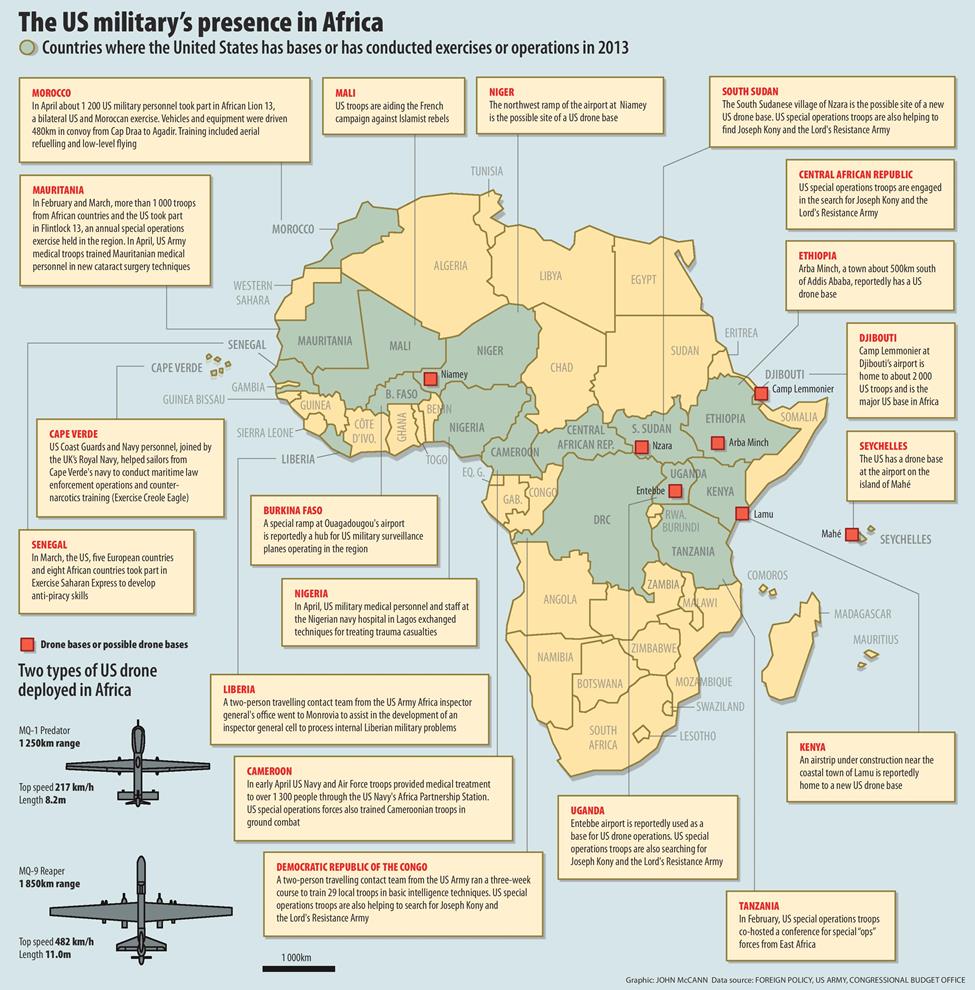
After four American servicemen were killed in in Niger in October, social media discussion fixated on President Trump’s insensitive remarks to the widow of one of the slain soldiers and questions about the logistics surrounding the unlucky mission. The focus turned the sad event into yet another chapter in domestic political debates, and, by dwelling on the most predictable issues surrounding the catastrophe, distracted Americans from a more serious question: just what is the U.S. military doing in Africa? Since 2001 there has been a dramatic expansion of U.S. military activity in Africa, but the shift can’t be measured just by the number of bases built, dollars allocated, or agreements signed. Most ominous is that Africa has become the proving ground for a new model of U.S. engagement with the post 9-11 world.


Figure: Niger, where the U.S. is building a $100 million dollar drone base and stationing between 400-800 troops, is ranked 188th out of 188 countries in the World Bank Human Development Index.

From Disaster in Mogadishu (1993) to U.S. Africa Command (2008)

For most of the Cold War era U.S. policymakers deferred to European allies on Africa. The U.S. assumed the former colonial powers had more interests in the region and, in any case, the need for Western solidarity dissuaded the U.S. from challenging Europe’s actions.

The Somalian famine in the early 1990s briefly changed the U.S. stance. The U.N. mission was caged in by militias seizing food aid for political exploitation and Europe was preoccupied with reinventing a post-Iron Curtain continent. The U.S., still flooded with testosterone from the successful intervention in Kuwait the year before, took on a new task of building a kinder, gentler world through military action, and sent the troops into Mogadishu. Unfortunately the mission ended in catastrophe, with the death of 18 Americans and hundreds of Somalis during the Black Hawk Down episode of 1993, and the Department of Defense put Africa back on the shelf.

The 1994 Rwandan massacres horrified the world, however, and raised questions about the morality of inaction from the country claiming the role of global leader in the aftermath of the USSR’s collapse. In response, the U.S. created the African Crisis Response Initiative to monitor and respond to crises like drought or ethnic cleansing. The new tool was subordinate to State Department control and mandated by Congress to work only with foreign militaries that met human rights benchmarks.

Source: Mail and Guardian, July 1, 2013. “Obama’s Scramble for Africa: US ‘Stability’ has ripped Africa Apart“ https://mg.co.za/article/2013-06-27-us-stability-has-ripped-africa-apart

The World Trade Center attacks of 2001 transformed U.S. policy completely. In Africa, the U.S. reliance on a small-footprint, crisis response team managed by State and situated outside the continent was replaced by a host of new military-to-military agreements. By 2013 the U.S. was running a network of dozens of military bases from Senegal to Somalia, training, equipping, and advising African military forces, establishing surveillance, improving infrastructure, undertaking joint exercises, and bringing African military personnel to the U.S. for training. The establishment of a separate “Africa Command” in 2008 marked the military’s institutional acknowledgment of Africa’s new status in U.S. defense planning. Surveillance, counter-terrorism, and tactical reach became the new buzzwords, pushing “nation building” and “human rights benchmarks” into the dustbin of history. 

For ten years after 9/11, the U.S. followed a government-to-government military engagement pattern in Africa that replicated the U.S. pattern in other regions, but the events of 2011 pushed the U.S. into a new era. The collapse of the Gaddafi regime in Libya during the Arab Spring and the fragmenting of Al Qaeda’s global franchise into ISIS and other rivals were both symptoms of breakdowns in political control. Neither Gaddafi nor Bin Laden could manage their empires after the debut of the iPhone, and the ensuing chaos destabilized the entire region. Africa was reeling from the effects of the refugee crisis out of Libya, the collapse of the oil economy, and the flood of black-market arms flowing out of Libya. Finally, the September 2012 Benghazi attack, resulting in the death of U.S. Ambassador J. Christopher Stevens, convinced American policymakers of the need to adapt to “the New Normal” in engaging with a hostile and unruly world of multiplying threats.

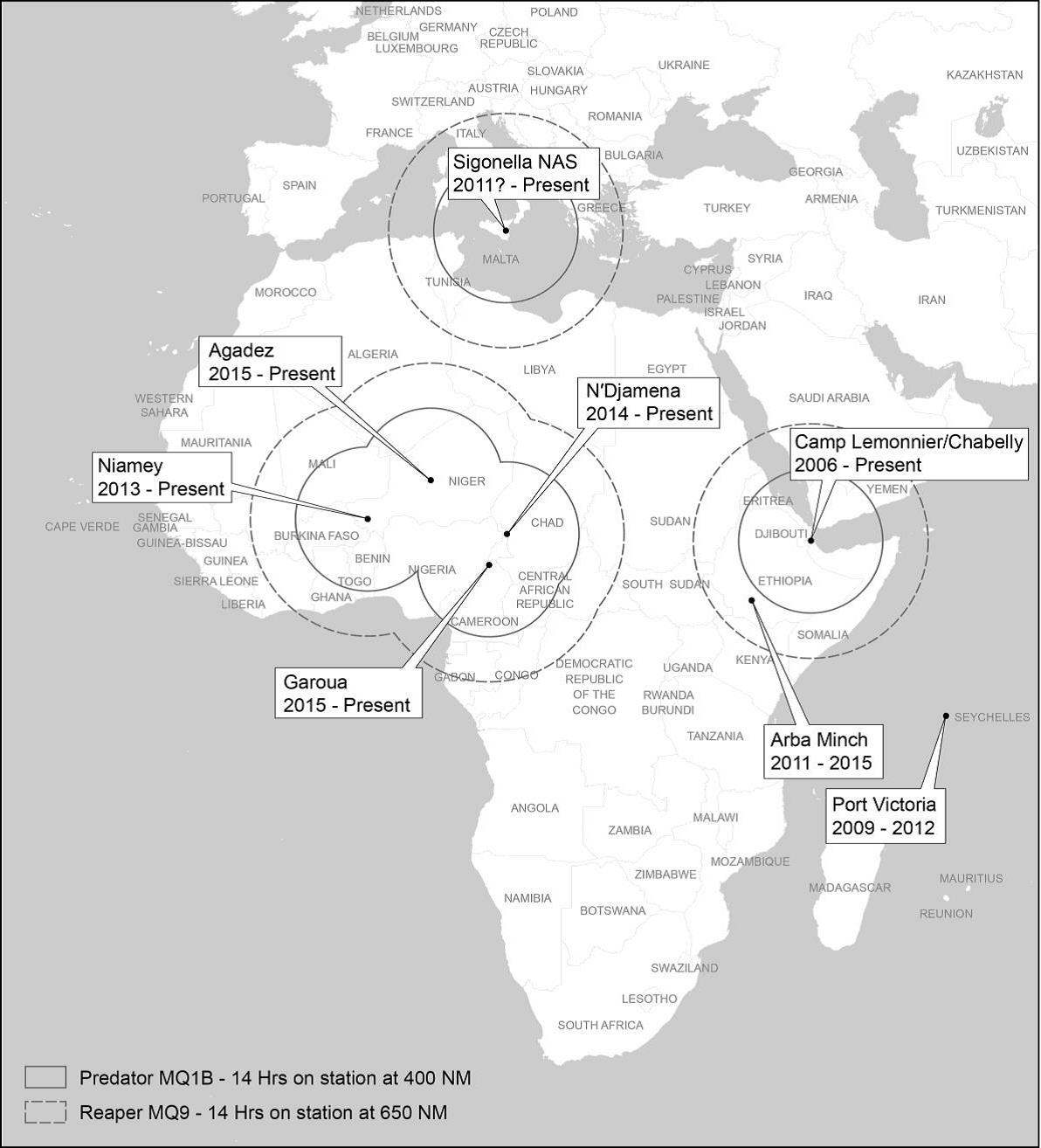
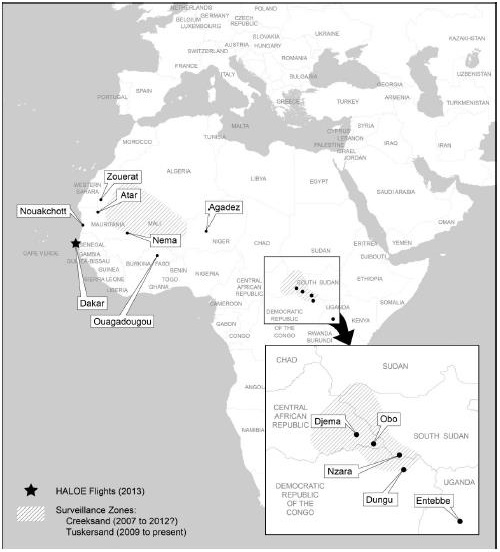
Fig: Drone and Surveillance (often run by contractors) bases are hard to research, but clearly multiplying.

Americans, mired in watching Congress hunt for a witch behind the Benghazi disaster, missed the most dramatic shift in American strategic practices in decades. Country-specific policies have been replaced by the centralized, decontextualized practices of the Global War on Terror. Drones and Special Operations Forces dominate the new mobile toolbox, both lauded as “fiscally sound” and “low-risk” means of projecting power in the new era. But it’s a policy built on punishment, not engagement.

Africa has provided the perfect laboratory for developing U.S. strategies for the post-Benghazi world. Except for with Egypt, there were no historic bilateral conventions to constrain reinvention. And there has been almost no domestic interest to drive congressional inquiry; most Americans pay scant attention to the world and even less to African nations. Couple that with the sleight-of-hand techniques that keep official numbers of U.S. troops low (special forces units are rotated in and out of regions and many tasks are outsourced to contractors), the overall shift in U.S. foreign aid from humanitarian and civil society funding to military programming, and the general lack of American interest in any action until there are American casualties, and you have a recipe for the unrestrained militarization of U.S. foreign policy.

Fig: Manned, contractor-based ISR zones and sites in Africa. Source for both maps: Adam Moore and James Walker. “Tracing the U.S. Military footprint in Africa.” Geopolitics July-Sept. 2016.

U.S. military engagement with Africa has been quietly setting a new model for U.S. foreign policy in the 21st century, and the model isn’t pretty. We have the almost total eclipse of the State Department by Defense in setting the agenda, a narrow focus on “taking out” the bad guys and beefing up local security forces, and budgetary disregard for addressing the factors driving extremism, discontent, crime, or migration. Africa is not an isolated reserve for wildlife and security challenges, but a continent of 1.2 billion humans enmeshed in all the struggles the planet has to offer, both good and bad. Climate change, water scarcity, black-market arms and drug markets; rising expectations for health and consumer standards; the globalization of labor, investment markets, and the media; rising extremism and exasperation with government performance … the issues are familiar because we are all beginning to grapple with them. And yet our policy treats the continent as if it were a game park for terrorists.

Since 2001, and even more since 2011, we have seen the militarization of U.S. foreign policy. Surveillance and strikes have replaced the development of regional expertise, the promotion of civil society norms, the cultivation of economic links, and the creation of multinational organizations to address common challenges like piracy or disease. Those didn’t guarantee perfect policy before, but their disappearance has removed any balance from policy that views the entire region as a battleground in the war against extremism. Africa has become the testing ground for a new style of American policing of the world, and it isn’t going to provide security for us or the Africans.

Fig: Joint Exercises with U.S. and Malian Special Forces. Photo, Nick Sparks, AFRICOM. https://theintercept.com/2015/11/20/in-mali-and-rest-of-africa-the-u-s-military-fights-a-hidden-war/

Recommended Reading on the Militarization of U.S. Policy in Africa:

For a brief overview of the U.S. military commitments in Africa, see Katrina van den Heuvel, America’s Expanding Shadow War in Africa,” The Nation, Nov. 1, 2017. https://www.thenation.com/article/americas-expanding-shadow-war-in-africa/

On the growing role of Special Ops Forces in Defense strategy, see Joint Special Operations Research Topics, 2016.  http://jsou.libguides.com/ld.php?content_id=13295950

On the DoD vision of the evolution of U.S. military relations with Africa, see DoD 2015 Senate testimony: https://www.foreign.senate.gov/imo/media/doc/060415_Blanchard_Testimony.pdf and

On the lapse of “Human rights Benchmarks,” see Nick Turse, “The U.S. is Training Militaries with Dubious Human Rights Records – Again,” The Nation, Sept. 10, 2015.  https://www.thenation.com/article/the-united-states-is-training-militaries-with-dubious-human-rights-records-again/

On the impact of the militarization of foreign policy on civil society in Africa, see Stephen Watts, “Identifying and Mitigating Risks in Security Sector Assistance for Africa’s Fragile States,” Rand Research Reports, 2015. https://www.rand.org/pubs/research_reports/RR808.html

On the budgetary shift in aid, see Helen Cooper. “White House Pushes Military Might Over Humanitarian Aid in Africa,” New York Times, June 25, 2017. https://www.nytimes.com/2017/06/25/world/africa/white-house-pushes-military-might-over-humanitarian-aid-in-africa.html

On the difficulties of researching the turn to manned surveillance and drone bases: Adam Moore and James Walker, “Tracing the U.S. Military footprint in Africa,” Geopolitics, July-Sept. 2016.

Posted in Africa, Foreign Policy, International, military | Comments Off on The U.S. Military in Africa: a Workshop for the Militarization of Foreign Policy

Stream some Laughs: Four Political Comedies from Mexico, Spain, and Puerto Rico

Subtitles don’t bite. Turn them on, if you need, and check out a superb satire from Mexican director Luis Estrada, The Perfect Dictatorship (La Dictadura Perfecta, 2014), streaming on Netflix. Prepare to laugh and squirm. In this uncomfortably relevant and sardonic tale, a dominant media outlet, TV MX, controls politicians by controlling public attention. As the story begins, the Mexican president, a client of the news network, commits an embarrassing gaffe. To distract people from his blunder, the news outlet digs up evidence of corruption on the part of a governor, and swamps the air waves. Now the governor is beholden to TV MX to improve his tarnished image, and soon a dramatic human interest story takes over the screens and minds of the viewers. The governor can step in as a hero.

Satirical critiques of media control and public illiteracy are not new. Think Network (1976), Wag the Dog (1997), and Idiocracy (2006). The Perfect Dictatorship crawls under our current skin by illustrating how easily people are consumed and influenced by television news. Even if we live without televisions in our homes, television news promulgates stories that pervade the airwaves, and social media helps to goose and spread alarm or smarm, whichever the case may be. This film perfectly mocks a dramatic style of reporting common today. And we get a view of some fringe areas in Mexico outside of elected government and media control. A few wild cards keep the plot exciting. Fair warning: this satire is not without violence. La Dictatura Perfecta was the top-grossing film in Mexico in 2014, and it won the Audience Award for Best Film at the 2015 Biarritz International Festival of Latin American Cinema that takes place annually in France.

Keep those subtitles on! While searching for contemporary Spanish films about Catalonia’s efforts to gain independence from Spain, I discovered the top-grossing Spanish film, a 2014 screwball comedy, Spanish Affair, that has a popular 2015 sequel, Spanish Affair 2.  Both films poke fun at regional stereotypes and separatist movements. The films, streaming on Netflix, are good entertainment but also instructional to outsiders, providing a comic entry into Spain’s range of regional and cultural differences.

In Spanish Affair (in Spanish the title is Ocho Apellidos Vascos (Eight Basque Surnames)), a young man, Rafa, falls for Amaia from the Basque country. The film opens in Seville, a beautiful city in the Andalusian region of Spain. Flamenco dancing, colorful tilework, bullfighting, and warm weather characterize Andalusia, but to some outside the region, the negative stereotype of laziness prevails. Rafa determines to travel north to the Basque country to find Amaia, a woman he met while she was in Seville trying to soothe her broken heart, having been left at the altar. His friends fear for his life. To them, he is traveling into enemy territory, where terrorism rules. As Rafa’s bus heads north, the landscape shifts from rolling hills of orange groves to rough, coastal fishing villages.

Rafa masquerades as a Basque to fit in and fool Amaia’s father, Koldo, a proud Basque. Koldo would never accept an Andalusian son-in-law. Rafa has to change his name, accent, vocabulary, hair style, and politics. Amaia teaches Rafa to replace his frequent phrase “my love” with the earthy “shit.” The kooky plot twists, verbal zingers, slapstick moves, and adorable characters keep the film buoyant and fun.

Most cultural references can be figured out from context, but it will help to know that migas is a standard dish that has regional variants, Euskera is a very old language spoken in the Basque region, kale borraka means “street fighting” and refers to an armed Basque separatist group, and a lauburu is an ancient symbol of the Basque region.

Director Emilio Martínez-Lázaro clearly touched a lot of Spanish nerves in this 98-minute romp, and, fortunately, audiences come away laughing. The romantic comedy genre, with its built-in security that love will prevail, leaves room to tease out all sorts of touchy subjects without hurting anyone’s feelings too deeply.

In Spanish Affair 2 (Ocho Apellidos Catalanes, “Eight Catalonian Surnames”) the former antagonists Rafa and Koldo team up. Koldo tells Rafa that, now that he knows him, “You’re not Andalusian to me. You’re Rafa.” Together they travel to Barcelona to stop Amaia’s marriage to a Catalan. The two bond over their shared prejudice. When they have to change trains in Madrid, Rafa carries Koldo because “no Basque can set foot in Madrid.”

The film’s rendition of Barcelona reads like the Brooklyn hipster stereotype, complete with man buns. We see a multi-ethnic, prosperous, cosmopolitan society. The wealthy, aged aunt of the groom thinks that Catalonia is already independent of Spain, thanks to her nephew who uses her money to stage a world that supports her illusion. (Side note: the 2003 German film Good Bye, Lenin!  uses this gambit to perfection as a devoted son keeps his ailing mother from learning that the Berlin Wall has fallen.) Spanish Affair 2 may be more silly and flimsy than the first, but still good for getting a comic glance into contemporary Spanish conflicts.

If you have access to HBO, take a look at Yo Soy Un Político (I am a Politician), a 2016 comedy from Puerto Rico by writer and director Javier Colón Ríos. The opening montage begins on Inauguration Day, 1981, when the central character, Carlito, is a baby. Then it dashes through the inaugurations of five Puerto Rican governors, using clips from their real speeches. We see Carlito’s development along the way until 2016, when he is thirty-five and recently released from prison. Carlito wants a job with “minimum responsibilities and a huge income.” His prison guru tells him, “Then politics is the way for you,” and Carlito, a most unlikely candidate, launches his campaign for governor. Yo Soy Un Político is a quick, light satire and an enlightening peek into Puerto Rican politics. And even today, knowing the terrible aftermath of Hurricane Maria, the film’s uplifting ending gives hope.

Posted in film, Latino/a, Media | Comments Off on Stream some Laughs: Four Political Comedies from Mexico, Spain, and Puerto Rico

Understanding the Rise of the Right in Poland

First of two parts

Polish Rightists demonstrate in Warsaw on November 11.

On November 11, Poland’s Independence Day, some 60,000 people converged in a Warsaw demonstration organized by Polish extreme-right nationalist groups; large banners proclaimed slogans including “Pure Blood” and “White Europe.” The Interior Minister of the ruling Law and Justice Party (its Polish initials are PiS), in power since October 2015 elections, called the march “a beautiful sight.” While held annually since 2009, this year’s event was much larger than in the past, and attracted international attention and condemnation as a manifestation of the xenophobic and intolerant orientation of the new government.

Four days later, the European Parliament voted 438-152 to start the process to invoke Article 7 of the treaty that undergirds the European Union (EU), which could ultimately, if violations of fundamental European principles of democracy and human rights are found, lead to Poland losing its voting rights. While the demonstration was referenced in the resolution, it had already been in the works for months, a reaction to PiS’s moves against the independence of judges and prosecutors, as well as that of the media and the civil service. Article 7 has never been implemented against any member state, though the process was also initiated in May against Hungary, due to its government’s refusal to accept its assigned quota of refugees, and to its harassment of independent civil society groups. But for the time being, PiS has little to worry about: Hungarian Prime Minister Viktor Orbán has pledged to block any final sanction decision, which would have to be unanimous.

Two countries’ historical alliance. Caption reads “Pole, Hungarian, two brothers, they fight and drink together” (above in Hungarian, below in Polish)

Solidarity between the two countries, both of which struggled for centuries for independence against oppressive empires, has a long historical pedigree; citizens of each can likely recite the catchphrase “Pole, Hungarian, two brothers!” in the other’s language. But the current political parallels go further. Like Orbán’s Fidesz party, PiS had a previous cycle in power, which gained it legitimacy although it was not strong enough to push through the anti-democratic “national revolution” now in progress. Both charge the liberal elites who dominated government since the fall of Communism in 1989 with enabling the thriving of the former “red bourgeoisie,” officials of the old system, in the new one; and claim that only now that they are fully in power-and not in 1989/90—has true liberation commenced. Both stoke panic about their culture and way of life being overrun by Muslim migrants and liberal “political correctness,” and both rail against “colonization” by the EU, banks and international institutions. Both rode solid minority support—PiS was elected with 37.5% of the vote—to power in the face of the collapse of pro-EU, liberal parties as a political force. PiS’s leader, Jarosław Kaczyński, even stated, soon after Orbán took power in 2010, that he wanted to create “Budapest in Poland.”

A satirical image, showing the ugly side of the historical alliance.

But Poland, with a population of 38 million, almost four times Hungary’s, constitutes a much more serious defection from the EU order of human rights and democracy aside a relatively free rein for markets and capital. The New York Times, in a long profile of PiS a year ago, lamented the impending demise of “the great success story of the former Eastern bloc,” ignoring the many losers, in Poland and across the region, in the transition to capitalism. Poland’s rural areas, especially in eastern and southern regions, and many workers felt left out of the 25% growth of the economy trumpeted as the fruit of the eight years of center-right rule that preceded PiS’s election. And many conservative, devoutly religious Poles feel marginalized by the secular liberal orthodoxy promulgated by the EU. The Polish populist right has been calling for a “redistribution of prestige” as a central part of its appeal, in addition to economic security for those struggling to keep up.

Poland was divvied up between Russia, Prussia and Austria between 1773 and 1795.

Poles form a proud nation that measures the length of its independence struggle not in years but in centuries. Their national tragedy was the late 18th century “partitions,” when what was once the largest nation in Europe (as the Polish-Lithuanian Commonwealth) was carved up by the Russian, Prussian and Habsburg Empires. It was wiped off the map for 123 years, before its resurrection in 1918 (the anniversary being celebrated on November 11). The concept of układ, denoting an alliance between selfish elites and foreign powers aimed against the nation, originated in the Partition period and has become current again in rightist discourse. This sense was only strengthened by the travails of the mid-20th century, when the country was once again carved up as a result of the Hitler-Stalin pact, its citizens abused, deported or killed, before an even more brutal Nazi occupation, and abandonment to the Soviet sphere at the end of the war. This sense of a very tenuous national sovereignty, that must always be defended, informs the antipathy to the EU’s attempts to move “beyond nationalism.”

In September 1939, the Nazis and Soviets again partitioned Poland.

Kaczyński has a very personal reason to access this historical sense of victimization. His long political rise, including the founding of PiS, was undertaken together with his twin brother Lech, the more personable and appealing public face of the pair. In 2010, during the party’s first stint in power, Prime Minister Lech, his wife and numerous other political and military leaders were en route to Smolensk, Russia for a ceremony to mark the 70th anniversary of the murder of some 20,000 officers, the cream of Polish society at the time, in Katyn forest by Soviet forces (though blamed on the Nazis right up until the fall of the Soviet system). Hitting heavy fog on landing, their plane crashed, killing all on board. Although separate Polish and Russian investigations at the time blamed flight crew error for the tragedy, Jarosław and his party continue to insist on Russian foul play—Lech and his wife’s bodies were recently exhumed, in order to check for residue of a bomb; the existence of fog-making machines purposely destroying visibility has also been claimed. This event further fertilized the ground for conspiracy theories, and allowed PiS to claim the mantle of the “party of national mourning.” (Alongside the historical Russian-Polish enmity, this issue complicates the role of President Putin, who in Poland as elsewhere in Europe has been funding and fomenting far-right, anti-EU movements—and has established close ties to Orbán.)

The 2010 funeral for Lech Kaczyński.

Religion is another pillar of Polish nationalism. The overall slogan of the Independence Day march was “My Chcemy Boga,” “We Want God,” a phrase from an old Polish religious song that Donald Trump made the centerpiece of his July speech in Poland. The country’s Catholic Church and the 1979 visit of the “Polish Pope,” John Paul II (born Karol Wojtyła) played major roles in sustaining the nation’s morale during the Communist period. But for centuries before, Poland was heroicized as the “Christ of Nations” for its sacrifices in defending Christian Europe from Muslim invaders. An October mobilization, “Rosary on the Borders,” brought hundreds of thousands of devout Poles to pray along the country’s 2000-mile-long frontier for the country’s salvation and against secularization and Islam. The occasion marked the anniversary of the 1571 Battle of Lepanto, when the Pope mobilized a naval armada to stop the Ottoman Empire’s incursions.

Poster for the October 8 “Rosary on the Borders” mobilization.

Defenders of the rule of law and inclusive, tolerant ideas of democracy threatened by the rising tide of nationalist authoritarianism would do well, especially in the case of Poland, to consider the deep historical and cultural roots of those who have been alienated by the rush to neoliberalism and top-down EU integration. Poles, like Hungarians, may tend towards a persecution complex, but they and their nation have indeed been persecuted for centuries, and especially in the one recently concluded.

In my next article, I will examine the current state of affairs in Poland, the role of Hungary as a model, and how these rightist projects impact the EU, and counter the simplistic view that characterizes Western media coverage.

Posted in Poland, Politics | Comments Off on Understanding the Rise of the Right in Poland

Congress must end American support for Saudi war in Yemen

By Mark Weisbrot

The New York Times editorial board recently took an unusual position of denouncing what it called “war crimes” by a U.S. ally, in a war in which the United States is actively participating militarily. “Saudis try to starve Yemen into submission,” was the headline, and it was no exaggeration. As the Times noted, there are nearly seven million people in Yemen, including millions of children, who are facing famine. “At least 10,000 people have been killed, many by Saudi-coalition bombings carried out with military assistance by the United States,” the editorial stated.

The famine and shortages of medicine result from the Saudis deliberately blockading Yemeni ports, including Hodeida, through which 80 percent of Yemen’s food imports arrive. Combined with the destruction of Yemen’s water and sanitation infrastructure, the Saudi war and blockade has also delivered the world’s worst cholera epidemic to Yemen. More than 900,000 people have been sickened, and although cholera is normally easily treatable, thousands have died.

All of this is well known, although neither the atrocities nor the U.S. role in perpetrating them have gotten the attention they deserve. But the efforts of humanitarian and anti-war groups, as well as lawmakers who believe that U.S. military involvement without congressional consent is unconstitutional, are beginning to close in on the perpetrators. Last week, the U.S. House of Representatives passed a resolution, by a margin of 366–30, which did two unprecedented things. First, it acknowledged the U.S. role in the war, including the mid-air refueling of the Saudi-led coalition planes, which is essential to the bombing campaign, and help in selecting targets. Second, it recognized that this military involvement has not been authorized by Congress.

The resolution was a compromise, so it contained a lot of excess verbiage inserted by Republicans, and it was nonbinding. It thus fell short of the goals of its sponsors, led by Reps. Ro Khanna (D-Calif.), Mark Pocan (D-Wis.), Walter Jones (R-N.C.) and Thomas Massie (R-Ky.), who had attempted to use the War Powers Resolution to force a full debate and binding vote to withdraw U.S. military forces from the war. But these two unprecedented statements are a big step toward ending this war.

The process that led to this resolution also forced the military to brief House leaders with classified information on the Pentagon’s role in the Saudi-led war, including its targeting and refueling assistance. It also allowed for a debate on the constitutionality of U.S. military involvement in the war against an indigenous Yemeni rebel group that has nothing to do with Al Qaeda. This is also a very big deal, since Article I of the U.S. Constitution reserves for Congress the right to decide whether our military wages war.

Under the War Powers Act, when the U.S. military is involved in hostilities, any member of Congress can force a debate and full floor vote on this involvement. But the Republicans, with possible complicity from Democratic leadership, threatened to block this vote and most of the debate, thereby forcing the compromise resolution. These details are important, because they show how an engaged citizenry, with just a handful of courageous members of Congress taking the lead, has much more power than is commonly believed to end U.S. involvement in atrocities.

The Republican House leadership did not pass this resolution because they care about people dying in Yemen. They did it because they were afraid of a full debate and vote to direct the president to remove the armed forces from engaging in an indefensible war, and to expose the U.S. military’s role in creating and perpetuating the world’s worst humanitarian crisis. They do not want this to become a major political and possibly electoral issue.

The House resolution has now set the stage for the fight to proceed in the Senate, which is more evenly divided. In June, there was an effort led by Sens. Rand Paul (R-Ky.) and Chris Murphy (D-Conn.) to block about $500 million of arms sales to Saudi Arabia. It failed, but the vote was 53-47. Speaking on the floor of the Senate last week, Murphy said, “It is U.S. refueling planes flying in the sky around Yemen that restock the Saudi fighter jets with fuel, allowing them to drop more ordnance. It is U.S.-made and -transferred ordnance that is carried on these planes and dropped on civilian and infrastructure targets inside Yemen. The United States is part of this coalition. The bombing campaign that has caused the cholera outbreak could not happen without us.”

It is important for as many people as possible to get involved in this next phase of the fight because this is the world’s best chance of ending this nightmare, as United Nations aid chief Mark Lowcock warned of Yemen experiencing “the largest famine the world has seen for many decades with millions of victims.” If Congress turns against this war and blocks U.S. involvement, the Saudis will have to negotiate an end to the conflict. Americans can contact their senators and representatives in Congress, and ask them to help put an end to this unconstitutional war, the mass starvation and the killing. Sooner or later, this war must come to an end. The only question is how many people, mostly civilians including children, will die before it does.

Mark Weisbrot is co-director of the Center for Economic and Policy Research in Washington, D.C. and president of Just Foreign Policy. He is the author of the 2015 book “Failed: What the ‘Experts’ Got Wrong About the Global Economy,” published by Oxford University Press. This piece first appeared in The Hill.

Posted in International, Middle East, military, Politics | Comments Off on Congress must end American support for Saudi war in Yemen

The Able-ist Gaze: Imagining Malingering

MeadowJonesMeadow Jones is an artist, activist and scholar. She is a doctoral student in Art Education at the University of Illinois. She works in the realm of aesthetic theory and practice, focusing specifically on embodiment, empathy, and disability.  She is a founding member of The Good & Weird Arts Collective.


This article was first published in the Feminist Wire.

By Meadow Jones

I’m home from my last class for the evening, and it’s now 7:30 at night. Before bed I will finish grading my students, prepare a presentation for tomorrow, try to finalize my travel plans for an upcoming conference, hope to eat, and endure the dog who wishes to be walked. I will do most of this from my bed, if I am able to. I was late to class again, by thirty minutes. I was unable to move quickly this morning. The pain of my invisible disability is intense. Along with the physical pain comes a sense of defeat, emotional fatigue, self-doubt, and worries that I’m an imposter. An imposter in illness and in academia.

An imposter, despite the tomes of medical records, the litany of diagnoses, the vault of medications filling my bedside drawers. Maybe I am malingering, I think, as I struggle to pull my pants up.  I cannot help but think this, as over the years it has been said to me in the looks I receive from others when I speak about my pain and disability. The unspoken questioning of my worth that I receive from the able-ist gaze has doubted my disability from the beginning. Much of this I attribute to the intersection of social class, disability, sexism, and identity.

“Are you depressed?” The doctor asks when he finds me weeping in his office. My partner, who has never dealt with illness or chronic pain, stands there with me, confounded. What could cause me to weep so relentlessly? I look up at him, speechless. I have been a feminist long enough to understand the cliché I am now encountering. The doctor sees before him a woman who appears able-bodied, twenty-five or so, plump and pink-cheeked — and complains of excruciating neck pain. He informs me that my x-ray has shown nothing wrong with me. That he suspects I am depressed. I am indignant, and I am certainly not depressed. I have struggled hard to make a meaningful life for myself. I have come from poverty and violence, from a family in which both parents are (and continue to be) disabled; I have been a caretaker and advocate for my deaf and disabled sister. Growing up, I was the competent one, the strong one, the hope of the family. I still am. And in this moment facing the doctor, I am not depressed. I am suffering.

The doctor offered an MRI but told me I would pay $3000 out of pocket. I knew I could not pay for this, and he took nothing else I said seriously. Malingering, depression, drug-seeking behaviors — whatever it was he decided was wrong with me, he easily dismissed me. But not before informing me that he regularly encountered men who had bone-on-bone arthritis, and who endured it without so much as a complaint. I took the shame to heart, without my permission. His authoritative voice had informed me of my failings, chief among them my visible suffering with no visible symptoms. Later, I would learn that x-rays were of no use in examining connective tissue, and that this was what was shattered and severed throughout my body due to the rampant autoimmune disease and the aftermath of a crushing car accident. If my tendons and ligaments were on the outside of my body, shredded like rotting cotton thread, then perhaps my suffering would not be ascribed as imagined. But they are not visible.

It was not until I changed class status, or began to, that my illness was diagnosed and addressed. When I was accepted into a prestigious women’s college, I came to have access to resources, health insurance, and the cultural capital to speak my own experience with less accusation of deceit. During the junior year of my undergraduate term, when I was already in my mid-30s, it became apparent from the MRI I finally received that I was being paralyzed by the crushed vertebrae from my car accident, and that lupus (also suffered by my father) and fibromyalgia (ditto, my mother) had advanced these injuries to the point of emergency. I remember that the doctor who finally read my MRI scans cried — she excused herself to the other room, and I watched her eyes tear as she left. I knew why. My illness had not been visible; I offered only verbal complaint, occasional crying, and expressions of fear over the slow attenuation of my life to a narrower and narrower window of experience. More and more, I had to take to my bed, as my body simply could not endure the pain of sitting or standing.

The surgery was quick, scheduled within a week of the MRI — the MRI I should have had a decade before, when I did not have health insurance, when I was too poor to be taken seriously, when the injury had not progressed so far as to have caused permanent nerve damage in my body. But I did not get the MRI then, and it did not occur until those artifacts of cultural capital — a college degree in progress, a partner with a middle-class background, the refined language of an academic environment — collected around me, rendered my experiences valid and believable, worthy of treatment and attention.

The surgery did not solve everything; the injuries are not curable, and the autoimmune diseases continue to run rampant. What the surgery did do was give me permission to slowly change the narrative of my life and behavior, to move away from my understanding of myself as a lazy, malingering, depressed, and useless woman — a narrative that was not explicitly stated, but which was indicated to me in the words and responses of others. It was a narrative I could not help but internalize over time, a narrative I am trying to release with the statements that I am disabled, that my body needs a different kind of care and attention, that I am not lazy, and that my contributions are valuable.

This has not been an easy transformation. It has been slow, very slow. I recognized the disdain with which the disabled were (and are) treated from my experiences as a medical advocate for my sister and my parents. Their pain is still met with doubt, their treatment dictated by indifference, and their class status still affects how they are read and addressed by the specialists who should be treating them with care. I have learned to wear pearls when I escort them to appointments, to try to pass so that I may present myself as a legitimate member of society, and not one that professionals unconsciously dismiss. I have also learned to hide any physical pains or manifestations thereof that I might be experiencing at the time.

This attempt at passing has done me both a service and a disservice. It allows me access to resources that were denied to me when I appeared to be ill. But it has also led to a continued schism in my identity. It is a mythology that any of us is able-bodied, because physical ability is a passing phenomenon. All bodies move toward illness, age and death. For some of us, our bodies move more quickly in that direction than for others. I suspect that class has something to do with how quickly and how acutely we become infirm at different ages. I cannot say why I became so ill. The environmental toxins and the social violence of my impoverished neighborhoods, the relentless responsibilities of having to work early and hard to contribute financially to my family, and the internalized sense of worthlessness that comes from living in a society that gives primacy to economic power — all of these may have contributed to the stressors and triggers that led to my early and aggressive illnesses. I think there is also something about an absence of agency: being in chronic pain is exhausting, and being in poverty and chronic pain is hopeless. I have witnessed this confluence of factors in the bodies and lives of people I love, and I know it well in my own body.

This is a situation not easily remedied. I live in a radical community, and I am outspoken about being disabled. I live in a community that gestures toward the idea of creating social change and justice, and when I am able I am a part of both direct action and political resistance. I am not always able, though, and I am often lonely. Although my community explicitly expresses an investment in mutual care, responsibility, and social change, not much of this is directed toward those who are disabled.

As our bodies decline, either from illness or from age, individuals may become more isolated; I am interested in finding methods of mutual support and investment in each other, not only at the times in which we have access to cultural capital, in whatever community that might be, but through the full spectrum of the lived experience, which for most of us will inevitably include illness.

It is not only in my community that I experience isolation, despite my attempts to resist it. I am not always able to be my own and only advocate. I cannot always ask for help when I cannot drive or when I cannot shop.  I cannot always express that I don’t want to be alone or that I cannot join others in a bar or café because the environment will be too hard on my body. The isolation occurs also — and especially — in my experience as a graduate student. Although I am registered as a disabled student on campus, and although I have made public and known my disability, I am still met with the gaze of doubt, the able-ist gaze which makes my body either abject or deceitful. I cannot help but notice my own doubt: maybe my advisor is right, I think, maybe I am malingering. I recognize the false consciousness for what it is, intellectually, although I cannot always resist it emotionally.

But it is just this able-ist gaze, the one that looks on my body as abject or worthless and my contributions as questionable, that drives me forward. I will have to make the world I want to live in, and I may not always be able to be my own and only advocate, but I am certainly determined to make my voice a part of the political discourse and cultural landscape. We need a diversity of voices to begin to change the dominant narratives, including those that say women of my status and background have little to contribute as a part of the polity. It is in resistance of these narratives that I persist with a kind of grim determination, that I identify as disabled, and that I fight: first with my own beleaguered body, but also against the disbelief and microaggressions of my professors and peers, in order to make sure that my intellectual and cultural contributions will find a place.


Posted in Ableism, health | Comments Off on The Able-ist Gaze: Imagining Malingering

Oct. 21: Books To Prisoners Book Sale

Books To Prisoners Fall Book Sale

October 21, 2017

10 a.m. – 5 p.m.
Independent Media Center
202 S. Broadway

All proceeds go to provide free, donated books to incarcerated people in Illinois.

Follow on Facebook.

IMC book sale flyer fall 2017

Posted in Uncategorized | Comments Off on Oct. 21: Books To Prisoners Book Sale

Parkland College Social Justice Club Response to Viral Video of Police Arrest

Below is a statement from the Social Justice Club at Parkland College. On Wednesday, September 20, they held a rally to demand accountability from the Parkland administration.

On September 7, 2017, a Parkland College student, Oluwatobi Mordi, also known as Toby, was assaulted and falsely accused of impersonation [of a student] by Parkland Police. Toby was in the cafeteria awaiting his ride home when two officers approached him. Without any justification or probable cause, the officers asked for proof of Toby’s identification. Toby complied and gave the officers proof of his identification in the form of his Parkland ID. Despite this fact, the officers falsely accused him of impersonating a student and then, without reading him his Miranda Rights, proceeded to assault him, causing a violent scene in the cafeteria, which ended with the police beating Toby with a club repeatedly and arresting him. This is another example of exacerbated disciplinary action at Parkland College and the criminalization of black youth. This institution chose to use excessive police force on a young Black student who was simply minding his own business, waiting for his ride after class at a public institution that he pays tuition to attend. Toby’s case is a clear example of being stopped while Black which is a constant issue for Black community members in the Champaign area.

This is not an isolated incident, Parkland College has a history of creating an unwelcoming environment for Black staff and students. This can be shown by looking through comments by former Black students on the Parkland Police Facebook page. Additionally, Parkland College recently laid off minority faculty last year and has a pending suit against a Black professor. This shows their disregard for Black employees as well as Black students.

As a student body, we should feel welcomed and not surveilled by an institution we pay money to attend. We, as tuition paying students, should not be harassed by police for our racial or ethnic identity while the administration willfully ignores it. Parkland College is choosing to criminalize Mordi. As a student body, this cannot stand. As a community dedicated to social justice, this cannot stand.

During this time we also want to uplift and support Toby through donations towards his legal funds. Please donate here: https://www.youcaring.com/tobymordi-948551.


Posted in African Americans, Police | Comments Off on Parkland College Social Justice Club Response to Viral Video of Police Arrest

 Interview with Bryton Mellott, Flag-Burner  

Last year, on July 4, 2016, Bryton Mellot was arrested by Urbana police for burning a US flag and posting the photos on Facebook. The protest was in response to the mass shooting in June at the Pulse nightclub in Orlando, Florida. His post went viral, and the case eventually made it to NPR, ABC News, and CNN. The charges against him were dropped, and the ACLU filed a civil suit on Mellot’s behalf in federal court. In September, a settlement was reached awarding $15,000 to Mellott, with the Urbana police admitting no guilt. After the original incident, the Public i published a statement in solidarity with Mellott and his right to free speech. Here we are honored to publish the first public interview granted by Mellott after his settlement.

Your original July post apparently hit a nerve among many people. Were you surprised that it went viral? Why do you think that happened?

I was actually pretty surprised that it had gone viral, I didn’t expect it to have an impact reaching further than the community I had built around myself in Chambana. But at that point I was still friends with many of the people I had attended high school with, so I would guess that this is how it ended up being spread so far. While there wasn’t really an “intended audience” for my post, it was understandably more upsetting to the people following me who had never left the mildly racist comfort of Mendota, Illinois.

How has Trump’s election made a difference? Have you seen over the last year that patriotism/nationalism/white supremacy/homophobia have gotten measurably worse?

I think that Trump’s election has caused an increase in events of intolerance towards marginalized communities, but I don’t think this is because people are any more bigoted than they always have been. Trump gave them permission to bring their intolerance out of the closet and onto the streets, and I think it’s crucial that we crush this intolerance while we can all see it (or at least beat it back into the closet where its impact is minimized).

Why did you settle the lawsuit and not take it any further? Do you feel like the $15,000 was fair? Do you think this will cause the Urbana police to think twice next time?

Throughout the process of filing a lawsuit, I was operating under the advice of the ACLU. It was my understanding that taking the lawsuit any further wouldn’t guarantee any sort of ruling in my favor or consequence for the Urbana Police Department. At that point, it became a matter of bringing an immediate monetary penalty to the police department responsible for my arrest. To be completely honest, I have no idea whether or not the $15,000 was fair. I think very often in cases of police brutality/rights violations, the victim is already in a position of poverty and an ideological victory isn’t the most pressing concern for them. You can’t survive by eating “justice,” and the sentencing of a corrupt individual will never pay your bills. I think police departments use this to their advantage because they can provide immediate financial relief to the victim or their families by putting them in a position where they’re made to feel okay with surrendering their personal beliefs, letting the department off the hook. I think if we really want any police department to think twice next time they want to subjugate an individual, we need to focus on defunding them and creating a situation in which monetary awards are handed to the victim in conjunction with sentencing that matches the crime the officer has committed.


Posted in Free Speech | Comments Off on  Interview with Bryton Mellott, Flag-Burner  

4th Annual Welcome Awards Ceremony Celebrates What Makes America Great

By David Cisneros.

State, national, and international news media have brought us a daily barrage of tragic or infuriating news stories. And national rhetoric increasingly features voices of nativism, racism, and hatred. In the face of all of this, it is easy to lose focus on the unsung hard work done by ordinary people to combat hate and make our nation and our community more just and welcoming. Thankfully, the 4th Annual Welcome Awards Ceremony and Celebration, held on Saturday, September 23 at the Muslim American Society Center in Urbana, was a welcome reminder of the many efforts within our own community to make Champaign-Urbana a more welcoming and diverse place. It was a testament to the fact that it is our diversity, hospitality, kindness, and commitment to justice that make America great.

The Annual Welcome Awards were a part of 2017 Welcoming Week, a national week of events that brought together immigrants and U.S.-born residents in a spirit of better understanding and unity. The Awards Ceremony, the culmination of Welcome Week, was co-sponsored by the Cities of Champaign and Urbana, the CU Immigration Forum, the Muslim American Society of Urbana-Champaign, and the Urbana Free Library. Four individuals and two local organizations were honored for their contributions to creating a welcoming Champaign-Urbana.

Nancy M. Ramirez Blancas, a U of I student at the forefront of activism around issues such as the Student ACCESS Bill (allowing financial aid for undocumented students) and support for DACA (Deferred Action for Childhood Arrivals) students like herself, was awarded the Student Leadership Award. Karyl Wackerlin, a local professional photographer who uses her camera to find and spread joy across the globe during mission trips, was awarded the Human Rights Award for work creating, organizing, and documenting (in word and film) mission trips to the God’s Littlest Angels orphanage in Haiti. Samuel Smith received the Humanitarian Relief Award for his leadership in the building of a clean water well in the Koyagbema community of Kenama, Sierra Leone, near a school operated by the Sierra Leone YMCA. Finally, the Distinguished Leadership Service Award went to Charles Larenas for over a decade of work as director of the Summer Migrant Education Program, a summer educational program at Parkland that provides high-quality and comprehensive educational programs for migrant children.

In addition to the individuals honored, two local organizations also received a Community Impact Award. The Immigration Project, a nonprofit organization providing immigration legal assistance to the 100,000 immigrants residing in Central and Southern Illinois, was honored for its efforts to help the immigrant community. The Education Justice Project (EJP), a college-in-prison program, was also honored for addressing the increasing threats facing immigrants today under the new administration of the United States through its Ripple Effect program, helping incarcerated people facing immigration and those who get deported.

Although the awards were the centerpiece of the afternoon, those in attendance were also treated to international food, music, and dancing. Refreshments were provided by local businesses Rick’s Bakery, the Red Herring Restaurant, and Ortelia’s Healthy Choices Catering. Urbana Free Library sponsored children’s activities, and the Angola Capoeira Center treated those in attendance to a demonstration of the Afro-Brazilian art form capoeira, a hybrid of dance and martial arts. In the spirit of celebrating international connections in Champaign-Urbana, Champaign Mayor Deborah Feinen and City Council Member Beck also honored a visiting Haitian delegation from Kenscoff, Haiti by giving them a key to the city of Champaign.

The Welcome Awards provided an opportunity to celebrate efforts to make Champaign-Urbana a welcoming place, and, just as important, it recognized the contributions of immigrants, refugees, and international residents to our community. Each of these winners showed the impact one individual can make toward a better and more just community. In light of so much national news that highlights divisions, the Welcome Awards served to remind us all of the hard work done everyday in our community to bring people together. In spite of rhetoric that maligns immigrants and refugees, the event honored the positive and necessary contributions of immigrants to our community and the nation. As Susan Ogwal, one of the afternoon’s emcees stated at the close of the ceremony, the 4th Annual Welcome Awards Ceremony and Celebration reminded us all that hospitality, kindness, and diversity of voices – “this is what makes this country great.”


Bio: David has lived in Champaign since 2013. He writes about immigration issues and has been involved with various community groups, including the CU Immigration Forum, CU SURJ, and Sanctuary For the People.

Posted in Human Rights, Immigration, Justice | Comments Off on 4th Annual Welcome Awards Ceremony Celebrates What Makes America Great

GEO Rally for Fair Contract

On Wednesday, Oct. 4, the Graduate Employees’ Organization held a rally for a fair contract. The union had been without a contract for 50 days.


Posted in labor, Labor/Economics, University of Illinois at Urbana-Champaign | Comments Off on GEO Rally for Fair Contract

A SMALL STEP FOR HEALTHCARE, A GIANT LEAP FOR A MOVEMENT

On Wednesday, September 13, 2017, Vermont Independent Senator Bernie Sanders introduced a single-payer/expanded and improved Medicare for All health care bill (Senate Bill 1804) in the U.S. Senate. At a press conference that day, Senator Sanders stated, “The American people want to know what we are going to do to fix a dysfunctional health care system that costs twice as much per person as [that of] any other country in the world and still leaves 28 million people uninsured and an even larger number under-insured because of the high cost of deductibles, co-pays, and other out-of-pocket expenses.” Sanders continued, “the crisis we are facing today in health care is not really about health care, it is a political crisis which speaks to the incredible power of the insurance companies, the drug companies, and all of those who make billions of dollars off of the current system. Over the years these entities have done everything they possibly can to prevent us from having lower-priced prescription drugs and universal health care.”

From a Fringe Movement to a People’s Movement

Although Senator Sanders has introduced a single-payer health care bill in the U.S. Senate every year since he was elected in 2007, until a few days before the September 13 press conference, not one U.S. Senator would co-sponsor his bill. As of September 13 there were 16 co-sponsors. What changed? One explanation is that, because Bernie Sanders brought up the topic during the 2016 Democratic Party presidential debates with his opponent Hillary Clinton, who steadfastly opposes single payer, that more people became aware of the issue. Others contend that the only reason Sanders suddenly had 16 co-sponsors–over 1/3 of Senate Democrats–is because of the tremendous grassroots organizing and activism during 2017. This phenomenon caught almost every corporate media pundit and politician off guard. Most of them thought the single-payer issue had vanished after the Democratic primary. Most of the 2017 activism came from organizations that have been fighting for single-payer Medicare for All for years, like Healthcare NOW, Physicians for a National Health Program (PNHP), National Labor Campaign for Single Payer, the Green Party, and the National Nurses Union. But other, more recently formed organizations like Our Revolution and Health over Profit also added to the momentum of the “health care is a human right” movement.

What Sanders’ Single-Payer Medicare for All Bill Will Do

Sanders’ Expanded and Improved Medicare for All Act will give everybody living in the U.S., including undocumented immigrants, an enhanced version of Medicare with no out-of-pocket expenses for health care needs, generic drugs, and dental, vision, and hearing aid coverage. It will eliminate all insurance premiums, co-pays, deductibles, non-coverage of procedures, and restrictive doctor and hospital choices currently mandated by corporate health insurance companies, and end lifetime spending caps that currently cause over one million people in the U.S. each year to declare bankruptcy and/or lose their homes in foreclosure due to medical debts. In essence, Sander’s healthcare bill will more or less eliminate corporate health insurance companies, and give the federal government the power to negotiate health care and pharmaceutical drug prices as a single payer, resulting in significantly lower costs. Under Sander’s bill, nobody will be denied healthcare or the drugs they need, a system that has successfully existed in every advanced industrialized country in the world except the U.S. for decades–since the late 1940s, for most of these counties.

To finance health care coverage for every U.S. resident, Sanders’ bill proposes a  6% tax on employers and a 1 to 4% payroll tax on employees, based on their income level, as well as a 1% tax on the richest 1% of Americans (billionaires) and a 1% tax on large banks and financial institutions. A 2013 study provided by Healthcare NOW has shown that even with a 10% tax on a self-employed person, who has to pay both the 6% employer and the 4% employee tax, those who earn less than $400,000 per year as an individual will save money and receive better coverage than they currently do with corporate health insurance.

The Battle Has Just Begun

Although the introduction of Sanders’ health care bill in the U.S. Senate is a major step forward, the campaign to get it passed into law will not happen overnight. There are very powerful corporate special interests that make tens of billions of dollars every year off the suffering of the American people that will fight this bill with every resource they have. Corporate health insurance companies, pharmaceutical companies, medical device manufacturers, and corporate hospital chains will pour billions of dollars into television, radio, newspaper and billboard advertising to try to convince Americans that Medicare for All is not the solution. Corporate media pundits on all of the corporate-owned (or corporate-financed, in the case of PBS and NPR) television and radio stations, newspapers like the New York Times and the Washington Post, small town corporate-owned newspapers, and even so called “liberal” and “progressive” outlets like The Nation, The Atlantic, and others will have one supposed “expert” after another that will join in the same scripted chorus, saying that “Medicare for All will not work,” that it is “too expensive,” that “there will be long waiting lines for healthcare,” and other lies and distortions. In some cases the “expert” interviewed or the writer of a new article will proclaim that they are personally in favor of Medicare for All, and then will devote the entire article/interview to creating confusion and doubt as to its viability. This was recently done by Joshua Holland in The Nation magazine, and we will probably see an explosion in the number of such writers/commentators, since defending the corporate agenda is always more advantagous for a journalist’s career and financial well-being than speaking the truth and advocating what is in the best interests of ordinary people. They will all propagate the same corporate party line, that only corporate health care or taxpayer-subsidized corporate health care as with the ACA (Obamacare), will work. The decades-long success of universal health care in Canada, the U.K., Germany, Norway, Sweden, Denmark, France, the Netherlands, Taiwan, Australia, New Zealand, and dozens of other countries proves otherwise.

No person in a country with a single-payer fully funded public health care system is denied the health care they need–unlike in the U.S. where 40,000-plus people die every year from treatable illnesses–nor are they forced into bankruptcy and/or losing their homes in foreclosure because of medical debt, as happens here in the U.S..

We cannot allow corporate special interests and their bought-and-paid-for politicians and media pundits to divide, distract, deceive, distort the truth, and lie to us in an effort to prevent us from getting what we desperately need: UNIVERSAL PUBLIC HEALTH CARE, a.k.a. Single-Payer Medicare for All. As of this writing, Illinois U.S. Senators Dick Durbin (217-492-4062) and Tammy Duckworth (217-528-6124) have refused to co-sponsor Senator Bernie Sanders’ healthcare bill. Call them and DEMAND that they co-sponsor Sanders’ bill (Senate Bill 1804).

David Johnson hosts the World Labor Hour radio program, which broadcasts and webcasts live worldwide every Saturday morning from 11 a.m. – 1 p.m. on WRFU – Radio Free Urbana , 104.5 FM and at www.wrfu.net.

Posted in health care | Comments Off on A SMALL STEP FOR HEALTHCARE, A GIANT LEAP FOR A MOVEMENT

Insurgent Midwest: The Constructing Solidarities Symposium

by Ken Salo, Zsuzsa Gille and Efadul Huq


[Editor’s note: the Public i requested contributions on this important conference from both organizers and academic attendees; these perspectives have been integrated into this article.]

On September 8-10, delegates from grassroots movements-in-resistance to evictions in Cape Town and Chicago gathered in Urbana-Champaign. This encounter was the latest phase of a two-year project to construct trans-local solidarities through building networks of shared local praxis. Convened by UIUC’s Humanities Without Walls – Insurgent Midwest project, about 10 delegates from three grassroots organizations—the Housing Assembly and Pathways to Free Education from Cape Town, South Africa, and the Chicago-based Autonomous Tenants Union—gathered to recommit to their shared vision for creating a more humane urbanism, to share organizing experiences, to express solidarity with the different struggles and to formulate common projects and future actions.

Before moving on to share the diverse issues, themes and perspectives that this gathering produced, we would like to say a few words about the title of our project. Its central aim is to provoke a series of insurgent epistemological encounters between active and activist scholars who are differently situated in struggles for more humane socio-spatial changes; between those with academic and those with territorialized commitments; and between ethnographic knowledge and the experiential worldviews of subaltern actors. Moreover, we use the language of insurgency not only in its usual meaning of forceful intervention but to suggest a clearing of different pathways for radically destabilizing authorized forms of power, knowledge and territorial organization. These clearings, we argue, are the sites where activists envision, experiment and construct their desired new socio-spatial relations out of the ruins of older realties rooted in relations of unequal exchange.

Transnational Dialogue for a Humane Urbanism

At the public symposium, the room was packed, with many only able to stand for both the kick-off event on Saturday evening and the all-day Sunday session. The talks were thought-provoking and the discussions passionate.

Scholars usually only study activists and their organizations, and it is unusual and frowned upon to give them a more active role than that of a research subject. Here the goal of the faculty, mostly in UIUC’s Urban and Regional Planning Department, was to understand the similarities and links among cities’ recent experiences with urban development, the privatization of public space, the mortgage crisis, and the attendant evictions and disenfranchisement of residents on the margins of society. Prior research and activist experience has shown the benefits of two types of collaboration: that between grassroots groups focused on different single issues, mostly labor and housing, and that between organizations in different countries. These cross-sectional and transnational ties are becoming ever denser, but they have not actually been documented and analyzed by scholars who equally see the need for political solutions to urban inequalities.

The task was thus to understand what forms of resistance and community organization work in similar situations in different parts of the world, and not just with the goal of learning from each other but also to explore how transnational alliances among these movements and organizations might help their cause. It is to the credit of the University of Illinois that its Illinois Program for Research in the Humanities funded this collaboration through the Global Midwest program.

The presentations by activists actually revealed even broader and richer synergies among issues than previously expected. The Autonomous Tenant Union, for example, mobilizes against multiple displacements—not just exclusion from low-rental housing due to gentrification and evictions, but also against deportations. Johnae Strong, representing the Grassroots Education Movement and Black Youth Project 100 in Chicago, told how organizing on one issue inevitably made activists “stumble” onto another and recognize the need to articulate their connections. For example, Black Lives Matter and the sanctuary cities movement both shed light on state violence and thus reveal the urgent need for safe spaces. However, as more and more public schools are shut down in South Chicago and as this same area is lacking a trauma center, one quickly recognizes how the state withholds its protective shield from certain undesirable citizens. While thus connecting racial inequality, health care and education, seemingly separate policy arenas, community organizers (that much ridiculed term in the 2008 elections) are finally allowed a glimpse of the Right’s long-term and broad vision for the city. Interestingly a Palestinian activist found many similarities between Palestine and “Chiraq” [using a controversial term that mashes up ‘Chicago’ and ‘Iraq’ to indicate a veritable war zone in parts of the city].

Lest one thinks this sounds like some conspiracy theory, we need to heed urban sociologist Michael Goldman, who came down from the University of Minnesota. He explained how the many seemingly unique and contradictory tendencies in big cities are tied together by the strategic maneuvering of finance capital, whose ever more sophisticated investment practices dictate what gets built where, quite independently of not only what is needed but also of what there is a market demand for. Building luxury apartments is not more profitable than building low-cost housing, but the former can more easily be securitized into globally circulating bonds. Thus even if these buildings are not even half filled, they still bring in billions in profits.

This of course raised the question of the time horizon of these movements. Are they forever stuck in reactive rear-guard action and caught up in protecting their communities in small battles day-in and day-out, or can they take a step back, allowing them to see the forest from the trees and articulate alternative visions?

Most did indeed articulate alternatives, but for some this was a concrete political strategy, while for others a whole new way of looking. The Autonomous Tenant Union argued against collaborating with elected officials or indeed even with the liberal cultural elite, and claimed that if it were up to them they would move directly to call for expropriation of private housing. Others stressed education and exploring indigenous ways of being and new ways of connecting class and race inequalities.

Field Notes on a Local Convergence of Grassroots Movements in Insurgent Motion

Grassroots movements of poor people are resisting their brutal evictions from public and private urban land and shelter in ways distinct from liberal struggles for individual citizenship rights. Despite the different realities of living in the peripheries and centers of our historically unequal, diverse and urbanizing world-system, emerging practices of collective resistance possess familiar features as responses to the devastating social problems wrought by new, global rounds of capital “accumulation by dispossession.”

A key common characteristic is territorial rootedness in spaces reclaimed through disruptive, insurgent and often illegal occupations of public and private land and housing. These occupations, often episodic, sometimes endure as collective “takeovers,” or the taking back and transformation of formally authorized places into informal and unauthorized territories for asserting new subjectivities, socio-political actions and reciprocal social relations.

A second common characteristic is autonomy from neoliberal corporate state formation, its political parties, labor and religious allies. This autonomy rests on reviving popular democratic cultures of decision making via self-organized people’s assemblies, and increasing the capacity for producing independent means of material subsistence. This model seeks self-sufficiency, usually via waste reuse and recycling, and producers’ familiarity and involvement with all phases of production.

A third common feature is increasing the capacity for self-educating and training members, families and children through active, performative and democratic education practices that build on lived experiences of resistance practices. The educational space is the whole occupied territory, and every resident is trained as an organizer and teacher; campaign slogans include “each one teach one” and “everyone an organizer.”

A fourth feature is the role of women and extended families as the mainstay of movement activities to extend existing networks of care, health and well-being beyond their biological families. Groups of families often shelter under the same roof, working community herb and produce gardens in Cape Town’s occupied territories.

These brief observations are not conclusions and represent only tentative aspirations, flows and movements in worlds that are constantly in motion. Nevertheless they are a barometer from which we can sense the profoundly humane quality of the social bonds among supposedly dehumanized activists forced to occupy territories from where, we think, the anti-systemic solidarities necessary to transform our present exploitative world will most likely arise.

To find out more about the project, go to insurgentmidwest.wordpress.com/.


Ken Salo is an activist scholar who works to support struggles of racially oppressed, exploited and excluded poor people for dignified livelihoods in the urban peripheries of segregated Cape Town, Champaign and Chicago.

Zsuzsa Gille is Professor of Sociology and Director of the Global Studies Program at UIUC.

Efadul Huq is a doctoral student in urban and regional planning at UIUC. He studies environmental governance and urban informalities in Bangladesh.

Posted in homeless, Justice, South Africa | Comments Off on Insurgent Midwest: The Constructing Solidarities Symposium