
Get Connected
Search Public i
Get Connected
Archives
- January 2026
- October 2025
- August 2025
- June 2025
- May 2025
- February 2025
- December 2024
- October 2024
- July 2024
- May 2024
- April 2024
- February 2024
- November 2023
- August 2023
- July 2023
- May 2023
- April 2023
- February 2023
- December 2022
- November 2022
- September 2022
- June 2022
- May 2022
- March 2022
- February 2022
- November 2021
- September 2021
- August 2021
- July 2021
- May 2021
- April 2021
- February 2021
- January 2021
- December 2020
- October 2020
- September 2020
- July 2020
- June 2020
- May 2020
- April 2020
- March 2020
- December 2019
- November 2019
- September 2019
- June 2019
- May 2019
- April 2019
- March 2019
- December 2018
- November 2018
- September 2018
- June 2018
- May 2018
- March 2018
- February 2018
- January 2018
- December 2017
- October 2017
- September 2017
- August 2017
- July 2017
- June 2017
- May 2017
- April 2017
- February 2017
- January 2017
- December 2016
- November 2016
- October 2016
- September 2016
- August 2016
- July 2016
- June 2016
- May 2016
- April 2016
- March 2016
- January 2016
- November 2015
- October 2015
- September 2015
- August 2015
- July 2015
- May 2015
- April 2015
- March 2015
- February 2015
- January 2015
- November 2014
- October 2014
- September 2014
- August 2014
- July 2014
- June 2014
- May 2014
- March 2014
- February 2014
- January 2014
- December 2013
- November 2013
- October 2013
- September 2013
- August 2013
- July 2013
- May 2013
- April 2013
- March 2013
- February 2013
- January 2013
- November 2012
- October 2012
- September 2012
- August 2012
- July 2012
- June 2012
- May 2012
- April 2012
- March 2012
- February 2012
- January 2012
- December 2011
- November 2011
- October 2011
- September 2011
- August 2011
- July 2011
- June 2011
- May 2011
- April 2011
- March 2011
- February 2011
- January 2011
- November 2010
- October 2010
- September 2010
- July 2010
- May 2010
- April 2010
- March 2010
- February 2010
- January 2010
- November 2009
- October 2009
- September 2009
- August 2009
- June 2009
- May 2009
- April 2009
- March 2009
- February 2009
- November 2008
- October 2008
- August 2008
- June 2008
- May 2008
- April 2008
- March 2008
- February 2008
- January 2008
- November 2007
- October 2007
- September 2007
- August 2007
- June 2007
- May 2007
- April 2007
- March 2007
- February 2007
- January 2007
- December 2006
- November 2006
- October 2006
- September 2006
- July 2006
- June 2006
- June 2005
- November 2004
- October 2004
- September 2004
- March 2004
- February 2004
- December 2003
- November 2003
- October 2003
- September 2003
- August 2003
- June 2003
- May 2003
- November 2002
- October 2002
- April 2002
- March 2002
- February 2002
- December 2001
- November 2001
- October 2001
- September 2001
- August 2001
- July 2001
Barbara Kessel Wins Burgess-Freiburg Award
Posted in Uncategorized
Comments Off on Barbara Kessel Wins Burgess-Freiburg Award
Announcement My Brooklyn
Kelly Anderson’s My Brooklyn will be shown on Wednesday, February 17 at 6:00pm at the Champaign Public Library, and on Thursday, February 18 at 7:30pm on campus in Plym Auditorium, Temple Buell Hall. The director will attend both viewings, and a q and a will be held immediately after.
My Brooklyn is a documentary about Director Kelly Anderson’s personal journey, as a Brooklyn “gentrifier,” to understand the forces reshaping her neighborhood along lines of race and class. She meets with government officials, urban planners, developers, advocates, academics, and others. Only when Anderson meets Brooklyn-born and raised scholar Craig Wilder, though, who explains his family’s experiences of neighborhood change over generations, does Anderson come to understand that what is happening in her neighborhoods today is actually a new chapter in an old American story. The film’s ultimate questions become how to heal the deep racial wounds embedded in our urban development patterns, and how citizens can become active in fixing a broken planning process.
More info available at:
Posted in Uncategorized
Comments Off on Announcement My Brooklyn
University YMCA Friday Forum: Breaking Down Racism
BREAKING DOWN RACISM:
Fighting for Racial Justice in the U.S.
Spring 2016 Friday Forum lecture series
YMCA of the University of Illinois | universityymca.org
The Spring 2016 Friday Forum lecture series builds on the Fall 2015 series by highlighting specific tools, campaigns, and changes necessary to combat racism and break down the institutional barriers to equality. Friday Forum is an initiative of the University YMCA, 1001 S. Wright St., Champaign, IL. Unless otherwise noted, all lectures are on Fridays at 12 noon during the spring and fall semesters in Latzer Hall of the University YMCA. Free and open to the public.
January 29
Mothers Against Senseless Killings (M.A.S.K.)
Tamar Manasseh, Chicago Activist and Founder of M.A.S.K.
February 5
#SayHerName: Toward a Gender Inclusive Movement for Racial Justice
Dr. Brittney Cooper, Assistant Professor of Women’s and Gender Studies and Africana Studies at Rutgers University and co-founder of the Crunk Feminist Collective
February 12
Panel on Local Efforts for Racial Justice
With Aaron Ammons, Evelyn Reynolds, and Marlon Mitchell
February 19
A Conversation with Opal Tometi, Co-founder of the National Black Lives Matter Movement
*Located at Allen Hall Main Lounge, 1005 W. Gregory Drive, Urbana, IL
February 26
Reclaiming OUR Narrative | How History Can Inform Policy, the Change, the Future
Pete Haviland-Eduah, National Policy and Communications Director for Million Hoodies Movement for Justice
March 4
Police and Youth Relations, Bridging the Divide
Eddie Bocanegra, Executive Director of the YMCA of Metro Chicago
March 11
The History of African American School Achievement in the 20th Century
Dr. James Anderson, Head and Gutgsell Professor of Education Policy, Organization and Leadership at the University of Illinois at Urbana-Champaign and Dr. Lorenzo Baber, Associate Professor of Education at Iowa State University
April 1
Complicity and Reconciliation
Dr. Teresa Barnes, Associate Professor of History, Gender and Women’s Studies, Center for African Studies and Assistant Professor of Center for Global Studies
Our generous sponsors of the Spring 2016 Friday Forum Lecture Series are: Anne Robin, Atmospheric Science, Black Lives Matter: Champaign-Urbana, Bruce Nesbitt African American Cultural Center, Center for African Studies, a National Resource Center under the U.S. Department of Education’s Title VI Program, Central Black Student Union, Channing Murray Foundation, The Chapel of St. John the Divine Episcopal Church, College of Fine and Applied Arts, Counseling Center, C-U AAUW, Department of Recreation, Sport, and Tourism, Diversity and Social Justice Education, First Mennonite Church, First Presbyterian Church of Monticello, Friedman Law Group, LTD, Human Development and Family Studies, League of Women Voters of Champaign County, LGBT Resource Center, McKinley Presbyterian Church and Foundation, New Covenant Fellowship, Prairie Research Institute, The School of Social Work, Social Action Committee of the Unitarian-Universalist Church of Urbana-Champaign, University of Illinois Speech and Hearing Science Department, UC Books to Prisoners, Urbana-Champaign Friends Meeting, Wesley Foundation of the University of Illinois, Wesley United Methodist Church, YWCA of the University of Illinois. Funded by SORF.
Posted in Uncategorized
Comments Off on University YMCA Friday Forum: Breaking Down Racism
#TuitionMustFall: The Radical Black Student Movement in 2016 & Beyond

Outside of the distraction that is the presidential election season, radical black students within this country have been reinvigorated in our fight against white supremacy and capitalism. While some organizations are still ambiguous about their ideological foundation, one point must now be made very clear: reforms that are co-signed by colonizers will never provide the colonized of this world with justice. As these moments mature into movements, we must all push each other to better understand the role that capitalism and colonialism play within our society. As a radical black student organization, much of our responsibility to the revolution resides within the educational realm. As we struggled throughout 2015 to educate and organize our campus and community, we were inspired by student activists in South Africa and learned an important lesson from them: angry and organized students still have a vital role in the liberation struggle. Given the failures of our own university to divert from a disastrous status quo, this is a lesson of supreme importance for us as we enter into the new year.
The University of Illinois, much like the society it resides within, is a bastion of contradictions and perverse neglect of oppressed people. This institution preaches acceptance and diversity, but practices fear and exclusion when confronted with ideas that challenge white elitist values. This institution claims to follow a path of progress and social justice, all while receding into an abyss of neoliberal policies that distract and perpetuate injustices against the working class. Thus, members of the University of Illinois system, just like the rest of our society, must abandon simple discussion for progressive brownie points and take necessary steps to restructure the institution from the ground up. This means that there must be a complete redistribution of resources on both the campus and the community. One area in which this restructuring must take place is the tuition system.

As a for-profit (yet public) institution, the UIUC has engaged in the exploitative process of pricing-out black students and other historically looted populations via skyrocketing tuition fees. In the last decade alone, tuition at the University of Illinois has risen over 70 percent. These policies have contributed to a countrywide tuition-peonage system that diminishes the independence of black students while barring most of their peers from even considering college as a viable option. Furthermore, while black people make up almost 15 percent of the population within the state of Illinois, black students make up less than 5 percent of the student population at UIUC. Despite those numbers, UIUC has recently declared that, in the event the Illinois General Assembly and governor don’t fund the program this year, MAP-Grant recipients, which many black students are, will have to make up the difference in lost aid themselves. With the average MAP-Grant award being about $2,700, this will be an unbearable blow for many working class black families.
Meanwhile, scholarships, grants, and resource-strapped programs continue to be cut as UIUC brings in over $660 million in tuition. A 2015 undergraduate student in-state tuition, fees, and room and board is an estimated $30,346; multiplied by 35,000 undergraduate students, it totals to an estimated $1.06 billion that the university collects. Considering that the state cut only $36 million from the university budget, a substantial amount of that remaining total is pocketed by balloon-salaried administrators and other privateers. UIUC will claim it is broke, but the fact remains that UIUC is disingenuous about its profit margin.

Our focus must not be to lessen the impact of global capitalism on our system of education through reform efforts, but instead we must imagine and struggle for revolutionary changes. For the revolutionaries within Champaign-Urbana, UIUC is a theatre within which we must boldly confront our oppressor on the topic of educational restructuring.
A modern example of radical opposition to racial capitalist control of education can be found within a nation possessing a profound history of opposition to white supremacy. The educational system within South Africa, like the U.S., exemplifies the enduring legacy of Western colonialism. Racial inequality in South Africa is as egregious as it has ever been–60 percent of black South Africans living below the poverty line and less than half of black South Africans graduate from high school. In 2015, the South African government proposed a 10 – 12 percent increase to tuition at public universities. Almost immediately, a series of student protests consumed the country.

One, the #feesmustfall action, successfully halted the proposed tuition hikes. A second, the #rhodesmustfall action, is calling for the end of institutionalized racism within South Africa’s schools. Through these actions, the students of South Africa declared their right to affordable and anti-racist education. Like their parents, they did not adhere to the illogical “politics of respectability.” They collectivized through political education, threw stones, set up barricades, and unapologetically demanded access to education beyond the stifling confines of Britain’s imperial legacy.
We must follow the example set by our South African family. If the proposed 10 percent tuition hikes helped awaken the radical spirit of young South Africans, then we must view the student loan debt travesty that is occurring within the U.S. as having the same revolutionary potential. Allowing rich white elites to grow even marginally richer by exploiting students through tired liberal reforms will never amount to justice.

Justice, as far as it concerns the cost of higher education, must be defined as the abolition of the tuition system completely. There are enough resources within this country to allow for free education at all levels, but it will never be that way until we demand it to be so.
The elimination of tuition, like other systemic changes, must be a nation-wide battle that is fought on the local level. As an institution within a corrupt system, the University of Illinois must be held accountable for that system’s ills–which it happily benefits from and perpetuates. Like our South African comrades, we must dare to do what is right and proclaim “no more.”
Black Students for Revolution UIUC
Black Students for Revolution is an independent black student organization that is fully committed to building a revolutionary movement based on the self-determination of black people in the struggle for decolonization through intercommunalism and radical intersectionality. Black Students for Revolution stands firmly against the threefold components of racial oppression that dominate black communities both in the United States and black communities across the globe: political subjugation, economic exploitation, and social humiliation. We seek to build communities and institutions for oppressed groups, particularly the black working class. As black scholar-activists, we recognize our unique role in the universal fight against the common enemy of all black people, and seek to fulfill it without compromise.
Posted in Uncategorized
Comments Off on #TuitionMustFall: The Radical Black Student Movement in 2016 & Beyond
New Prime Minister Justin Trudeau Offers Hope to Canada’s First Nations Populations

Prime Minister-elect Justin Trudeau and his wife, Sophie Grégoire, arrive with his cabinet to his swearing-in ceremony at Rideau Hall in Ottawa on November 4, 2015.
Outgoing Prime Minister Stephen Harper was nearly universally viewed by First Nations (known in the US as “indigenous” or “native” people), Métis and Inuit peoples as, at the least, insensitive to their concerns and, at worst, actively hostile towards Canada’s indigenous populations.
Pamela Palmater, Associate Professor and Chair in Indigenous Governance at Ryerson University, declared, “In ten short years, Canadian Prime Minister Stephen Harper has set the relationship with First Nations back a hundred years. While all past governments have had a hand in the colonization and oppression of First Nations, the Harper government stands out as one of the most racist and aggressive governments that First Nations have had to work with in many generations.”
It is no coincidence that Idle No More, Canada’s largest, most coordinated social protest movement, whose stated vision is “to honour Indigenous sovereignty, and to protect the land and water” formed during Harper’s tenure.
It is also no coincidence that the recent election saw the largest turnout of First Nations, Métis and Inuit voters, so high that some communities ran out of ballots. Their votes helped Liberal Justin Trudeau to become Canada’s next Prime Minister. The 2015 election also saw a record ten indigenous MPs elected to the House of Commons.
Although at the national level, scant attention was paid to aboriginal issues during the 12-week campaign, Liberal party leaders and candidates did make efforts to do so at the local level. Trudeau, the 43-year-old son of the late Pierre Trudeau, Canada’s 15th Prime Minister, spoke to the Assembly of First Nations and participated in the Aboriginal People’s Television Network’s (APTN) “Virtual Town Hall” broadcast.
Canada’s roughly 1.4 million indigenous people, the most overlooked demographic in Canada, face serious issues that are frankly shocking in a country recently ranked fifth in the world on the Legatum Prosperity Index. Among the most critical:
- Poverty and Standard of Living
- In 2005, the Census estimated the Aboriginal poverty rate at 18.7% for families and 42.8% for unattached individuals, as compared to 5.9% for non-Aboriginal families and 26.9% for non-Aboriginal singles.
- A 2013 study by Canadian Centre for Policy Alternatives indicated that the average child poverty rate for all Indigenous children in Canada is 40%, compared to 15% for non-Indigenous children.
- Reserves are not included in official Canadian labour statistics, but their residents may have an unemployment rate as much as five times that of the non-aboriginal population.
- 5% of homes on reserves need major repairs, compared with 7% in non-aboriginal households outside reserves, and that rates of overcrowding are six times greater on reserve than off.
- Two thirds of all indigenous water in Canada has been under an arcane “boil water advisory” at some point since 2004, with 400 out of 618 First Nations communities without a secure supply of drinking water.
- The Justice System
- While Aboriginal people make up about 4% of the Canadian population, they constitute 23.2% of the federal inmate population, with a 43.5% increase since 2005-06.
- Aboriginal women are almost three times more likely than non-Aboriginal women to be a victim of a violent crime, regardless if the violence occurred between strangers or acquaintances, or within a spousal relationship.
- In the last 20 years, there have been nearly 1200 missing and murdered Aboriginal women, prompting a UN expert committee to charge Canada with “grave violations” of human rights.
- Health and Wellness
- In 2017 the life expectancy for the total Canadian population is projected to be 79 years for men and 83 years for women. For indigenous peope, the figures range from 64-74 years for men and 73-80 years for women.
- Twice as many First Nation adults living on reserve experienced major depression as among the general population; surveys also show most see alcohol use as a significant problem in their communities.
- Suicide and self-inflicted injuries are the leading causes of death for First Nations youth and adults up to 44 years of age, at a rate several times that of non-Aboriginal youth.

Protest demanding justice for missing and murdered indigenous women.
History of Residential Schools
The Indian Residential School System was a state-sponsored, church-run network of residential schools that operated between the late 1800s and the 1990s. It was designed to teach Aboriginal children the English language, as well as the religion, values, and work skills of Canadian society. The overall goal, as set by the Canadian government, was to “get rid of the Indian problem.”
In the words of Georges Erasmus, President of the Aboriginal Healing Foundation, “The ‘Indian problem’ consists in the fact that Aboriginal people, given the choice, prefer to be Aboriginal people, and not something else… the residential school system came to represent both in theory and practice a deliberate systemic effort to sever generations of Aboriginal children, one by one, from family, community, language, culture, and, broadly speaking, Aboriginal ways of living in the world.”
Although exact figures are unknown, it is estimated that more than 150,000 children were sent to 130 schools. The intergenerational effects of the systematic removal of seven generations of children from their homes has been devastating. In the early 1990s, survivors came forward with disturbing disclosures of physical abuse, such as beatings, bondage, electric shocks and needles pushed through tongues as punishment for speaking Aboriginal languages; sexual abuse; forced eating of rotten and/or maggot-infested food; use of students in medical experiments; forced labour and more.
The Truth and Reconciliation Commission of Canada (TRC) examined the residential schools saga and released a comprehensive and critical report in June of this year, from which Stephen Harper distanced himself. In sharp contrast, Trudeau immediately endorsed the report and the Liberals pledged in their election platform to enact its recommendations. In at least one speech, he mentioned that implementation would start with the UN’s Declaration of the Rights of Indigenous Peoples.
At the core of the declaration is land restitution, Article 26, which stipulates that “Indigenous Peoples have the right to the lands, territories and resources which they have traditionally owned, occupied or otherwise used or acquired.”
Justice Murray Sinclair, chair of the TRC was quoted in the Ottawa Citizen as saying “I’m much more hopeful” now that Trudeau has been elected Prime Minister.
Many First Nations people found hope and encouragement in Trudeau’s campaign promise to deal with them at a “nation to nation” level. Trudeau promised to review all Harper-era legislation on First Nations and repeal those that contravened Section 35 of the Constitution respecting aboriginal and treaty rights.

Jody Wilson-Raybould, the first indigenous Minister of Justice in Canadian history.
The introduction and swearing in of Prime Minister Justin Trudeau’s cabinet on November 4 provided further hope for a new direction for Canada. PM Trudeau’s cabinet is comprised of half men and half women. Additionally, the new cabinet reflects Canada’s ethnic and religious diversity and includes Hunter Tootoo as New Minister of Fisheries, Oceans and the Canadian Coast Guard, the second Inuk to ever be appointed to a cabinet position; and Canada’s first aboriginal federal Justice Minister, Jody Wilson-Raybould.
Assembly of First Nations Chief Perry Bellegarde welcomed Trudeau’s appointment of two indigenous MPs to cabinet as a “new era of reconciliation.”

New Minister of Fisheries, Oceans and the Canadian Coast Guard Hunter Tootoo, the second Inuk to ever be appointed to a cabinet position.
“It sends a powerful statement about inclusion and it sends a powerful statement about the reconciliation that is going to be required in rebuilding a new relationship between Canada and Indigenous Peoples… One of the most important things is to start rebuilding the relationship we have in a co-operative and a collaborative manner.”
That kind of hopeful reaction is sweeping through the country among indigenous people. But former Assembly of First Nations national chief Phil Fontaine offered words of caution, “We have to be careful, at least on our part, the indigenous community — that we temper our expectations somewhat, so that we give the government the time and space to do its job.”

Berenice L. Ruhl is a consultant and educator who specializes in diversity and inclusion issues and an Illinois native. She currently divides her time between Illinois and Canada and enjoys being a volunteer and airshifter at WEFT 90.1 FM in Champaign.
Posted in Indigenous, International, Politics, Section
Comments Off on New Prime Minister Justin Trudeau Offers Hope to Canada’s First Nations Populations
Children With Incarcerated Parents Played Key Role in Phone Justice Victory!

IMC at the FCC: Wandjell Harvey Robinson (second from right) and Danielle Chynoweth (far left) lobby the FCC for Prison Phone Justice.
The Federal Communications Commission (FCC) voted recently to cap the rates of phone calls from prisons and jails after years of profiteering by telecommunications companies that have made millions off of those incarcerated and their families. In her comments before the vote, Commissioner Mignon Clyburn, who has long championed this issue, recognized in the audience Kevin Reese, Jr., a 12-year-old whose father is incarcerated. “The reason we are doing this is because we care about your future,” said Clyburn, her voice trembling. “The reason we are here today is because you deserve relief.”
Kevin Reese travelled to Washington DC for the first time with his mother along with a delegation attending the FCC hearing. Since he was just a baby, his father has been incarcerated at Lino Links Correctional Facility in Minnesota, which has the highest rates for phone calls in the country. As Kevin was growing up, the phone was the way he stayed in touch with his father. “If I wasn’t able to talk to him,” he says in a video made by the campaign, “I wouldn’t know my dad. Everyone should have a dad.” Now that the FCC has lowered rates, “It’ll be better, just knowing I can talk to him every day.”
Under the umbrella of the Campaign for Prison Phone Justice, this effort has been led by the Human Rights Defense Center, Center for Media Justice, and Working Narratives. It has involved pro bono attorneys, policy experts, lawmakers, media activists, and civil rights organizations.
In this campaign, the Media Action Grassroots Network (MAG-Net), a national coalition of social justice organizations including, among others, Voices for Racial Justice, Generation Justice, and our own Independent Media Center, played a critical role in advancing the voices of those impacted, particularly children like Kevin Reese.
There are an estimated 2.7 million children with an incarcerated parent in the United States. MAG-Net sent a delegation including children with parents incarcerated to advocate before lawmakers and attend the FCC’s final ruling. I talked with some of the organizations working with them to find out their strategies of spotlighting the lives of those who for too long have remained in the shadows.
Building Power
Activists today have organized around the hashtag #PhoneJustice, but the campaign goes back to a time before Twitter when the Internet was still young. In 2000, Martha Wright filed a lawsuit seeking legal remedy to the high cost of phone calls she was paying to talk to her grandson locked up in a federal penitentiary. The case was eventually referred to the FCC which in 2013 took its first step of capping rates for interstate calls.
On October 22, 2015 the commission approved its second ruling which will bring sweeping reform of the industry. Rates are capped at a maximum fee of 11 cents a minute for state and federal prisons. For Kevin Reese, what was once a six dollar call to talk to his dad will now be only $1.65.
The 12-year old got involved in the phone justice campaign through his father, Kevin Reese, Sr., who is an activist from inside prison and works with the group Voices for Racial Justice, based in Minneapolis. Two years ago, the older Reese heard Vina Kay, Executive Director for the organization, on the radio talking about the prison phone justice campaign. He wrote her a letter and they began a correspondence. Soon, Kay was introduced to Reese, Sr.’s family, including his son.
Last month, after Kevin Reese, Sr. gathered 100 letters about restoring voting rights for those released from prison, his son personally delivered them to Minnesota Governor Mark Dayton. In just a short time, young Kevin was able to connect with the governor. In an interview with Truthout, Kay said he was able to “humanize incarceration for families, and for children in particular.” When it came time to send a representative to lobby the FCC, Kevin immediately came to mind. He was featured in several media stories about the FCC’s decision on prison phone calls, including an NBC report.
The goal of Voices for Racial Justice, Kay told Truthout, was “building power” and creating a space to elevate the voices of kids like Kevin. Especially when working with people of color, it is important they don’t feel used, but that they have a sense of agency.
“I’ll Stand Up for Him”
Jazlin Mendoza was another young person whose story was mentioned by Commissioner Clyburn as she moved to vote for reforms. Clyburn described Jazlin’s family forgoing a computer for college in order to pay for the phone calls to her father in a federal penitentiary. Jazlin, now 21 years-old, has grown up while her father has been in prison for the past 12 years.
In a video online produced by Generation Justice, a youth media project located in Albuquerque, New Mexico, Jazlin gives a moving testimony. “I lost the bonding that me and him had as a young girl,” she reflects. Jazlin only has the chance to talk to him about once a month, and then only for five minutes, as there are other family members who also want to talk to him. This video was the first time of publicly telling her story. Today, she wants to be an advocate for her father, “I’ll stand up for him and be his voice.”
Roberta Rael, Executive Director at Generation Justice, talked with me about how Jazlin’s story made it to the FCC. The organization’s work with youth is not a “one way street,” she said, but is focused on building mutual relationships based on trust. Over the past six years, Jazlin has produced radio and video with Generation Justice around social justice issues. “We encourage young people, especially young people of color to speak out through media,” said Rael.
Use Those Bricks and Build a Castle

Wandjell Harvey-Robinson, of Champaign, at the FCC.
In the audience at the FCC meeting was Wandjell Harvey-Robinson, of Champaign, also a part of the MAG-Net delegation to Washington DC. She spoke at a press conference before the hearing. Both of her parents were incarcerated when she was in the third grade. “I didn’t necessarily know why they weren’t living with me anymore,” she recalls in an online video. She is grateful for the FCC’s intervention so that children like her can now more easily talk to their parents incarcerated.
Wandjell volunteers with Ripple Effect, a support group for families with a loved one incarcerated. They meet at Bethel AME in Champaign to share experiences, comfort one another, and write letters to those inside. At a public event they held in September, Wandjell told her story about growing up with her mom and dad in prison. She was approached by those with the Illinois Campaign for Prison Phone Justice, based at the Urbana-Champaign Independent Media Center. A month later, she was in Washington DC advocating on behalf of families.
“It is high time that the families of people incarcerated get the attention due to them,” said James Kilgore, a member of the campaign and author of the new book featured in this issue of The Public i.
Prison phone justice activists expect a lawsuit will challenge the FCC’s ruling. The phone companies feel they are being negatively portrayed as the bad guys. They say the vote is a “business-ending event.”
“Use those bricks” that the phone companies and police throw at you, says Wandjell Harvey-Robinson, “and build a castle. Because we did it.”
A longer version of this article was published at Truthout. Reprinted with permission.
Posted in African Americans, Community Forum, Human Rights, IMC, National, News, Policing, Politics, Prisoners, UC-IMC, Voices of Color
Comments Off on Children With Incarcerated Parents Played Key Role in Phone Justice Victory!
Mother Nature EP by Klevah and T.R.U.T.H: The Elements Personified

T.R.U.T.H. and Klevah a.k.a. “Mother Nature.”
There is no greater time to be a hip hop head in Champaign-Urbana. While the towns have always boasted superb talent―there is deep hip hop history here―that two emcees joined forces to create something new is newsworthy.
Shasta Knox a.k.a KLEVAH, born and raised in Urbana, is goddess of the hip hop crossroads. She is a trickster warrior on the mic, unafraid and for good reason; her skill is second to no one. Tierney Reed a.k.a T.R.U.T.H looks up to KLEV as a big sister and rhymes like a mac truck going over the speed limit cuz the stories she tells are just that urgent. The highly anticipated drop date for their first joint project Mother Nature EP is Spring 2016, with several singles from the project already available via https://mothernaturebarz.bandcamp.com. You will not want to miss their headlining performance on December 10th at Cowboy Monkey because with Mother Nature, KLEVAH and T.R.U.T.H elevate their already superior independent sound. As artists who produce so much in so little time and collaborate with so many different people, they know something about a quality whole and how to cooperate as a matter of survival. The conditions have been met for their coming together, therefore the Mother Nature EP deserves our full public attention. To do otherwise would only cost us more lives and unheard Black girl truths, neither of which we can afford.
“Or maybe it’s just different when you modest and you gifted and you give it,” KLEVAH rhymes on Golden, and the words are not lost on me. That’s a difference I want to live in and the kind of difference that makes a difference for those of us interested in social justice. Difference is the change she masterfully embraces to confront the darker sides of life in her music, making her an exceptional rapper whose rhyme play with life’s light is naturally effortless. Holding both/and simultaneously with hella audacity, in every verse spit, is definitive KLEVAH.
More than KLEVAH’s honesty, it seems to be her generosity imploring her to take to studio and stage for collective benefit. She started The Culture, an open mic set for people to express themselves creatively. For as dope of an emcee as she is, she can also run the bar, work the door, host, organize, design the space and manage it all to create the opportunity for someone else to express their vision in a spotlight that shows their art is cared for and appreciated. KLEVAH knows in-town hip hop talent deserve the very best platforms from which to showcase their art just as much as anyone else. Therefore, if access to the best stages continued to be ignored and/or denied by premier performance arts complexes and downtown establishments, KLEVAH creates the space needed for a necessary people, herself. It’s that hip hop can’t stop won’t stop ambition for the sake of belonging that those hostile to hip hop need to hear and heed through her music. So whether you riding out to KLEVAH’s music or fangirling a live performance, she is going to look back at you to make sure you got it, because that is love. But also recognize she’s looking back at you already so far gone, legions ahead of the rest. Don’t ever get it twisted.
To rewind back to T.R.U.T.H’s first project, Luxocracy, there is no realer moment than when she raps “wats real/how you really feel/cuz I don’t like what I see.” Her rhymes are to the point, intensely personal, and encourage you to look in the mirror to become a better person right along with her. Born and raised in Chicago, T.R.U.T.H is a part of the crew that decided to stay in Champaign-Urbana intentionally post-collegiate graduation. Like many who stay and give back to the town, she ought to be heard with the excitement reserved for national treasures and heralded as our very own hometown superhero.
Political and social issues are at the heart of her music, though it never comes across as preachy because you can always count on T.R.U.T.H. to also come through running strong game. Before, after, or during the rally, strategic meeting, protest, and one-on-one T.R.U.T.H fearlessly reminds us there is good love to be had. Her follow up project, E.V.E., proves she is a tried and tested champion emcee whose music boasts progressive metaphors, politics, and danceable beats at the same time. Behind the signature shades there is a complex mastermind vulnerably bearing her soul for collective witness and individual wholeness. She rhymes us to wellness, destination liberation. Her notebooks are freedom maps. T.R.U.T.H’s code is readiness, her mantra preparedness. Where T.R.U.T.H goes, you want to follow, and not turn back.
That these creative individuals came together to form a mighty duo giving us Mother Nature means, Black girl genius not only survives but wins with an uncompromising sound! In the tradition of unstoppable Black womanhood, both artists are also a part of other groups. KLEVAH is a member of The Gr8Thinkaz, and T.R.U.T.H represents Paradigm Shift. While working on their joint project, Mother Nature, they also recently released solo projects, including Golden and E.V.E., respectively.
In a system oriented toward competition, rather then collaboration, their resistance is a really big deal. Their commitment to interdependence and insistence on each other is evident on stage when they rhyme side by side, arms wrapped around the other’s back, supported by a lived out loud sister-soulhood. That they respect the long arc of each other’s triumphs as their very own is obvious by the way they interact after the lights go down, the crowd dissipates, and the show is over. Steady in the reach of their gifts, Mother Nature is a come up and a come back for all the people who desire forward movement. With the most gangsta all Black lives mattering barz, this EP means more than hope, but reveals Black girls done it again.
On the title track, Mother Nature, KLEVAH and T.R.U.T.H chant:
“I’m the one that u need
Meet me in the sky
217 i’m queen
But my reign is worldwide”
And they ain’t never lied. This is music for the public because it mobilizes and organizes us here while pointing toward new universals. We need KLEVAH and T.R.U.T.H because they are rhyming for our lives by showing us how possible we are. They’re right here, right now in the CU, soundtracking our politics and our private leisure activities, fully deserving of the kinds of opportunities Viola Davis recently called for in her 2015 Emmy Awards speech after winning for best leading actress. KLEVAH and T.R.U.T.H should be presented with so many opportunities here, the privilege of figuring out what to actually turn down would feel like a burden because it’s only 24 hours in the day. KLEVAH and T.R.U.T.H run the bizness and never not the other way around.
Regardless, before a big move, it all goes viral, and the producers have to construct a “where it all started Urbana-Champaign narrative,” it would be good to have to say, we heard them when they showed us the power of hip hop, while they were here. Whether they are organizing to stop local jail expansion, remembering Sandra Bland, kicking it with friends on the low and late night, or making music at somebody’s studio together and separately, KLEVAH and T.R.U.T.H punctuate the revolution impeccably, with dope beats, sublime poetic lyricism, and hopefully more Chris “Two Brainz” Smith visuals. Before it ever becomes mainstream, it is local. When the “Mother Nature EP” drops in the spring, support the artists who “rayze” us higher. The elements of hip hop personified by this duo sound like a balance between our community and the whole unknown universe.
 Ruth Nicole Brown is a mother and SOLHOT homegirl. Currently, she works as an associate professor of Gender and Women’s Studies and Education Policy at the University of Illinois Urbana-Champaign.
Posted in African Americans, Arts, Voices of Color
Comments Off on Mother Nature EP by Klevah and T.R.U.T.H: The Elements Personified
Cuba-US Relations: New Beginning or New Offensive?

Marta Terry González speaks in Champaign-Urbana
The US has opened up talks with Cuba and reestablished formal diplomatic relations so that the two countries’ “interest sections” are now embassies. Could this be a full normalization of relations, or is it just a new US offensive for regime change? Our answer is: Both.
We are scholar-activists who have been to Cuba on many occasions and support the goals of the Cuban Revolution. Opening the possibility of people-to-people contact, better conditions for trade, and better government exchanges is a welcome process for peace and stability in the region. On the other hand, basic US policy has not changed. The illegal blockade continues. The illegal occupation of Guantanamo continues. And the US government objective of regime change holds firm.
The US blockade, or embargo, has been in place since 1960. The US government has reinforced it several times since then. It keeps Cuba from doing business with US entities or with anyone who wants to do business with the US. It isolates Cuba from the world’s banking networks, from shipping, from buying and selling. As a result everything costs more on the island, or is not available at all.
A second event that has put Cuba in deep crisis is the end of its preferential trade with the Soviet Union. The capitalist restoration that tore the USSR apart led Russia to immediately end this trade agreement. The Cuban economy shrank by one-third in three years. The Cubans called this a “Special Period in Time of Peace,” and there are aspects that continue to today. The third major challenge is the constant state of war facing Cuba, based on a history of US-sponsored military interventions and provocations and forcing Cuba to use a huge amount of its resources for the military.
People in the US need to learn more about Cuba, not from the bias of anti-Cuban propaganda, but in face-to-face talk with Cubans themselves. Likewise, Cubans need to learn about the US from all of us. We had this opportunity in CU just last month.
This October, Marta Terry González was a Miller Visiting Professor at the University of Illinois, giving talks and meeting people, thanks to support from eight units on campus and the organizing work of Kate Williams. Marta has been a leading librarian since the Cuban Revolution took power in 1959. She has led Cuban libraries and developed the library profession in Cuba and represented Cuba in international library discussions and debates for over 50 years. At this very moment of an apparent opening of a new stage of US-Cuba relations it was very helpful to have such a visit.
The initial stimulus for organizing this visit was the publication of a biographical study of Marta: Roots and Flowers: The Life and Work of the Afro-Cuban Librarian Marta Terry González by the two of us (Library Juice Press, 2015).
Although in her 80s, Marta spoke on campus every day and also one day in Chicago. Her main MillerComm talk took the form of a dialogue with Abdul Alkalimat. She gave a historical review of the different leadership roles she has had. She was head librarian at the Economic Planning Board (JUCEPLAN) for six years, with Che Guevara among the leadership. For 20 years she directed the library at Casa de las Américas under the leadership of Haydée Santamaria, one of the handful of women who fought with Fidel in the mountains before taking power. For 10 years she directed the José Martí National Library of Cuba, working with Minister of Culture Armando Hart. She has also worked at or established several other libraries. She helped expand the internationally acclaimed annual Cuban book fair.
Marta helped to clarify how Cuba is using libraries to build democracy. When the revolution came to power, as they put it in Cuba, overthrowing the US puppet and dictator-president Fulgencio Batista, one million people on the island could not read. There was barely one public library. A slogan emerged, “Don’t believe, Read!,” and to make that possible, the Cuban revolution organized a literacy campaign that became world famous. More than 100,000 teenage literacy teachers went off into all regions of the country to teach people how to read. As a result literacy in Cuba went from 70% (1953) to 96% (1964). The “Battle for the Sixth Grade” followed, and so on. School enrollment went from 56% (1953) to 100% (1986). Marta has a personal tie to this reading culture, as her nephew Pelayo Terry is editor of the daily national newspaper Granma. Put another way, as she said, “The revolution is just people doing things.” In other words, this has meant staying active and on point towards, for instance, free health care provision and free education through the PhD. It has meant building up their country to not be an impoverished neocolony of the United States governed from Washington and New York.
In 1959, when the revolution took power, many of the middle-class elites left the country thinking that they would be returning in a matter of months. They left their belongings including their books. Marta and her long time classmate Olinta Arioso led in sorting through the books and setting up the first school libraries. Later, as head of the National Library, Marta was responsible for building up the entire Cuban public library system. She stabilized this process by helping to form the Cuban professional association for librarians, ASCUBI. Libraries are essential for a democratic society so that the broad population has access to information required for informed decision making.
She led ASCUBI to join the International Federation of Library Associations (IFLA) to learn from and to share with other librarians. As IFLA Vice-President, she was able to arrange for Cuba to host IFLA’s 1994 meeting. She was eventually named an IFLA Honorary Fellow, the first from the Global South. But also at IFLA Marta faced down an attack on Cuba that (it later came out) was funded and fomented by the US State Department. She was engaged in tense ideological and political battles even after the American Library Association sent a delegation, including several librarians from Illinois, to Cuba to investigate. They found small book collections in the living rooms of Cuban dissidents, often funded and supplied by the US government, claiming to be better than the island’s actual libraries. All of this while the US-enforced blockade prevented official Cuban libraries from buying books and subscribing to US publications.
One of the purposes of Marta Terry’s visit was to begin discussing possible connections between US libraries and Cuban libraries, including between the University of Illinois and the University of Havana. Marta was a lead person in building up the library studies program at the University and has been an adjunct faculty since the 1960s. As a result of her trip, faculty and graduate students interested in Cuban research and teaching are planning to begin meeting on a regular basis.
Cuba offered to send health workers to volunteer after the Katrina crisis but the US government refused. Cuba graduates low income students from the US from their international medical school with free tuition; many of them are now practicing in low income inner city and rural communities. More doctors from Cuba have volunteered to help fight Ebola in West Africa than any other country. Maybe the US can learn something from Cuba.


By Abdul Alkalimat and Kate Williams
Abdul Alkalimat is professor emeritus of African American Studies and Library and Information Science, retired from the University of Illinois. Kate Williams is an associate professor in the Graduate School of Library and Information Science at the U of I.
Posted in Cuba, International
Comments Off on Cuba-US Relations: New Beginning or New Offensive?
Hometown Dedication
The below poem was read by Coco Harmon at the 15-year anniversary celebration for the Urbana-Champaign Independent Media Center. You can watch it online here thanks to UPTV.
—
Have you been there?
You know, that moment when your legs go numb
as if they’ve finally given up
finally had enough
But, some how you are still moving
You scan your surroundings in a search to locate the source
Not realizing that it serves as the main function of your very own core
Do you remember the first time you experienced resilience?
The way it felt when it squeezed it’s way out of the piles of pain, pity and doubt
And introduced itself as the face of a fierce forever?
You wondered where you could have possibly gotten the access to such a anomaly
See, normally… we end up at the mercy of defeat because we cannot bear to go on
So we give in to complacency
Rejecting the opportunity to be considered valiant
We accept becoming stagnant
But not this time
You see, I remember my first date with irrepressibility
It could not wait to get into me
Because it saw my potential of becoming unending in my calling
It mixed the hurts of never being heard
And the elation of having a masterpiece as your creation
And stirred them into a stew to feed the same souls that came out to support it.
It was you
The same people in these chairs today that held me up
When my hopes had gave in and went away
We’ve worked through the hurt and pains
that plague and stain
every generation of this communal location
It was you who I marched with in the name of unity
When I didn’t even have myself together
It was you who understood my rage
And saw that if given the right platform
I could express it in an impactful and eloquent way
So then YOU built the stage
Besides my mother and father, you were my first example of resilience
Chambana, we’ve been through a lot of Paign
But still we have endless initiatives to try to make this a better place
We’ve created a type of cycle
where we take turns reviving the hope that keeps us alive and striving
When I look at the hurricane taking place in my heart
The tsunami disturbing my soul
And the blizzard freezing the thoughts in my brain
I realize that what I’ve learned right here—
In the #1 transit town of Illinois—is one of the only reasons why I can still have joy
You taught me that the best has yet to come
Because we are still creating it
 Collette Harmon, a Unit 4 alum and UIUC college student, is dedicated to the task of informing others of the importance of expression. Using empathy, artistry and her access to a multitude of emotions, she writes and performs ‘pieces’ of her heart in and around the CU community and campus. She has been an active poet and performer since she was 12 yrs old.
Posted in African Americans, Arts, IMC, Voices of Color
Comments Off on Hometown Dedication
The Criminalization of Poverty
When most people think of mass incarceration they think of massive prisons–Stateville, Sing Sing, Angola. But mass incarceration has a local face: jails. In our own county Build Programs, Not Jails has fought for three years to halt plans to spend more than $30 million to build new jail cells in East Urbana. We have opposed this largely because jails have become repositories of the poor and in many cases virtual debtors’ prisons. The following passage on jails descries the process of criminalizing poverty. It a slightly modified version of the text from Chapter 7 of my book, Understanding Mass Incarceration: A People’s Guide to the Key Civil Rights Struggle of Our Time.
Changes in Local Laws and Punishments: The Criminalization of Poverty.
Across the country policing of urban spaces has intensified in the last three decades. This constitutes part of the criminalization of the poor, a process researcher Christopher Petrella calls “from welfare to cellfare.”
The criminalization of the poor not only fits in with the aggressive policing of the War on Drugs, but also includes “zero tolerance” or “broken windows” approaches to policing that have become the norm in many cities. The broken windows idea comes from a 1982 article by sociologists James Q. Wilson and George L Kelling. Written at a time of escalating crime rates, the “broken windows approach” suggests that small crimes, such as vandalism leading to broken windows, are the first step to more widespread and more serious criminal activity.
In response, many police departments, led by New York City under Police Chief William Bratton, began a “zero tolerance” policy by systematically arresting people for minor ordinance violations like loitering, graffiti writing or public drunkenness. In addition, many cities passed ordinances making it illegal to engage in some of the survival activities common to many poor people especially the homeless: “aggressive” panhandling, selling goods and services on the street (like windshield washing at stop lights), sleeping or urinating in public. A survey undertaken by the National Law Center on Homelessness & Poverty and The National Coalition for the Homeless in 2009 found that of 235 cities surveyed:
- 33% prohibited “camping” in particular public places in the city and 17% had citywide prohibitions on “camping.”
- 30% prohibited sitting/lying in certain public places
- 47% prohibited loitering in particular public areas and 19% prohibited loitering citywide.
- 47% prohibited begging in particular public places;
- 49% prohibited aggressive panhandling , 23% had citywide prohibitions on begging.
In some places restrictions extend to outlawing sharing of food in public. For example, Las Vegas passed an anti-food sharing ordinance to halt a program organized by the group “Food Not Bombs” to feed the homeless in public spaces. Further restrictions have targeted people who live in cars. Silicon Valley in California was one of the first places to make this illegal, taking away one of the last living space options for many homeless people.
Apart from these changes in the law, forceful policing has become more common. For instance, in some cities, police carry out sweeps of areas where homeless people are concentrated. These often lead to arrests, personal injury to the homeless and the destruction of their personal property, or confiscation of their medication.
Fines and Poverty Penalties: The Re-birth of Debtors’ Prisons
This array of new legal sanctions against urban survival activities has been accompanied by the increasing use of fines and fees as additional punishment. These financial penalties come in a variety of forms and often end up being the reason for people being re-incarcerated. The American Civil Liberties Union has said that this effectively amounts to a restoration of debtors’ prisons, a form of punishment the US outlawed in the 1800s. Many states impose charges simply for entering the criminal justice system. In 2009 for example, the North Carolina state legislature passed a set of fees to be levied on all defendants. regardless of whether they were eventually found to be guilty. These included a “general court fee” of $95.50-102.50 and a “facilities fee” of $30.00. Louisiana has a $300 judicial expense fund, while Washington state adds $100 for taking a mandatory DNA sample and a $600 Legal Financial Obligation for each felony conviction. Washington authorities also charge 12% annual interest on money owed to the criminal justice system. Arizona levies an 83% surcharge on all fines. Hence, in Arizona a $500 traffic ticket actually costs $915.
In 2010 the Brennan Center carried out a survey of fifteen large population states. They found that fourteen had jurisdictions that used “poverty penalties”- adding extra charges onto unpaid debt. All had jurisdictions that incarcerated people for failure to pay fines and fees. Eight of the fifteen suspended driver’s licenses for non-payment, while seven revoked voting rights until the debt was paid. Several offered defendants an opportunity to “volunteer” to serve time to settle their criminal justice debts.
In Alabama and Georgia, further financial complications have come via the outsourcing of probation to private firms such as Sentinel Offender Services and Judicial Correction Services. According to a report by Human Rights Watch, in some instances, these firms offer no real probation program other than collecting fines on behalf of the local government. However, they top up the fines with monthly fees for their own services and then use the threat of incarceration on people who fail to pay these service charges.
Many local authorities argue that these fines are necessary in order to finance the operations of the criminal justice system. Yet the Brennan Center report questioned the financial viability of this system. They found that most states had not even studied the costs of collecting fines as compared to the revenue generated. Until we halt this criminalization of the poor and provide some form of “welfare” instead of “cellfare,” mass incarceration will persist. This involves not only a change in policy but a change in mindset from demonizing poor people to finding ways to create bonds of solidarity across class and racial divides.
TEXT BLOCK:
Criminal Justice Debt: A Life Sentence?
For many people going to jail ends up in a series of fines, fees, and penalties which become a long term burden, Sociologist Alexes Harris, an expert on criminal justice debt, argues that this can set up a cycle of debt and incarceration which in some cases can amount to a “life sentence.“ She maintains that “as a result of interest and surcharges that accumulate on these financial penalties, this portion of a person’s sentence becomes permanent legal debt, carried for the remainder of their lives.”
Harris advocates the abolition of all criminal justice fines and fees apart from restitution.
Other people argue that such fines, along with excessive bails violate the eighth amendment of the US constitution. While many people are aware that the eighth amendment bans cruel and unusual punishment, it also outlaws the “excessive bail” and “excessive fines.”
TEXT BLOCK:
How Criminal Justice Debts Lead to Debtors’ Prisons:
The Brennan Center has cited four ways failure to pay criminal justice debt can land someone in a “debtors’ prison”
- Their parole or probation can be revoked
- A civil or criminal court action can order them to jail
- Their probation or parole can be extended
- People “choose” jail as an alternative to cash in order to pay off their fines.
Posted in Prisoners
Comments Off on The Criminalization of Poverty
Illinois Budget Stalemate: A Third Way
Dear Mike and Bruce,
Nice going guys. Illinois has been without a budget since the second half of 2015. The longest in state history. And the longer it goes on, the more it will cost to fix. That’s because with 90 percent of budget spending automatic, there is only 10 percent left to negotiate (including all of the higher education budget).
Funny how those less well-off are screwed by both of you. Directly screwed by you, Bruce, who refuses to agree on a budget before ramming your pro-business, anti-worker structural reforms down our throats. If you showed up at a corporate board meeting and presented an economic balance sheet like that of Illinois and lack of progress since you have been in charge, you would be fired on the spot. And what about you, Mike? The champion of labor, of the poor and disadvantaged, all of whom you have and continue to sacrifice as so many pawns.
So, thanks to both of you for showing that, indeed, budgeting and tax policy are not economic issues – driven by the “dismal science” – so much as political, and social issues. This is an important reminder. Tax policy and the budget are as much, if not more, political statements about what kind of society we want, than they are straightforward, “objective” economic documents.
Now, here’s an idea. Focus on the economics, not the politics, of the budget. You know, the facts necessary to make evidence-based policy decisions. To do so, look at data compiled by the Illinois bi-partisan, non-profit Center for Tax and Budget Accountability.
Can we do that, please? Because when we do, we see that the budget economics are not rocket science. Presented with the facts, the voters, the citizens of Illinois can easily see what both of you are not doing.
Best wishes,
–David
Top Seven Myths About Illinois’ State Budget:
1: “Illinois is a High Spending State”
Not true.
Illinois is a low spending state compared to the rest of the U.S. It ranked 28th in General Fund spending on services per capita, and 36th in General Fund spending on services as a share of GDP in FY2012, the most recent year for which there is nationally comparable data.
Yet Illinois is a rich state. Its Gross Domestic Product (GDP) is the fifth highest in the US, and its GDP per capita is the 12th highest. Illinois’ economy is the 20th largest in the world, bigger than that of Egypt, Colombia, Belgium, Sweden, Greece, Ireland, Portugal, Norway and Nigeria.
Therefore, it is simply false to argue that Illinois’ budget problems are driven by overspending. In fact, the opposite is true.
2: “Illinois Needs to Cut Spending to Balance its Budget”
In fact, it already has, but both Democratic and Republican politicians confuse people.
Between FY2000 and FY2015 General Fund appropriations increased 19.1 percent in nominal dollars for the four core service areas of education, healthcare, social services, and public safety. But when adjusted for inflation and population growth, these appropriations decreased in real terms 27.4 percent (Senate Revenue Hearing, slide 15).
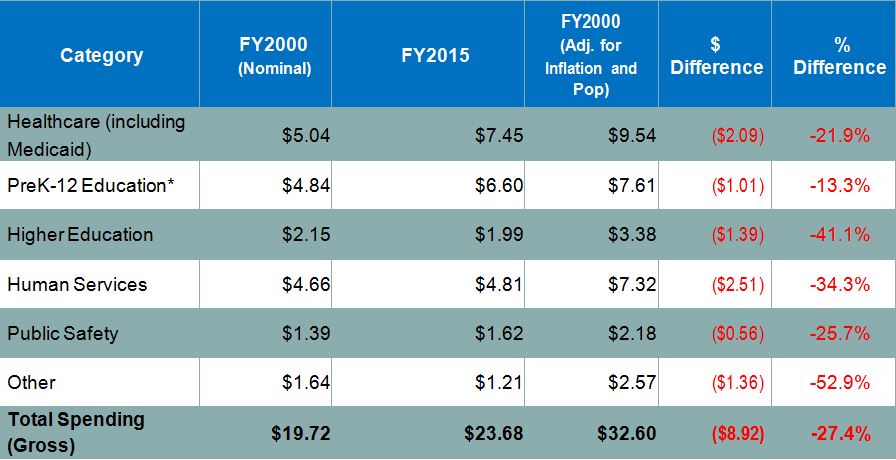
Therefore, spending is not the problem. And spending less has not fixed the problem. Instead, the problem is a structural deficit (see below).
3: “Illinois Needs to Shrink Government by Cutting State Workers”
Illinois is already next to last in the nation.
It ranked 49th in the U.S. in the number of state workers per 1,000 residents in 2011, the most recent year for which comparative data exists.
No, the number of public sector state employees is not driving the budget problem.
4: “Illinois Needs to Reduce Pension Debt By Cutting Pension Benefits”
Overly-generous pension benefits are not the cause of the pension debt.
Illinois tried to cut benefits despite the plain language of the state constitution that states that retirement benefits cannot be “diminished or impaired.” And failed in court.
No, outsized benefits are not the cause of the pension debt. The cause is that Illinois has underfunded pensions over the last 25 years, under both Democrats and Republicans. Worse, Illinois borrowed from the pension systems to fund current services instead of modernizing its tax policy. Let us be clear: Illinois has borrowed from Peter – the pension systems – to pay Paul’s costs – of funding state services.
As if this was not bad enough, the repayment plan for that debt was “backloaded,” that is, annual payments increase each year. The “pension ramp” created thereby is unsustainable: Illinois will never have enough money to pay the costs ramped-up over time.
5: “Illinois is a High Tax State”
Wrong.
As a percentage of personal income, Illinois’ total state and local tax burden usually ranks in the bottom 10 nationally. Of seven Midwest states, Illinois’ tax burden is next to last; only Missouri’s is lower (Senate Revenue Hearing, slide 20).
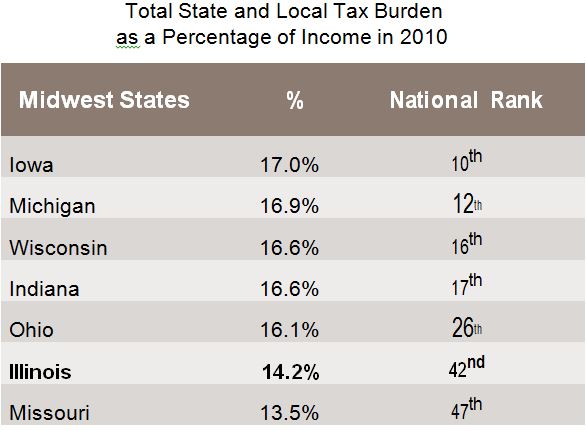
The good news is that because the tax burden is relatively low, Illinois can increase taxes and still remain a low tax state.
6: “Illinois Corporate Taxes are Too High and Driving Business Away”
Not true.
In 2010, before the tax rate was temporarily lowered from seven percent to 5.25 percent, almost 70 percent of corporations paid no tax, and nearly 93 percent paid $5000 or less (Senate Revenue Hearing, slide 23).
Rauner and his business buddies like to complain about Illinois corporate taxes. What they do not say is that the corporate tax is a tax on big businesses – the vast majority of businesses pay little or no tax at all.
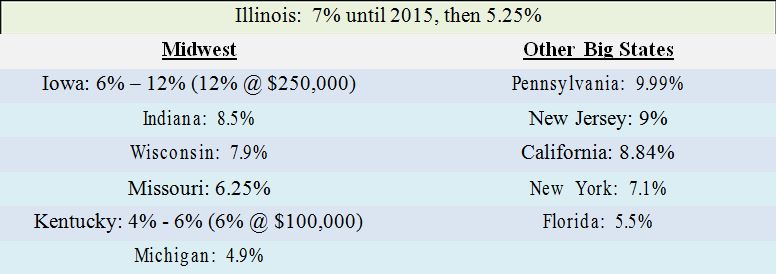
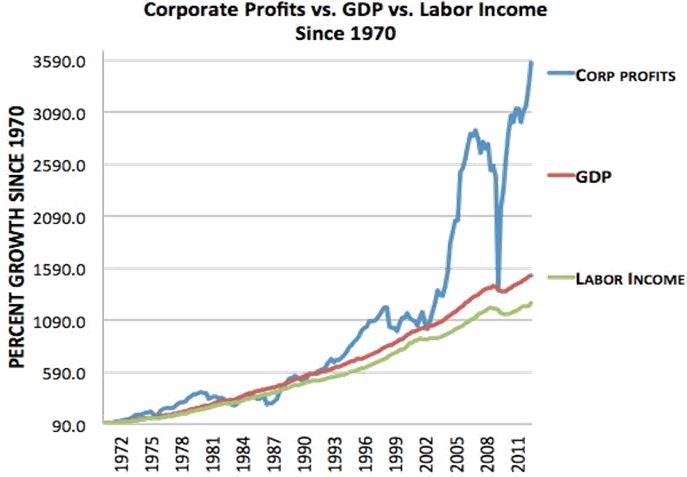
Nor do Rauner & Company willingly admit that corporate profits are at an all-time high in supposedly “business-unfriendly” Illinois.
Using 1970 as a baseline, neither labor income nor GDP has kept pace with increased corporate profits for the 40 years through 2011 (Senate Revenue Hearing, slide 26). Particularly striking is the spike in profits before and after the 2008 Great Recession.
7: “Illinois Needs to Cut Taxes on the Wealthy To Trickle-Down Money to Spur the Economy”
In effect, this is what Illinois did in rolling back the temporary 2011-2014 tax increase from five percent to 3.75 percent.
But the top 40 percent income earners received nearly 87 percent of the resulting tax relief. Meanwhile, the bottom 60 percent of income earners in Illinois—who have experienced real loss in wages over the last 30 years—receive just 13.2 percent, or $491 million of the $3.7 billion in total tax breaks provided by the phase-down.

(lllinois State & Local Taxes Paid as a Share of Family Income for Non-Elderly Taxpayers, Senate Revenue Hearing, slide 12)
The context here is increasing income inequality in both the state and nation. It is the bottom 60 percent who have experienced real loss in wages over the last 30 years.
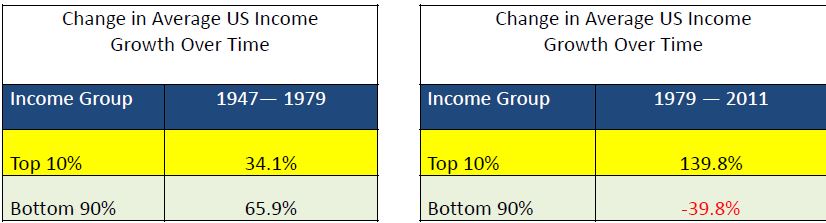
(Increasing Income Inequality, 1947-1979 vs 1979-2011, Senate Revenue Hearing, slide 13)
The rollback in the personal income tax means that tax revenue will decrease from $36.7 to an estimated $32.1 billion in 2016. This constitutes the “fiscal cliff” Illinois is racing towards.
It is worth emphasizing that the Illinois state constitution mandates that the personal income tax be a flat tax – everyone is assessed at the same percentage rate – which by definition makes it a regressive tax – the richer you are, the less you pay as a percentage of income.
The rollback in the personal income tax is also occurring at a time of record corporate profits, as documented above.
The argument in favor of decreasing taxes on the wealthy is that it stimulates the economy. This is one of the pillars of “supply-side” or “trickle-down” economics, one of whose proponents is Arthur Laffer, known for the “Laffer curve.” In 1980 George H. W. Bush accurately termed “Reaganomics” as “voodoo economics.”
It is not only counter-intuitive, but flat-out, empirically wrong. As Nobel-prize-winning economist Paul Krugman puts it, “The classic zombie idea in U.S. political discourse is the notion that tax cuts for the wealthy pay for themselves.” Krugman defines a zombie idea as “a proposition that has been thoroughly refuted by analysis and evidence, and should be dead — but won’t stay dead because it serves a political purpose, appeals to prejudices, or both.”
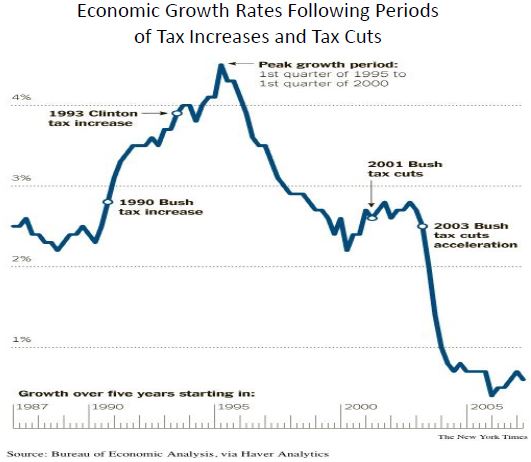
(Senate Revenue Hearing, slide 41)
Rauner hired a Laffer acolyte as his economic advisor at a salary of $30,000 per month. Every leading Republican presidential contender embraces this “supply-side,” “trickle-down” nonsense.
Giving a tax cut to millionaires — which is what rolling back the state income tax rate amounted to — provides no material stimulus to the economy, and actually worsens income inequality in Illinois. Instead, Illinois should be cutting taxes on the less-wealthy to stimulate the economy.
This is because of the “marginal propensity to consume” (MPC). Families with less income have a higher MPC than wealthier families. Generally, those with fewer resources have unmet material needs, so for every additional dollar of income, they tend to spend a higher proportion of that additional dollar than a high-income household. In contrast, a high-income household already has sufficient income and have already purchased their necessities, so that with each additional dollar they are more likely sock it away rather than spend it.
Given that consumer spending accounts for 70 percent of all economic activity, cutting taxes on the less well-off is what stimulates the economy.
What is To Be Done?
1) The cause of the budget problem is the structural deficit in the general fund due to the tax system
The “structural deficit” is the ongoing gap between the cost of maintaining current services, and tax revenue.
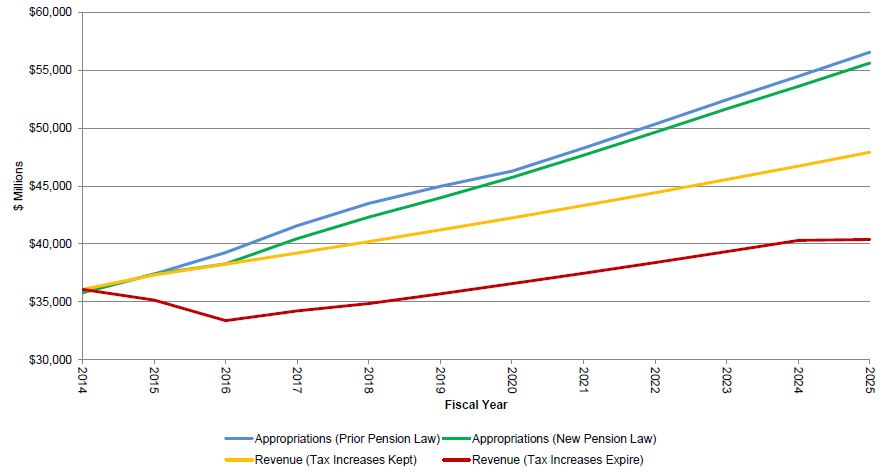
(Going Forward: Illinois Still Has a Structural Deficit, Senate Revenue Hearing, slide 32)
Instead of revising its outdated tax policy to generate more revenue, Illinois politicians, both Democratic and Republican, have chosen for decades to take a “pension holiday,” and borrow from what it owes the pension systems to subsidize the cost of current services not covered by current taxes.
If you are in a hole, stop digging deeper. Yet to pay back the pension systems, Illinois created the “pension ramp,” a repayment schedule that increases annual payments over time to unaffordably high levels.
2) Reform tax policy to generate more revenue
The structural deficit results, in turn, from poor tax policy.
That is the bad news. The good news is that there are a number of ways to raise revenue. And still keep Illinois a relatively low tax state.
a) Reform sales tax policy by expanding the base of the sales tax to include most consumer services
Illinois’ tax code is woefully out of date and needs to be revised.
First, some background. Illinois’s sales tax rate for most goods is 5 percent. However, the state sales tax rate is usually identified as 6.25 percent. This is because, in 1990, the state rate of 5 percent was combined with a local sales tax rate of 1.25 percent. Thus, the 6.25 percent sales tax rate is actually made up of a 5 percent state sales tax rate and a 1.25 percent standard local government sales tax rate. Note that Illinois’ state sales tax rate of 5 percent is below the national average of 5.5 percent.
The purpose of taxes, including sales taxes, is, of course, to generate stable revenue for the state. For a sales tax to do this, it needs to apply to most transactions in the consumer economy. Now, consumer spending both nationally and in Illinois accounts for nearly 70 percent of all economic activity. Moreover, consumer spending usually does not decline substantially, even during major economic downturns, such as the 2007-2010 Great Recession. If a sales tax base applies to most consumer transactions, therefore, that sales tax will provide some stability to a state’s fiscal system.
The problem is that in Illinois this is not the case.
The “base” of a sales tax is simply the basket of items and services that the tax applies to. But Illinois generally taxes goods (such as clothing and furniture), but not services (pet grooming, health clubs, lawn care, and the like). The general sales tax applies only to five of the 168 generally recognized service industry categories. Among the 45 states that levy a sales tax on services, including Illinois, the average number of service industries taxed is 51. Among these states, Illinois ranks dead last in the number of service industries subject to its general sales tax.
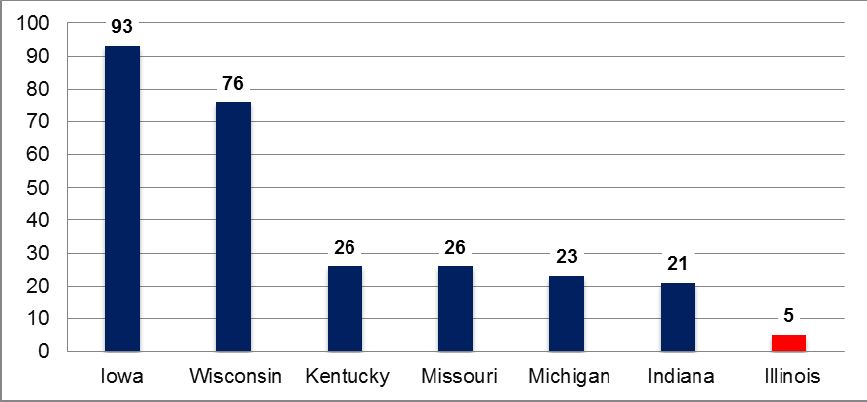
(Number of Service Industries Taxed under General Sales Tax, Senate Revenue Hearing, slide 34)
By excluding most services from its sales tax base, therefore, Illinois is shooting itself in the foot, and making the achievement of fiscal health difficult. For it has created a fiscal mismatch between the really existing state economy, and that portion of the economy taxed to fund public services. On the one hand, the sale of goods as a percentage of GDP declined between 1965 and 2012 from under 41 percent to under 18 percent. On the other hand, the sale of services increased from over 51 percent to over 72 percent (Senate Revenue Hearing, slide 33).
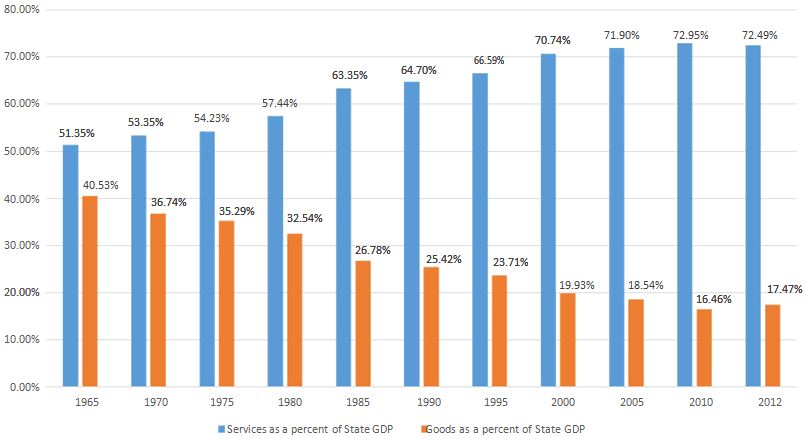
The bottom line is that even as the Illinois economy changes – and grows – the state collects less and less in inflation-adjusted dollars. Measured as a share of the state economy, the sales tax base has lost more than half of its value in the last 45 years.
b) Increase the personal income tax rate from 3.75 percent to 4.75 percent or 5 percent
The temporary personal income rate of five percent 2011-2014 fell back to 3.75 percent beginning this year.
As discussed above, by rescinding the temporary tax increase, Illinois began racing towards a “fiscal cliff” due to the resulting loss of revenue from $36.7 to an estimated $32.1 billion in 2016. This economic reality is why all the politicians realize that as part of the resolution to the current budget stalemate, there will have to be a tax increase — even Governor Bruce is on record as acknowledging this.
It is necessary, therefore, to raise the personal income tax rate to 4.75 or 5 percent. Note that even at a five percent rate Illinois would be a comparatively low-tax state, as we saw above (Myth #5).
c) Tax some retirement income
Of 41 states with a personal income tax, Illinois is one of only five that does not tax retirement income. Yet roughly 18 percent of the state’s population will be of retirement age by 2030, which makes for an overly broad exclusion.
This contributes to making Illinois one of the five most unfair taxing states in the country.
Therefore, tax retirement income, but phase it in gradually from $50,000 adjusted gross income (AGI), so that no low income senior is harmed. Under such an approach, any taxpayer with an AGI under $50,000 would keep the full deduction, and pay no state income tax on retirement income.
d) Increase the corporate income tax rate from 5.25 percent to 6 percent
Recall that despite Rauner Republican rhetoric, most businesses do not pay any tax at all.
At either 5.25 or 6 percent, Illinois would still be low relative to other states – 6 percent would be in the mid-range.
e) Eliminate corporate tax expenditures that do not generate a public good or stimulate the economy
Some corporate tax expenditures do generally produce a public good or service, such as underwriting research and development. Others, however, do not, and should be eliminated. This is the case all-too-often with tax expenditures to stimulate job creation.
f) Impose a Tax on sugary sweetened beverages
This is a no-brainer.
Given out-of-control obesity rates, and Illinois’s current tax code, good health policy and good tax policy both mandate such a tax. Killing two birds with one stone is a win-win.
3) Re-Amortize the Pension Debt
The second major requirement for eliminating the structural deficit is to re-amortize Illinois’ pension debt.
Re-amortization simply means changing the annual repayment schedule for the pension debt Illinois already owes. Get rid of the backloaded, unsustainable “pension ramp” repayment plan. Repay the same amount over an increased number of years, just like a traditional, fixed-rate mortgage.
Illinois can resolve its unfunded liability, grow its funded ratio, meet all system cash flow obligations to pay retirement benefits, and free up substantial current revenue to fund current services by utilizing a level dollar annual repayment of its pension debt of approximately $7.014 billion.
Conclusion: An Economically-Viable, Fact-Based Budget Turnaround

(Senate Revenue Hearing, slide 39)
If Illinois were to increase income taxes to 4.75 percent, tax some retirement income, expand the sales tax base to include most consumer services, eliminate the tax expenditures noted above, and impose a new tax on sugary beverages, the state would raise over $7.9 billion in new revenue in FY2016.
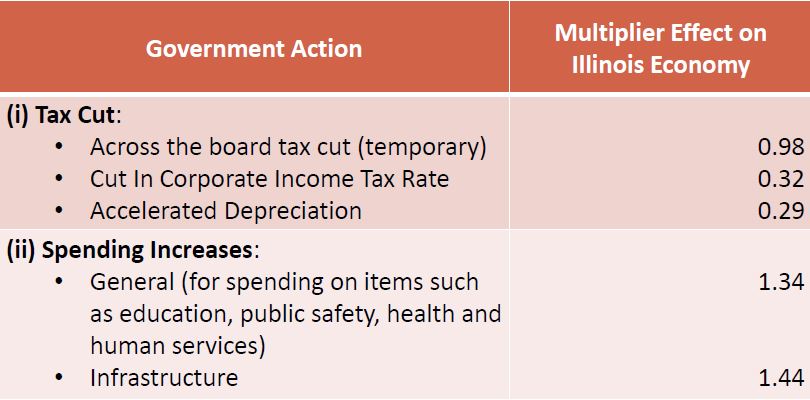
(Increasing Taxes the Right Way: For Every Dollar Spent the Resulting Multiplier Effect, Senate Revenue Hearing, slide 40)
Budget problem solved, economically. The only think lacking is the political will to do it.
David Prochaska formerly taught colonialism and visual culture in the UI History Department
Posted in Uncategorized
Comments Off on Illinois Budget Stalemate: A Third Way
History Matters: Compromising How We Teach Slavery
If you checked your Facebook feed early in October, there is a good chance you saw a news story about a textbook controversy in Texas. In case you missed it, here is what happened. A ninth grader opened his World Geography textbook from McGraw-Hill. He found a map labeled “Patterns of Immigration.” Next to the map was a text box reading, “The Atlantic Slave Trade between the 1500s and the 1800s brought millions of workers from Africa to the southern United States to work on agricultural plantations.”
The student contacted his mother about the page, who then spoke out about it publicly. The story quickly went viral on Facebook and other social media.
Characterizing the forced enslavement of millions of Africans under the category of “immigration” erases the violence and murder wrought by the slave trade. Describing enslaved people as “workers” likewise erases the involuntary nature of their forced toil and the daily violence that structured plantation enslavement.
Due to the outcry, McGraw Hill apologized for the wording, promised to change the online version of the textbook and also to send stickers with alternative wording to cover over the poorly chosen text box.
And maybe those stickers will help solve the problem of the language on that one textbook page. And anyway, why should residents of Illinois care about one textbook page down in Texas?
The History According to Texas
This textbook story is part of an alarming trend that won’t be so easily stickered over. In 2010 the Texas Board of Education approved new guidelines for history textbooks. The vote was bitterly partisan, with nine Republicans voting for the new standards and five Democrats standing against them. The board’s new standards sought to reverse what they termed a “liberal bias” in education. The standards deemphasized the roll of slavery in the Civil War. Instead the curriculum was to characterize the War as a matter of “States’ Rights,” in which slavery was a side issue. The textbooks were also to downplay mentions of Jim Crow laws or the Ku Klux Klan.
The only required primary sources for the Civil War included in the Texas high school curriculum are the inaugural addresses of President Abraham Lincoln and Confederate leader Jefferson Davis. Neither of those sources mention slavery in relationship to the war. Many, many other documents do however focus on slavery as the cause of the war.
This includes Texas’ own declaration of secession, which cites protecting the institution of slavery as the main reason for leaving the Union. One paragraph from Texas’s announcement on leaving the United States read, “We hold as undeniable truths that the governments of the various States, and of the confederacy itself, were established exclusively by the white race, for themselves and their posterity; that the African race had no agency in their establishment; that they were rightfully held and regarded as an inferior and dependent race, and in that condition only could their existence in this country be rendered beneficial or tolerable.” Later the document reads, “By the secession of six of the slave-holding States, and the certainty that others will speedily do likewise, Texas has no alternative but to remain in an isolated connection with the North, or unite her destinies with the South.” This is just one of multiple primary sources that clearly lists slavery as the primary cause of the Civil War.
Many educators, both in Texas and beyond, protested these new standards, forcing the textbook companies to dial back some of the changes. In 2011, Texas passed a law that teachers could choose books not on the state approved list. However, the vast majority of schools still purchase their books from the School Board’s list.
There are five million students in Texas. The state has the second largest school population, behind California. A total of 48 million textbooks across subject matters are purchased in Texas each year. That market share means that Texas influences curriculum on a national scale, as textbook writers want their volumes to sell.
American Exceptionalism
But this attempt by conservatives to change how history is taught has not stopped in Texas. In 2014, the College Board released new national guidelines for the Advanced Placement exam in US History. AP courses allow high school students to prepare and take a test for college level credit. The new framework, amongst other things, places more emphasis on the histories of American women and minorities. It also has more of an international framework for teaching US history.
Conservative backlash quickly flared. The Republican National Committee adopted a resolution in August 2014 calling the changes “a radically revisionist view of American history that emphasizes negative aspects of our nation’s history while omitting or minimizing positive aspects.” In September 2014, students and teachers at four Jefferson County high schools west of Denver staged walkouts to protest local school board demands for a more “patriotic” teaching of American history.
In February of this year, the committee on education in the Oklahoma House of Representatives voted along partisan lines to pass House Bill 1380. It would ban the use of state funds for teaching AP history. The backers of the bill were angry that the new AP standards undermined what they called “American Exceptionalism.” Protests from teachers, parents and students who did not want the legislature deciding what is taught in their classrooms helped stop that bill. Similar protests have emerged in South Carolina and Texas.
What is at stake in all of these protests and counter protests is more than just a couple of pages in a history textbook, or a few questions on a test for college credit.
The subject of history, and particularly the history of race and slavery in America, has always been contentious ground. In the early twentieth century, the historical scholarship on the subject mostly treated the institution of slavery as relatively benign and promoted the racist idea of the inferiority of the African race. Many historians since then have worked to correct this record.
W.E.B. Du Bois’s Black Reconstruction
In 1935, the great scholar, W.E.B. Du Bois wrote his groundbreaking work Black Reconstruction in America as a powerful corrective to accounts that sought to denigrate the contributions of black Americans during the post-Civil War period.
Toward the end of his book, Du Bois attempted to explain why earlier histories failed to accurately wrestle with the histories of African Americans. He wrote, “We fell under the leadership of those who would compromise with truth in the past in order to make peace in the present and guide policy in the future.”
Today we are faced with another push to “compromise with truth in the past:” To smooth over the tough questions in our national history. To tell our children easier stories about ourselves.
But we all must resist such urges. History matters. Because how can we hope to promote justice and equality in the present if we are not willing first to look unflinchingly at our past?
Posted in Community Forum, Uncategorized
Comments Off on History Matters: Compromising How We Teach Slavery
NTFC Local #6546: The Time for Action
The end of October marked a change in the weather in Champaign-Urbana—a few days of rain and a change in temperature that brought Fall to town. And NTFC Local #6546, the union of non-tenure-track faculty (NTTs) at UIUC, was out there in it, with a unified teach-in and rally on the last Wednesday in October. Our members were out on the Quad and in the Illini Union, teaching our classes, meeting with our students, collaborating with our partners, and making our voices heard. In short, we were doing our jobs, making ourselves and our work visible, to highlight our mission, putting Education First.
This action was one of the first major actions with events on all three University of Illinois campuses—Urbana-Champaign, Chicago, and Springfield—coordinated by higher education unions who are all affiliated with the Illinois Federation of Teachers (IFT). These IFT higher education locals include thousands of tenure-track faculty, non-tenure-track faculty, graduate employees, and staff who do a huge chunk of the work of the University of Illinois system. This coalition thus represents much of the core of the educational mission of the University, and is why we’ve been using the motto “Education First.”
As I’ve pointed previously in The Public I, we believe that one of the best ways to embody this motto is to put on display the various ways education really happens at the University of Illinois. This time around, it was teach-in and rally at Urbana-Champaign, a panel discussion on the state budget and higher education at Springfield, and the conclusion of the contract ratification vote at Chicago. Each of these actions represent the ways in which unionized faculty and students really do our work: we teach and rally, we elucidate and discuss, we organized and settle contracts. Unions and their members are committed to all of these activities, and none of them can happen in isolation. Without our specialized knowledge and skills, we can’t teach or research effectively; without bringing attention to the problems of our times, we can’t find solutions; without fair contracts, we can’t effectively do any our jobs.
Earlier that same week, at UIUC’s Annual Meeting of the Faculty, University President Timothy Killeen and Interim Chancellor Barb Wilson addressed the role of NTTs on our campus (which the administration refers to as “specialized faculty”). Killeen described us as “part of our family,” who “need to be listened to” and “respected.” Wilson went on to describe her sense of the administration’s ideal relationship with the NTT faculty: “our goal is to create a stable and strong sense of commitment to our specialized faculty.”
We couldn’t agree more, but Killeen and Wilson both deferred on the mechanisms by which that lofty rhetoric would be translated into action. Wilson mentioned contract negotiations, and that negotiations with NTFC were but one of the more than twenty or so that are ongoing (in one stage or another) at UIUC. Which is quite true. But we have been negotiating our first contract for more than a year, having starting at the beginning of October 2014. To date, we’ve tentatively agreed on only a handful of proposals, and the administrative bargaining has taken more than six months to respond in any way to our economic proposal. They now blame the stalled state budget, but didn’t want to propose such language in the months before the budget crisis, so the delay seems more tactical than anything else.
Our members deserve the “respect” that President Killeen suggests and we demand to be listened to. It’s all well and good to have administrators take a few questions from us at their occasional fora for doing so, but those principles must be translated into the negotiating room. When the administration’s bargaining team proposes that management rights includes their full control over all aspects of “courses, curriculum, and instruction, including content, methods, and instructional material […] the nature and the form of assignments required […] research, research compliance and academic integrity, and other scholarly, scientific, and service-related activities [… as well as] grading policies and practices,” where is the respect? When they retreat to caucus for more than half of each bargaining session, where is the respect? When they aren’t even sure what their proposed language means or why they included it, where is the respect?
NTFC Local #6546 isn’t going away, and we’re not going to wait around for respect; we’re demanding it. We’ll be making our work visible. We’ll be making our demands visible. We are not alone—there are thousands of other union members across the three University of Illinois campuses. And we want the same thing: fair contracts that give us the respect, security, and stability to do our jobs and make the University of Illinois work.
We’re not going away, and we’re not going to wait.
Posted in Uncategorized
Comments Off on NTFC Local #6546: The Time for Action
Art Contest for People Incarcerated
TMK Cleaning service is announcing an art contest for those incarcerated! We will accept submissions from January 1, 2016 through April 4, 2016. This is a contest to enter your best art through poetry, short writing, painting etc. Only published materials will be accepted! Unpublished material will be disqualified. 1ST place will receive $250, 2nd place $150, 3rd place $100. And winners will receive a spot on our website. Details coming soon.
http://teachmeknowledge.wix.com/tmk15
Posted in Prisoners, Uncategorized
Comments Off on Art Contest for People Incarcerated
#BlackLivesMater-CU’s Winter Coat Drive
Black Lives Matter: Champaign-Urbana’s Winter Coat and Outerwear Drive
Many children and families in Champaign-Urbana are in need of winter coats and outerwear such as: gloves, scarves, socks, hats, and boots. Please join BLMCU in our effort to make sure folks are warm this winter. You can drop off items at the Independent Media Center (202 S Broadway Ave, Urbana, IL) the week of November 15-November 21. The drop off times are as follows:
Sunday, November 15: 4-6pm
Monday, November 16: 4-6pm
Tuesday, November 17: 10am-1pm
Wednesday, November 18: 4-6pm
Thursday, November 19: 10am-1pm
Friday, November 20: 4-6pm
Saturday, November 21: 4-6pm
Distribution of items will take place at New Free Will Baptist Church (601 E Grove St, Champaign, IL) on Friday, November 27, from 5-8pm. Please donate if you are able. If not, please spread the word so that we can help those in need.
Posted in Uncategorized
Comments Off on #BlackLivesMater-CU’s Winter Coat Drive
Nov. 30: (T)error documentary at Art Theater
 Mon, Nov 30, 7:00PM
Tickets: $10/Adult, $8.50/Annual Member
Post-show discussion to follow
(T)ERROR is the first documentary to place filmmakers on the ground during an active FBI counterterrorism sting operation. Through the perspective of “Shariff,” a 63-year-old Black revolutionary turned informant, viewers get an unfettered glimpse of the government’s counterterrorism tactics and the murky justifications behind them. Taut, stark and controversial, (T)ERROR illuminates the fragile relationships between individual and surveillance state in modern America, and asks who is watching the watchers? 2015, Dir. Lyric Cabral & Felix David Sutcliffe, 95 min, NR, DCP.
” … something in between Burn After Reading and a Dostoevsky novel, except everything happens for real.” -Newsweek“As the story plays out, the cheap thrill of peeking behind the curtain turns into creeping dread, and then outrage.” -AV Club
” … something in between Burn After Reading and a Dostoevsky novel, except everything happens for real.” -Newsweek“As the story plays out, the cheap thrill of peeking behind the curtain turns into creeping dread, and then outrage.” -AV Club
Posted in Uncategorized
Comments Off on Nov. 30: (T)error documentary at Art Theater
Whither the Refugees, W(h)ither Europe?

Refugees at the de facto refugee camp at Budapest’s Keleti train station. Photo credit: Richard Esbenshade
Since I arrived in Hungary in early summer, the media, and everyday conversations, were filled with the refugee crisis. From the dangerous boat crossings from Libya to Europe’s Mediterranean island outposts such as Lampedusa, Italy, the main flow had shifted to somewhat less dangerous crossings from Turkey to Greek islands, followed by a ferry ride to the mainland, and the land journey up through the Balkan peninsula to the Serbian-Hungarian border. A precipitous drop in UN aid to refugee camps in Jordan and Turkey also caused a sharp upsurge in numbers of Syrians seeking to make their way to Europe. Haggard sojourners from all parts of the Middle East and beyond became a common sight in Budapest, and the underground plaza adjoining the main Keleti train station became a makeshift refugee camp for groups of young men and many families.

“Billboard put up by the opposition ‘Hungarian Two-Tailed Dogs’ Party'”
The Hungarian government’s first reaction was to incorporate the issue into its ongoing propaganda campaign under the rubric of “national consultation.” In rhetoric reminiscent of Donald Trump’s, citizens were warned against criminals and terrorists swamping the borders, taking Hungarians’ jobs and threatening their well-being and identity. Official billboards went up exhorting the refugees, in Hungarian, “If you come to Hungary, you have to follow our laws” and “You have to respect our culture” and “ You can’t take Hungarians’ work.” Given that no refugee could read them, they were obviously put up for political rather than instructional purposes. Many of the billboards were defaced or altered by opponents of the government, and the absurdist “Two-tailed Dogs’ Party” even collected enough funds to mount a counter-campaign, featuring identical-looking billboards stating “If you come to Hungary, you have to wait until someone leaves, so we stay the same number,” “If you come to Hungary, couldn’t you bring a reasonable prime minister?” and, on a less sarcastic note (and in English), “W e love immigrants!”
These “billboard wars” were telling, both because they revealed an undercurrent of resistance, and, depressingly, because the fearful and self-absorbed official slogans resonated far more widely among the general population (which reelected the ruling party by a wide margin in 2014). It is here that the effects of over forty years of Communist rule—and centuries of independence struggles before that—become manifest. Most Hungarians feel themselves part of a noble nation that has been suppressed and downtrodden throughout history. Soviet domination after 1948 continued that pattern, while also enforcing a taboo on expressing and taking pride in national identity. Refugees from war-torn countries threaten Hungarians’ hard-earned sense of victimhood, and visions of the loss of sovereignty and culture surface immediately at any crisis. And, like other eastern Europeans, they still are much poorer than their western counterparts, despite supposed European integration, and feel unable to make further sacrifices to accommodate others, no matter how desperate their situation.
At the same time, this perhaps understandable attitude covers up a major disconnect: practically every Hungarian has a family or other connection to the 200,000 of their countrypeople who fled after the Soviet invasion that suppressed the popular uprising of 1956. Usually walking and with just what they could carry, and once across the border dependent on the kindness of others, these forbears were not so different from the current wave, except for their religion and skin color. And the recent economic crisis, coupled with poor economic management, has pushed another 500,000, mostly young and educated, Hungarian citizens towards the more prosperous parts of the European Union (EU). London, with 300,000 of them, mostly waiting tables or doing construction, is now the second-biggest Hungarian city after Budapest.

“Refugees and the temporary fence–to be replaced by a stronger,permanent one–at the Hungarian-Serbian border”
On July 6, the Parliament approved the construction of a fence along the southern border with Serbia (it is currently being extended to the border with Croatia). This was followed in September by the deployment of the army to try to seal the country off from the onslaught. But this hard-line strategy cleverly takes advantage of several complications of EU laws and policies. EU law makes a sharp distinction between refugees, who are fleeing political persecution or war and must be accepted, and “economic migrants,” who are “merely” seeking a better life, and have no inherent right to stay. The case of the Syrians seems clear—and their ability to pay thousands of Euros to smugglers proves they were citizens with means and positions and not penniless beggars—but they make up less than half of the flow. The cases of others—Iraqis, Afghans, Pakistanis—may be less straightforward. EU rules call for potential refugees to stay in the first EU country they enter to await a decision on their application; in this case that would be Greece, which however is in near economic collapse due to the debt crisis, and has been facilitating their passage northwards without registering them. In addition, Hungary contends that Serbia, though not an EU member, likewise counts as a “safe country,” where Syrians and others could have respite from the violence and persecution that they fled.
The fact of the matter is that hardly a single refugee is willing to stay in Greece, or Serbia, or Hungary. All want to continue north to their promised land, whether Scandinavia, Great Britain or, in the majority of cases, Germany. When I visited the Keleti station in late August, I talked to Hassan, who wanted to go to England, and Taboor, who favored Spain, both Pakistani, but, understandably, neither was very forthcoming about their reasons for fleeing or the route they had taken (nor did they speak more than a few words of English). In what is roundly called Europe’s worst refugee crisis since the aftermath of World War II, when many millions were on the move due to Nazi depredations and the devastation wraught by German-spawned war, the sight of crowds of refugees, prevented from traveling further, chanting “Germany! Germany!” as they took over the main highway leading west from Budapest shows history’s sharp sense of irony.

“Refugees in front of Budapest’s Keleti station at the beginning of September protest their being closed off from the station and further travel”
I also met two middle-aged Hungarian women at the station, Judit and Ágnes, who had spent every day for the past several weeks there distributing hand-me-down clothes, food and blankets. They seemed to have bonded with the mostly young men in that part of the plaza, despite the lack of any common language, and told me that when they saw all the suffering, they had to help. But when I asked them about the border fence being constructed, they expressed unequivocal support for it, since “they shouldn’t come illegally.” They also wondered why the refugees “didn’t just go to Africa, or Dubai,” where they could be with people “more like them.” Many Budapest residents have rallied to try to help alleviate the suffering, either through organizations like Migration Aid that have sprung up, or on their own. But the inconsistent ideas I discovered on the part of these Hungarian women showed how far the population is from developing a coherent, and fully empathetic, perspective.
The government’s inept and often brutal handling of the crisis has caused Hungary’s international reputation to suffer greatly. The September 22 EU decision to distribute refugees according to a mandatory quota for each member country was taken against the strenuous objection of the Hungarian government, joined by Slovakia, the Czech Republic and Romania. These former communist countries, also motivated by their historical identities as “defenders of Christendom,” along the frontier with the Islamic Ottoman Empire, have said they are willing to take on Christian refugees only. This seemingly callous, almost ludicrous stance paints the eastern Europeans as still lagging in terms of compassion and a “European approach.” But the latest diktat from the EU is also an example of what is often referred to as the “democratic deficit.” Policies based on an idealized, West-centered, ahistorical version of what it means to be European are decreed without any attempt to meet citizens’ fears and frustrations on their own terms. As with the debt crisis, the gaps between North and South, West and East are papered over. “Fringe” Europeans are accused of nationalism and right-wing extremism that has no place in the new Europe. This is the kind of self-fulfilling prophecy that threatens not just the newer EU members’ attachment to the Union, but that of all of its citizens—not to mention the future ones being generated by the thousands every day in the Middle East and beyond.
Posted in International, Politics, Section
Comments Off on Whither the Refugees, W(h)ither Europe?
Money and Otherness

Raha and her sister in joyful abandon, sometime in the late ’90s, Vancouver.
I was an immigrant child growing up in Vancouver. I spent a lot of time walking alone, to and from school, through the forested neighborhoods and along the suburban roads. Every day a new experience floating in my mind. Here is where I cultivated my solitude in the act of walking from place to place. This walking would become forever a way to heal. Heal from elementary school exclusion and social drama. Heal from an eating disorder many years later. Sit with and heal from the otherness that followed me and my family the minute we stepped foot on Canadian soil.
Another place I walked to and from many times as a child in Vancouver was Vanleena Dance Academy, nestled in a semi-industrial, somewhat sketchy area behind a rather pathetic shopping mall. I walked to and from Vanleena about twice a week for ballet class. Twice a week was all we could afford to pay for expensive dance classes. I entered the space of affluent white children, many of whom spent every afternoon and evening there, going from ballet, to jazz, to lyrical to tap. Eating their after-school snacks and their dinners all in the same studio lobby. Not only did I look different, but being that I was only there twice a week meant I would always be an outsider. But those two days a week were my salvation, from elementary then high school society, from home, and from the increasingly depressing tone of immigrant life, as it revealed itself as anything but a rags-to-riches story. This would never be the land of opportunity for us.
And the fear of not having enough was something that would subsume and infiltrate a family who never had to worry about such things, and put immense stress on mom and dad so the very nature of their relationship would be forever changed.
I realized tonight that my immigrant childhood experiences forever bound up money with my otherness. That the heavy worry money causes in my life now is so deep and cutting because it reminds at every turn that I am other, and I will always have to struggle to barely survive. Not having money meant also that I couldn’t dance everyday like the other girls, so not having money exaggerated the fact that I was already obviously an outsider.
The panic and anxiety that would fill our home for as long as I can remember were direct consequences of a sense of lack that accompanies immigration and otherness. Like many immigrants, I internalized a belief that I must do in order to prove my worth. If I am not productive, if I am not doing enough, this world will not tolerate someone like me. So not only a deep anxiety about money and lack, but an almost neurotic approach to doing has characterized much of my life. This obsession with doing more and being better were, no doubt, part of the causes of my eating disorder in my early twenties.
For the last 15 or so years, my family and I have struggled for pathways to US permanent residency and found ourselves continually blocked. In that time, the amount of money we have paid immigration lawyers and the US government must be exorbitant. All in an effort to acquire the right to live here, to be here, to just be included.
We have paid a fortune for the right to be here.
We have squandered savings, we have invested hopes, we have shed tears, for the right to be here.
We have worked hard, we have worked passionately, we have given our hearts and minds, for the right to be here.
The economics don’t, and will never, add up.
I learned pretty quickly, nothing about anything is fair.
And I realized today, that money awakens such deep trauma and terror in me precisely because it picks at the scab of my otherness. It reminds cruelly that I will never belong.
I realized tonight that the free-floating, paycheck-to-paycheck life that many of my (particularly West Coast) white friends have lived could never be mine, because this lifestyle is, for me, deeply-engrained trauma. It is not something I can experiment with. It reminds me of the darkest of childhoods, in a small town where I walked everywhere alone, an immigrant girl constantly aware of not belonging.
 Raha is an Iranian-born, Canadian citizen living in the US. Currently, she is pursuing a Master’s Degree in Urban and Regional Planning at UIUC.
Posted in Immigration, Women
Comments Off on Money and Otherness
Our climate is changing, and we’re feeling the dangerous and costly effects right now
Our climate is changing, and we’re feeling the dangerous and costly effects right now
2,200 deaths in India, 1,000 in Pakistan: severe droughts are becoming increasingly frequent on our planet, and those who feel them are primarily developing countries. Natural disasters, such as droughts, are caused by extensive carbon emissions. The largest emitter of carbon fuels in the world is the United States.

Not only is the temperature around the world increasing, average temperatures have risen in most states since 1901, with 14 of the 15 hottest years on record occurring in the twenty-first century. Climate and weather disasters in 2012 alone cost the American economy more than $100 billion. Climate change, once considered an issue for a distant future, has moved firmly into the present. In May, 2014, the US Global Change Research Program released the third National Climate Assessment, an authoritative and comprehensive survey of the available scientific information on the impacts that climate change is having across all US regions and on critical sectors of the economy.
On June 2, 2014, the EPA proposed a common-sense plan to cut carbon pollution from power plants as part of President Obama’s Climate Action Plan. On August 3, 2015, the EPA finalized this plan and our country took a big step forward in the effort to address climate change. The science shows that climate change is already posing risks to our health and our economy. The Clean Power Plan’s finalization will result in an affordable and reliable energy system, while also cutting pollution and protecting our health and environment now and for future generations. Nationwide, the Clean Power Plan will help cut carbon pollution from the US power sector by 32 percent from 2005 levels by 2030.
Although there are limits at power plants for other pollutants like arsenic and mercury, there are currently no national limits on carbon.
Why does cutting emissions matter?
Climate change has real and dangerous consequences for our health, especially for children, the elderly, and the poor, who are the most vulnerable to a range of climate related health effects. Cutting emissions will lead to billions of dollars in public health and climate benefits, now and for future generations.
The Clean Power Plan has the potential to provide public health and climate benefits worth an estimated $34 billion to $54 billion per year in 2030, far outweighing the costs. It reduces emissions and exposure to particle pollution and ozone in 2030 which in turn avoids a projected:
– up to 3,600 premature deaths
– 90,000 asthma attacks in children
– up to 1,700 heart attacks
– 1,700 hospital admissions
– 300,000 missed school and work days
Oil and gas industry sponsors strictly opposed the plan. On their behalf, the National Black Chamber of Commerce launched a PR campaign against the carbon regulations. The public was misinformed that the Clean Power Plan would cost minority communities millions of jobs and increase their poverty levels by more than 25 percent.
Coal Divestment at UIUC
Most recently, a new analysis revealed that $2.6 trillion has been divested in shifting assets as part of the global divestment movement. “This movement has struck a chord with people across the world who care about climate change, and convinced some of the largest and most influential institutions in the world to begin pulling their money out of climate destruction,” said May Boeve from 350.org. One of these institutions is the University of Illinois at Urbana-Champaign, even though it has yet to divest from university endowment funds.

As Anastasia Schemkes, campaign representative of the Sierra Student Coalition, explains, the University of Illinois at Urbana-Champaign became the latest school (of the 300+ campuses working on fossil fuel divestment) to pass a student-wide divestment referendum two years ago. With all votes tallied, they won with 6-to-1 in favor of divestment – 86% of the voting student body demonstrated their support of coal divestment at UIUC!
In a state ravaged by the coal industry, UIUC Beyond Coal had begun working on coal divestment in August 2011, following an incredible student-driven effort that secured a 2017 commitment by the administration to stop burning coal at the campus power plant.
This represents one step forward for the university to stop supporting coal on our campus, but to bring about the end of the nation’s dependence on coal, UIUC will need to stop financial support of the industry as well, Tyler Rotche from UIUC Beyond Coal points out. To become a truly sustainable university, UIUC administration should make public all its coal investments and divest all university endowment funds out of the “Filthy 15”– the dirtiest utilities, coal operators and mining companies in the U.S.
Posted in Uncategorized
Comments Off on Our climate is changing, and we’re feeling the dangerous and costly effects right now
UIUC Sport Scandals
The University of Illinois has been the focus of myriad scandals in the past months. While much attention has been given to the academic and ethical transgressions, there has been relatively little paid to the outrageous behavior alleged to be emanating from the University’s athletic departments.
In early May, Simon Cvijanovic – a former offensive lineman for the Fighting Illini football team – took to Twitter where he alleged that the team’s head coach Tim Beckman forced him to play through injuries.
Cvijanovic said that he was pushed to continue playing after suffering a torn labrum and that during a meeting between Cvijanovic, Cvijanovic’s parents, Coach Beckman and offensive line coach Tom Brattan, Cvijanovic was told the pain was “in [his] head.”
The lineman went on to allege that when he suffered a knee injury, he was initially told that it was no big deal and that he’d be back in two weeks. Ultimately, Cvijanovic had to have surgery where they removed almost his entire meniscus.
He continued by stating that athletes haven’t spoken out because Coach Beckman “and his staff have systematically removed our voices by holding scholarships over our head.”
While facing criticism from much of sports media for having ‘sour grapes’ or an ‘ax to grind’, the University of Illinois fired Coach Beckman on Aug. 28 after an independent investigation into the allegations validated Cvijanovic’s claims. In part, the report stated: “During a preliminary briefing from the external reviewers, [Athletic Director Mike] Thomas said he learned of efforts to deter injury reporting and influence medical decisions that pressured players to avoid or postpone medical treatment and continue playing despite injuries. He also said in some instances student-athletes were treated inappropriately with respect to whether they could remain on scholarship during the spring semester of their senior year if they weren’t on the team.”
Meanwhile, this summer also saw the University face another athletic scandal in soccer. Former Illini player Casey Conine sued Athletic Director Mike Davis, soccer coach Janet Rayfield, sports medicine director Paul Schmidt, trainer Brittany Scott and the UIUC Department of Intercollegiate Athletics over alleged handling of her concussion spectrum injuries.
After suffering a concussion spectrum injury during an October 2014 game where she crashed into an opponent head on, she was not removed from the game. The coaching staff did not take her out despite her collapsing and having a difficult time making it to her feet. She had suffered two concussions in 2013 and that likelihood of more concussions increases if you’ve had previous ones.
Conine also alleges that the trainer – Brittany Scott – told her she was cleared to play despite never seeing a doctor. After playing in two more games, her symptoms got markedly worse and she saw a doctor who diagnosed the concussion. Ultimately she was told that she’d not be medically cleared to play again.
Conine’s suit alleges that the University did not follow its protocols for concussion spectrum injuries, did not protect her health and destroyed a possible professional sport career.
To round out the summer of scandal in UIUC sports, seven former women’s basketball players have also filed suit against the University alleging that Coach Matt Bollant and former assistant coach Mike Divilbiss created a racially hostile environment for the team.
The mostly African American players alleged that there was a series of racially charged comments from staff toward the black athletes. They also said that teams of white players were discussed as being more disciplined and intelligent while teams of mostly black/brown players were unintelligent, undisciplined and playing “west side ghetto” ball. The suit even alleges that the coaching staff had racially segregated travel arrangements for away games.
While the suit is currently making its way through the courts, an investigator hired by the University stated that the claims were unfounded. However, the investigator did note that the former coach Divilbiss was harsh and suggested update for a code of conduct for the coaches.
Taken in isolation, each of these is simply more legal egg on the face of the University at a time when it can ill afford that. However, taken in concert, it is another example of concerning institutional rot at the University of Illinois, right along with the other ethical scandals.
How has Athletic Director Mike Thomas managed to keep his job despite these serious examples of athlete mistreatment and apparent lack of institutional control?
To ensure that players’ medical care, dignity and rights are respected, lawsuits and investigations are a start. But there’s still a long row to hoe when it comes to ceasing the exploitation and harm to college athletes at the University of Illinois and beyond.
Posted in Uncategorized
Comments Off on UIUC Sport Scandals