Rep. Carol Ammons Holds Community Advisory Panels

Newly elected State Representative of the 103rd House District Carol Ammons, is reaching out to Champaign-Urbana community members to bring their passion and expertise to her Community Advisory Panels. Each panel is responsible for following the bills moving through corresponding committees in the state legislature, analyzing them for their impact on the 103rd district and the state overall, providing feedback to Representative Ammons on the bills, and proposing and drafting legislation that is needed. For example, at the first Environment & Energy meeting several proposed House bills were discussed, including one that proposed ending the ban on Bobcat hunting. The panel recommended that Representative Ammons oppose that bill. Each panel has its own dedicated and competent University of Illinois intern to assist with research, writing, and coordination of meetings.

The Community Advisory Panels are:

All Panel meetings are held at Representative Ammons’s office at 407 East University Avenue, Champaign. The office is accessible and parking is available behind the office building.  For more information, call the local office at (217)531-1660 and go to staterepcarolammons.com to sign up for a Panel so you will receive relevant materials before the meeting and be updated on any changes.

Please grab this chance to make a difference for our community and state! This is what democracy looks like!

Posted in Community Forum | Comments Off on Rep. Carol Ammons Holds Community Advisory Panels

Alternative to U.S.-Led War

Sarah Lazare is a staff writer for Common Dreams and an independent journalist whose work has been featured in The Nation, Al Jazeera, TomDispatch, Yes! Magazine, and more. She is also an anti-militarist organizer interested in building people-powered global movements for justice and dignity. This article is an excerpt from a longer article that first appeared in Foreign Policy in Focus.

 Towards a Politics of Solidarity

 A long-term alternative to war, ultimately, can only be built by popular movements in Iraq and Syria. While we in the United States are inundated with images of death and victimization, surviving grassroots efforts on the ground in both countries tell a different story. These countries are not mere geopolitical battlefields — they’re hotbeds of human agency and resistance.


Iraq saw a blossoming of nonviolent, Sunni-led movements against repression and discrimination by the U.S.-backed government of Iraq in 2013. But the Iraqi military brutally crushed their protest encampments. This included the Hawija massacre in April 2013, discussed by scholar Zaineb Saleh in an interview last summer, in which at least 50 protesters were killed and over 100 were wounded. In a climate of repression and escalating violence, civil society organizations from across Iraq held the country’s first social forum in September 2013, under the banner “Another Iraq is Possible with Peace, Human Rights, and Social Justice.”


Amid siege from ISIS, repression from the Iraqi government, and bombing from the United States and its allies, popular movements survive on the ground in Iraq. Groups like the Organization of Women’s Freedom in Iraq are organizing emergency aid for women and families fleeing ISIS — while at the same time demanding U.S. withdrawal, and end to Iraqi government oppression, and reparations for the U.S.-led war.

The Federation of Workers Councils and Trade Unions in Iraq, meanwhile, continues to organize workers against Saddam Hussein-era anti-labor laws that were carried over into the new government and backed by the United States. Right now, the Federation — alongside OWFI — is mobilizing within the country’s state-owned industries, which are undergoing rapid privatization and imposing lay-offs, firings, and forced retirement on hundreds of thousands of workers. Falah Alwan, president of the Federation, explained in a recent statement that the gutting of the public sector is the result of austerity measures driven, in part, by the World Bank and International Monetary Fund. “We are in daily confrontations with the government, by demonstrations, sit-ins, seminars, [and] agitating the other sectors to take part,” Alwan told me over email. “At the same time we are preparing for a wide conference next March, for all the companies across Iraq, that will need support from our comrades in the U.S. and worldwide.”


Both of these organizations are collaborating with U.S. groups — including the War Resisters League, the Center for Constitutional Rights, Iraq Veterans Against the War, and Madre — under the banner of the Right to Heal Initiative to press for reparations for the harm from U.S. policies in Iraq dating back to 1991. Along with damages from the last war and the sanctions regime that preceded it, their grievances include environmental poisoning in Iraq from the U.S. military’s use of depleted uranium, white phosphorous, burn pits, and more.

Likewise, “There are still people and groups in [Syria] who are working through nonviolent means,” said Mohja Kahf, a Damascus-born author and poet, in a recent interview. “And they matter. They are quietly working for the kind of Syria they want to see, whether the regime falls now or in years.” As Kahf argued in a piece penned in 2013, it is critical for the U.S. peace movement to connect with movements on the ground in Syria, not only when they are threatened by bombings, and not only when they are used to win arguments against U.S.-led military intervention.


We in the U.S. left must take a critical — if painful — look at the harm U.S. policies have done to the Middle East, press for a long-term shift in course, and seek to understand and build links with progressive forces in Iraq and Syria. The United States has a moral obligation to provide reparations to Iraq for its invasion and occupation. But these things must be demanded now, before the U.S. spends one day more waging a new armed conflict based on the same failed policies.


Grassroots movements did offer an alternative to endless war following the 2003 invasion, and that needs to happen again. This dark time is all the proof we need that the U.S. must get out of the Middle East once and for all, and the pressure to do so is only going to come from the grassroots.
iraq-war-syria-obama-isis-military-intervention-advisers-special-forces-diplomacy


Next Steps


Building international solidarity takes time, but you can get started today. Here are a few suggestions for productive next steps anyone can take.

Direct Support. Donate to relief efforts on the ground in Iraq and Syria that are orchestrated by grassroots organizations seeking to help their communities survive in the face of ISIS. The Organization of Women’s Freedom in Iraq has been working to provide food and winter survival gear to people fleeing ISIS and maintains shelters in Baghdad and Karbala. Furthermore, they have created a “Women’s Peace Farm” outside of Karbala, which provides “a safe and peaceful community” for refugees, according to a recent OWFI statement. Direct donations to this work can be made at OWFI’s PayPal account.

Learn. Now is a critical time for U.S.-based movements to educate ourselves about both the histories and current realities of struggle and resistance in Iraq and Syria, as well as Afghanistan, Yemen, Pakistan, and beyond. A forthcoming book by Ali Issa, field organizer for the War Resisters League, will be important reading for anyone interested in learning more about Iraqi social movements. Entitled Against All Odds: Voices of Popular Struggle in Iraq, the book is based on interviews and reports highlighting environmental, feminist, labor, and protest movement organizers in Iraq.


In the process of learning about civil societies in Iraq and Syria, it is important to avoid simplistic equations that reduce all opponents of Assad to agents of the U.S. government, and likewise regarding opponents of ISIS. As Kahf emphasized in her interview, “It is racist to think that Syrians do not have agency to resist an oppressive regime unless a clever white man whispers in their ear. … Syrians can hold two critiques in their minds at the same time: a critique of U.S. imperialism and a critique of their brutal regime.”

There is also a great deal to learn from U.S. civil society, including the powerful movement for black liberation that continues to grow nationwide. From Oakland to Ferguson to New York, people are showing by example that justice and accountability for racism and police killings will not be handed from above, but rather must be forced from the grassroots. This moment is full of potential to build strong and intersectional movements with racial justice at their core — a principle that is vital for challenging U.S. militarism. The Stop Urban Shield coalition — comprised of groups including Critical Resistance, the Arab Organizing and Resource Center, the War Resisters League, and the Malcolm X Grassroots Movement — powerfully demonstrated the connection between domestic and international militarization when they kicked a global SWAT team, police force, and mercenary expo out of Oakland last September.

Ultimately, solidarity with Iraqi and Syrian people will require more than a push to end the U.S. bombings, but long-term pressure to steer away from U.S. policies of endless war and militarism, in the Middle East and beyond. Building consciousness across U.S. movements is critical to this goal.


Pressure the U.S. government. Grassroots mobilization in the United States can play a vital role in preventing lawmakers from charging into war. This was recently demonstrated when people power — including overwhelming calls to congressional representatives and local protests — had a hand in stopping U.S. strikes on the regime of Syrian President Bashar al-Assad in 2013. Mass call-ins, as well as scattered street protests, also had a hand in preventing war hawks from passing new sanctions in the midst of talks with Iran last year. It will be important to closely track any Obama administration attempt to pass explicit authorization for the war on ISIS, as well as congressional efforts to sabotage diplomacy with Iran.

Posted in military, Politics | Comments Off on Alternative to U.S.-Led War

A Running List of CU Businesses Supporting White Supremacy

UIUC’s chief is a proud tradition…of white supremacy

UIUC’s chief is a proud tradition…of white supremacy

Offensive imagery is a big problem on our campus.  That is, the entrenched white supremacy that formed and birthed my institution of higher learning resists erasure in powerful ways.  Each year we see a familiar slew of problems – in residence halls, some students hang Confederate flags and declare their southern pride; others, like the skinhead and ROTC student on the first floor of my friend’s apartment building (on campus) not only proudly displays a large Swastika flag and Nazi paraphernalia to all outside his window, but also blasts Third Reich-era music during weekend ragers (it’s okay, the apartment is “world war two themed.”)

Actions like these are rarely addressed, but they are at least generally frowned upon by administrators and students alike.  Yet an exception is made when it comes to the racist fake Native imagery around town, surrounding our school’s former mascot.  We in the Champaign-Urbana community constantly see the casual pardoning of blatantly racist bullshit when it comes to the Chief, whether we’re in class, out socializing, or just walking around campustown.

This trope plays out in particular around Unofficial St. Patrick’s Day every Spring.  What sets this holiday apart from the vast majority of banal student-coined drinking holidays across American universities – aside from Unofficial being invented by local bar owners instead of students themselves – is that many fiscally-minded students and community members take this opportunity each year to further a number of racist images revolving around the fictional Chief Illiniwek, our school’s former mascot.  T-shirts are sold and kitschy memorabilia distributed, all celebrating our school’s extremely racist and not-so-distant past icon.

Binge drinking isn’t healthy, but it’s honestly a personal choice, and it’s college, so you might not be surrounded by those who use alcohol responsibly, particularly if you’re a member of the Greek system.  But drinking aside, I stand with my fellow embarrassed university alumni and students who have had our inboxes flooded each year with unsolicited advertisements for Chief-themed paraphernalia.  We are embarrassed that while our university and various departments send us students emails year after year asking us not to participate in glorifying alcohol abuse for this “dying holiday,” never have the racist images that reemerge each March been publicly addressed.

My friend Ross recently asked his Facebook friends to give him the names of businesses in the Champaign-Urbana community who support fake Native American imagery so he can withhold his patronage from them.  Based off comments on that thread, I’ve created what I hope will become a running list of businesses, administrators, and organizations in the UIUC community who actively support white supremacy, settler colonialism, and anti-Native sentiment in the name of “protecting tradition” and propagating irresponsible and racist depictions of indigenous peoples.

In short, if you’re going to sanction and hallow white supremacy in the name of making a buck, we are not going to support your business.  Below are some of the places (and people) to avoid in Champaign-Urbana, listed along with their specific transgressions, if possible. Without further ado, here are your neighborhood establishments to boycott for their endorsement of racism:

Bars

Legends – their website displays the photo of a man in a Chief costume and reads: “The Chief Lives On at Legends: Come see the life-sized statue commemorating Chief Illiniwek and other Illini legends.”  If being assailed by a polyester, life-sized racist costume behind a glass case is your thing, stop by Legends honor these Legendary acts of white supremacy and more with daily drink specials.

KAMS: Home of the Drinking Illini – so that’s the actual full name of the bar?  Not surprising.  If the place’s vomit-imbued atmosphere and dank fraternity vibe wasn’t enough reason to skip out, the large murals of the Chief displayed on the floor and wall inside and outside might be another reason.

Restaurants

TGI Fridays – a gigantic Chief mural is emblazoned across the wall of their restaurant.  The community considers them martyrs for keeping this up.  (UPDATE: this branch is apparently recently closed.)

Orange and Brew

Dos Reales – Chief paraphernalia on display

Zorba’s

Stores

Evergreen Tobacco – among other Chief products, they apparently sell this travesty of a shirt.  If you’re really set on purchasing expensive smoking products on campus, make sure to buy your cigarettes, cigars, hookahs, and weed-rolling shit elsewhere.

Te Shurt – a slew of fake Native imagery is mostly how this clothing business makes a profit.  Our school’s former mascot stands as a statue in the display of their store, half a block from the heart of campus.

T.I.S Bookstore – an entire department of racist paraphernalia and merchandise is featured on their website and in the store.  A large picture of white men dressed as Native Americans is emblazoned on a far wall and a life-sized cardboard cutout (of white dude dressed as the Chief) is placed near the exit.

Realty Offices

Village at Colbert Park – they handed out Chief-themed shirts to advertise for their rental apartment properties last year.

University Affiliates

Office of the University President – has a Chief mascot displayed in a painting on his wall.

Our current Student Trustee – purportedly has a Chief flag displayed in his office.

Sports

The UIUC Hockey team – they have Chief insignia on each of their team/sweater polos

Football Games – do not. Do not. Do not go if you are triggered or upset by anti-Native racism.

* * * * *

Blacklisting these businesses is a good start.  Emailing the owners (especially if they’re corporate branches?) might be a good idea as well, in addition to informing them directly why they are no longer going to receive your patronage.

I know I’m missing quite a few.  What did I forget? I’ll also keep this list as a running resource on my website.  Fill me in by sending me an email at arealrattlesnake.com and I will update the list as necessary; if the above information is inaccurate, let me know as well and I’ll update it with apologies.  If an establishment removes their racist image, I will remove them from the list.

Posted in Indigenous, University of Illinois at Urbana-Champaign | Comments Off on A Running List of CU Businesses Supporting White Supremacy

#BlackLivesMatter Protests Locally

Along with others across the nation, people of Champaign-Urbana have held protests, die-ins, and marches. Below are photos from some of the events. On Tuesday, November 25, CU Citizens for Peace and Justice held a demonstration outside of the county courthouse and blocked off Main Street for an hour.

Black Lives Matter lg

On Monday, December 8, UIUC students held a die-in at the Alma Mater.

UIUC Die-in (Credit: Jeff Putney)

UIUC Die-in (Credit: Jeff Putney)

(Credit: Jeff Putney)

(Credit: Jeff Putney)

(Credit: Jeff Putney)

(Credit: Jeff Putney)

Students at Centennial and Central High Schools in Champaign organized protests. On Wednesday, December 10, Central students marched after school.

Central High School students march

On Friday, December 12, Students for Justice, made up of students city-wide, held march with people lining Springfield Ave. in Champaign.

Students for Justice along Springfield Ave. (Credit: Danielle Chynoweth)

Students for Justice along Springfield Ave. (Credit: Danielle Chynoweth)

BLM poster


Posted in Policing, Voices of Color | Comments Off on #BlackLivesMatter Protests Locally

Neo-Liberalism and a UIUC/Carle Medical School

It is no longer necessary to argue that corporatization, the neoliberal application of business practices to the university, is occurring at UIUC. The latest example is the proposed public-private UI-Carle medical school spearheaded by Chancellor Phyllis Wise. “This article resonates with me because our goals of a COM [College of Medicine] in Urbana-Champaign will rely predominantly on our convincing many of our generous and passionate donors of the critical importance of our project.”

Andrew NYT article redone

“This article” refers to a New York Times piece linked by Fox-Atkins CEO Peter Fox in a March 14, 2014 email to Wise, which she commented on and forwarded to 14 folks. The article, “Billionaires With Big Ideas Are Privatizing American Science,” describes how since the 2010 Tea Party takeover of Congress, the previous “bipartisan consensus” that lead to federal science funding “rising steadily for decades” has “eroded,” leading to an approximately 25 percent fall in spending on basic research in 2013, “one of the sharpest declines ever.”

Not only do Fox, Wise, and their cronies see nothing wrong with this Tea Party-driven defunding of public research and concomitant increased funding by billionaires. They cynically embrace it, seeing it as another golden business opportunity, to profit still more from the American for-profit healthcare system.

Conservatives like to complain about what they see as big government over-regulation and slow-moving bureaucracy. But at least the National Institutes of Health and the National Science Foundation make an attempt to allocate research funding based on rigorous professional standards, open competition, and peer review. Their overall goal is improving the general welfare of everyone.

“Fundamentally at stake,” however, “is the social contract that cultivates science for the common good,” as the Times says. For today, the more research is privatized, the more money targets the personal interests, and pet projects of the super wealthy. This is especially true of medical research, where “a number of the campaigns, driven by personal adversity, target illnesses that predominantly afflict white people — like cystic fibrosis, melanoma and ovarian cancer.”

CCU facility fee

Meanwhile, taxpayers in Urbana are reeling from Carle going off the tax rolls, because it successfully lobbied Springfield through the Illinois Hospital Association – which Carle CEO James Leonard headed at the time — to expand the definition of so-called “charity care” in 2012 legislation. After paying $4.6 million taxes in 2009, Carle paid zero in 2013.

This is the exact opposite of what Leonard and Carle Clinic CEO Bruce Wellman pledged in 2009 when the two entities were merged into a non-profit. “If a merger bringing the currently for-profit Carle Clinic under the not-for-profit organization of Carle Foundation Hospital is approved, Carle plans to make payments in lieu of taxes at the current tax level.”

Back in 2002 Carle agreed to make a lump sum payment to Urbana in lieu of taxes, generally referred to as PILOT, of $450,000 to the school district and $175,000 to the park district, plus $20,000 per year for the next five years. Late in 2014, and long after Urbana had taken Carle to court over nonpayment of taxes, Carle independently made its own guessestimate of what it owed Urbana, and cut checks totaling $100,800. With a pending lawsuit, Urbana tore up the checks. However, they would have constituted only a drop in the bucket compared to the nearly $5 million dollars Carle had paid previously.

That’s not all. Medicare is fining Carle for readmitting too many patients within 30 days of their initial visit for medical issues requiring treatment. Carle is weighing whether to do what is necessary for the government to recognize it as an Ebola treatment center, a certification that the UI Chicago medical center – with whom they are competing for the proposed UI medical school — has already received.

CCU yard sign2

In addition, the Chancellor sent staff to testify in July 2014 in support of Carle’s request for additional surgical beds, a request that had nothing to do with the UI-Carle medical school. After the staffer in question was criticized for conflict of interest, she tore up rather than cash the checks Carle wrote to reimburse her.

No wonder Urbana-ites have formed Concerned Citizens of Urbana (CCU) to push back against Carle. They have created a website, organized community meetings, and dotted Urbana with yard signs. “My Family Pays Carle’s Share of Taxes,” says one. “Carle’s ‘Charity’ Medical Care Paid for by Urbana School Children,” reads another.

CCU yard sign

Attention has focused, therefore, on Carle. But the 800-pound gorilla in Urbana’s room that goes mostly undiscussed is UIUC. As a nonprofit, the University also does not pay taxes. Some years some chancellors have made some payments in lieu of taxes, de facto PILOTs. Below are the annual amounts paid to the school district (first column), from which an amount went to the library (second column):

1994-1995 $158,000 $14,950
1995-1996 through 1999-2000 $317,000 $30,000
2000-2001 through 2009-2010 $365,300 $34,500
2010-2011 $240,000 $22,560
2011-2012 through 2014-2015 $100,000 $9,400

Chancellor Wise’s office has informed Urbana that funding will end in 2015.

North Campus 1985

Moreover, UIUC has bought up significant amounts of land between 1985 and 2005. The National Center of Supercomputing Applications, the Seibel computer science building, plus the parking structure east of the Beckman building – all were built on land formerly on the tax rolls.

North Campus 2005

To top it off, Urbana is home to the research park that didn’t happen. That’s right: along with what is referred to as the South Campus research park in Champaign, there was discussion of a North Campus research park in the late 1990s and early 2000s. In May 1999, a 50-plus page Request for Proposals for a “Science & Engineering Technology Commercialization Initiative” for both a North and South center was issued, with what response is unclear.

Libby RFP

While Chancellor Wise is ending PILOTs in Urbana, she also has raised the possibility of “a ring of [tax-paying] businesses associated with biotech” surrounding her proposed medical school. What she did not tell Urbana is that if such a venture materializes the smart money is on it being located in the Champaign Research Park. Rubbing it in, she declined Urbana Mayor Laurel Prussing’s invitation last month to meet and discuss Carle in a public forum.

Meanwhile, the Wise-led public-private proposed medical school has hit some road bumps. For as long as the Steven Salaita affair continues – and it continues unabated – it acts indirectly as a powerful drag on getting her medical venture off the ground, and getting “generous and passionate donors” on board.

The UI Board of Trustees has also raised more questions than the friendly audiences in Champaign-Urbana. It has charged UI President Robert Easter with evaluating the competing UI-Carle and UI-Chicago medical school proposals in March. Given his loyalties to the Urbana campus — including loyally seconding the Chancellor concerning the Salaita matter — this assignment will certainly put his professional judgment to the test.

Wise faces a similar test, although she likely sees it simply as business as usual. When she was named to Governor Bruce Rauner’s transition team, the consensus of her supporters was that UIUC was ensured thereby a seat “at the table” of the deciders. Her Republican and neoliberal views fit Rauner’s neo-liberalism-with-a-vengeance to a T. A private sector member of the top 1/10 of one percent of all Americans governing the public sector, Rauner intends “to use the governor’s residence to do the government’s business… and I’m going to entertain them [companies] at the governor’s residence… and make it a nice place to do the people’s business.”

Rauner will generously serve the people for an annual salary of $1 and no benefits. To fight “corrupt” public sector unions, he has already amassed $20 million in his PAC, including $10 million of his personal fortune, for his new, right-wing, anti-union campaign. All this springs from his idea of “ethics,” his wanting the state to act “ethically.” Like the business practices he pursued in becoming wealthy.

The ethically-challenged do not understand by “ethics” what the rest of us do. Wise — the decades-long serial self-plagiarizing researcher, sending her staffer to lobby for Carle — engages in prima facie conflict of interest by sitting simultaneously on the UI Research Park Economic Development Advisory Group with the Busey Corporation board president, and on the Busey Corporation board. As Chancellor, sees no contradiction in overseeing annual ethics training at UIUC from the top down, but not from the bottom up.

Given the virtual certainty of Rauner’s impending higher education spending cuts, how exactly will Wise spin her role? Voting to slash the budget of UIUC, the institution that she was hired to serve?

It all comes together in neoliberalism, “capitalism with the gloves off.” A proposed public-private UI-Carle medical school. Chancellor Wise acting in concert with Carle’s Leonard, the Research Park’s Fox, and Busey Corporation’s board president. But not consulting faculty regarding Salaita. Taking a page from the national Tea Party playbook concerning billionaires, who pursue their private research agendas that dovetail sometimes with those of the general public. Not to mention wealthy donors. Carle and UIUC refusing to compensate Urbana for lost revenue from properties they have rejiggered off the tax rolls. All the while, their economic interests trumping good citizenship.

Is Phyllis Wise a public sector CEO? A private sector Chancellor? Is there any difference? Yes, yes, and no.

January 13, 2015

 This is the second in a series of articles. The first can be found online at www.https://publici.ucimc.org/?p=50834

2014 10 30 fur ball FullSizeRender

David Prochaska formerly taught colonialism and visual culture in the UI History department

Posted in Uncategorized | Comments Off on Neo-Liberalism and a UIUC/Carle Medical School

Groundswell Organizing and Obama’s Executive Action on Immigration

After President Obama signed his executive action on immigration last November, immigrant activists commended the president for his decision, which might help up to 4 million undocumented immigrants normalize their status, and at the same time emphasized that this action is not enough because it leaves another 7 million behind.  This new executive action follows a similar action in 2012 that protected “DREAMers”, or undocumented immigrants who came to the US as children, which is estimated to benefit 1 million residents.

With these actions the president is trying to rebrand himself as an advocate of immigrants. And while his executive action will clearly benefit many families and communities, it does not erase his track-record of fracturing families through 2.3 million deportations, more than any other president in US history.  This record has rightly earned Obama the title of “Deporter-in-Chief.”

The majority of deportations over the past 5 years have been processed through a program with the Orwellian title of “Secure Communities.” Far from protecting local communities, it has led to the fragmentation of immigrant families, and in large measure contributed to 3 million children orphaned by deportations. “Secure Communities,” or “S-Comm”, was designed during the Bush administration but implemented under Obama.  With his recent executive action, the president has now discontinued “Secure Communities,” and he replaced it with a program he claims will protect most immigrants (that is yet to be seen).

Obama’s Mixed Record

The national media is now caught up with the question of Obama’s legacy: will he be remembered as the “Deporter-in-Chief” or as the president who helped 5 million undocumented immigrants?  Is he a friend or a foe of immigrant families?

Personally, I think this is the wrong question to ask.  President Obama is a political actor, and as such, he responds to political pressures based on how he thinks it will affect him politically.

Obama’s policy record on immigration, like his record on the many other issues of our time–perpetual war, mass surveillance, the criminalization of communities of color–is mixed at best.  Yes, in some ways his policies have curbed Bush era policies. And at the same time other Obama policies have entrenched and even expanded upon Bush. With his executive actions, Obama’s policies will help immigrants, and through “Secure Communities” he has broken up millions of families. Given the totality of his record, there is no reason to give the president much credit.

The real issue is not whether President Obama is a defender of immigrant families or not. The story of the day is how immigrant activists successfully pressured the president to be in a position where he had no other option but to take decisive steps.  As Arturo Carmona, Executive Director of the immigrant advocacy organization Presente, said, “this was not a victory for President Obama and the Democrats. This was a resounding victory for the grassroots, for immigrants and Latino families.” And I might add: this was also a victory for immigrants and allies in our own community.

Grassroots Power

In 2010, I began organizing with local leaders, undocumented students and allies at UIUC, immigrant families and advocates, and together we founded the group that is now known as the “C-U Immigration Forum”.   Through this campaign I met and learned from activists, such as Andrea Rosales, an undocumented student leader at UIUC who was part of the student group La Colectiva, and who in 2011 participated in a civil disobedience action in Atlanta.  She and seven other undocumented youth from around the country sat down in the middle of the street to block traffic.  They were protesting the failure of Congress to pass the DREAM Act, as well as national and state policies that criminalized undocumented students.  They were arrested and held for possible deportation, but then released due to a well-organized pressure campaign.  The bold actions of Andrea and other immigrant youth activists, who risked being torn apart from their families and friends through deportation, was what eventually forced Obama to grant administrative relief to undocumented youth in 2012.

I also met and worked with another student member of La Colectiva, Jesse Hoyt.  Jesse was interested in expanding the work of La Colectiva beyond campus, and these initiatives helped give rise to the Immigration Forum. Later, in 2013, Jesse organized a community coalition of mostly black and Latino residents to stop the construction of a for-profit immigrant detention facility in Joliet, Illinois.  And more recently, Jesse was the Field Director on Carol Ammons’ successful campaign for State Representative (IL-103), which was similarly a bottom-up campaign of grassroots coalition-building and community power.

Starting in 2010 and with the members of the “C-U Immigration Forum”, I designed and organized a campaign to pressure the Champaign County government to opt-out of “Secure Communities”. While “S-Comm” was a federal initiative, it relied on local authorities to hold immigrants without a warrant in county jails.  Under “Secure Communities”, the Champaign County Sheriff’s Office began holding hundreds of immigrants per year.  Through Freedom of Information Act requests, we learned about this practice and brought it to broader attention.  We also organized mass know-your-rights trainings and town hall meetings to pressure local officials, and specifically Sheriff Dan Walsh, to sever ties with federal deportation agents. And in 2012, after an ongoing campaign of shaming the Sheriff’s Office, and community organizing drives designed to build our collective power, Walsh eventually caved and agreed to stop holding immigrants.

Because of our successful campaign, an estimated 200 immigrant families per year in Champaign County have escaped the ordeal of being torn apart because of a held or deported family member.   Our local campaign was actually a national pioneer. With our 2012 victory, our county became the 7th nationwide to opt-out of “Secure Communities”. Since then, local campaigns around the country have succeeded as well, and an additional 257 localities stopped enforcing the program. Now this movement has reached the White House. “S-Comm”, which was originally touted as a more “humane” deportation policy, intended only to target criminals (a thoroughly debunked claim), is now a source of shame for the administration.

Jeh Johnson, the Secretary of Homeland Security, and hence the nation’s highest-level deportation authority, wrote in conjunction with Obama’s executive action: “The goal of Secure Communities was to more effectively identify and facilitate the removal of criminal aliens… But the reality is the program has attracted a great deal of criticism, is widely misunderstood, and is embroiled in litigation… Governors, mayors, and state and local law enforcement officials around the country have increasingly refused to cooperate…”

Of course, immigrant and ally activists did not “misunderstand” the so-called “Secure Communities” program. Through its effects on our families, our friends, and our neighbors, we became keenly aware of the violence and tragedy that it brought to our communities. But Secretary Johnson did get something right: it was not Obama or the Democrats that won this victory, it was our own communities that stood up against it, spoke truth to power, forced local authorities to discontinue cooperation with the federal government, and by extension forced the Obama administration to finally act, and to grant administrative relief to 5 million immigrants and to discontinue the disastrous and shameful “Secure Communities” program.

And yet, there is still much organizing to do… La lucha sigue!

Aaron Johnson-Ortiz has worked as a labor and community organizer in Champaign-Urbana since 2010.


Posted in Immigration, Latino/a, Politics | Comments Off on Groundswell Organizing and Obama’s Executive Action on Immigration

The Conundrum Over ISIS: The Issue of International Responsibility

In the November/December issue of the Public i, my colleague Susan Shoemaker wrote a very compelling article against the use of U.S. military strikes against ISIS in Iraq and Syria.  After citing opinion polls finding that while 73% of Americans favored bombing ISIS, only 51% thought it might actually “work,” she asks a very poignant question: “What are the moral implications of a people that approves of bombing other countries even though they are not confident that it will help?”

Before probing the issue further, I will say at the outset that I completely agree with Susan that US interventions in other countries, from the overthrow of democratically elected government in Iran and Guatemala in the 1950s to the invasion of Iraq, have been a disaster morally and politically.  The one exception to that in my mind was Clinton’s decision to join other NATO countries in trying to stop the Serbian encirclement and bombardment and sniping of civilians in the multi-religious and multi-ethnic city of Sarajevo.

Since I did think that the military force used against the assault on civilian citizens in Sarajevo was the right thing to do, it is obvious that while I hate war I am not a complete pacifist.  The default position for me has always been against war.  But, under certain conditions, I do think that nation states that have the capability to do so are under an obligation to attempt to come to the relief of victims of those who commit gross violations of international human rights and humanitarian law.

Gross Violations
ISIS engages actions that, taken as a complex, constitute a height of humanitarian law violation that is well beyond the norm even for habitual violators. Some of my progressive comrades have contended that it is just media hype, some have tried to diminish the significance of those violations by analogies to rights violations in or by the United States or other Western countries.  I have been extremely critical of those as well, but I think that ISIS represents something much worse.  For a more complete rendering, I would refer the reader to Amnesty International’s report on ISIS, “International Humanitarian Law and the Conduct of the Islamic State,” and to the Report of the Independent International Commission of Inquiry on the Syrian Arab Republic, called “Rule of Terror: Living under ISIS in Syria.”  These are not documents put out by the U.S. State Department.  Indeed, Amnesty International has been very critical of U.S. human rights violations, both domestic and foreign.

Prelude to an ISIS beheading

Prelude to an ISIS beheading

In summary, these reports substantiate that ISIS uses its military might to kill people who are not Muslims or who do not conform to their special brand of Islam, to rape and capture women in these other groups in order to place them in sexual slavery, to execute prisoners it takes, to decapitate hostages (including American civilians) and distribute the videos of this hideous process over social media, to torture and kill people who speak out against their actions, to oblige children to watch and sometimes participate in their atrocities so they will become willing recruits in the barbarity, to forcibly displace people on the basis of their ethnicity or religion, and to destroy the cultural heritage represented by mosques, churches, monuments, and other cultural relics that have survived over centuries.  In other words, what the Nazis did to the Jews, ISIS does to everyone who falls under their control and refuses to accept their religious and ideological beliefs.  ISIS represents genocide on steroids.

International Obligation
It is rare that states act out of pure altruism.  Aside perhaps from the very generous development and humanitarian assistance programs provided by the Scandinavian
countries in the global South, some calculation of interest is mixed with altruism.
But if we admit that ISIS is as bad a violator of humanitarian law and human rights as I and international human rights organizations contend they are, and if we admit that there is a moral obligation to try to spare as many people as possible from falling under their control, we are going to have to rely upon the intervention of the military forces of states that have the capacity.  It would be nice if the United Nations had such a force, but it does not.  It can supply “peace keeper” soldiers from countries willing to offer them.  But these Blue Helmets are not an offensive fighting force, as was evident in the 1995 Srebrenica massacres of approximately eight thousand Bosnian men and boys by a Serbian force that the peacekeepers could do nothing to stop.  Thus, both UN Secretary General Ban Ki Moon and the U.N. Envoy to Syria, Staffan de Mistura, have called for nations with the capability to come to the aid of the people of Kobani.  De Mistura said: “You remember Srebrenica. We never forgot and we probably never forgave ourselves for that.”  (New York Daily News online edition, October 10, 2014)

No internal force in either Serbia or Iraq could have come to the assistance of the Yazidis
(members of a Kurdish religion linked the  Zoroastrianism of ancient Mesopotamia), other Kurds, Christians, secularists, or non-ISIS Muslims.  The only countries able to do that were countries that had a significant military air capacity.  The U.S. had the greatest capability, but at least five other states have engaged in air attacks against ISIS.
I think that there was a moral obligation to do just that, even if that also served other US interests.  It is obviously in the interest of the United States to not have Iraq and Syria controlled by ISIS governments. I think that is a legitimate interest, and one that is widely shared internationally.

Will it “Help”?
Let’s go back to Susan’s question: “What are the moral implications of a people that approves of bombing other countries even though they are not confident that it will help?”  What do we mean by help?  If by “help” we mean will it assist democratic movements, or nondemocratic but secular movements, or just moderate nonaggressive movements to come to power in either Iraq or Syria–maybe a little in the longer term, but maybe not.  On the other hand, if we mean by “help,” does it help people avoid being victimized in the brutal way that ISIS victimizes people who don’t join or submit to them, then the answer is yes.  At least some people, although I can’t give a precise number, have been helped to avoid death or a fate of subjugation when ISIS’s advances have been stalled or when ISIS has been routed from territory they held.  Furthermore, it could prove to be of help to the Iraqi national forces by giving them time to regroup and become a more effective force to counter ISIS.

I think that those nations that have the capacity to be of this kind of “help” also have the moral obligation to so. Now, national interest might restrain some from doing it, as has been the case of Turkey despite pleas from UN and U.S. officials for it to be of military assistance.  But since the U.S. has the capacity to do it, and since President Obama was willing to do it, whatever the combination of morality and national interest I think he did the right thing in attacking ISIS from the air. At the same time, I do share the worry of Susan and most Americans about an escalation into another ground war with U.S. troops, and I agree that any military action involves some collateral casualties. I don’t take those downsides lightly. But the only thing I detest more than military force is genocide and the kind of wanton cruelty exhibited by ISIS and the Serbian militia that slaughtered mainly Moslem civilians in Bosnia.

Posted in Human Rights, International | Comments Off on The Conundrum Over ISIS: The Issue of International Responsibility

The Lessons Ebola Is Teaching

whitecoat

Greg Damhorst is an MD/PhD student in the Department of Bioengineering at the University of Illinois at Urbana-Champaign . His graduate research involves the development of diagnostic technologies for HIV/AIDS. Greg is also a co-founder of the Global Health Initiative at the University of Illinois, an academic community that seeks to build multi-disciplinary efforts around global health issues.

As an MD/PhD student who works with pathogens on a daily basis, I can appreciate a virus for what it truly is: a sub-microscopic assembly of biomolecules – the same building blocks which make up all of life. Viruses – “organisms at the edge of life” – are non-living yet possess the cunning to infect, replicate, and destroy. It’s exciting to me, in a purely academic sense, when a virus becomes headline news. But if we truly listen, the things Ebola has taught us in 2014 are much more than a biology lesson. Unlike the virus itself, the inequalities that Ebola has exploited, highlighted, and perpetuated cannot be bleached away or combated with a good vaccine. If we listen, these are the lessons that the Ebola outbreak is teaching.

DSC_0077

The current epidemic was first beginning to talk hold in Guinea last February when I was visiting neighboring Sierra Leone. The purpose of my visit was to meet with colleagues at Njala University, an institution planted by University of Illinois faculty in the 1960’s fulfilling a USAID program. Our goal, as we joined in celebrations of Njala’s 50th anniversary, was that collaboratively we could identify opportunities for partnership in health-related academic research, training, and outreach. This brief visit introduced me to a university community emerging from the devastation of a civil war, eager to expand its impact as a leader within Sierra Leone and a peer amongst academic institutions globally.

I met students training in Njala programs like agribusiness and nursing – future leaders who perhaps embody what their country needs most. Today, their campus is shut down by the outbreak. I traveled roads which were improving rapidly and saw first-hand the evidence of rising infrastructure, much of it driven by foreign developers who today are unlikely to be found. Their absence may be just a fraction of the toll Ebola is taking on West African economies. The first lesson that Ebola is teaching is that the conditions which have predisposed the region to this outbreak are being perpetuated by its presence.

The second lesson involves the world’s response. When American doctors and nurses contracted the disease, they had options not available to West African patients. They benefited from evacuation to the U.S., advanced facilities, and experimental treatments. It is critical that we do not forget the challenging questions these series of events raise. Attempt to place yourself in the shoes of the patient who laid in the bed next to the white missionary doctor in an Ebola treatment center in Liberia: As he is transferred to an ambulance and driven to a medivac aircraft, you remain in a makeshift facility for which the term “inadequate” is an insufficient description. When word reaches you that the Americans are receiving experimental substances and recovering from a disease for which there is no specific treatment available – a disease from which you are expected to die – the situation must be all the more disheartening.

It’s difficult to make a blanket statement against the handling of Western Ebola patients. The import of cases to the U.S. provided the opportunity to study the disease at a depth never possible before. The costs, meanwhile, are not entirely clear. While I found the preferential treatment of Western patients unsettling, I wondered to what extent previously arranged insurance may have covered the expense of evacuation. The administration of experimental therapies, meanwhile, raises ethical questions that may not have correct answers. But another lesson we must learn from Ebola is that while the Western missionary doctor can purchase relatively low-cost medical travel insurance, no such option exists for the Sierra Leonean, Liberian, or Guinean. No aircraft is waiting to take them to a state-of-the-art facility. The American is privileged with access to such resources, while the West African would be lucky to be granted a tourist visa to the U.S. should she be able to afford the application fee. This is a structural inequality that was in place long before patient zero.

DSC_0069

Many people have undoubtedly wondered why a vaccine or treatment for Ebola did not exist before this outbreak. The simple answer, unfortunately, is that Ebola is not a large enough disease, nor does it affect wealthy enough people, to carry the economic incentive for pharmaceutical companies to develop such a drug. The third lesson Ebola has taught us – and one for which I am extremely ill-equipped to offer any suggestions for solutions – is that the economics of pharmaceuticals needs to be reimagined. Activism has made a difference in increasing access to pharmaceuticals in the past – perhaps this is another moment when the world must demand change.

Our society seems to have an obsession with firing the head coach in response to a losing football season – we are obsessed with blaming leadership for a lack of better outcomes. Yet our mistake is in thinking that a change in leadership represents a solution. In many ways it has been the same with Ebola. The Ebola crisis has been wielded as a political tool in just this manner (did anyone else notice a reduction in media hype following the midterm elections?).

Possibly the biggest lesson we must learn from Ebola is that it is a disease which targets the people we like to forget by exploiting the conditions with which we’ve grown too comfortable. While we celebrate this year’s responders at the front line of the crisis, we need to realize that those who are in it for the long-haul are the heroes who would prevent the next episode, including those who seek to train where there is a lack of physicians and educate where there is low literacy. Blaming our leaders for the problems Ebola has caused is a convenient distraction from asking ourselves what we can do to address the underlying problems, while our true failure is that of forgetting to invest in the empowerment of our neighbors. Perhaps it is the responsibility of campus-communities like Champaign-Urbana to seek out ways to further partnerships, to hold in high regard the expertise of our colleagues at institutions like Njala, and to leverage the globalization of our century toward novel ways forward together.

DSC_0061

Perhaps the radio silence that follows when American hospitals have released the last cases and when fueling hysteria is no longer useful as a political tool will give us an opportunity to examine these lessons. The world will solve the Ebola problem – and I pray it’s sooner rather than later – but the vaccine or treatment or the public health education and containment which will ultimately stop this epidemic will not cure the underlying problems which made West Africa vulnerable to the largest outbreak in history.

My hope is that we will think beyond fear, that we’ll respond to the need to build-up and empower individuals in West Africa and low-resourced regions around the world through partnering, educating, and creating opportunities. These are the lessons Ebola is teaching – are we listening?


Posted in Healthcare, International, Uncategorized | Tagged , , , , , , | Comments Off on The Lessons Ebola Is Teaching

ACLU Screening of “OverCriminalized”

OverCriminalized

Tuesday, Feb. 10th, 7:30PM.
Art Theater, downtown Champaign,

Champaign County ACLU is sponsoring this free showing of a film on alternatives to criminalization. Panel discussion to follow.

OverCriminalized profiles three promising and less expensive interventions that may actually change the course of people’s lives. It’s time to roll back mass criminalization and focus on what works.

Posted in Uncategorized | Comments Off on ACLU Screening of “OverCriminalized”

Why the Republicans Were So Successful in the Mid-Term Elections

It is obvious from the recent mid-term elections that the Democratic Party nation-wide is in crisis. The corporate media states that the Democratic Party must become more “centrist,” meaning that the Democratic Party needs to be more like the Republicans. The liberal publications on the other hand, perform an elaborate contortion act of an analysis blaming everyone from the Republicans to “ignorant voters.” In both cases, neither wants to talk about the real cause of the Democratic Party’s defeats.

Confusing Message from the Voters

Yes, the Republicans kept their majority in the U.S. House of Representatives, obtained control of the U.S. Senate, and elected several new Republican Governors, but what about the voter referendums that passed? Referendums to raise the minimum wage passed in Alaska, Arkansas, Nebraska, South Dakota, Illinois and parts of Wisconsin, as well as in the cities of Oakland and San Francisco, California.

In addition to the above referendum results, a survey of voters on election day, conducted by the HART Research Group, found that 62% favored raising taxes on the wealthy, 75% favored increasing funding for education from preschool to college, 69% opposed financial deregulation, 82% opposed raising the eligibility age for Medicare, and 83% opposed cutting Medicaid or social security benefits.

So how can it be possible that Republicans won so many elections when they are opposed to all of these issues and referendums that a majority of Americans support?

Corporate Influence vs. the People

Since the Presidency of Bill Clinton, the Democratic Party in general has become more concerned with corporate campaign contributors than with the well-being of the average American. Many of the policies that Bill Clinton and the Democratic National Committee promoted, and passed into law in partnership with the Republican Party, has slowly but systematically lowered the standard of living of working people and increased income inequality. The North American Free Trade Agreement (NAFTA) alone has resulted in the loss of over one million U.S. manufacturing jobs that paid union wage rates and caused a 20% decline in overall U.S. manufacturing wages. The repeal of the Glass-Steagall Act, that restricted the affiliation of commercial banks with investment security firms, was also supported by Bill Clinton and many Democrats and is considered the main cause of the 2008 financial crisis.

Following the Clinton administration and the eight disastrous years of the George W. Bush presidency, Barack Obama won the presidential election in 2008, swept into office on promises of “Hope and Change” with an unprecedented level of voter registration and turn-out, even winning Republican states in the South like Virginia and North Carolina. Two years earlier, the Democrats had also taken control of the U.S. House and Senate. From January 2009 until January 2011, the Democrats had control of all three branches of government, but nothing changed for the better.

The same corporate-friendly policies of the Bush and Clinton years were not just continued but expanded, to the detriment of working Americans.

Fast Forward to 2014

By 2014 overall unemployment was lower as a result of an expansion of jobs, but these jobs were mostly low-wage service sector jobs with no benefits, and overall wages were stagnating for most workers. In addition, attempted theft of public sector workers’ pensions had increased in states nation-wide, not only by Republican governors but Democratic governors as well, like Jerry Brown in California and Pat Quinn in Illinois.

The 2014 mid-term election season began with concerns by many Democratic senators that the unpopular Affordable Care Act (a health care law written by Liz Fowler and the corporate health insurance industry) was going to hurt their prospects for re-election. Later into the campaign, Republicans began to attack certain Democratic U.S. House and Senate candidates for their support of the Obama-appointed Simpson-Bowles Social Security and Medicare cuts committee―policies that the Republicans of course supported as well, but were now using as a weapon against the Democrats. This was used with particular effectiveness against incumbent North Carolina Democratic senator Kay Hagan, a multimillionaire banker who supported Simpson-Bowles.

In this recent 2014 election, 64% of eligible voters stayed home. Of the 36% who did vote, many abstained from voting for either Democratic or Republican candidates in certain races or voted for a Republican in order to punish the Democratic incumbent. Among voters surveyed by pollsters, 87% said that the economy was the number one reason for voting for whom they did, and that their wages were flat or falling.

Since 2008, 5.5 million more Americans live in poverty, the median household income has declined by almost 5 %, but corporate profits are at their highest rate ever and the effective corporate tax rate is at its lowest since 1929.

The Republican election victories do not represent a shift of the American voters to the right, but it do represent the failure of the Democratic Party to affect real change for the better for working Americans. People are frightened and angry but they see few if any ways of changing things for the better.

What Will it Take to Turn Things Around?

Elections alone will not create systemic change, and blindly voting for someone just because of their party affiliation has not been working. In this Orwellian age of corporate media doublespeak and superficiality, we cannot support any candidate who accepts corporate money. And in addition, we should only support candidates who have proven themselves to be worthy of our vote and support.

In Illinois, two Democratic Party candidates for state representative bucked the national trend of Democratic Party defeat: Carol Ammons, an African American community activist from Urbana, and Will Guzzardi, a community activist from Chicago. Both not only won their elections as first time candidates, but also inspired a significant number of people to register to vote and to turn out on election day. Both candidates ran grassroots campaigns with little money during the primary election against well-funded candidates who had the backing of corporate interests and the state Democratic Party. Both candidates were also the victims of vicious and slanderous personal attacks. Both candidates were successful because they were known in their respective communities as fighters for economic and social justice for many years before their decisions to run for elected office.

It will be candidates like Carol Ammons and Will Guzzardi, regardless if they run as Democrats, Greens, Socialists, or whatever, that will begin to make the difference. But this is only if we support them and not believe the lies and fear mongering that is waged to keep the corporate special interests in control and the rest of us effectively disenfranchised.


Posted in National, Politics | Comments Off on Why the Republicans Were So Successful in the Mid-Term Elections

UC-IMC’s Own Aaron Ammons Receives Pardon

Aaron Ammons SEIUOn Monday night, January 12, 2015, Aaron Ammons sat in the front row of the audience at the Urbana city council meeting. The purchase of Tasers for police was being discussed. He got a call and stepped out of the room. He came back and sat back down. During public input on the topic, Aaron spoke of his opposition to Tasers, which he and his group CU Citizens for Peace and Justice, has fought for a decade. He also announced that he had just received a pardon from outgoing Governor Quinn.

In the early 1990s, Aaron took a plea bargain to a felony drug offense. This felony, what he calls the modern day “scarlet letter,” has followed him ever since. Today, Aaron is not afraid to talk about his past in the underground drug economy. He performs poetry about his time on the streets at SPEAK Café, which he founded and MCs. He also started the group Citizens With Conviction, made up of those with felony records. In Spring 2014, they successfully won a “Ban the Box” initiative in Urbana, eliminating the question about felony history on job applications. Congratulations to Aaron!

Posted in Uncategorized | Comments Off on UC-IMC’s Own Aaron Ammons Receives Pardon

Is a Viable Third Party Still Possible?

​After the lowest midterm election turnout since World War II, it is obvious that many Americans are fed up with politics as usual and that we are facing a “crisis in democracy“. Both the Republicans and the Democrats are now “wholly owned subsidiaries” of Big Money. Many Americans seem to be aware, at least on some level, that the current dysfunction in Washington benefits the elite Big Money interests which now make our political system an oligarchy rather than a democracy.

For progressives, it won’t do to simply elect another Big Money -sponsored candidate with possibly good intentions. When Obama took Big Money to get elected in 2008, he effectively rejected the center-left consensus of the time and revived the Wall Street Wing of the Democratic Party initiated by Bill Clinton in the 1990s. That left both the Democrats and the Republicans dependent on Big Money. As long as these two corporate political parties are our only choices at the ballot box our political system is not likely to change in the foreseeable future. This fact is demonstrated by the lack of legislative movement on issues that most Americans support, such as getting Big Money out of politics in order to end our current system of legalized corruption.

A majority (58%) of Americans think we need a third major party because the Republicans and Democrats “‘do such a poor job’ representing the American people.” By 2014 political Independents outnumbered either major party, with 42% calling themselves Independents while only 31% identified as Democrats and 25% as Republicans according to a Gallup poll.

Given the current disgust with politics as usual, the time may be ripe to try to build a viable third party. However, it is extremely difficult to launch a third party in this country. A “major impediment that was there even before big money was as important as it is now…is really key to the viability issue at the national level and it has been for a very long time.” That is the single-member district (SMD) system, which discourages plural parties. “Most countries that have viable multi-party systems have either only proportional representation (PR) or some combination of SMD and PR” according to Belden Fields. Another main reason, of course, is lack of financing for third party campaigns. In addition, because of winner-take-all rules and the Electoral College, no presidential candidate for a third party is likely to be elected. Ballot access laws that require petitioning and/or registration fees may stymie Congressional third party candidates. Debate rules also may exclude third party candidates.

In 2012, Americans Elect, using borrowed money from wealthy sympathizers in addition to small contributions, overcame some of these barriers. They mounted a $35 million operation in which they gained ballot access in 29 states. Their online primary was a disaster, however, with no candidates being advanced and Americans Elect basically closing down before the elections. This was due to a needlessly complex system that resulted in no real platform and no clear winners. And, of course, from their beginning they excluded everyone who didn’t have or choose online access.

A viable third party would need to avoid such needless complexity and appeal to large numbers of voters, whether independent, conservative, or progressive. One aim for such an independent citizens party could be to pass legislation in accordance with the people’s wishes, which are currently being ignored by Congress. That could be accomplished by having a platform based on polls that already show at least 60% agreement on the issues among the American public.

A Third Party Platform

Here are some of the things a third party platform could address which are supported by at least 60% of Americans according to national polls:

Get Big Money out of politics (74%), either through a Constitutional amendment (which would be extremely difficult to pass) or statutory laws on the federal, state, and local levels, such as much stronger disclosure laws; laws that corporations that do business with a particular level of government cannot spend money to influence election outcomes on that level of government; and laws against corporate spending on elections without the consent of shareholders. Lawrence Lessig says we need to convince voters there is something they can do to change the system, such as a bill for small dollar funding of public elections that would eliminate the need for a constitutional amendment and be perfectly constitutional.​
● Enact higher taxes for the rich.
● End corporate welfare for oil companies and other big business interests.
● Cut military spending and put the saved money into infrastructure and education.
● Protect the social safety net, strengthen Social Security, and provide improved Medicare to everyone in the United States.
● Transition to a clean energy economy and reverse environmental degradation.
● Protect worker rights, create jobs, and raise wages.
● Raise the Minimum Wage (78%).
● Create a meaningful jobs program that includes massive infrastructure investment.
● Legislate common sense gun reform.
● Stop trying to act as the world’s police force.
● Pass immigration reform.

What Would Need to Be Done

Money. The key to having a third party that is independent of Big Money would be to have it depend solely on small contributions (say, no more than $1,000 per donor). This would obviously put the party at a financial disadvantage which would have to be made up for in other ways. Quite a lot of money could be raised from small donors, as Howard Dean did in 2004. In the age of crowd-sourcing even more money could be raised, perhaps enough to jump-start petition campaigns, pay registration fees, hire a few staffers, and run enough TV ads toward the end of the election campaign to make sure that voters know there is an alternative to the do-nothing Congress and Washington dysfunction.

Volunteer Efforts. Such a third party would need a tremendous volunteer effort in order to show up at community events to publicize the party, arrange for local assemblies, recruit good candidates, get onto state ballots, get candidates into congressional debates, contact registered voters, and run a good ground game. Generating word-of-mouth about the party would be an important part of the effort.

Social Media and the Internet. Much of the work of a third party would need to be done on social media and various Internet sites that attract politically-oriented people.

Viable third parties are not unprecedented. In Spain, the Podemos Party, started in January 2014 by a group of political science professors, is now leading the polls a year before national elections. One of their organizing tools was setting up hundreds of local assemblies where citizens meet weekly to discuss issues and vote on what they want to do.

Putting in the necessary energy, time, and money that a viable third party would necessitate might be quixotic and could deflect efforts from other worthy movements. On the other hand, if we don’t take democratic control soon, there is the possibility that we will lose more of our technically guaranteed rights, just as we have lost the right to privacy to the National Security Agency. In this time of mass protests, since besieged governments typically respond to threats with repression, violence, and “perception management“, we may be running out of time to exercise the rights we still have, especially since the recent terrorist attacks in France are serving as an excuse for more government surveillance and undermining of our rights.

A third party movement might also help build a larger community dedicated to furthering social justice in this country.

An old saying goes, “organized people are the best antidote to organized money.”

Posted in Politics | Tagged | Comments Off on Is a Viable Third Party Still Possible?

How Public & Private Work Together Today: A UIUC/Carle Medical School?

University of Illinois (UIUC) Chancellor Phyllis Wise, already at the center of the Steven Salaita affair, is proposing that UIUC and Carle partner to build a medical school. A public university pursuing a large-scale project with the private sector is again all about the neo-liberal corporatization of the university. An already large, expanding corporation selling health has everything to do with the American for-profit healthcare system.

For some, Wise’s plan is a game-changer of limitless opportunities with nothing but upsides. For others, “the devil is in the details” of a tiny number of individuals engaging in largely out-of-the-public-eye discussions, possible conflicts of interest, and unethical dealings that, nonetheless, will impact the public at large.

From Front Story to Back Story

The UIUC/Carle proposal is clearing administrative and political hurdles on its way to becoming a reality, if its backers have their way. With Chancellor Wise in the lead, UIUC is spearheading the project slated to open in fall 2017 with an initial 25 students that would meld bioengineering, biomedical, and related UIUC strengths, with a research-based medical school. Carle is to provide $100 million, and UIUC would seek donors for $135 million.

Andrew econ adv grp2

According to an October 2014 publicly released business plan, classes would be held initially in upgraded buildings at Carle or on campus, whereas an earlier plan called for a new $100 million facility. Meeting since at least last February, and likely earlier, an Economic Development Advisory Group convened by Chancellor Wise that includes Provost Ilesanmi Adesida, Vice Chancellor for Institutional Advancement and UI Foundation Senior Vice President Dan Peterson, UI Research Park developer Peter Fox, UI Research Park administrator Laura Frerichs, Carle President and CEO James Leonard, Busey Corporation board chair Gregory Lykins, and local businessman Richard Stephens, has led to speculation that the medical school would be sited in the UI Research Park. A February 2014 letter from the Fox Development Corporation CEO to the Research Park director states that it “is very supportive of the proposed Carle [redacted] Facility in the Research Park,” but the October 2014 business plan skirts the issue, saying a new facility is yet “to be determined.”
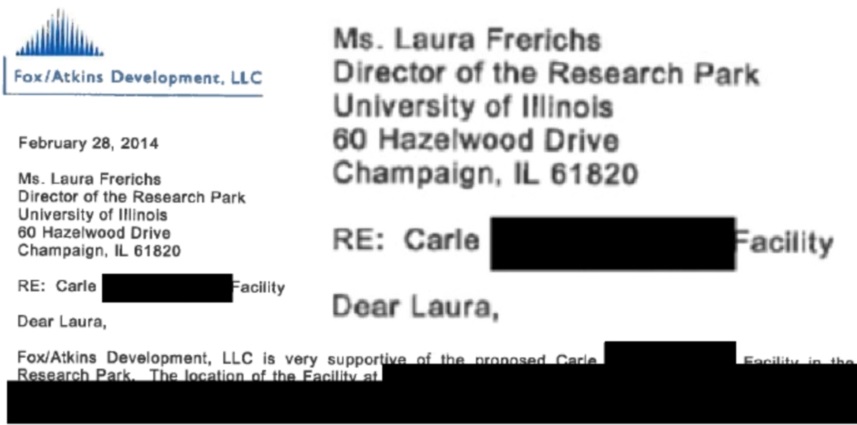
Carle in Resch Pk Feb 2014

So far, a succession of institutional bodies have signed off on the proposal, including the University Senates Conference, and the UIUC Academic Senate, with the UI Board of Trustees (BOT) still to go. Meanwhile, the project has garnered enthusiastic approbation on and off-campus, including from the local business booster community, speaking primarily through its mouthpiece, the News-Gazette. Chancellor Wise: “Without a college of medicine, we are less competitive…We think this is a defining moment.” Local entrepreneur, I-Hotel owner, and Jimmy John’s multiple-franchise-lessee Peter Fox: “I think [the idea] is the salvation of the community.” Carle CEO Leonard is “absolutely committed.” News-Gazette publisher John Foreman: a UI-Carle medical school is “a dream worth living.”

With everybody who is anybody apparently on board, what is there not to like? The University of Illinois-Chicago (UIC) does not like the plan. It proposes “a competing vision” that would partner with UIUC to offer expanded engineering-centered doctor training through the existing UIC medical school, whereas Wise’s plan would create “conflicting, competing entities.” UIUC has bluntly said “no” to UIC’s alternative plan.

Provena Presence Hospital does not like still more competition from rather than cooperation with Carle, which it says is trying to “drive [it] out of business.” Last summer Carle wanted to add 48 medical/surgical beds, but Provena objected, arguing that the state itself had determined that there was already an excess of beds in the region. At first the state rejected Carle’s request, but after Carle lobbied, with help from the Chancellor’s office, it was approved.

Residents in Urbana do not like the fact that Carle’s property tax-exempt status, effective 2012, has resulted in plummeting city revenues and a 10 percent spike in 2013 individual property tax bills. Pushing back, Urbana-ites have formed Concerned Citizens of Urbana (CCU), which has created a website, organized community meetings, and dotted Urbana with lawn signs. As part of her meetings with area stakeholders, including Urbana Mayor Laurel Prussing, Chancellor Wise has raised the possibility that “there will be a ring of businesses associated with biotech” surrounding the new medical school. If so, Urbana wants the school sited in the city so as to receive any additional tax revenue.

Dr. Andrew Scheinman does not like the Chancellor’s office lobbying in favor of Carle’s bed expansion. An Urbana native, UIUC grad and local patent attorney, Scheinman has galvanized residents into action through CCU. He argues that it is unethical for UIUC to involve itself in Carle’s bed expansion, and that Carle supplied talking points to and paid the Chancellor’s office to lobby on its behalf. He has filed complaints alleging unethical conduct with the University Ethics Officer plus Illinois Attorney General Lisa Madigan’s office.

Carle enjoys a reputation as a center for medical research, although not everyone agrees. In 2009, Carle’s Leonard fired then-recently-hired Vice President for Research Dr. Suzanne Stratton, who had accused a Carle cancer researcher of systematic ethical violations in a story that made the New York Times. Wise herself has published research in medicine that has been called into question. Numerous stories have appeared in, among other places, the Chronicle of Higher Education, Retraction Watch, and Electronic Intifada, that report on Wise’s “self-plagiarism,” the practice of publishing research results more than once. On a number of occasions between 1990 and 2006, Wise allegedly republished entirely, or in only very slightly altered form, previously published work. In at least one instance, she admitted as much. “The author wishes to correct a number of serious errors in the writing of her [Neuroscience 2006] publication,… the paper is written in a way that misleads the readers to think that it is an original article. The author wishes to correct that impression with the following changes in the text of the published paper…” Such self-plagiarism can occur in all academic fields, given the pressure to “publish or perish.” It is especially pernicious, however, in fields such as medical research where an artificially inflated number of article citations could have real-life consequences for prescribing drugs, establishing medical procedures, and the like. Both the Stratton case and Wise’s self-plagiarism revolve around medical research ethics.

Wise retraction

“Super Surprising”

The other side of the coin of Wise lobbying for a medical school is her simultaneous campaign, along with President Robert Easter and the UI Board of Trustees (BOT), against appointing Professor Steven Salaita to a tenured position. The anti-Salaita people are literally falling over themselves to line up behind the Chancellor’s initiative, while pro-Salaita folks are either not involved, or not consulted. Moreover, Wise began pushing her proposal last spring around the time that the Provost, seconded by other high administration officials, refused to reappoint another faculty member, adjunct professor James Kilgore, whom they also anathematized. The same anti-Kilgore individuals then are anti-Salaita now. Having ratified Wise’s decision not to appoint Salaita at their September meeting, the BOT, in a surprise decision at their November meeting, voted to allow Kilgore to be reappointed. Clearly, the BOT is deeply divided. After four hours in executive session engaged in what they themselves termed a “robust debate that represented a wide range of divergent viewpoints,” they failed to reach a consensus. In fact, it is not too much to say that the BOT is in disarray, at war with itself. The implications for the Salaita affair are not lost, moreover, on Kilgore supporters. “In light of the recent abrogation of academic freedom in the de-hiring of Professor Stephen Salaita… this [paving the way for rehiring Kilgore] is a very small step forward… We must continue to back his [Salaita’s] cause.”

Wise is at the center of both the Salaita affair and the medical school plan. Clearly, she sees the medical school as her signature achievement. Wise appears caught off-guard by continued faculty and student opposition over Salaita that has forced her into damage control mode. Certainly, BOT Chair Chris Kennedy was caught off-guard, saying that the response the university had received was “super surprising.” Were the reputation of Wise – not to mention that of the university – continue to suffer due to the ongoing Salaita affair, then her standing to lead the medical school plan would suffer by association.

Lifting All Boats, Or A Tub Sitting On Its Bottom?

The more we learn about the medical school proposal and how Wise is handling it, the more questions arise. Where does working for the common good leave off, and conflict of interest begin? When she was University of Washington provost, Wise was criticized for simultaneously sitting on the Nike board. Now at UIUC, and still on the Nike board, she was paid $290,000 in 2013 alone. Since the beginning of 2014 she also sits on the Busey Corporation board. She leads simultaneously the aforementioned Economic Development Advisory Group that also includes the Busey Corporation board chair, which appears to be a conflict of interest. Wise gave a keynote at a Republican Congressman Rodney Davis event held last July in the midst of his 2014 reelection campaign. Governor-elect Bruce Rauner has named her to his transition team. The machers, big shots, make out, and seem fine with it. Their politics and worldview nestle with their agendas like Russian dolls.

Rodney Davis

How did we get here? The short answer is short. It is all about the neo-liberal corporatization of UIUC at a time when state budget support has fallen to an execrable 12 percent. It is all about a corporation selling health as part of the American for-profit healthcare system in the era of Obamacare.

These are national issues, reproduced locally. And locally, the Champaign/Urbana elite, like all-too-many others elsewhere at other times, acts as though what is best for them is best for everyone. They do not notice, or do not care, that their socioeconomic calculus leaves out somewhere between Mitt Romney’s 47 and Occupy’s 99 percent of the population. However you calculate it, this amounts to a disproportionately high number of the lower classes, women, and minorities.

This is not new. The history of American philanthropy is the history of trickle-down, paternalistic largesse. An online comment in the News-Gazette gets it right. “There is a consistent push by the ‘movers and shakers’ in C-U’s economic development plans that local residents and particularly those that are mid-to-low incomes [sic] can,… for the foreseeable future, well,….uh,…just leave, and make way for out-of-town people who are wealthier. Thanks. Here is a map to Rantoul or Tolono if you need re-locating options.” In contrast to UI-Chicago’s larger, more inclusive medical school student body, UIUC’s would be smaller, and tuition would cost at least 20 percent more. The October 2014 business plan projects annual tuition at Urbana ranging from $45,000 for in-state students (UIC $35,442), to $60,000 for out-of-state residents (UIC $72,442), and $75,000 for international students (plus $9,000 in fees). The new college of medicine dean would make $500,000, top administrators between $100,000 and $250,000, and 75 new faculty between $140,000 and $270,000, not to mention 40 to 50 new Carle physicians.

Carle is largely tax-exempt, largely because of their “contribution” – read: “lobbying” –rewriting the 2012 state law concerning charity contributions. Yet they cannot cough up from their $1.8 billion in assets a voluntary “charitable contribution” to Urbana, otherwise known as payment in lieu of taxes (PILOT). Instead of making up anything close to the $5.8 million Urbana lost in 2013 tax revenue, Carle has voluntarily cut checks for $100,800, based on their own calculation of their fire and police costs.

Locally, it is mostly Republicans who stand to profit from the medical school project, but these are not Democratic vs. Republican, or even conservative vs. liberal issues. Look at Barack Obama, his former chief of staff and current Chicago Mayor Rahm Emanuel, former Chicago schools chief and current Secretary of Education Arne Duncan, and their neo-liberal ilk. In this country in 2014 it is “radical” to be a post-1945 European social democrat. “Radical,” not radical, because in the late 1940s Europeans creating single-payer health-care systems and the rest of the then-new welfare state were not radicals, but liberals. Similarly, European universities charge students even today a fraction of what both public, as well as private, U.S. colleges do. The difference between then and now is a measure of how much we have eviscerated the state, and undermined its legitimacy in pursuit of the chimera of the “job creator,” “free market.”

Are there other ways of doing business? Of running a university? Of course. And they are not theoretical, but empirically tried-and-true ones. For the last 65 years, European and Canadian social democracies have been delivering, despite scattered objections and cutbacks, the overwhelmingly popular social goods of single-payer health insurance, and largely state-subsidized university education.

November 14

This is the first of two articles.

2014 10 30 fur ball FullSizeRender

David Prochaska formerly taught colonialism and visual culture in the UI History department

 

Posted in Uncategorized | Comments Off on How Public & Private Work Together Today: A UIUC/Carle Medical School?

American Exceptionalism and Our Newest War

Once upon a time, when I was a child growing up in 1950s America, I truly believed in American Exceptionalism, the idea that the United States is a virtuous country and unique among nations because of our revolutionary history, experimental democracy, and personal liberty. For many, American Exceptionalism implies superiority to other nations and therefore a special role to play in world history through interventions in other countries. America is then seen as “the indispensable nation” on the world stage. Neoconservatives like Dick Cheney believe that the United States has the right to promote our national interest even when that requires military force and even when we are breaking international laws.

The United States emerged from World War II as the most powerful nation on earth because of our abundant natural resources, strong economy, and military superiority. With that power came “an outsized confidence in the efficacy of American power as an instrument to reshape the global order” according to political scientist Andrew Bacevich.

Since World War II, although we have had no declared wars, we have frequently conducted military and other interventions all over the world, some of which were against international law and/or our own Constitution or other laws. These have included major wars in Korea, Vietnam, Afghanistan, and Iraq, as well as U.S.-backed coups of democratically elected governments ranging from Iran in 1953 to Chile in 1973 to, arguably, Ukraine this year. The United States has gotten away with illegal actions in other countries because of our economic and military might, and because, as a member of the Security Council, we have been able to block any sanctions from the United Nations.

Virtually all of our meddling has resulted in “blowback”, or unintended consequences. John Mearsheimer points out that because we have the Atlantic and Pacific Ocean “moats” to protect us, as well as nuclear weapons, “turning the world into one big battlefield” has not resulted in significant strategic costs for us “precisely because the United States is such an extraordinarily secure country. It can pursue foolish policies and still remain the most powerful state on the planet….. The pursuit of global domination, however, has other costs that are far more daunting. The economic costs are huge—especially the wars—and there are significant human costs as well. After all, thousands of Americans have died in Afghanistan and Iraq, and many more have suffered egregious injuries that will haunt them for the rest of their lives. Probably the most serious cost of Washington’s interventionist policies is the growth of a national-security state that threatens to undermine the liberal-democratic values that lie at the heart of the American political system.”

Since 1980, the United States has invaded, occupied, and/or bombed fourteen countries in the Islamic world. Barack Obama has cited security and/or moral imperatives for bombing seven largely-Muslim countries (Libya, Iraq, Pakistan, Afghanistan,Yemen, Somalia, and now Syria). The results so far have been thousands of civilian casualties, the global expansion of terrorism, and increased terrorist organization recruitment.

President Obama said as recently as August that there was no military solution to the Syrian crisis and that we could not trust “moderate” opposition to the Assad regime, yet by September his strategy for dealing with ISIS, the Islamic State of Iraq and Syria, depended on both. Obama’s stated aim for the first bombings against ISIS was to save the Yazidis, the minority religious sect that had been trapped on a mountaintop by ISIS, but this was window-dressing. This was not ISIS’ first foray into genocide. It was, however, the first time ISIS was threatening the oil-rich Kurdish region of northern Iraq. The real reason for the bombing campaign was to save the Kurdish forces defending Erbil, where there is an estimated trillion dollar international oil industry presence. As usual, our Middle East meddling is far more concerned with oil than with people. The “collateral damage” to civilian populations of our bombing is likely to result in many casualties. Already there are reports of dozens of civilian deaths from our military campaign, and this is after only a few weeks of bombings that are planned to go on for years.

Some people here support the bombing for genuinely humanitarian reasons. They point out that ISIS is carrying out genocide, rape, torture, slavery, and other cruel and evil acts. But these concerns are not really those of the Administration. ISIS was doing the same things for months before Obama decided to intervene, when the Kurds in Erbil were on the verge of collapse. As George Monbiot has put it, “Whenever our armed forces have bombed or invaded Muslim nations, they have made life worse for those who live there. The regions in which our governments have intervened most are those which suffer most from terrorism and war.” The overall results of this new military campaign are likely to have similarly negative consequences for the people of Iraq and Syria.

Now that the Free Syrian Army is on the run and the Republicans will soon take control of the Senate, there will be more pressure on the president to escalate the war to include American “boots on the ground”, which will further exacerbate the harm we are causing. Obama has already ordered 1500 more troops into the war zone. So far, the United States strategy is failing badly.

U.S. Air strikes on Kobani (Guardian)

U.S. Air strikes on Kobani (Guardian)

Phyllis Bennis notes that our military strikes “are making real solutions impossible.” She claims that “weakening ISIS requires eroding the support it relies on from tribal leaders, military figures, and ordinary Iraqi Sunnis.” Joshua Landis also thinks our current war will fail,and suggests an alternative. Bennis’s and Landis’s proposals for nonmilitary political solutions would take a long time to effect change, but Obama’s strategy will take “years.” Why go on with our current destructive strategy, which is likely to bring even more misery to the people we are supposedly trying to save from ISIS?

Do two severed American heads justify the carnage we are visiting on Iraq and Syria? After the intense media coverage of the beheadings, the late September polls showed that 73% of previously “war-weary” Americans approved of bombing ISIS, even though only 51% thought it might actually work.

​What are the moral implications of a people that approves of bombing other countries even though they are not confident that it will help? Like “the white man’s burden,” belief in American Exceptionalism seems to carry with it willful blindness to the harm we cause to anyone but ourselves. “The dead” from our misadventures means American deaths. Our mainstream media often don’t even report on those nameless hundreds of thousands who are killed, maimed, displaced, or disease-ridden because of U.S. foreign policy decisions. Members of wedding parties and children are just “collateral damage”, while our government assures us that all males over 13 who are killed are “enemy combatants”. The only thing that counts is how many targeted enemies we’ve taken out.

And this is all to no avail–in fact, it is counterproductive, since every military strike results in escalating recruitment for our enemies, ISIS is continuing to grab more territory despite our bombing campaign, and our military actions will further destabilize the entire region. Peter Van Buren puts it succinctly: “Washington’s post-9/11 fantasy has always been that military power—whether at the level of full-scale invasions or ‘surgical’ drone strikes—can change the geopolitical landscape in predictable ways. In fact, the only certainty is more death. Everything else, as the last 13 years have made clear, is up for grabs, and in ways Washington is guaranteed not to expect.”

I remember feeling quite moved during President Obama’s eulogy for the innocent children who were murdered at Sandy Hook Elementary School—until I remembered mid-speech that he had ordered drone strikes that killed scores more innocent children in other countries than those gunned down here, in our exceptional America.

Susan Shoemaker lived in central Illinois for most of her life before moving elsewhere to work as a college professor. When she retired she came home to Champaign-Urbana.

Posted in International, Politics | Tagged , | Comments Off on American Exceptionalism and Our Newest War

Important Questions Related to the Steven Salaita Case at the U of I

For university faculty, when, if ever, is speech that includes what may be perceived as vulgar, discourteous or uncivil language protected from putative action by university administrators and/or boards of trustees? Is speech which uses such language, even swear words, acceptable as a way of expressing extreme feelings of anger, outrage or injustice about the behavior of others; of getting the attention of an otherwise complacent audience, especially when more refined or orthodox language has repeatedly fallen on deaf ears; or, more specifically, of arousing a strong response from a particular audience that one is attempting to reach (e.g., fellow citizens who need to “wake up and take action”)?

Should different standards be applied in evaluating faculty speech which occurs in academic settings (classrooms, professional meetings, publications) from speech expressing one’s personal thoughts or feelings through less formal social media channels? Given the fact that a faculty member’s tweets may be read by others, including one’s students and colleagues at the university and even alums and financial donors, must one always be careful not to offend others through what may be perceived as inappropriate language, or would such sanitized speech often seriously limit its forcefulness and impact?

Application to the Treatment of Salaita

How should all of these questions be answered as they apply to Steven Salaita, the faculty member offered a tenured faculty position at the University of Illinois in Urbana-Champaign, whose formal appointment was blocked by the chancellor and board of trustees after major donors and others raised concerns about his angry tweets against the Israeli government and its prime minister in response to their treatment of Palestinians in Gaza in June-July 2014? Should his Twitter speech have been protected from putative action? Was his denial of employment an infraction of both his freedom of speech and his academic freedom as well as of established university personnel policies and procedures?

Because Salaita’s credentials and past academic performance were reviewed by departmental faculty, the relevant dean, and the provost at UIUC before being forwarded with a recommendation for hire to the chancellor and board of trustees, his substantive views on colonialism and the occupation of Palestine by Israel were known by those involved in the hire—or at least were available for their scrutiny. Also known was Salaita’s background as a Palestinian American with family and friends in Palestine.

Among the claims made by Salaita’s critics is that some of his Twitter posts were “anti-Semitic.” A careful reading of the posts, however, will show that they did not criticize Jews in general or Judaism, but the actions of the Israeli government and its prime minister. Significant numbers of Jews living both inside and outside of Israel oppose the occupation of Palestine and the harsh actions of the Israeli government toward Palestinian civilians over many decades.

Were Salaita to be employed at UIUC, would his angry tweets intimidate Jewish and other students on the UIUC campus and undermine his ability to communicate openly, rationally and respectfully with them in the future? Judging from his positive teaching evaluations elsewhere and from comments by students which highlighted his openness, approachability and willingness to listen to and respect diverse points of view, this does not appear to be the case. Should not UIUC students be exposed to viewpoints other than their own? Should not universities, good ones at least, be places where a broad range of perspectives on important public issues of the day are expressed and debated face-to-face and through multiple media outlets? Steven Salaita thinks so. In addressing students and others at the University YMCA on the UIUC campus in September, Salaita said, “Universities are meant to be cauldrons of critical thinking. They are meant to foster creative inquiry and, when at their best, challenge political, economic or social orthodoxy.”

Conclusions

From my perspective, Salaita’s angry Twitter speech can be understood and accepted as a response to the grossly inhumane actions of Israel in Gaza that he was protesting, actions criticized by human rights organizations, the United Nations, and governments around the world. In fact, at one level, it reveals a truly human side to Steven Salaita: Who would not have responded in a similar manner if they had comparable historical knowledge of Israeli-Palestinian relations as well as familial and other personal connections to Palestine?

I prefer to judge Salaita’s probable future performance as a tenured teacher and scholar at UIUC on the basis of his demonstrated record which is outstanding. The chancellor and board of trustees have acted inappropriately and violated both Salaita’s rights and the University’s own personnel policies and procedures. As a result, they should either reverse their decision or be prepared to have the American courts do so in the future at great cost to the University’s reputation as a top tier academic institution.

Gary Storm is Professor Emeritus and former Dean of Human Services and Sciences at the University of Illinois at Springfield.

Posted in Education, University of Illinois at Urbana-Champaign, Voices of Color | Comments Off on Important Questions Related to the Steven Salaita Case at the U of I

A View on Bulldog Coal Mine from the Appalachian Mountains

“Support coal or sit in the dark.” That phrase is familiar in the coal-burdened areas of Central Appalachia, but now some who supported coal are finding themselves out of work, abandoned by coal—many too injured by coal mining to work elsewhere—surrounded by a crumbling state infrastructure and declining population. The reality is that coal production is shifting from Appalachia to the Illinois Basin and farther west, and while some in central and southern Illinois are excited at the prospect of new jobs—even if temporary and dangerous—there’s a reason the late Mountain Keeper Larry Gibson said “Coal keeps West Virginia poor.”

Locally, Hallador Energy subsidiary Sunrise Coal, LLC, is seeking a permit for its Bulldog Mine site 30 minutes southeast of Urbana, near Homer and Allerton. Hallador Energy claims the Bulldog Mine will employ 300 people at $18 to $24 per hour, or approximately $36,000 to $48,000 per year, implying these jobs will be local jobs. They don’t mention the advertisements running in Appalachia encouraging laid off miners to move to the mines in Illinois. It’s more likely that Hallador will hire experienced miners from far away, instead of training new miners. The coal companies here are not above making the same hollow promises as coal companies in Appalachia.

I moved to Illinois last January after spending the better part of five years working with people in West Virginia and across Appalachia to stop strip mining, often referred to as mountaintop removal. It’s nice to live somewhere that has good water, no elevated levels of cancer and birth defects, and where a Friends of Coal sticker is not similar to a Little Red Book. The coal industry is always full of promises, PR events and campaign contributions, but they’re short on living up to those promises or rosy PR pictures. People living in Champaign and Vermillion counties should work together to prevent a coal relapse here, now.

My friend’s dad worked decades for the coal industry, giving them his best years. After the industry all but got rid of the union, and when they were done with my friend’s dad, they quickly dropped him without a pension. Now he’s too injured from coal mining to work, but has been agonizing through months of tests and waiting for doctors to be available to prove that he’s disabled.

A common defense of coal industry supporters is that coal mining is highly regulated, including surprise inspections by the federal government. However, in places like West Virginia, where there’s been more attention focused on the coal industry in recent years, coal  mine managements are being convicted of illegally warning mine site workers that inspectors were on their way so the miners could quickly get everything into compliance for the brief inspection visit. Private labs like Appalachian Labs, who routinely test water quality for the mine companies, have come under recent scrutiny for substituting the samples with clean water—water monitoring is a “self-regulating” process. Community and environmental groups in West Virginia, Kentucky and Virginia have petitioned the federal government to take back state oversight and enforcement of some federal mining and environmental laws, because those states don’t effectively enforce the laws. Without effective enforcement and oversight, regulations and inspections are meaningless, and Illinois could be guilty of the same thing.

Citizens Opposing Pollution, an advocacy group in Clinton County, Ill., filed a petition in the Federal District Court for the Southern District of Illinois on October 15, 2014, asking the federal government to revoke the Illinois mining program. The Writ of Mandamus, in Citizens Opposing Pollution v. Sally Jewel, Secretary of the U.S. Department of Interior, asserts that Illinois’ ineffective oversight and enforcement of coal refuse facilities has caused the Pearl Sand Aquifer to be polluted beyond suitability as a drinking water source.

The Illinois Department of Natural Resources is currently reviewing the Bulldog mining permit, and held an informal conference about the permit in Georgetown, Ill., on Oct. 7. At that hearing, a geologist who worked with coal during his career testified that Hallador’s responses in the permit application made no sense with regard to the mine or the permit, made no mention of critical geologic formations like a drinking water aquifer, and showed no regard for Oakwood’s drinking water intake just downstream. For every mention I saw of exploratory bore holes in Hallador’s application the company said each collapsed, which indicates a higher probability of subsidence than the company admits in their permit application.

One resident I spoke with who lives above the proposed underground portion of the Bulldog Mine described how Hallador has been getting some of their mineral leases signed by landowners. The resident said Hallador sent young attractive women to persuade men to sign a lease, and sent intimidating men to persuade women to sign. Hallador’s actions and permit responses do not inspire confidence in their ability or willingness to follow the law and run a clean, safe operation, let alone be honest with regulators, inspectors, neighbors or the public.

Many of the area’s residents who spoke in favor of the Bulldog Mine at the informal conference made the case that the watershed is already stressed from agricultural runoff, urban waste, pre-law mining and other sources, so the addition of a coal mine should be no big deal. However, these are reasons why we need to continue to clean up and safeguard the watershed from future potential harm, as mining pollution can render local water supplies unfit to drink.

I lived in Charleston, W.V., in January 2014 when Freedom Industries spilled Crude MCHM (4-methylcyclohexane methanol) just a mile upstream of the sole drinking water intake for 300,000 people in nine counties. Many in the surrounding counties receive water from the Charleston water plant because their nearby sources became too polluted by coal and gas extraction to be suitable for even treated drinking water. Crude MCHM is used in processing coal, an activity planned to take place at the Bulldog Mine literally on top of the drinking water aquifer that Hallador failed to mention in their permit application. It seems unimaginable to go weeks in the U.S. without water for drinking, bathing, cooking, or cleaning—but it happened, and that situation should not be repeated in Illinois.

Proponents of Bulldog and of coal claim that we need to mine more coal because the U.S. and Illinois need this “cheap” energy source. However, this rhetoric ignores the fact that coal is an international commodity that’s sold to the highest bidder. Not only does the U.S. ship coal to at least Asia, South America and Europe, the U.S. no longer needs to burn coal at its current pace. According to the U.S. Energy Information Administration, coal as a percentage of national electricity generation has decreased from nearly half the U.S. electricity supply in 2007 to 37.5 percent in 2012, the last year of available data.

The coal industry has made a name for itself in deception, extortion, blackmail, corruption and subversion of regulatory processes. Any short-term local economic benefit will be negated by long-term negative impacts on the environment and other economic activities like farming, as the coal industry goes after the high-hanging fruit. Champaign and Vermillion country residents should work with StandUpToCoal.org to convince the Illinois Department of Natural Resources to deny the Bulldog Mine permit.

csuggs-head-shotCharles Suggs is an environmental justice activist who spent much of the last six years living in southern West Virginia. He has campaigned against dirty resource extraction, volunteering primarily in Appalachia with organizations including Mountain Justice (http://mountainjustice.org) and RAMPS (http://rampscampaign.org). Currently Charles is a web developer and gardener living in Urbana with his fiancé, and their cat Rebar.


Posted in Environment | Comments Off on A View on Bulldog Coal Mine from the Appalachian Mountains

Political Soccer: A Global Phenomenon—Except Here

This summer’s soccer World Cup—always the most-watched sporting event on the planet—in Brazil was accompanied by enormous demonstrations, at times violently repressed. Citizens protested the diversion of vast resources from urgent social needs to the building of hugely expensive stadiums, stadium-specific transportation systems and other amenities, and massive security measures, to meet the requirements of FIFA, the world governing body that runs the tournament. While this connection between sports and politics seems an unfamiliar stretch in view of the American landscape, the use of sporting events as venues for political expression is not completely alien to us: recent years have seen demonstrations outside big games against domestic violence and sweatshop abuse in the production of sports gear, among other issues. And the (ab)use of Native American-related monikers for team names and mascots, familiar to us locally in the Chief Illiniwek controversy, has been protested in front of the stadium homes of the Washington, D.C. football and Cleveland baseball teams.

But beyond our shores, and above all in the case of soccer, the games become not just an occasion for political expression, but something political in and of themselves. People’s identities are bound up with a team, passed on through generations—as sometimes happens here—but a team that is rooted in a city district, a class or religious/ethnic configuration, even a certain occupation. Fans of the opposing side become not just enemies in sport—bad enough when sports are taken seriously—but alien others, obstacles to an ideal society, to be eliminated.

Matches between national soccer teams, especially for qualification for the World Cup and other international tournaments, are the most recognizable magnets for conflicts based on (in this case, national) identity. Indeed, there are numerous examples of national sides becoming surrogates for struggles involving both symbolic and real social and economic issues. The most famous is the 1969 “Soccer War” between El Salvador and Honduras. A World Cup qualifying match spawned conflicts between fans and harassment of players, which culminated in a four-day war involving mutual air strikes and thousands of dead and wounded. A territorial dispute and tensions over the many migrant laborers from overcrowded El Salvador to more spacious Honduras constituted the powder that was primed to explode.

More recently, in November 2008, Slovakian police beat up Hungarian fans, who were provocatively chanting anti-Slovak and pro-Hungarian-expansionist slogans, at a Slovakian league game in a largely ethnic Hungarian town near the border between the two countries. Coming in the midst of heightened tensions over the substantial Hungarian ethnic minority in Slovakia, the incident led to demonstrations, flag-burnings and a diplomatic crisis. In 2009, a World Cup qualification match between Egypt and Algeria, followed by a tiebreaker match in Sudan between the same teams, spawned violence against both countries’ fans, as well as diplomatic tensions (here, too, longstanding grievances at the governmental level and resentments at the individual level played a role). And just weeks ago, a qualifying match for the Euro 2016 tournament between Serbia and Albania was abandoned after a drone bearing a flag representing greater Albania (a dream of Albanian nationalists, which would incorporate the disputed Kosovo and parts of Serbia proper) flew into the stadium, was grabbed by Serbian players, and defended by Albanian players, leading to a brawl.

The last few years have seen increasing media coverage of nationalist extremists, neo-Nazis and racists—in evidence in both the Slovakian and Serbian events—in and around European soccer stadiums. The Western press has largely painted this as an “Eastern European disease,” as in the BBC documentary about the last European championships, hosted jointly by Poland and Ukraine, entitled Euro 2012: Stadiums of Hate. The documentary highlights the abuse from the stands of black and brown players on the various national sides, and of fans. But Western European countries, especially England, Germany and Italy, have long had their share of skinheads, fascists and racists in the various “ultra” fan clubs, and among the hooligans that have dogged the sport, becoming a major social issue in the 1980s and ‘90s. Black Italian star Mario Balotelli has been subject to racist abuse, such as monkey calls and bananas thrown from the stands, in both Italy and Spain.

But it is at the level of club football, where clubs have become entwined with the identities of certain cities, districts of cities, ethnic communities, classes and even political positions, that the connection between soccer and politics becomes most visceral and intense. A textbook case is the storied rivalry between Celtic and Rangers, the two dominant teams in Scottish soccer. Celtic supporters tend to be Irish Catholic immigrants, and Rangers supporters Protestants, many of them with ties to Loyalists (supporters of British rule) in Northern Ireland. In Spain, Real Madrid has traditionally represented the cultural and political dominance of the central government, especially during the long dictatorship of Francisco Franco. FC Barcelona has from its founding in 1899 symbolized Catalan independence and resistance to the center; Atletico Bilbao has fulfilled a similar role for Basques. Although “Barca,” now one of the richest clubs in the world, celebrates that history of resistance at its lavish stadiumside museum, many argue that Franco propped up the club and the rivalry as a “safety valve,” to divert potential political opposition into passion for the team.

The political commitment of club supporters can lead to extra-local violence. In the Yugoslav wars of the early 1990s, the most brutal Serbian paramilitary commander, nicknamed Arkan, got his start as leader of the “Ultras” of Red Star Belgrade, and recruited his henchmen from the fan group. They “trained” at clashes at matches between Red Star and the Croatian team Dinamo Zagreb for the ethnic cleansing they would later execute against Croatians and Bosnian Muslims. But more positive roles are also possible: during the Arab Spring uprising in Egypt, the “ultras . . played a more significant role than any political group,” according to a prominent Egyptian blogger. Most active in defending the revolutionaries in Tahrir Square were the fans of the foremost Egyptian club Al Ahly, founded in 1907 explicitly as a center for anti-colonial resistance. Tragically, less than a year after the victory over the dictator Mubarak, Al Ahly’s fans were brutally attacked by fans of another team, El Masry, at a game in Port Said, with dozens killed and hundreds injured, as police idly stood by.

Less noted by history are the activities of local groups such as the Carsi of Besiktas (one of the three big teams in Istanbul, Turkey), who employ the “Anarchist A” and Che Guevara among their imagery, carry out left-wing social activities (including bolstering the extraordinary 2013 anti-government demonstrations), identify as anti-racist, anti-sexist (certainly unique in the macho world of men’s soccer) and ecologist, and responded to racist harassment of their team’s players with banners reading “We are all Black.” If, as claimed by soccer writer Phil Ball in his book on the Spanish game, “eleven men in shorts are the sword of the neighborhood, the city, or the nation,” the hundreds or thousands in fan clubs are the cannon fodder, too often for ill but sometimes for good. Here in the US, we may be glad that our sports violence is, for the most part, restricted to celebratory riots after championships (aside from the violence on the field, court or rink). But our culture that tends to divide sports and politics also makes us poorer, in both realms.

Posted in International, Politics | Tagged , , | Comments Off on Political Soccer: A Global Phenomenon—Except Here

Academic Freedom and the Board of Trustees at the U of I: A Historical Perspective

At the panel on academic freedom and free speech across disciplines held in the Beckman Institute on Monday, September 29, one of the panelists, Professor Colleen Murphy, said that the project now must be to make sure that the way in which Professor Salaita was treated by the university never happens again. That is certainly a worthy goal, but it should not be inferred that, prior to Salaita’s treatment, academic freedom, free speech, and due process procedures have been relentlessly followed in the treatment of faculty and students who have espoused dissenting or unpopular views.

My association with this university has spanned well over half a century, first as an undergraduate graduating in 1960, then as a faculty member from 1965 until my retirement in 2000. I continued to teach and serve in the Senate for several years after my retirement. When I was a student here state law prohibited those who were Communists or members of organizations deemed by the US Attorney General to be subversive from teaching or working at the U of I (the Broyles Bill of the mid-1950s), or even just speaking on campus (the Clabaugh Act of 1947).

Prior to my arrival on campus, in the late 1940s and early 1950s, some old guard faculty members in the College of Commerce and Business Administration tried to keep Keynesians (seen as Pink if not Red) from being hired by the Economics Department. At that time—and continuing until 1994—the Board of Trustees was elected on political party lists. Some conservative Republican members of the Board, especially Board President Park Livingston and football star Red Grange, openly supported the effort to keep Keynesians out, as did area Republican state senators E.R. Peters and Charles Clabaugh, the author of the 1947 Act preventing Communists from speaking on campus. The Republican-supporting News-Gazette enthusiastically cheered them on. Largely for his openness to recruiting Keynesians, Howard Bowen, the dean of the college, was forced out of his post in 1950. That was followed by the 1953 Trustees’ ouster of President Stoddard, partly due to his stance on the Keynesian controversy.

During my last academic year as an undergraduate Professor Leo Koch was summarily fired by President David Dodds Henry. The offense committed by this biologist in the Division of General Studies was that he responded to a letter in the Daily Illini that condemned necking and “petting” at fraternity and sorority parties. Koch’s responding letter argued that if consensual sex were not so stigmatized there would not be this kind of
public expression of sexual desire. A far right-wing reverend who had a daughter at the U of I organized a campaign among parents and state legislators portraying Koch as part of a communist conspiracy to demoralize American youth. His summary firing by President Henry earned the U of I a place on the AAUP’s list of offenders of academic freedom, where it remained for several years.

In the 1960s and ’70s, there were restrictions on where students and faculty could express
themselves. For a while, there was a designated “free speech” area on the southeast corner of the Illini Union patio. Students were sometimes arrested for holding dissenting signs (e.g., against CIA recruiting) inside the Union building. In July 1970, fifteen faculty members in the Department of Political Science issued a statement referring to the Nixon Administration as a “criminal regime.” This followed the killing of student protestors by the National Guard at Kent State University and the US military incursion into Cambodia. The Chicago Tribune called the fifteen professors (I was one of them) “academic vipers” and editorialized that the university did not deserve public tax money if it had professors like us. The Trustees instructed Chancellor Jack Peltason to tell us that if we did not retract the statement we would be fired. Two faculty members took their names off, but the remaining 13 issued a new statement explaining in greater depth the rationale for our statement. (The text is in Summer Daily Illini, July 30, 1970, p. 5.) Chancellor Peltason talked the trustees out of firing us, but they did censure us. We rejected the censure and took it to the Academic Freedom Committee of the American Political Science Association. The committee ruled that the trustees had violated our academic freedom, but the trustees never withdrew the censure.

As already noted, after 1994 a change was made in the selection of Trustees. The nonstudent Trustees have since been appointed by the governor. While administrators had sometimes issued questionable rules, such as on what content can be communicated on university computers, and while the University Police did prevent distribution of leaflets on political and social issues to football fans in university parking lots, I am not aware of any intrusion of the Trustees into academic freedom issues until Chair Kennedy convinced the Board to deny UIC Professor William Ayers emeritus status upon his retirement, in 2010. So far as I am aware, this was unheard of even during the Red Scare of the 1950s. That denial was followed by the Trustees’ intrusion into the employment of James Kilgore, whose reappointment had gone through all of the proper unit and college channels. When Kilgore sought an explanation for this cancellation from Vice-Chancellor and Provost Adesida, he was met with a stony refusal to give any reason. But it was clear that either the entire Board, or Chair Kennedy himself, was involved. And now, following right on the footsteps of the Kilgore situation, we have the open intrusion of Chair Kennedy and his Board (minus one) in overturning the decision to hire Professor Salaita, an appointment that had gone through all of the proper academic procedures. Academic freedom, freedom of expression, shared governance, and due process are left in tatters.

“Never again”? I will accept the explanation that it was uttered as an aspiration. But the history of this institution shows that we can never assume that structural modifications will guarantee respect for the fundamental values off the university. Appointing rather than electing Trustees was indeed a good idea to address certain problems. “Shared Governance “ is also a good idea, but it can also elide into the development of an administrator/faculty elite that becomes so tight interpersonally that the necessary critical stance required to protect those values is seen as being hurtful, rude, or “uncivil.” This is why organizations that maintain that critical stance, like the CFA and the AAUP, are so terribly important, not just to the faculty, but to the integrity of the university as a whole.

This article is a slight variation of an article that first appeared on the website (cfaillinois.org)of the Campus Faculty Association (CFA) at the University of Illinois, Urbana-Champaign

Posted in Education, Human Rights, Politics | Comments Off on Academic Freedom and the Board of Trustees at the U of I: A Historical Perspective

The Red-hunt Did Not Skip Urbana

By Chandler Davis

Chandler Davis Snapshot_2010-09-22_17-55-39-1

Chandler Davis had to ply his trade in Canada, turning
emeritus at the University of Toronto in 1992 after thirty
years in the tenured ranks.  Nevertheless he was not forgottenby US colleagues, and was even elected Vice-President of the American Mathematical Society in 1991.

Without being a historian, anyone old enough to remember the notorious Red-hunt of 1947-1960 may feel some déjà vu seeing the frenzy with which criticism of Israel is savaged today. The Illinois campus is trying to come to terms with the shabby way your top administration (and in the wings a few donors accustomed to getting their way) have treated Prof. Steven Salaita. Several of you have been reminded of the Red-hunt. It takes me back…..

In 1950, I was a fresh Ph.D. hoping to break into the faculty ranks — preferably without selling my soul. All my fellow left-wingers in the universities knew they might come under attack. My professor and mentor Dirk J. Struik at MIT had already been attacked in the press as a communist (he was to spend 1951-55 under indictment for conspiracy to overthrow….., and suspended but not fired from his professorship). His daughter (and my friend) Ruth Rebekka Struik was a graduate student and assistant at the University of Illinois. That very year, 1950, she was told her support would not be renewed. A coincidence, do you suppose? We all took it as just part of the pattern. She took refuge in Canada for a few years, and returned to a successful career in the US; she is now emerita at the University of Colorado.

Hundreds of us were targets of political attack, whether public as in Dirk’s case or tacit. We compared notes, sub rosa. Thus my friend Ray Ginger, the American historian, told me he had had to leave his Harvard job, and it was his choice whether to protest. His school knew that if he uttered a public complaint he would be consigning himself to the blacklist, and Ray elected to keep it quiet; and indeed, after a few years in limbo he was able to get academic employment again.

Investigating committees held sensationalized hearings into “subversion.” Witnesses were asked about their association with the Communist Party and other organizations; if they answered any such question they were deemed to have waived their right under the Fifth Amendment to remain silent, and thus became liable to prosecution if they refused to answer any other questions — including names of their associates. This became a terribly familiar routine, whether by the House Committee on Un-American Activities (HUAC), by other Congressional bodies such as the Jenner Committee, or by their emulators in some states: a Massachusetts committee took part in the harassment of Dirk Struik, and Illinois had been threatened with getting such a committee by Senator Paul Broyles repeatedly since 1947.


Norman Cazden, ca. 1970

Norman Cazden, ca. 1970

At Harvard, Cazden worked with, among others, Walter Piston and Aaron Copland. His Ph.D. dissertation, Musical Consonance and Dissonance, ran over 900 pages. From 1945 to 1960 he was musical director of Camp Woodland, a center influenced by John Dewey’s “Progressive Education” model, and located in the Catskills. Cazden was interviewed for, and mentioned in, Victor Navasky’s book about the blacklist in academia, Naming Names. This year is the centenary of his birth; for more information, see the website http://www.normancazden.com/biography/


In 1953, Norman Cazden was a faculty member at UIUC in music. Norman was a Harvard Ph.D. in musicology (whose thesis I enjoyed reading, by the way), but he was much more: he taught music, conducted concerts and accompanied performers, and ran a regular program on music on the campus radio; one of his many compositions was performed in this period by an orchestra in Springfield. He was also associated with individuals and causes of the sort that were under attack in those days; why, he had been for years director of music at Camp Woodland: very suspicious! His wife, Courtney Borden Cazden, went to Springfield as part of the successful campaign to stop the Broyles Bill. (The campus opposition to Broyles’s perennial subversive-hunting campaign was powerful through 1953, but fell short in 1955.) Norman and Courtney took part also in protests of the trial of Julius and Ethel Rosenberg as “atomic spies,” and in mourning their execution in 1953.

Norman Cazden (left) and Camp Woodland musical director Herbert Haufrecht, Catskill Mountains

Norman Cazden (left) and Camp Woodland musical director Herbert Haufrecht, Catskill Mountains

In short, it was not surprising that HUAC came nosing around about Norman. Their inquiries at the University presumably were the reason why the promotion and tenure he had been orally promised for 1953 did not come through. In 1954, he was called to the stand, and it was not surprising that he declined to answer, on the basis of his Fifth Amendment rights. Norman and Courtney by this time had quietly left Illinois; Norman continued giving private lessons, teaching at Camp Woodland, and performing and composing. After some years he was able to escape the banishment. At the time of his too-early death in 1980 he was a much-loved professor at the University of Maine. Courtney is still with us, she is emerita at Harvard Graduate School of Education.

My wife and I first met the Cazdens, if I remember right, when Norman and I were in the same hot water. I don’t know which mutual friend put us in touch. I was a tenure-track faculty member at the University of Michigan, and was subpoenaed in 1953 to testify before HUAC. Whether I would rather have tried to make myself inconspicuous for a while, as my friends Ray Ginger and Norman Cazden did, I don’t know; the option wasn’t offered me, HUAC wanted to expose my evil deeds with full publicity, and in May 1954 they did. The story ends happily for me as well, ultimately, but I was obliged to emigrate. I am now emeritus at the University of Toronto, no cause for complaint.

Only for HUAC does the story not end happily. Just as Senator Joseph McCarthy’s omnipotence had been punctured in 1954, the apparently unstoppable HUAC had hardly any clout after 1960.

Yes, I think there is more than superficial resemblance between the dogging of left-wingers in those days sixty years back and the attacks on academics like Joseph Massad, Norman Finkelstein, and Steven Salaita today. The Red-hunters never called us terrorists or anti-Semites or (gasp!) uncivil, but they called us subversive and disloyal in the same fevered, evidence-free way, and they did their very best to expel us from the community. There’s nothing for it but to stand up to them.


Posted in Uncategorized | Comments Off on The Red-hunt Did Not Skip Urbana

The People’s Struggle in El Salvador Continues

For twenty-two years I have been part of a local group engaged in a sister relationship with five impoverished settlements in the mountains of eastern El Salvador. The five settlements are called Calavera. Our local group is called Friends of Calavera. During the twelve-year civil war (1980-1992), this mountain area was in a war zone.

Beginning in 1992, our group has sent delegations each year to visit these settlements. We are welcomed by the people, they share their homes and tortillas with us, and we listen to their stories. Stories of incredible suffering and courage in a centuries-old struggle for justice. Stories that remind me of the long struggle for civil rights in the United States, where the people refused to give in to official lies and brutality. Stories that announce, “Si se puede” (“Yes we can”). Stories of hope in the face of unjust power. A Jesuit who taught at the University of Central America told me once, “El Salvador exports more hope than coffee.”

The Christian Base Communities

On October 16th a visitor from El Salvador gave a presentation at the Friends Meeting House in Urbana that told about today’s Salvadoran reality. And about a small organization’s work in the face of that reality.

The visitor was José Gomez, a coordinator of many community projects for CEBES, the Christian Base Communities in El Salvador. He has been our guide to our sister communities for the past dozen years. On a five-week tour that began in late September, José has been visiting the several dozen sister communities across the United States that are associated with CEBES. Accompanying him to coordinate the trip and translate for him was Laurel Marshall, who has been a North American volunteer at CEBES for the past three years.

For centuries there has been a restless agitation for justice in poor communities throughout Latin American. Midway through the past century they began to organize and act to dismantle official systems of oppression. Many of these efforts were rooted in a faith that God sides with the poor and the powerless. That vision of a God who accompanies them in their struggle for a better life is called liberation theology. Some Churches joined in their struggle with a policy called the fundamental option for the poor.

The Christian Base Communities developed from these restless roots. Despite only wanting a democratic voice, access to land, education, health care, and other basic services, those engaged in the struggle were labeled “communists.” Nonetheless, the communities continued to organize and demand access to their basic human rights.

José gave a summary of the people’s long struggle for justice in El Salvador, beginning with the mid-1970’s. By the early 1980’s hundreds of thousands of members of popular organizations filled the city streets, calling for official reforms, particularly land reform. The government’s response was brutal.

In the twelve years of the government’s war against the people (1980-1992), over 75,000 civilians were killed by death squads and military action. Refugees scattered throughout Central America and to the United States. During this period, the U.S. gave over five billion dollars in military aid to the Salvadoran government’s war against their people.

A U.N.-brokered peace accord was initiated in 1992. In the wake of peace, the Christian Base Community in El Salvador formed a central office, called CEBES, to act as a network of all the Christian communities throughout the country. In spite of its name, these communities are not officially Christian, inviting people of all faiths committed to serve the excluded.

CEBES is not only focused on pastoral accompaniment and opposing the root causes of poverty and injustice. It also recognizes and responds when the basic needs of the poor are not being met. José gave a current example of this when he told about a serious drought that occurred in the whole region of Calavera early this summer. As a result, the campesinos have completely lost their crop of corn and beans. This situation can mean starvation because they depend on those crops to feed their families. CEBES has given them the seeds to plant for their next crop which should be ready by the end of next month, and is now providing them with the food they need till the harvest.

In solidarity with the poor, CEBES searches for self-reliant solutions for their basic needs. Project ideas come from the desires of the communities themselves through their elected leaders. I have observed that Salvadorans have a knack for organization. Their ability to organize collective efforts probably came out of the war years when their survival demanded that they work together.

Fighting Against Poverty and for Social Justice

Though the war ended in 1992, most of the Salvadoran people have not risen from poverty. For the poor there are few job opportunities besides the maquiladoras (sweatshops), which at 12 to 14 hour days seven days a week, do not pay enough to provide for their families.

The Central American Free Trade Agreement (CAFTA) has had devastating effects on the poor because some basic public services are left to unpredictable shifts in market prices, and can become financially unfeasible. One Central American leader has called CAFTA, “a weapon of mass destruction.” CEBES does not oppose trade, but can only agree to fair-trade practices that will lift the poor out of poverty.

CEBES has a number of projects in the five settlements that the Friends of Calavera have been able to participate in. We have financially supported a nutrition program supervised by a physician that has provided nutritional meals, anti-parasitical drugs and vitamins to children and the elderly suffering from malnutrition in our sister communities. CEBES has used our donations to repair the roofs of some homes, part of a Habitat-type of program. We have provided funding for CEBES’ efforts to revive their schools that had been wiped out during the war. We have been offering financial support for their scholarship program, which helps students to go to high school in a nearby town. CEBES has been a key partner in programs that has helped the people rebuild their settlements destroyed by the war.

CEBES has been providing innovative programs like solar panels and rainwater collection tanks. We’ve seen these at the schools. CEBES’ programs are helping improve methods for raising chickens, goats and rabbits. The organization has been providing micro credit loans to poor farmers and artisan crafters. CEBES has been advocating alongside communities through protests, marches, and meetings for basic services and rights.

José encouraged his listeners to consider participating in their sister relationship program with Salvadoran communities. I know that this has helped our mountain settlements, and that it has also provided rich blessings to our delegations. I enthusiastically endorse the work of CEBES.

There is a very old bench that the Urbana Friends Meeting House acquired from another Friends House in western New York State. It was used in the Quaker House when Frederick Douglass, the great abolitionist, worshipped there about one hundred and fifty years ago. He was a great liberation theologian whose life and work was dedicated to freeing slaves. In his dedication to the struggle for justice, José deserves a place on that bench alongside Frederick. There’s room for us to join them.

Tom Royer is a resident of Urbana who was the Pastor of St. Mary Church (1973-2011). He is a member of local group, “Friends of Calavera,” that has had a sister relationship with five settlements in the mountains of El Salvador for twenty-five years.

Posted in Human Rights, International | Comments Off on The People’s Struggle in El Salvador Continues