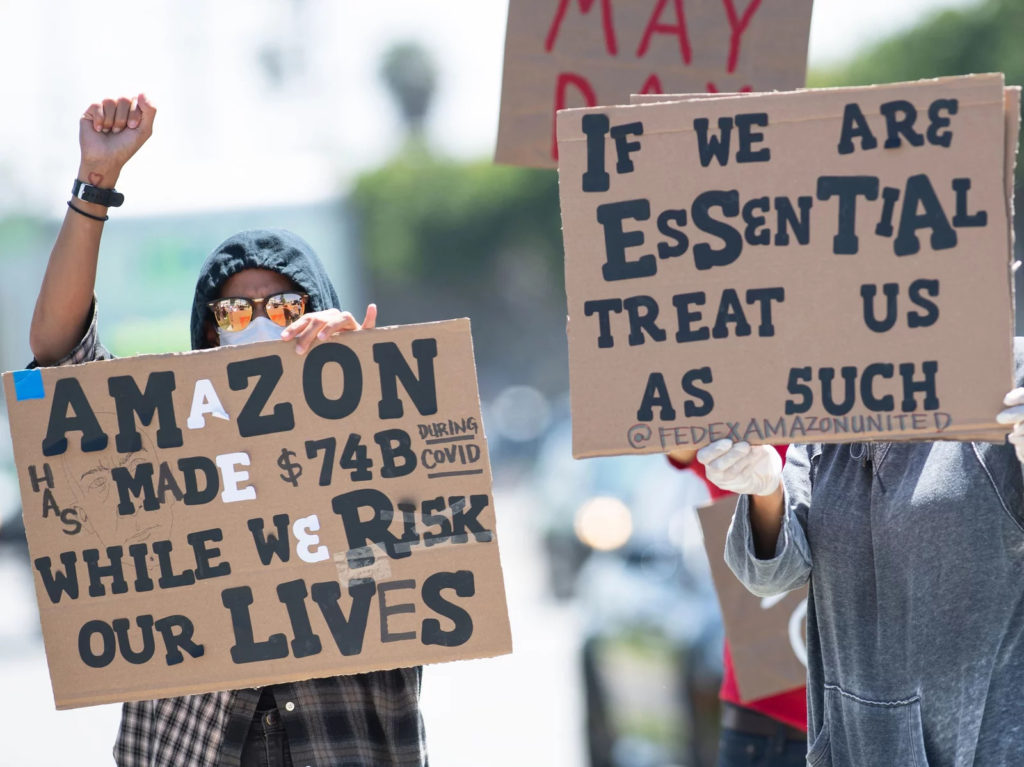
Amazon wokers demonstrating for their rights
During the past year, as the pandemic reshaped our daily lives, the media has paid more attention to work and workers than it has in a long time. The pandemic has shone a spotlight on the deep inequalities that persist in the US labor force—where women and workers of color are over-represented in low-wage, frontline work, putting them at a greater risk of contracting COVID-19, while their labor has quite literally kept our economy going. It has demonstrated the disproportionate burden of home and childcare that continues to rest on the increasingly exhausted shoulders of working mothers. And it has highlighted the obscene wealth that is hoarded in the hands of a few, while millions struggle to pay their rent or mortgage and keep the lights on during economic hard times.
The media—which for years has drastically reduced or outright eliminated its labor-beat coverage—scrambled to tell the story of work during the pandemic. By this spring there was one story that seemed to capture the moment: a group of Amazon workers in Bessemer, Alabama had decided to try and form a union. Bessemer had all the elements of a good news story. On one side there was David: Amazon workers in a predominantly Black, post-industrial town just outside of Birmingham, where more than a quarter of the residents live below the poverty line. On the other side was Amazon, the Goliath of our day: the titan of the new tech economy, led by Jeff Bezos, the world’s richest man, who saw his personal wealth grow by a staggering $75 billion during the pandemic. Continue reading