October Surprise: Harold “Killer” Koh to Lecture at UI Law School in Election Week

th

Harold Hongju Koh

Harold Hongju Koh, Hillary Clinton’s former legal advisor at the State Department  has been invited as an ‘endowed speaker’ at the U.I. College of Law, twelve days prior to the November election. Koh, currently a Yale Law School professor and former Dean, is a close friend of Yale Law School graduates Bill and Hillary Clinton. He was appointed by President Bill Clinton as Assistant Secretary of State for Democracy, Human Rights and Labor; and by President Obama, as senior legal advisor to Secretary of State Hillary Clinton: he provided legal advice to her during the 2009 coup in Honduras, the 2011 US/NATO attack on Libya, and Obama’s ongoing drone assassinations – as well as damage-control in her email controversy. He won’t say what that advice was, claiming “attorney-client privilege” – despite the Supreme Court ruling against attorney-client confidences between government lawyers and government officials.

An avid advocate of the targeted killing program, “Killer Koh” supports the legality of what he terms “extrajudicial killing” in Pakistan, Yemen and other Middle Eastern countries in the US “war on terror,” saying it complies “with all applicable law, including the laws of war,” and citing the ‘principle of proportionality’ in “taking great care in planning and execution to ensure that only ‘legitimate’ objectives are targeted and that collateral damage is kept to a minimum.” In a feeble attempt at transparency, the Obama administration recently released a modest admission that some “116 civilians” may have been victims of U. S. drone attacks – a figure that is not reconcilable with the accounts of eyewitnesses, journalists and human rights researchers, who have documented many thousands of casualties. President Obama said – in a revealing moment of self-reflection – “Turns out I’m really good at killing people … Didn’t know that was gonna be a strong suit of mine” (from Mark Halperin & John Heilemann, “Double Down: Game Change 2012”).

If Hillary Clinton is elected president, with the advice of Tim Kaine and Killer Koh, she may be even more eager to mass-murder than her predecessor: the number of casualties would likely exceed that of Obama’s kill list, just as his toll today greatly outnumbers G. W. Bush’s.

Late on Friday 5 August, the White House grudgingly complied with an Federal Court order (from an ACLU suit) and released a redacted “President’s Policy Guidance” (PPG) on Obama’s program of targeted killings. The PPG stipulates that “nothing in this PPG shall be construed to prevent the President from exercising his Constitutional authority … to authorize lethal force against an individual who poses a continuing, imminent threat to another country’s persons.” (Killing US citizens requires specific approval by the President). Death lists are drawn up weekly by the ‘nominating committee’ and are reviewed by lawyers of the nominating agencies (CIA, Pentagon, NSC, officials of the State Department and “deputies and principals of the nominating committee”).

Of the seven Middle Eastern countries where drone assassinations take place, “active war zones” – Iraq, Syria and Afghanistan (it’s not clear if Libya is included) – do not require prior approval. With this protocol in place, the White House and the National Security Council are insulated from outside scrutiny, even by Congress. It assumes that the Commander in Chief can do anything s/he wants; it would provide a President Clinton #2, with the approval of hawks Tim Kaine and Harold Koh, immense power and license to kill.

Koh as the (former) State Department lawyer has publicly defended extrajudicial killing as “due process under the Constitution in the age of moral and political degeneration.” In a speech at the Oxford Political Union in 2013 he said, “This Administration has not done enough to be transparent about the legal standards and decision making process … fostering a growing perception that the program [extrajudicial killing] is not lawful and necessary…,” adding that this lack of transparency is counterproductive and has led to the “negative public image” of targeted killing. Does Prof. Koh think the recent exposure of the (heavily redacted) PPG ordered by the Court provides the “transparency” to satisfy critics of the legality of targeted killing?

Although Koh has been described as a prominent advocate of human and civil rights (apparently exclusively of US citizens), he has been an “equal opportunist” as a legal advisor to Reagan, Clinton and Obama administrations – all of whom have violated the human rights of foreign nationals. He hardly represented human and civil rights as a member of the Department of Justice’s Office of Legal Counsel to the President in the Reagan administration, when that office justified violations of international law, the Charter of United Nations and the US Constitution, in grievous violation of human rights and attempts to destabilize the countries of Grenada, El Salvador, Nicaragua (attempting to withdraw from the International Court of Justice, which denounced the US for bombing Nicaraguan harbors), Guatemala, Libya, Angola and elsewhere in southern Africa; and when it supported the South African apartheid government against its black population, supported Israel’s invasion and massacres of Palestinian refugee camps in Lebanon, and supported illegal Israeli settlements in the Palestinian Occupied Territories – for which the US exercised its veto in the U.N. Security Council, in opposition to sanctions against US. In addition, the Reagan administration and its legal advisors refused to support nuclear test ban treaties, instead proliferating first-strike nuclear weapons, SDI (“star wars”) and MX missiles. Not a record to be proud of for someone serving as legal counsel to the president.

The opportunity extended Harold Koh to lecture potential scholars of political and international law poses the question, Is the University of Illinois College of Law – with its record of sanctions – qualified to educate future lawyers, when it sponsors a person of Harold H. Koh’s character in these politically charged times?

The Nuremberg Military Tribunal in 1947 stated unequivocally that the crimes of the ten civilian Nazi defendants who were convicted of murder and other atrocities, conspiracy to commit war crimes and crimes against humanity of civilians and nationals of occupied territories, were liable to severe penalty whether or not they had engaged in military action. The Nuremberg judgment still stands in  international law.

A reception to protest Professor Koh’s appearance is planned at the north courtyard of the College of Law before the lecture on the afternoon of October 28.

(Midge O’Brien was an academic professional in U. of I. life science laborotories over twenty years and secretary in the Union of Professional Employees; was an election judge twelve years; a member of Nuclear Freeze, and Prairie Alliance against nuclear power; and an anti-war activist since 1965.  She is a member of the Green Party.)

Posted in Human Rights, International, Justice | Comments Off on October Surprise: Harold “Killer” Koh to Lecture at UI Law School in Election Week

Activists Among Us: Claire Szoke

By Julie Laut

Claire Szoke is an activist among us who has worked tirelessly on behalf of social justice issues for over forty years. She is currently the co-chair of Central Illinois Jobs With Justice, part-time director at the Channing-Murray Foundation, and an active member of the C-U Immigration Forum amongst other volunteer activities. She remains as committed to working for social justice today as she did decades ago as an anti-Vietnam protestor right here in Champaign-Urbana. I have had the pleasure of getting to know Claire through her work on the Social Action Committee at the Unitarian Universalist Church of Urbana Champaign (UUCUC). She was gracious enough to give me a few hours of her time this summer to share some of her past experiences and her thoughts on the current state of social justice action in our community.

2016 08 18 Laut Szoke

The first thing Claire told me when we sat down to lunch to discuss this article was an excellent reminder of how gender discrimination in the workplace has historically undermined women’s access to employment and fair wages. A graduate of the University of Tulsa, Szoke was teaching high school in Danville in 1970 when she became pregnant with her first child. Danville, like many school districts around the country at that time, required female teachers to go on leave after their fifth month of pregnancy. When Szoke protested the policy to her principal, he assured her it was for her own good; he didn’t want her to get knocked down the stairs by rowdy students. Dismissed from Danville, Szoke looked for a teaching position here in town after the birth of her daughter, only to encounter discriminatory policies monitoring mothers’ work well beyond pregnancy. The Champaign school district refused to hire a woman with a child under age one, and Urbana denied employment to mothers with children under two. She could substitute teach, but could not hold a permanent job. In telling this story, Szoke pointed out that her varied work résumé since that period reflects what happened to many other women in similar positions.

But what has not been varied in Szoke’s life has been her positive and active engagement in social justice issues. Claire’s interest in social and political issues began during her high school years in Tulsa in the 1950s, and at the University of Tulsa, and her commitment has only grown throughout the years.

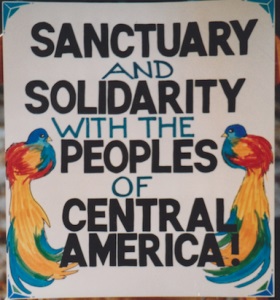
A thread that runs through all of the work Claire has done is a commitment to the belief that all individuals deserve respect and the opportunity to live in a fair and safe society. She protested to end the war in Vietnam and against the invasions in Iraq in 1991 and again in 2003. But her commitment did not wane after the active wars ended. After 1990, Claire worked against what she refers to as the “draconian sanctions” imposed by the United Nations against Iraq, which had a devastating impact on the Iraqi people. Virtually all imports and exports were sanctioned, including food and medical supplies, leading to a collapse of the country’s infrastructure and a huge increase in infant and child mortality. (See Joy Gordon, Invisible War: The United States and the Iraqi Sanctions (Harvard University Press, 2010)). And she speaks with particular passion about the work done by the Champaign-Urbana Ecumenical Committee on Sanctuary (CUECS) to support refugees from countries such as El Salvador and Guatemala who were escaping death squads and civil war. These refugees were denied political asylum because the U.S. government backed the Central American dictatorships. Throughout the 1980s, the movement provided aid to refugees, culminating in churches and synagogues publicly offering “sanctuary” to individuals being moved into the United States through an underground network of religious organizations. This purposeful flaunting of the law was a way to draw the community’s attention to the need for policy changes. See Linda Rabben, Sanctuary and Asylum: A Social and Political History (University of Washington Press, 2016).

2016 08 18 Laut 1

Szoke sees a direct connection between the sanctuary movement of the 1980s and immigration issues today, in particular the crisis created by the on-going Syrian war. As such, she continues to work on behalf of refugees through the C-U Immigration Forum, which seeks comprehensive immigration reform. The organization works with immigrants in the community with legal help, addresses individual needs, provides translation services, and conducts workshops such as “Know Your Rights.” She has more recently become involved in inter-faith action such as the C-U Friends Assisting Immigrants and Refugees (FAIR), which formed in the wake of Governor Rauner’s November 2015 announcement refusing the resettlement of Syrian refugees in Illinois.

Claire also remains an active member of the Channing-Murray Foundation, a self-described “radically inclusive” organization that has brought people from all different backgrounds together over social justice issues for decades. She is especially proud of Channing-Murray’s commitment to involvement with the campus community and history as a space dedicated to social justice action and the affirmation of diversity in our community.

It is easy to get discouraged about the lack of progress on many fronts despite decades of work by dedicated activists like Szoke. The Black Lives Matter movement reminds us that the violence of racism remains a potent problem in the United States despite a too often celebratory narrative of civil rights accomplishments. Labor unions are under attack throughout the country with legislative initiatives undermining workers’ rights and threatening labor’s power while the wealth gap continues to grow. The failure to achieve gender equity continues to undercut the social, political, and economic power of half of the population. And comprehensive immigration reform seems far out of reach in this volatile political environment. But talk with Claire for just a few minutes and any discouragement you might feel about lack of progress will turn into renewed determination to work toward a more humane and equitable society.

2016 02 25 Julie Laut

Julie Laut recently completed her Ph.D. in history at UIUC.


Posted in Immigration, International, Refugees, Women | Comments Off on Activists Among Us: Claire Szoke

The World According to the News-Gazette

In Champaign-Urbana, the News-Gazette is in the business of selling a commodity, the “news.” That’s the way “corporate media” necessarily work in a capitalist economy. Where media are government-run, the government subsidizes, that is, pays the costs.

What determines matters is the bottom line.

Selling a commodity and calling it “news”

So, what does the newspaper product look like? What are its selling points? The News-Gazette consists of articles and ads organized into sections. Section A (news, including editorials, opinion columns, and letters to the editor). Section B (local news, including opinion columns). Section C (sports). Other sections appear at intervals during the week – health and family – and on Sundays – entertainment, business.

Dig deeper. Just because it looks like a newspaper, and uses certain journalistic  conventions does not mean that it contains much news. Conventions like starting a story with a lead paragraph, progressively narrowing down and adding more and more detail.

But rather than assuming it is a newspaper because it ‘reads’ like one, think about how it is laid out. Think about what it leaves out as well as what it puts in.

The first, or news, section typically runs two or three local stories on the front page, and a couple of national or international stories on page 3. A non-news feature, “A Salute to Those Who Served,” runs invariably on page A-1.

On page 3, the paper has largely given up on comprehensive national coverage, but runs a roundup in the right-hand column, “Around the US.” “Dad fatally hurts zoo flamingo.” “Infant dies after being left in SUV.” ”Student stabs couple, bites face.” “Dolphin snatches woman’s iPad.” “Priest sentenced for sex tourism.” “Mother, boyfriend put child in dryer.”

Next comes an editorial page, expanded to a Commentary section on Sundays. For more than 75 years, the paper’s editorial line has been rightwing, consistently on the wrong side of history, as I documented in the June Public i.

“If it bleeds, it leads” —  the single largest number of news stories by a single reporter is crime stories

Section two, local news, includes a few local and state stories, but focuses especially on crime. The single largest number of news stories by one reporter is crime stories. Crime is all over the News-Gazette. Besides the bylined crime stories, there are the crime stoppers articles – including their annual fundraiser featured on the society page — and police blotter write-ups. And don’t forget the mugshots, and surveillance camera stills. There is also the too-weird-to-be-true stories. The pupply cooked alive in the oven. The guy who tortured his girlfriend’s cat. ‘If it bleeds, it leads,’ is the paper’s motto, and not only the News-Gazette’s. All manner of crime except white collar crime, which is conspicuously absent.

Crime in the News-Gazette is slanted. Crime reporting is unrepresentative of actual crimes committed, as I discussed at length in the April, 2016 Public i. Crime coverage slops over from local news to the front page. A murder trial gets detailed front-page coverage. The story the day after when the suspect is found not guilty runs in the second section. This happened twice in less than a month in late 2015.

Crime in the News-Gazette is geared to generate fear. It is implicitly about us good folks versus the ‘bad guys’ out there, and it plainly shows the ‘bad guys’ are primarily Black. In short, the News-Gazette applies the tried-and-true methods that Roger Ailes used to create Fox News’ “fear factory.

Section three is sports. With its logo, “Consistently recognized among the nation’s best sports sections,” the paper clearly signals that it is the most important section. The largest number of pages, and the smallest amount of hard news content.

For years it has been about making lemonade out of lemons. ‘Giving it the ol’ college try’ is the sports section’s narrative, its story line. Consider: nearly every sports story can be written in one verb tense, the conditional. “With a few tweaks, Illini could contend on biggest stage” (April 4, 2015, my emphasis).

This is not to knock sports generally, not to knock Illinois in particular.  Yet when you are so intent on making lemonade, you risk failing to call a lemon a lemon. The paper was almost the last news source to report, for example, on UI student athlete complaints concerning trainers and abusive coaches in 2015. In other words, as journalism it failed.

What else the paper says nearly nothing about is money in sports, except coaches’ salaries. It looks no more deeply into the economic realities of market-driven sports, and who profits than it probes outsized private sector CEO salaries. Rather than reporting on the intrinsic tension between education and sports, the paper  argues that Illinois should admit every NCAA-eligible player, admissions standards be damned (Loren Tate on Al Kurtz show, WEFT, August 10, 2016).

Instead, the paper delivers locker room chatter, inside baseball, and lots and lots of box scores that we readers can relate to. Almost none of it newsworthy. And all of it packaged in shiny, morsel-sized featurettes. After each football game: “What happened,” “What It Means,” “What’s Next.” “Pigskin Predictions” (“top 50 countdown of preseason football rankings”). “Welcome Matt” (“sports editor Matt Daniels gets your morning kick-started with what to expect this week from The News-Gazette”).

“Sportsification”– the friendly takeover of the news sections by the sports section

The world according to the News-Gazette changes somewhat over time while remaining basically the same. Since 2014, for example, the paper has selected new editors and publisher.

The chief change has been “sportsification,” the friendly takeover of the news sections by the sports section. Newly appointed executive editor Jim Rossow had been sports editor since 1996. Newly-named news editor Jeff D’Alessio covered UI men’s basketball 1994-2001. He then went on to the Sporting News 2000-2002, Florida Today sports editor 2002-2004, Atlanta Journal-Constitution 2004-2008, including as deputy sports editor, then back to the Sporting News 2008-2014, before returning to Champaign.

Back when he was sports editor in 2008, Rossow came up with “12 days (and stories) of Christmas,”12 of his favorite [sports] stories that ran in the past five years.” Flashforward to 2015, and now-editor Rossow commissioned his stable of reporters for “12 stories of Christmas 2015,” including “The Power of PJs” and “Nun traded fisticuffs for happy habit.”

Sportsification at the News-Gazette has meant spreading the sports section’s gimmicky featurettes to the rest of the paper instead of reporting more news and doing it better. For his 2015 “50 Ways to Engage Our Readers,” Rossow “asked everyone to come up with their own feature.”

In the last two years at the News-Gazette, this make-work scheme has generated a slew of featurettes including the following. “The Health Reporter Is In.” “Ask Mimi.” “A Salute To Those Who Served.” “Spotlighting Service.” “Teacher of the Week.” “What’s in a name?” “Where Am I?” “Who lives here?” “Clergy Corner” (“What’s the one hymn that gives pastors goose bumps whenever their choir belts it out?”).

Several are simply lists, or more accurately, “listicles” reminiscent of Rossow’s “50 Ways.” D’Alessio’s “Big Ten.” “Go Figure” (“A numerical look at headlines”). “By the Numbers.” “Frank’s Five.” “The Future Five.” “Just 1 Question.”

Featurettes” — virtually devoid of news value — are placeholders for news never delivered

Such human interest, reader-oriented featurettes have infected papers nationally desperate to shore up their bottom line. At best, they are human interest stories. At worst, they are tabloid features, replete with the focus of tabloid journalism on crime, sex, and celebrities. But what is gained in revenue is lost in news.

Eight years ago Chicago Jewish billionnaire Sam Zell bought the Los Angeles Times, Chicago Tribune, and Orlando Sentinel. Zell spoke to nervous Sentinel staffers in 2008.

Zell: “My attitude on journalism is very simple. I want to make enough money so I can afford you. It’s really that simple. Okay? You need to, in effect, help me by being a journalist that focuses on what our readers want and therefore, generates more revenue.”

Sentinel photographer Sara Fajardo: “But what readers want are puppy dogs, and I mean, we also need to inform the community…”

Zell: “I’m sorry, I’m sorry, I can’t – you know, you’re giving me the classic, what I would call journalistic arrogance of deciding that puppies don’t count. Hopefully we get to the point where our revenue is so significant that we can do puppies and Iraq. Okay? Fuck you.”

I think that’s pretty clear.

For featurettes are in fact ‘space wasters.’ Devoid of news value, they mostly take up space. They are placeholders for news never delivered.

Taking up space, grabbing our attention, these space wasting featurettes convey the world according to the News-Gazette more clearly, more explicitly than more straightforward news stories. The intention is that we identify with, feel good about ourselves and our Lake Wobegon community in the cornfields, that we feel trustworthy, loyal, helpful, friendly, courteous, kind, obedient, cheerful, thrifty, brave, clean, and reverent. And buy the paper.

This is the world according to the News-Gazette.

Featurettes increasingly swamp “hard” news, they drive actual news out. Still more disturbing, these “soft” news featurettes tend to reproduce the status quo, already conservative, rather than reporting news that challenges readers, pushes them out of their comfort zones.

By definition, featurettes do not present or discuss issues. Featurettes avoid talking about politics. Politics is evacuated explicitly, but politics is still present implicitly. The ideological work that featurettes perform is to uphold the status quo. But this is done indirectly and dishonestly.

On the front page, for example, “A Salute to Those Who Served” implicitly devalues those who did not by simply excluding them. Vets fought in wars; implicitly, the featurette is pro-military, pro-war. In the News-Gazette‘s world, war critics, antiwar protestors, and conscientious objectors, are all by definition non-persons. They literally do not count; they are airbrushed out.

This is not to knock the military. Some wars need to be fought. But Vietnam? Iraq? Those are debatable… so let’s have a discussion, a debate. But the News-Gazette refuses to present more than one side. It has never met a war it didn’t like, so end of story. With “A Salute to Those Who Served” the paper disserves the broader community. And in the process, it contributes to the gradual corrosion of our increasingly militaristic, militarized society and body politic.

Another featurette, “Clergy Corner,” is to date Christian only. Islam, Judaism — to name only the other major monotheisms – apparently do not qualify.

How exactly do they get us to buy what they are selling?

Human interest stories are supposed to make us feel good. We are also meant to feel other things. The cheap thrill of recognition. Titillation. The voyeurism of dirty laundry.

These treacly human interest bromides make us feel good,.. well, many of us. We identify with it. We literally identify individuals we know. ‘His/her name in the paper!’ So there is the cheap thrill of recognition.

We are also meant to feel other things, which is where the crime coverage fits in. Titillation – sex crime charges against a Champaign police officer of the year. And voyeurism.  And especially the dirty laundry.

“I make my living off the evening news

Just give me something

Something I can use

People love it when you lose

They love dirty laundry” (Local Yocal online comment)

This is the underside of their Republican right respectability.

The News-Gazette is selling us a bill of goods. It is smug, self-satisfied, and not accountable, because money-making featurettes trump reporting the news. The paper does not cover the news in any depth, let alone do investigative reporting. Instead, it makes money by reflecting back to its loyal subscribers the world it and they already live in, the comfort zone they inhabit, plus another, different, private-made-public world they voyeuristically peer into from the outside.

It all comes down to selling its readers on the world according to the News-Gazette. In selling us this bill of goods it calls “news,” the paper is conning us. No wonder they’re smirking all the way to the bank.

I, for one, don’t buy it.

Would we be better off without the News-Gazette?

Yes.

This question is sometimes asked, especially by those who have just read yet another editorial that makes us cringe.

The usual response is ‘I read it for the local news.’ By this people apparently mean what could be termed “surface stories,” that is, what is going on in the local schools, city councils, county board, and the like. Although less willing to admit it, many also get a guilty pleasure, a low-level voyeuristic thrill from reading the obits, letters to the editor, and the often lurid crime stories with their accompanying mugshots.

By ‘local news’ folks do not mean investigative journalism, that is, extensive, in-depth coverage of local business, the university, and news analysis of local wheeling and dealing, of what really went on at the last city council/county board meeting, and the like. For that you have to read between the lines of a story, plus online reader comments, and any subsequent letters to the editor.

Arguably, therefore, the News-Gazette is no better on local news than it is on state news  (spotty), national news (including sensationalistic page A-3 blurbs), and international news (hit or miss, except “terrorism”).

At this point in the discussion, either the News-Gazette, or one of its defenders, will respond that ‘if the paper were owned by a newspaper chain, rather than locally-owned, then there would be much less, and less knowledgeable, local news coverage.’ Although often made, this point is largely a self-serving myth, repeated especially by the News-Gazette For it is rarely, if ever, backed up or substantiated versus simply asserted.

First of all, there was a local paper owned by a national chain during its last years. People did not complain about the lack of local news in the Urbana Courier.

Second, the Courier had been running in the red in the years before it folded in 1979, but the  News-Gazette also operated at a loss in the five or so years after 2008.

Third, by ‘locally’ or ‘family-owned,’ people are referring to the paper’s byzantine for- profit/not-for-profit tax status. The for-profit paper is technically owned by a non-profit foundation set up when Marajen Stevick Chinigo died. The News-Gazette claims this ‘far-sighted’ move safeguards the paper from a corporate takeover.

What the paper does not tell you is that it is also a financially astute mechanism to maximize tax advantages, meaning it pays lower taxes. The News-Gazette is not operating illegally, but like that other locally-based for-profit/non-profit — Carle Foundation Hospital/Carle Clinic/Health Alliance – it is definitely pushing the envelope.

So, would we be better off without it? If you say no, keep it, then you are also saying that it is OK for the News-Gazette to have a news monopoly, and for that to be Faux-News Champaign.

2014 05 21 cell meeting for Roediger 3

David Prochaska formerly taught colonialism and visual culture in the UI History Department

Posted in News-Gazette | Comments Off on The World According to the News-Gazette

Statement on the Upcoming Ballot Referendum on “Public Facilities”

Statement delivered by Build Programs, Not Jails before the County Board on August 18, 2016. 

Signs posted outside County board meeting of Aug. 18, 2016

Signs posted outside County board meeting of Aug. 18, 2016

Last week [on Tuesday, August 9, 2016] the County Board’s Committee of the Whole voted in favor of placing a referendum on the November ballot for a ¼ percent sales tax to pay for “public facilities” purposes. We fully recognize that the county has pressing maintenance needs, particularly in regard to the county’s public nursing home.  We also recognize that the use of these funds will be determined on an ongoing basis by the sitting County Board.  However, based on the Facilities Action Plan that was presented as background to the referendum, by far the largest portion of immediate spending will be for jail building. This is unacceptable.  Apart from directing too much money toward jail construction, we reject the proposal the Board is recommending on four other grounds:

1.       A decision on constructing or renovating jail space  should be made in the context of considering how to decrease the number of people incarcerated, and only after that is addressed should jail construction be included in a proposal on facilities and maintenance.  Given the serious incarceration debate that has taken place in our community, any attempt to address issues of jail construction must be considered as part of a political process which examines the criminal justice system as a whole and includes participation by the community. We must pay special attention to including the Black community, which has been most seriously impacted by incarceration.

2.      The Facilities Action Plan neglects virtually any measures that would keep people out of jail or reduce jail numbers. While the jail is labeled as an immediate priority and is put in Group A, the only proposal to reduce the incarcerated population is for a Behavioral Health Services Facilities, which is in Group C: “Projects in this group are conceptual only. They require further study relative to the construction and operational costs to be incurred as well as funding strategies.” As an important alternative to incarceration and the absence of behavioral health services in our county, this project should be a top priority in the critical group, not at the bottom of the list.

3.      The presentation of the Facilities Action Plan claimed that between closing the Downtown Jail and new construction at the Satellite Jail there would be a considerable decrease in the overall jail capacity, whereas in fact it is only a 10% decrease from 313 to 282 (additionally, not all cells in the downtown jail are currently available for use).  The presentation also said the plans for the jail reflected a 40% decrease in cost compared to the 2015 Sheriff’s Office Master Plan, not recognizing how outrageously expensive that plan was.

4.      The referendum proposal was presented in the context of the Facilities Action Plan, which outlined priorities and allocations of funding. However, when members of the public attempted to criticize that plan, we were told the plan meant nothing, that the next board would develop the actual plan. This appears to be a conscious deception calculated to obscure the essence of the board’s intention and to cover up the excessive funding to be directed to the jail.

Likely the debate over jail construction has been the most hotly contested political issue in this county in decades. Incarceration is unnecessary for the majority of people who are arrested, and can further disrupt people’s lives, especially for low-income individuals.  However, the county board’s referendum is a quick-fix solution aimed at ignoring the problems and solutions that the community has brought to this board for the last four and a half years.  We reject this plan and hope that the county will come forward with a solution to these problems that breaks with the history of excessive reliance on incarceration to solve social problems, and which contributes to eliminating the racial disparity that has become a persistent feature of our county jail.  It is time for a new direction.

Posted in Justice, Prisoners | Comments Off on Statement on the Upcoming Ballot Referendum on “Public Facilities”

Oct. 8 FOIA Fest

A workshop on how to file Freedom of Information Act (FOIA) requests will be hosted by State Representative Carol Ammons. Come learn how to file a FOIA for public documents. Let the sun shine in!

Saturday, October 8, 6-9pm at the Channing Murray Foundation (1209 W Oregon St, Urbana).

With Andrew Scheinman (who ran anti-Carle campaign), and Brian Dolinar, (of the Public i).

Join your fellow students and/or Champaign-Urbana neighbors for an informative discussion about one of the most noteworthy pieces of legislation of the past century. Signed into law on July 4, 1966 by President Lyndon B. Johnson, the Freedom of Information Act allows for the full or partial disclosure of previously unreleased information and documents controlled by the United States government. The event will include a presentation on the history and legalities of the FOIA, a panel discussion about how FOIAs have been used in local campaigns, and how to file a FOIA.

Posted in Uncategorized | Comments Off on Oct. 8 FOIA Fest

We Don’t Need a New Jail, We Need Abolition

Speaking to the Champaign County Board on Tuesday, August 9th, local Black organizer/activist, Kadeem Fuller made a much needed case for the abolition of jails, prisons, and white supremacy. The following is a transcript of his speech. 

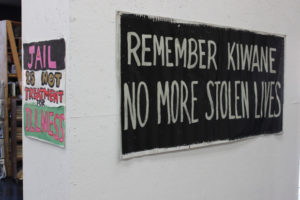
Tonight I sit before the people of Champaign County and declare we have been set up. Once again members of our local government have attempted to set in motion a project that will doom the most vulnerable among this county’s population. Once again this county board is conspiring with oppressors of the people, men with badges, in an attempt to revitalize the draconian tactics of the War on Crime masked as a simple proposal for a safer Champaign County. Put simply this County board is attempting to sign a deal against the people of this county. This ridiculous proposal attempts to justify the construction of a jail project estimated to be 10 to 15 million dollars. This proposal places the jail project in Group A which is the highest priority category while interestingly enough places the creation of a Behavioral Health Services Facility in Group C, which is the lowest priority level.kiwane-banner

Although the proposal also mentions maintenance of the nursing home it is important to remember that the jail construction project is 65 percent of the entire proposal budget. This proposal is nothing more than an attempt to sneak a new jail into this county.

In the proposal it states that Group A projects are considered critically important and there are no other feasible alternative solutions. We have seen time and time again the results of incarceration. Broken homes and torn relationships, babies growing up without fathers, mothers, sisters and brothers. We have seen within Black communities both locally and nationally the slaughtering of dreams, both potential and realized. We have no more room for incarceration, we have no more room for despair. We have no more room for jail cells where jobs, schools and other resources should be.

Over the last few decades much research has been conducted detailing alternatives for incarceration: methods ranging from revolutionary restorative justice to reform in policy. There are several alternatives to incarceration.

In fact, mental health services, similar to the facility this proposal places in Group C, could indeed be seen as an alternative to incarceration. It is clear this county board do not concern themselves with alternatives to oppression. In June this county board listened to several family members of people who died in the Champaign County jail. These family members suggested a detox center and a pretrial program as alternatives to the harshness of incarceration, yet neither are mentioned in this new jail proposal. These people came and shared their hearts, tears and grief to this county board and you all turned your head to them.

The proposal also stated that this jail project would address concerns of both corrections staff and community members. My question is how? How can you meet the concerns of both the oppressed and the oppressor, of both tyranny and resistance, of both a corrupt and repressive government with the calls of liberation from the people? It simply cannot be done.

I ask you what makes you all think we need a new jail? This county jails takes lives. In this county Black people represent 13 percent of the population but represent over 60 percent of those in jail. What’s more, from July 1, 2015 to June 2016, 29 deaths were reported to the Illinois Department of Corrections, with Champaign County placing second on the list with three.

45-year-old Toya Frazier found dead December 1, 2015 in the Champaign County Jail.

59-year-old Paul Clifton died on Easter Sunday after collapsing in the Champaign County Jail.

48-year-old Veronica Horstead found dead on June 10, 2016 in the Champaign County Jail.

We do not need a new jail.

What we need is justice for the people that have died in custody in the Champaign County Jail. What we need is the abolition of jails and prisons in this county, state, nation, and world. What we need is an end to anti-Black racism and white supremacy in this county, state, nation, and world.

A new jail will not solve the neglect that incarcerated people face in this county. Only the toppling of prisons and jails can do that. I condemn this heinous attempt for a new jail and I condemn the people who support it. It will not stand. All power to the people!

Kadeem FullerKadeem Fuller is an organizer with Black Lives Matter Champaign-Urbana and Black Students for Revolution at the University of Illinois Urbana-Champaign. 


Posted in African Americans, Voices of Color | Comments Off on We Don’t Need a New Jail, We Need Abolition

IMC Helps Pass Prison Phone Justice Bill in Illinois

ppj Carol&WandjellState Representative Carol Ammons and Wandjell Harvey-Robinson attended the signing of HB6200 on August 22, 2016. The bill will cut in half the cost of phone calls from Illinois prisons.

Thank you to Rep. Ammons and Wandjell for fighting for those incarcerated and their families!

Wandjell lives in Champaign and grew up paying the high costs of these phone calls talking to her two parents who were incarcerated when she was in the third grade. She is today involved with Ripple Effect, a support group for families with a loved one incarcerated. She was actively involved in the campaign to pass HB6200, speaking at two legislative committee hearings and appearing before the press.

“There are thousands of Illinois children whose lives will be dramatically improved by the actions today,” Wandjell said at the bill’s signing.

The new law will take effect January 1, 2018.

The Illinois Campaign for Prison Phone Justice is a project of the Urban-Champaign Independent Media Center, and was also involved in the national campaign that brought the FCC’s decision last year to regulate the entire prison phone industry.

Support the IMC and help us give voice to those incarcerated and their families!

Posted in Human Rights, Prisoners, UC-IMC | Comments Off on IMC Helps Pass Prison Phone Justice Bill in Illinois

The Syrian Refugee Crisis and the Problem of Categories

The Syrian refugee crisis is ultimately a problem about categories, not numbers.

Yes, the numbers are overwhelming. But, unfortunately, after years of tragic stories about the 11 million displaced by the Syrian war, international sympathy is waning even as the situation worsens. There are just too many faces, too much heartbreak and no apparent end to the chaos in the Syrian homeland. The refugees are human hostages on the front lines, bargaining chips at diplomatic conferences and easy targets for populist politicians, but they are seldom recognized as what might be their most important role, heralds of the future.

A Global Shift In Human Displacement

Rather than be distracted by the numbers, we should be looking at the Syrians as symptoms of a global shift in human displacement. Thinking about the migration challenge from this perspective doesn’t need to lessen our compassion for any individual fleeing war, but it might help us see why this issue is so seemingly intractable.

2016 08 17 Jayes 2

Most Syrians live as internally displaced people within their own country, separated from their families, work and schools. They live with the constant risk of being caught between factions, or even targeted directly by militias or government troops.

Numbers offer us a starting point, if not the entire story.  Eleven million Syrians, or one half the pre-war population, is displaced. About six million of these are internally displaced, some in makeshift shelters 100 yards from their old homes, some in distant communities still exposed to the horrors of war including, according to the UN Security Council, “systematic starvation” of civilians. Some refugees have crossed borders, straining neighboring economies. There are over a million in Lebanon, (a nation of only 4 million) and almost 3 million in Turkey. A few who can afford it (about .5 million) have been able to travel farther into Europe, while the poor and vulnerable (women and children) are the most likely to remain in vulnerable situations in the conflict zones.

These numbers should be seen in global context. In June the UN sadly noted that the number of refugees had reached 65 million worldwide. Another 244 million are classified as “migrants,” or individuals who live outside their native country. Both these groups are historically undercounted, but even the conservative figures suggest that about 1 in every 113 humans is living a life of displacement.

2016 08 17 Jayes 4

In three years Camp Zaatari in Jordan has acquired an air of permanence, but this only increases hostility from neighbors who blame residents for lowering regional wages and causing food shortages.

Historical context matters as well here. Humans have always moved, but during the past 100 years states have erected barriers that police the edges of the nation-state. The beliefs that resources belong only to residents (a principle inconsistently observed regarding other people’s resources) and that money and goods can travel, but that people should not, have become the norm. Regimes of immigration control emerged alongside the concept of the modern state.

Nation-State Fences in Place, but Globalization Continues Apace

By the mid-20th century the nation-state fences were in place, but globalization of the economy and climate change continued and, according to the UN report, became the key drivers of migration by the 1990s. In the last fifteen years migrants seeking survival—not just opportunity—abroad have soared. Yet both those who travel with some kind of permission and those who travel without endure exploitation if they lack language skills and legal advocates, advantages usually reserved for the educated migrants at the peak of the migrant pyramid. More often, desperate migrants risk dangerous journeys across desert and sea to find themselves on the economic and social fringe of their new homes.

The patterns set up by these earlier migrants are part of the backstory of the Syrian exodus. Earlier generations from the Middle East had already notched migration trails into Lebanon, Turkey or Europe, and these trails became escape routes after 2011. Then, just as they have affected every other aspect of the Syrian conflict, new telecommunication technologies kicked in and further changed the migration game.

Whether migrants were leaving Mali or Syria, the ease of sharing information completely altered the decision making calculation. Humans shared information in earlier eras, but the internet and cell phones sped up the process of information exchange and kept the migrants ahead of state-imposed barriers.  Only in the past few years have migrants been able to reach out to their families and friends and research conditions in real time. The technology gave them knowledge of alternatives, and they used it.

2016 08 17 Jayes 1

The half million Syrians arriving on the shores of Europe capture most of the political attention in the West, but the majority of Syrian refugees (10 million others) were trapped within Syria or in neighboring countries.

Unfortunately, the cell phone not only kept the migrant informed and ahead of the state, it kept the human traffickers ahead of the game as well. Worldwide migration has provided a lucrative new expansion opportunity for transnational criminals.  Human traffickers armed with technology and knowledge of local networks moved in quickly to offer their services to desperate Syrians and others. In fact, Syrians are not even the majority of the new European immigrant market. Of the estimated 1 million migrants to enter Europe in 2015 (a fourfold increase over 2014), less than half were Syrians. Migrants fled wars in Afghanistan and Iraq, instability in Western Africa, and depressed rural economies in Central Asia as well as the conflict in Syria.

Social Media Amplify Exploitation of Refugee Crisis 

There is one final way in which the Syrian refugees reflect the political dynamics of the age, and sadly, this might determine the future of many humans in the situation of displacement. The potential to manipulate social fears through exploitation of the refugee crisis is vastly amplified by social media. Even though the vast majority of terrorist acts in the West have been committed by radicalized citizens, not foreign jihadists, populist movements have demanded the closure of borders and rejected traditions of tolerance. Fighting over refugees has become a way of discrediting opponents. The immediate human harm may be less visible than that created when ISIS deliberately targets civilians in order to drive new refugee streams into Turkey, but they are both manipulations of the vulnerable for political strategy.

In the long run, the decline of cultural tolerance, the militarization of daily life, and the loss of cooperative problem solving between nations may leave even greater casualties than terrorism for the West. And leaving the human victims of war, climate change and economic collapse to struggle alone cannot possibly contribute to a more secure world. The most powerful predictor of who will follow extremist groups is the sense of being culturally, economically or politically marginalized. Extremists, (and perhaps some populist political movements?) offer a narrative that restores a sense of order and purpose where one was lacking.

2016 08 17 Jayes 3

Women and children are often found in camps within Syria. They are both the most vulnerable and the least likely to be able to flee war zones.

Our sympathetic response to the iconic refugee, the mother and child fleeing destruction and waiting to be restored to their homes, is laudable, but it shouldn’t blind us to the bigger problem. This is a global human movement crisis, of which the Syrian refugee crisis is one piece. Hopefully, Syrians will be able to return home in the near future, but even if the Syrian crisis is resolved we will still be dealing with a mismatch between human needs and the modern state. Our old categories of refugee and migrant, citizen and non-citizen, with accompanying attitudes of generosity or rejection, may have fit our illusions of nation-state autonomy, but they are inadequate for the interconnected world we live in. Our response to the Syrians and other displaced people will tell us much about the world we will be building for our future.

Third in a series on how the Syrian conflict illustrates new dynamics in global politics.

2016 05 13 Janice Jayes

Janice Lee Jayes, Ph.D. teaches Modern Middle East history at Illinois State University. She has worked in Morocco, Latvia, Kyrgyzstan, and was a Fulbright scholar in Egypt.

[Caption 1: Most Syrians live as internally displaced people within their own country, separated from their families, work and schools. They live with the constant risk of being caught between factions, or even targeted directly by militias or government troops.]

[Caption 2: In three years Camp Zaatari in Jordan has acquired an air of permanence, but this only increases hostility from neighbors who blame residents for lowering regional wages and causing food shortages.]

[Caption 3: The half million Syrians arriving on the shores of Europe capture most of the political attention in the West, but the majority of Syrian refugees (10 million others) were trapped within Syria or in neighboring countries.]

[Caption 4: Women and children are often found in camps within Syria. They are both the most vulnerable and the least likely to be able to flee war zones.]

Posted in Middle East, Refugees, Syria | Comments Off on The Syrian Refugee Crisis and the Problem of Categories

Orlando Shooter Was A Product of US Hyper-Masculinity

Like so many others, I’ve been at a loss trying to make sense of the heinous act of anti-queer mass murder in Orlando. The following are some of my scattered thoughts on the topic, some of which I originally posted in a couple of rants on social media the past two mornings:

I have family members and friends who are queer, immigrants, Muslim, or all three, and who are very worried about the proliferation of the harmful imperialist ideology that comes with characterizing the murderer Omar Mateen as “ISIS,” “jihadist,” “Muslim”–in short, foreign, other, not of the United States. They recognize that this discourse carries with it repressive power that harms queer, Muslim, and immigrant communities. I’ve seen discussion on social media blaming the patriarchal culture of Afghanistan. What this discourse fails miserably to notice is that Mateen was not from Afghanistan. He was born and raised in the United States. He went to US schools. He watched US movies and television shows. He played in US neighborhoods. He shopped at US malls. He worked for US companies. He was socialized in the United States. He was a United States citizen from birth. So if we’re going to interrogate patriarchal culture, and I think we should, let’s start with the United States.

For the past year I’ve been teaching a US Gender History course to undergrads at the university. One of the things I emphasize is the interconnectedness of US imperialism, capitalism, white supremacy, and violent masculinity. I’ve learned, and continue to learn, from Black, Brown, Indigenous, “third-world,” anti-colonial, Queer, and working-class feminist scholars, organizers, and activists about the many ways cis-hetero-patriarchy is historically intertwined with histories of capitalism, imperialism, and white supremacy. I try to share that knowledge with my students. The violence committed by Mateen has US hyper-masculinity written all over it.

He idolized cops, fetishized guns, hated queer people, was racist, abused his ex-wife, used steroids, and worked for G4S, which is a multinational corporation that profits from technologies of social control, prisons, colonialism, and border imperialism (see chapter 4 of Angela Davis’s Freedom is a Constant Struggle for a discussion of what G4S is). This was a guy who thoroughly internalized US ideals of “manliness.” He was the product of a long history of patriarchal values in US culture and politics. He over-conformed to the ideal of “manliness” that all of us cis-men in the United States were socialized―through family, coaches, teachers, religious leaders, media, etc.―from childhood to internalize.

We’ve got to destroy the gender ideology―which is deeply intertwined with white supremacy, capitalism, and imperialism―that underlies this murderous violence. That means nothing less than social, political, cultural, and economic revolution. At the very least it means we need to start recognizing that one of the most harmful things we teach boys is that they need to toughen up and “be a man.”

And we can’t ignore the role of hetero-patriarchal religion in perpetuating these toxic notions of “manliness.” Mateen believed he was defending his family from the threat posed by homosexuality. According to family members, he was angry that his son saw two men kissing. He needed to defend the family from the gays. Every church leader and mosque leader who has been perpetuating this “family vs. gays” discourse, from Mormonism, to Catholicism, to Evangelical Christianity, to Islam, and more, is complicit. Every politician, who, in the name of “Christian values,” has worked to pass legislation that marginalizes and devalues LGBTQ people is complicit. And every “good citizen” who votes based on hetero-patriarchal “family values” is complicit. We’ve got to tear down this whole system, and that means tearing down these anti-queer religious leaders with their hypocritical and disingenuous “hate the sin, love the sinner” nonsense.

Lastly, I want to praise my Queer and Muslim comrades who have been working to forge Queer/Trans and Muslim solidarities. They are queer people who challenge Islamophobia, pinkwashing, and colonialist belief systems within their own queer communities. They are Muslims who challenge cis-hetero-patriarchy within their own religious communities. And they are queer Muslims of color at the intersections of all of these violent systems fighting for their lives in a hateful world. Both the heinous act of mass murder against LGBTQ people and the opportunistic abuse of that tragedy to justify increased targeting of Muslims demonstrate how crucial their work is. We fight hatred, ignorance, and systemic injustice with revolutionary solidarity.

Tariq Khan photo

Tariq Khan is a father, a veteran, an agitator, and a PhD student at UIUC, originally from Northern Virginia.

Posted in International, LGBTQA, National, Politics | Comments Off on Orlando Shooter Was A Product of US Hyper-Masculinity

How Lawmakers Are Exploiting Public Fear After Orlando to Push More Police Militarization

To date, the Orlando Police Department has disclosed no definitive evidence that its military-style weaponry protected public safety the morning of the horrific massacre at the LGBTQ Pulse club’s Latin night. And the department’s chief has not ruled out that officers may have been responsible for some of the casualties when they stormed the nightclub. But that is not stopping law enforcement unions and congressional representatives from seizing on public fear over the mass shooting to push for police militarization across the country.

On June 15, the Republican-controlled House of Representatives passed an amendment to the Department of Defense Appropriations Act that states, “no funds shall be used to implement President Obama’s Executive Order 13688 limiting the donation of surplus federal equipment to state and local law enforcement.” Obama’s 2015 executive order placed some limits on the federal program that allows the Pentagon to fork over unlimited amounts of military grade weaponry to police departments. After passing the House, the bill will be conferenced with the Senate.

Demands for the demilitarization of police have been a key rallying cry of Black Lives Matter protests since 2014, and many argue that Obama’s order did not go far enough. But the new legislation, which is still in the House, could strike a significant blow against even the most limited police reforms.

The June 15 amendment was introduced by Rep. David Reichert (R-WA), who has a record on LGBTQ rights that could be described as spotty at best. In 2006, Reichert voted in favor of a constitutional amendment to define marriage as between a man and a woman.

Chuck Canterbury, the president of the Fraternal Order of Police, a national police union known for its vehement resistance to reform, showered praise on Reichert June 16. “The heroic response of law enforcement to the terrorist attack on the Pulse nightclub demonstrated the utility and necessity of the equipment our officers need and we are very pleased that Mr. Reichert’s amendment… was adopted to restore our nation’s equipment programs.”

This statement was featured on the Facebook page of the Orlando chapter of the Fraternal Order of Police. Widely-circulated media images of heavily armed SWAT team members indicate that at least some officers were equipped with military-style gear.

In the aftermath of the bloodbath, police and lawmakers have hammered on the importance of keeping massive stockpiles of military-style weaponry in law enforcement arsenals.

Concealing Information, Controlling the Narrative

The police and city of Orlando have gone to extreme lengths to conceal information about the mass shooting from the public, rejecting public records requests from roughly two dozen media outlets. This lack of transparency was criticized by the Florida Society of News Editors: “There are many important questions raised in the wake of this tragedy, and it’s our responsibility to try to find answers. The state needs to live up to the law.”

While keeping these records from journalists, police have actively shaped a narrative of the massacre through anonymous leaks and official statements. Within hours of the shooting, police told the media that the killer, Omar Mateen, had sworn fealty to ISIS. And an anonymous officer told the Daily Beast’s Michael Daly that Mateen was seeking to protest the U.S. bombing in Iraq and Syria. A narrative of “Islamic terrorism” quickly dominated the news coverage, even as other salient factors came to light, including Mateen’s obvious confusion about the array of militant organizations he allegedly swore loyalty to. This singular media focus continued even after the heads of the CIA and FBI admitted there were no signs of material links between Mateen and militant organizations outside of the United States.

At the same time, police hit the cable news circuit to champion the bravery of the police force, with Orlando Police Chief John Mina telling CNN’s Anderson Cooper, “Those first officers on the scene and our SWAT officers, they saved many, many lives.”

Unanswered Questions

Many troubling questions remain about the police response. Mina could not rule out whether some of his officers may have shot Pulse patrons in the hail of gunfire against Mateen. According to Mina’s account, moreover, there was a roughly three-hour gap between when officers first engaged Mateen and when they stormed Pulse with explosives and a BearCat vehicle. Many have criticized the delay, including former police officers. Chris Grollnek, “an expert on active-shooter tactics and a retired police officer and SWAT team member” (Associated Press), stated, “How have we failed so poorly that we did not learn our lesson… when we see SWAT teams respond and not making entry creates victims. Period. End of story.”

Survivor Angel Colon, who was shot five times, told Fox’s Good Day New York, “I didn’t understand why they [the cops] didn’t go in. There is no reason why they should be standing there with all these gunshots going off. I have videos of me yelling at the cops to go in there.”

Attorney Flint Taylor, one of the founding partners of the People’s Law Office in Chicago who has been working on police violence and torture cases in Chicago and around the country since 1969, told AlterNet: “Why won’t they release the full 911 tape if they are going to talk about it? If there is a legitimate reason not to release it, they shouldn’t be leaking it selectively… Reactionary forces are utilizing it selectively and it makes you skeptical and suspicious of what the motive is.”

History of Repressing LGBTQ Communities of Color

Amid the vacuum of information about what exactly happened at Pulse, any political push for expanded police powers depends on the public’s trust in law enforcement agencies.

But Hermelinda Cortés, an organizer with the queer liberation organization Southerners on New Ground, told AlterNet that police have failed to earn the confidence of the very communities whose pain and loss is being invoked to justify widening powers.

“Increased armament of law enforcement does not make us feel safer. For queer and transgender folks of color, that increased police presence does not provide us with security, especially for communities already targeted by police on a daily basis,” said Cortés. “We’re talking about from the Stonewall Riots until now.”

June Pride celebrations originated to mark the Stonewall Riots on 1969, in which primarily Black and Latina LGBTQ patrons of a gay club in New York’s Greenwich village rebelled against a discriminatory and violent police raid.

Police departments across the country have a long history of violently repressing LGBTQ communities. In recent years numerous law enforcement agencies have been sued by gay bars that suffered violent, SWAT-style police raids over “lewd behavior” and alleged violations of alcohol licenses. In 2009, more than 20 police officers wearing SWAT gear raided the Atlanta Eagle gay bar and, according to an investigation, forcing patrons to lie down in broken glass while hurling homophobic slurs at them.

As author Radley Balko pointed out, police have a troubled relationship with communities of color in Orlando. The Orange County sheriff’s office was sued by owners and customers of numerous Black and Latino barbershops in the Orlando area in 2014 for violently raiding the establishments with “ballistic vests and masks, and with guns drawn” demanding to see their barber’s licenses.

According to Cortés, the call for police militarization grows alongside “increased Islamophobia, increased whitewashing and erasure that it was a hate crime against queer and transgender people.”

Reprinted and edited with author’s permission from Alternet.

Sarah Lazare is a staff writer for AlterNet. A former staff writer for Common Dreams, she coedited the book About Face: Military Resisters Turn Against War. 

Posted in Latino/a, LGBTQA, Police | Comments Off on How Lawmakers Are Exploiting Public Fear After Orlando to Push More Police Militarization

Bryton Mellott’s Flagburning Facebook Posts

On July 4, Independence Day, Bryton Mellott was arrested for posting photos on Facebook of his burning of a US flag. The story was picked up by Forbes, NPR, ABC news, CNN, and other national outlets, and went viral on social media.

The irony of those protesting what the Supreme Court decided in 1989 is free speech was not lost on many nationwide. In the media storm over the flag burning pic — including numerous threats of physical violence — Mellott’s text received scant attention:

I am not proud to be an American. In this moment, being proud of my country is to ignore the atrocities committed against people of color, people living in poverty, people who identify as women, and against my own queer community on a daily basis.

I would like to one day feel a sense of pride toward my nationality again. But too little progress has been made. Too many people still suffer at the hands of politicians influenced by special interests. Too many people are still being killed and brutalized by a police force plagued with authority complexes and racism. Too many people are allowed to be slaughtered for the sake of gun manufacturer profits. Too many Americans hold hate in their hearts in the name of their religion, and for fear of others. And that’s only to speak of domestic issues.

I do not have pride in my country. I am overwhelmingly ashamed, and I will demonstrate my feelings accordingly. #ArrestMe.

State’s Attorney Julia Rietz declined to charge Mellett, and he was soon released. Urbana police said they “respect” Rietz’s decision, but have not admitted to wrongfully arresting Mellott for flag desecration and disorderly conduct, as well as being a victim of disorderly conduct. Police Chief Patrick Connolly needs to explain who and exactly why the decision was made to arrest Mellott.

Threats of physical violence, including death threats, continued to be posted on social media. Mellott himself posted, “So it’d be super-duper if the death threats could stop,” and later, “Let’s see… survived for… almost three days.” We call on the police to identify and the state’s attorney to prosecute those making death and other physical threats in violation of the law.

The Public i stands in solidarity with Mellott’s right of free speech to write and do what he did.  It is utterly perverse for police to “protect” free speech by arresting, handcuffing, and imprisoning those who exercise it.

July 7

Posted in Free Speech | Comments Off on Bryton Mellott’s Flagburning Facebook Posts

News-Gazette: Always Right

The News-Gazette has always been Right — right-wing Republican, and in its smug self-righteousness, right.

The paper presents itself as “respectable Republican,” as representing the values of “proper,” polite society. It abhors what is impolitic, impolite.

That the News-Gazette is politically conservative is a truism, something everybody can agree on.

By this is generally meant that the news sections report the news, and the editorial page editorializes, that they are separate and different. Later, I will argue that this is, in fact, not the case.

Here, however, the focus is squarely on the conservative slant expressed on the editorial pages. It is important to distinguish between small “c” conservatism and capital “C” Conservatism, because the News-Gazette has changed over time. Its editorial line today is not exactly the same as it was five, 10, 50, or 100 years ago. What it means to be Republican or Democratic changes over time, but the relationship — or difference – between “liberal” and “conservative” is a constant. What changes is the content, the position on specific issues, but Republicans continue to be more “conservative” relative to more “liberal” Democrats. Thus, it is widely acknowledged, for example, that over the past 25 or 35 years both national parties have moved to the right, become more “conservative.”

The single best way to understand the paper’s conservatism, its editorial position today, is to understand its editorial position yesterday. The News-Gazette has been on the wrong side of history continuously and consistently, and not just occasionally. Ask yourself: have you ever seen the paper take a liberal and progressive stance, an anti-Republican position on a major political or social issue?

To be sure, it is anachronistic to read generally-held views today into the paper’s past positions. Yet relative even to its contemporaries, it is conservative. Neither did the Champaign-Urbana Courier (1877-1979), nor certainly does the Daily Illini (1871-present) take consistently “liberal” positions. But they were and are relatively more “liberal” than the News-Gazette.

It may be argued that in east central, especially rural, Illinois conservatism is normative, but that obfuscates as much as it purportedly explains. On the one hand, “Red-baiting” during the McCarthyite period 1947-1953 was both a national and local issue. On the other hand, this is a college town, and even Champaign/Urbana is generally less conservative than the surrounding, mostly rural counties. The example of the Louisville Courier-Journal comes to mind. Family-owned like the News-Gazette, it is a Democratic paper in a conservative town and region, which suggests that a local paper does not necessarily have to mirror the conservative politics of a conservative region (Hunter Thompson, “A Southern City with Northern Problems,” 1963).

Below, I focus on some of the historical highlights, or lowlights, of the News-Gazette‘s editorial positions on political and social issues over time. Due to severe space limitations, what follows is, of necessity, not comprehensive, but it is sufficiently representative to demonstrate common themes and pervasive attitudes.

1) To begin with, consider the tone and attitudes set by publisher Marajen Stevick Chinigo (1967-2002), president and CEO John Hirschfeld (1987-1997), and publisher John Foreman (2003-2014).

The attitudes of people like Chinigo and Hirschfeld, in particular, determined the paper’s tone.  Everyone is entitled to their own opinions, but not to their own facts. For Chinigo, Hirschfeld and their ilk, however, their personal opinions too often trumped the journalistic facts. Key is that they rarely let professional journalism standards get in the way of expressing their personal politics in print. To understand the paper they and others made, therefore, it is necessary to discuss their personal lives and the beliefs that they carried over into the paper they ran.

The point is not to make personal, ad hominem attacks. The point is to understand how the paper works, what makes it tick. It is not me but they who have made the personal political, and in so doing, necessitated a discussion of them personally. The News-Gazette looks like a newspaper, it is laid out like a newspaper, it uses the rhetoric of newspaper prose (ledes, he said/she said viewpoints). But this “news” is all-too-often news inflected, when not determined, by personal opinions and whims versus professional journalistic ethics. In short, Chinigo, Hirschfeld made, and their News-Gazette successors continue to make, their personal lives political.

Chinigo was Champaign County’s “very own Rupert Murdoch

Chinigo’s editorial interference is a matter of record (“In Memoriam, 2000-2009,” Smile Politely, 2009; Miner, “Power Failure,” 2000; DeLong, “Down, minions, down!,” 1982). In the late 1970s replacing a Democratic editor with a Republican one, dismissing the crime reporter for political reasons, and banning reporters’ bylines for a time out of vindictiveness. Replacing a pro-Democratic letter to the editor as the first one published with a pro-Republican letter. Moving an Evans and Novak column, “Reagan Can Lose Illinois,” a few days before the 1980 elections so that it ran under a pro-Reagan George Will column. The list goes on.

The pressure for self-censorship must have been and be incredible. Staying on the “right” side of the “old girl,” and more recently the successive “good old boys,” must be exhausting, soul-sapping. Partisanship is not journalism.

John Hirschfeld had no background in journalism before becoming involved with the News-Gazette. “He was a journalist only to the extent he enjoyed the confidence of Marajen Stevick Chinigo,” according to former Champaign mayor Dannel McCollum.  “Maybe like me he had a paper route, but I know of no other background experience that would have made him a journalist.” McCollum is a Democrat, and he tangled repeatedly with Hirschfeld on the pages of the News-Gazette, but he is also even-handed, even generous, in his assessment of Hirschfeld — more so than some of Hirschfeld’s own Republican critics. For example, McCollum stated that “In person, John is one of the most engaging, positively charming people I have ever met.”

Hirschfeld had been involved in his family’s Orange and Blue beer distributorship, which dated back to 1898, and which he continued to participate in. In 1992, for example, he criticized Champaign’s crackdown on Campustown bars for serving underage drinkers — a clear conflict of interest – saying Black on white Campustown attacks were more important than underage drinking (“Politicians who condone violence really encourage more of it,” May 6, 1992).

Before this in the early 1970s, he was a state legislator in Springfield. In his most notable act as a legislator supposedly interested in education, he dressed as a student, went into the UI dorms, and detailed the allegedly illegal, unsavory behavior the students engaged in.

In the 1980s he chaired the county Republican Party. What happened was that Hirschfeld “forged an alliance of convenience” with local politician Tim Johnson. “It’s always been my impression they were never very good friends,” McCollum says, “but they combined their resources to oust the former Republican county chair. John assumed the role and later vacated it for Tim. The partisan manipulations that went on were, I felt, extremely adverse to the long-term interests of the county. Decisions were made for pure partisan advantage rather than the general good.” Partisan politics was Hirschfeld’s hallmark.

Already by 1975 while still serving in Springfield, Chinigo had hired him as her personal lawyer. Hirschfeld was a founding partner in Meyer, Capel, the leading conservative Republican, white shoe law firm in the county. Soon after Chinigo had him hired as the News-Gazette’s corporate attorney, and in 1987 she named him as the paper’s CEO/Publisher. “The party boss became president and CEO of Chinigo’s media companies, which controlled not only the Champaign News-Gazette but the the weekly Tolono County Star and radio stations WDWS AM and WHMS FM.”

Hirschfeld’s radio show on Stevick-owned WDWS-AM “gained him a reputation as Champaign County’s own Rush Limbaugh”

From the 1970s into the 1980s and 1990s, his ascent was meteoric – he was the darling of the Republican establishment. Apparently his positions as the paper’s attorney and CEO/publisher did not satiate his political impulses. So, Hirschfeld began a regular hard-right column, “From Where I Sit,” and added a regular radio show, “Ricochet,” on Chinigo-owned WDWS-AM, which “gained him a reputation as Champaign County’s own Rush Limbaugh.”

His ascent reached its apex, in a manner of speaking, when he went from local and state politics to national politics in 1991 and was named to Education Secretary Lamar Alexander’s education accreditation advisory committee under George H. L. Bush. As we have already seen above, however, Hirschfeld had no more training, experience or background in education than he did in journalism.

“John had immense influence in political circles, not only in this town, this county, but statewide,” McCollum says. “And my personal opinion is that John didn’t handle it very well. He was very partisan.” Political partisanship, public service, and journalism – for Hirschfeld they were all one and the same.

In his extreme rightwing, take-no-prisoners newspaper columns, writing especially on racial and civil liberties issues, pugnacious Hirschfeld regularly went for the jugular. When the mayor of Urbana and Champaign mayor Dannel McCollum jointly proclaimed in 1989 “Lesbian and Gay Pride Day,” Hirschfeld questioned McCollum’s motives. “How better to get re-elected than by satiating the public desires of a very small, but very vocal minority.” Wondering what the mayors would proclaim next, Hirschfeld  suggested a few possibilities: “Pride in Desecrating the Flag Day’…’Nudity Day’…’Pedophilia Photo Day’…’Beastiality Month.’… The list could go on.”

McCollum responded in the paper that he stood by his Pride Day proclamation, and hoped that “those who have raised the furor re-examine their own sense of charity and tolerance in this matter” (News-Gazette, July 4, 1989). Bloviation is not journalism.

Not only Hirschfeld’s homophobia, but also his extreme racism is a matter of record. In 1991, Hirschfeld defended the Champaign Park District’s inadvertent use of a racist clip art cartoon in which African “cannibals” boil a white person in a large vat. What happened was that a low-level employee inadvertently picked the image for a Champaign Park District flier advertising a course, “Cooking with a Foreign Flair,” which the Park District director did not see before publication. When it was published the director profusely apologized to the understandably outraged African-American community. Hirschfeld, however, opined that if anyone should complain, it was him. “That such events [a white man being boiled alive in the cannibal’s pot] actually occurred is historical fact, and all the black militancy in the world can’t change that.” He went on, “Until you [African-American critics] can document discrimination and racial insensitivity, it is best you keep quiet. Otherwise, you will continue to stew in your own pot” (News-Gazette, September 29, 1991).

Around the same time, a campus McKinley Foundation flier used the very same cartoon among several other racist images on a flier announcing an anti-racism film series. Hirschfeld wrote a letter on his News-Gazette stationery to the McKinley director asking, “why is using the one ok [on the McKinley film flier], but not the other [on the Park District flier].” To which the director logically responded that they were not at all comparable, because McKinley was using the image, along with the other ones, to explicitly underscore racism in film as the flier plainly stated.

Still in 1991, Hirschfeld devoted two columns to white supremacist David Duke, simultaneously disavowing the person, and urging serious consideration of his views by Republicans. Duke’s Klan membership was “despicable,” but it was “only a subterfuge for liberal opposition” to Duke’s message. “What terrifies the liberals is not the Klan, but the message Duke is carrying,” Hirschfeld wrote. Duke has “touched the pulse of this country” (News-Gazette, November 14, 1991).

When Hirschfeld’s racist views were brought to the attention of Lamar Alexander’s Department of Education  that had appointed Hirschfeld to its education advisory committee, the resulting flap made the pages of the New York Times (“Education Advisor Defends Duke,” January 19, 1992), Washington Post (“Accreditation and Politics,” Jan 23, 1992), and Chronicle of Higher Education (March 4, 1992), among others. (Full disclosure: Belden Fields, pictured and quoted in the Chronicle article, is a founding member of the Public i editorial collective.)

Then in 1997 it all came crashing down. Chinigo fired him over his very public divorce and marital peccadilloes (she was one to talk). It was revealed that Hirschfeld had billed Chinigo as her personal lawyer over $1 million for work that he should have been doing as part of his News-Gazette duties between 1993 and 1997. Found guilty, Hirschfeld was disbarred from practicing law, fired by Meyer, Capel, as well as disowned by Chinigo.

“As citizens and as consumers, we’re gratified that Hirschfeld will not be practicing law any time soon, if ever again”—News-Gazette editor John Foreman (2000)

Compared to a piece of work like Chinigo, and a moral and ethical reprobate like Hirschfeld, Foreman comes across, at first, as a kindly old curmudgeon. But beware the flailing tail — there is more than one dinosaur out there. For his editorials are dyed in the same colors as those by Chinigo and Hirschfeld. Columns railing against Barack Obama (“Obama’s first term shows our judgment was sound,” November 4, 2012), marijuana (“Smoke it if you got it,” September 6, 2013), Obamacare (“Obamacare gets close to liftoff,” September 17, 2013), James Kilgore (discussed below; “Kilgore’s status leaves unanswered questions,” February 16, 2014), and same-sex marriage (“Maybe I just don’t understand,” September 27, 2015), and in favor of Chief Illiniwek (“No symbol can fill void left by Chief Illiniwek,” June 9, 2013) are all too representative.

2)  The News-Gazette’s long, lamentable history of playing conservative politics emerges clearly from its editorializing about, and demonstrated meddling in campus issues. Time and again it positions, it fancies itself as an influential player between campus, on the one side, and its allies on the UI Board of Trustees, and local and state politicians, on the other. So-called “town and gown” tensions and conflicts are a phenomenon of college towns nationwide. Locally, however, the “town” has historically determined outcomes much more than “gown” cares to think about or acknowledge. While News-Gazette owners and managers are part of the local Republican elite, they reflect and push, but do not direct or determine matters.

The News-Gazette’s long history of playing partisan politics is even clearer during the McCarthyite “Red-baiting” years between 1947 and 1953. Whether it was the 1947 Clabaugh Act banning Communists from speaking, the 1947-1950 Bowen controversy over hiring Keynesian-oriented economists, the 1949 Broyles commission pushing for public employee loyalty oaths, or the1953 firing of UI president Stoddard primarily for not being anti-Communist enough, the News-Gazette consistently editorialized in favor of these firings and dismissals, measures and laws, and against critics claiming they violated the First Amendment.

In 1948, for example, local Urbana congressman Charles Clabaugh got his eponymous act enacted in Springfield that banned communists or communist sympathizers from speaking on campus. Not until 1966, 18 years later, was it challenged when students at UI-Chicago invited a W.E.B. Dubois Club speaker to speak. Finally, it was declared unconstitutional in 1968 by a unanimous panel of three U.S. District Court judges as a clear violation of the First Amendment.

3) Between 1947 and 1950, the so-called “Bowen controversy” virtually destroyed the economics department. The issue was ostensibly intellectual: whether or not to hire Keynesian-oriented economists. In fact, the issue was immediately and continuously politicized, on and off campus, as “Red,” or at least “Pink,” Keynesians and their fellow travelers versus patriotic, anti-communist, “proper” Republicans, who just happened to be also pro-business.

Throughout the controversy the News-Gazette editor, Eddie Jacquin, was in continuous contact with both faculty and off-campus opponents of Bowen, editorialized unceasingly against teaching Keynesian economics, and opened the paper’s pages to Bowen’s opponents. Before the News-Gazette and its co-conspirators on campus, in the community and in Springfield were through, 17 economics faculty members had resigned or been driven out. One of them, Franco Modigliani, went on to receive the 1985 Nobel prize in economics.

Among other things, the Bowen controversy elicited strong political support to “protect the business community” from the supposed disease of Keynesian economics, certainly considered “pink,” if not thoroughly “red.” This is, of course, risible. No liberal he, Keynes’ main motivation was precisely to save capitalism from socialism and communism through his reformist economic policy, including deficit spending paid back through economic growth resulting from the multiplier effect.

4) Support of the business community, coupled with its anti-labor positions – anti-union, anti-“fair share” union payments and pro-“right to work,” anti-minimum wage increases – has been an editorial constant at the News-Gazette. How the business elite substitutes its interests for the interests of the entire community, and how an often libertarian, radical individualism expressed in the pages of the paper trumps a more inclusive community is discussed below.

More recently in 2008, the paper staunchly supported creation of the so-called Academy for Capitalism and Entrepreneurship, a rightwing infiltration of economics at UIUC. Its “free enterprise,” “free market” bias was so egregiously lacking in intellectual content and persuasiveness that the Academic Senate, after spending way more time and effort studying the issue than it deserved, concluded that it had no place on campus. Thanks primarily to the demonstrated partisanship of former Vice President Craig Bazzani, however, faculty watched helplessly as it was set up as a one-of-a-kind, quasi-independent entity operating out of the U of I Foundation, of all places.

5) The News-Gazette is as anti-labor as it is pro-business. Today, it editorializes against “fair share” union dues payments and in favor of Gov. Rauner’s “right to work” policies, and against minimum wage increases. In 1995 in one of the most notorious anti-union moves in Illinois history, the paper editorialized in favor of the collusion between then-UI president Stanley Ikenberry and then-representative Stanley Weaver to destroy the then-faculty union at UI Springfield (formerly Sangamon State). This was Ikenberry’s personal requirement for making Sangamon State the third school in the UI system. Weaver made duplicitous, illogical,  university-serving arguments in legislative hearings, as verbatim transcripts make clear.

Here is what happened. In 1995, the Sangamon State University faculty union, the University Professionals of Illinois affiliated with the IFT, had been in existence for nearly 10 years. As a condition of joining the UI system, however, president Ikenberry told the Illinois Republican-dominated state legislature that he would only allow the school to join the UI system as UI Springfield if it got rid of the union. Compliant state legislators acquiesced. They added a last-minute provision to the legislation reorganizing the system that merged faculty at all three UI campuses into a single bargaining unit. This maneuver had the effect of killing the union, because Springfield unionized faculty were very few in number compared to the number of faculty at Chicago and Urbana.

“We got screwed through a process of backstabbing, underhanded, double-dealing politicians in smoke-filled rooms” –former Sangamon State faculty union president Bob Sipe

Although more than 80% of Springfield faculty signed a petition to the UI Board of Trustees (BOT) in favor of their right to bargain, the BOT refused, the last multi-year contract ended in 1998, and by 2000 the union was de facto defunct. “For possibly the first time in United States history,” wrote two union members, “a state legislature overturned a state labor board’s prior decision specifically to make sure that the usual criteria for bargaining unit recognition such as commonality of purpose and physical proximity would not be followed–and only in a single institution!”

In the Southern Illinois University system, for example, Carbondale faculty could vote in a bargaining unit without needing a majority vote of the Edwardsville campus, but not so in the UI system. “We got screwed,” said former union president Bob Sipe, “through a process of backstabbing, underhanded, double-dealing politicians in smoke-filled rooms who pushed their agendas to the total exclusion of faculty, staff, and students.”

6) Key during the “Red-baiting” years, free speech and related issues have arisen several times since, and the News-Gazette has editorialized against them, too, from Vashti McCollom’s 1948 case concerning religious instruction in public schools, to Leo Koch’s 1960 firing for defending premarital sex, and from the failure to reappoint James Kilgore in 2014, to rescinding Steven Salaita’s already accepted job offer in 2014-2015. In both the Koch and Salaita cases, the AAUP censured UIUC.

Free-speech-for-me-but-not-for-thee has consistently been the paper’s position. That the First Amendment is not about speech we support, but instead protects speech we do not support is a crucial distinction wholly lost on the News-Gazette.

What the News-Gazette appears incapable of doing is framing such issues in terms of competing rights: my right not to serve gays vs the right of all LGBTQ folks to marry, weighing them and choosing the more constitutionally compelling and significant right to uphold. Even the mostly right-wing John Roberts Supreme Court has more often gotten this rights balancing correct – which is not all that often — than the News-Gazette, and its rearguard, retrograde, largely Republican supporters.

But what about the First Amendment protections of freedom of the press, you ask? True, it can be counted on to defend freedom of the press, which, not to put too fine a point on it, is in its own self-interest. While the paper is quick to defend freedom of the press, it cannot help leaning Republican here either.

7) In theory, the News-Gazette supports both the rights of free speech and assembly. In practice, it is more “do as I say, not as I do.” Law and order often trumps the rule of law, legal niceties be damned. At no time was this clearer than during anti-Vietnam war protests in the 1960s and early 1970s.

Several UIUC faculty, a tiny number of administrators, and very sizeable numbers of students were against the Vietnam war, and supported peaceful, nonviolent protest. The generally pro-war News-Gazette favored disciplining anti-war faculty, students, and others.

Beginning with the 1965 SCOPE conference; continuing in 1966 with W.E.B. Dubois club recognition favored by students and faculty, and opposed by everyone else; the first sit-in against Dow (“agent orange”) Chemical in 1967; and the belated release of campus security files; to 1968 sit-ins, arrests and suspensions over Project 500 plans to admit more African-American undergraduates;  peaking with the 1970 protests after the Kent State murders, including firebombings, demonstrations, curfews; and calling out the National Guard alongside campus “Illicops,” before protests died down in 1971, the News-Gazette barely tolerated peaceful protest, not civil disobedience, and certainly not violent or militant protest.

8) Struggles over race and racism have fared no better historically on the News-Gazette’s editorial pages, from 1920s Champaign Ku Klux Klan rallies to the League of Women Voter’s 1949 North End “shack study,” and from multiple 1969 protests against racism (February 7, 12, 14, 17 and March 4, 18, and 25) to the 2009 killing of Kiwane Carrington.

Racism here is so structurally, systemically rooted, white supremacy is so pervasive, widespread, extensive, casual — it is a part of the air we breathe, part of the city’s respiratory system. It is the elephant in the room, too big to be seen, right in front of our faces – unseen most of the time by most whites.

This is not the Deep South, but it is the Bible Belt. There are towns all around that were “sundown” towns – Mahomet, Monticello – but most people simply find it impossible to give credence to such arguments. Even more seriously, most locals fail to connect the dots linking de facto sundown town policies then with low, nay miniscule, Black populations now.

Hirschfeld’s racism detailed above is neither isolated nor out of the ordinary. Defenders, including the News-Gazette, of the Park District’s racist clip art, for example, and defenders of the Chief Illiniwek mascot, argue that these are tempests in a teapot, superficial, unimportant. Besides, Chief Illiniwek is not a “negative,” racially demeaning mascot, they argue, but a “positive,” Noble Savage symbol.

What the News-Gazette has never copped to is, however, that the Noble Savage is a racial stereotype. But the key point is that representations are social facts. And the fact is that they are part and parcel of, and reflect the underlying, structural, systemic racist attitudes expressed on the editorial pages of the paper.

9) Racism specifically against Native-Americans in Champaign-Urbana goes back further than African-American racism, since the cities were founded on the expropriation of native Americans in the 1830s to make way for white settlers. Such racism locally, a foundational characteristic of what some term “whiteness,” is simply not seen, which is the point

Chief Illiniwek is constitutive of white identity in Champaign-Urbana. One of the bitter historical ironies is that the physical absence of Native Americans has been transformed into the presence of a sports mascot that refers to no physical thing; it is a sign without a signifier. Long after the demise of 1940s and 1950s anti-Communist loyalty oaths, one loyalty oath that every newly-named campus administrator, for example, must swear fealty to is Illinois sports, “Illini Nation.”

The News-Gazette personifies the mascot’s embrace by many in the community. From the beginning of the anti-Chief movement in the late 1980s, to its “death,” by its “retirement,” in 1997, the paper has spoken the loudest, longest and shrillest in its favor.

Is Illinois sports so inextricably bound up with its racist mascot that they cannot be thought of without it? Apparently so.

10) After the mascot’s “death” in 1997, it “lives” on, after a fashion, in loyalists’ “Illini Nation.” But its apotheosis at the News-Gazette has taken a new, not to say surreal, twist. What can be termed the “sportsification” of the News-Gazette is the friendly takeover of the news sections by the sports section. The passing of the editorial baton in 2013 and 2014 from the older generation of editor John Beck and publisher John Foreman to the younger, but already middle-aged, generation of editors Jim Rossow and Jeff D’Alessio amounts to a game, set, and match won by the sports section, “consistently recognized among the nation’s best,” as they like to remind us. The new-old paper reports every mascot-related tidbit, drop, and crumb, and never fails to fabricate an excuse for ever more.

11) The flipside of Champaign-Urbana as one community, indivisible from a mythical “Illini Nation” is the reality of radical individualism and its deleterious consequences. It was suggested above that there is a connection between a business elite substituting its own interests for the interests of the entire community, on the one hand, and an often libertarian, radical individualism, as expressed in the pages of the paper, trumping a more inclusive community, on the other.

Furthermore, radical individualism, especially a libertarian attitude of “do whatever you want,” works to reinforce and reproduce the status quo. “Don’t let government tell me I have to fasten my seat belt/wear a helmet/not text while driving/not smoke/not drink sugary drinks.” The News-Gazette editorializes against these and other measures regulating all such behavior, because it views them as some sort of Thatcher or Reagan “nanny state” that is “intruding into our private lives.” The News-Gazette employs variations on these arguments over and over to block, prevent, and slow-walk change. And the News-Gazette’s contagion infects others.

Take a longer-term, wider-angle view. McCarthyism. America First. Foreign policy isolationism in east central Illinois 60 years ago nested nicely with domestic Republican laissez faire editorial policies. Incessant conservative calls to “shrink government” (Grover Norquist) and its “entitlements” (an erroneous term since they are not given but  have been earned), because Ronald Reagan preached that “government is the problem,” and the “government does nothing” has led today to national political gridlock and all-too-many reactionary Republican-dominated state legislatures. But the entire argument is teleological, a self-fulfilling prophecy. Government does nothing, because we do not allow it to do anything. These anti-social, conservative views for 35 years have been pounded into us, so many mantras repeated over and over, ad nauseum. In east central Illinois, the News-Gazette has been leading the attack on the legitimacy of the state, pushing exclusivity over inclusivity, and simultaneously dissing the public sector and trumpeting the private sector in reflexively knee-jerk reactions.

Historically speaking, constant attacks on the legitimacy, combined with the inefficacy of liberal democracy, in 1920s Italy and 1930s Germany were the necessary, but not sufficient, prerequisites for Mussolini and Hitler. Today, Republicans locally and nationally are experiencing buyer’s remorse, as the seeds of political illegitimacy they have sowed are coming to fruition.

12) In a final bitter irony, the News-Gazette lacks the strength of its editorial convictions. It can only argue its conservative political positions by engaging in tendentious distortions and ad hominem attacks – acts of commission. That is, except when it chooses to simply not cover an issue, pretending that what everyone else is talking about does not exist —  acts of omission.

Takeaways

1) With the heavy hand of owners and managers like Chinigo and Hirschfeld, the paper has failed historically to distinguish between personal partisan politics and professional journalism standards.

2) Time and time again, the News-Gazette has actively meddled in University of Illinois educational, especially academic freedom, issues. The paper positions itself as an influential player siding mostly with its campus friends and UI Board of Trustees allies, plus local and state politicians versus faculty and students. Yet historically, the “town” – Champaign — has determined outcomes much more than “gown” – UIUC — cares to think about or to acknowledge.

3) Consistently on the wrong side of history, the paper’s died-in-red extremism emerges especially clearly during the McCarthyite “Red-baiting” years between 1947 and 1953. Corollary is its constant support of business, and the business community.

4) The News-Gazette is as anti-labor as it is pro-business. Anti-union. Anti-“fair share”/”free ride” union payments. Pro-“right to work”/”right to work for less.” Anti-minimum wage increases.

5) The paper is against faculty unions in particular, ranging from support for the breakup of the Sangamon State University union in 1995 to attacking the newly-formed UI-Chicago faculty union in 2013-2014, and the UIUC Campus Faculty Association’s attempt to create a union in 2014-2015. cite my articles

6) Instead of free speech, the News-Gazette supports “free-speech-for-me-but-not-for-thee.” That the First Amendment is not about speech we support, but instead protects speech we do not support is a crucial distinction wholly lost on the paper. The News-Gazette is incapable, along with the rest of the mainstream media, of framing and deciding issues in terms of competing rights. The right of a group of individuals, such as the LGBTQ community, to enjoy equal protection under the law, plus the doctrine of separation of church and state outweigh the right of an individual, a business, or a church to discriminate against an entire group of people, or the right of a state that defines marriage as a union between “a man and a woman,” since federal law trumps states’ rights.

7) For the News-Gazette, “law and order” usually ranks above the rule of law, legal niceties be damned. The paper barely tolerates peaceful protest, has less patience for civil disobedience, and none for militant let alone violent protest.

8) Racism directed at Blacks in Champaign-Urbana is so structurally, systemically rooted; white supremacy is so pervasive, widespread, extensive, and casual that it is unseen most of the time by most whites. including the News-Gazette. Instead of reporting on, interrogating, and challenging white supremacy, the paper through its desultory reporting on the underlying issues, its consistent editorializing in favor of, for example, building a bigger jail, and defense of racial profiling in police stops, plus its biased reporting of crime and recycling of criminal stereotypes (cite Althaus) – all this produces and reproduces deeply-entrenched white supremacist attitudes. Key is that racialized stereotypes and attitudes are social facts.  And the fact is that they are part and parcel of, and reflect the underlying, structural, systemic racist attitudes expressed on the editorial pages of the paper, thus closing the circle.

9) Racism against Native-Americans in Champaign-Urbana is a foundational characteristic of “whiteness,” the construction of what it means to be white locally. Chief Illiniwek is constitutive of white identity in Champaign-Urbana. The News-Gazette exemplifies the mascot’s embrace by all-too-many in the community, even after its “death,” through “retirement.”

10) While remaining fundamentally the same, the paper changes slightly over time. Thus, the passing of the editorial baton in 2013 and 2014 has led to the “sportsification” of the News-Gazette, the friendly takeover of the news sections by the sports section.

11) The flipside of Champaign-Urbana as one community, indivisible from a mythical “Illini Nation” is the reality of radical individualism and its deleterious consequences. Arguably, there is a connection between a business elite substituting its own interests for the interests of the entire community, on the one hand, and an often libertarian, radical individualism, as expressed in the pages of the paper, that trumps a more inclusive community, on the other.

The important point is that this kind of radical individualism, especially a libertarian attitude of “do whatever you want,” works to reinforce and reproduce the status quo. “Don’t let government tell me I have to fasten my seat belt/wear a helmet/not text while driving/not smoke/not drink sugary drinks.” News-Gazette attacks on these and similar measures work in effect to block, prevent, and slow-walk change.

In east central Illinois, the News-Gazette has been leading in effect the attack on the legitimacy of the state, repeatedly dissing the public sector and trumpeting the private sector. Today, however, “respectable” Republicans locally, as well as nationally, are experiencing buyer’s remorse, as the seeds of illegitimacy they have sowed for more than 35 years are coming to fruition.

12) The News-Gazette lacks the strength of its editorial convictions. It may come as a surprise that behind the self-satisfaction, self-righteousness, and bluster, the paper is actually quite  defensive. “Pay no attention to that man behind the curtain” – Illinois is, after all, not far from Kansas.

The paper can only argue its conservative political positions by engaging in tendentious distortions and ad hominem attacks, instead of a balanced presentation of the pros and cons on issues.

Instead of professional journalism, what we get is Faux-News Champaign. It is as though those who power the paper graduated from the Roger Ailes school of journalism that is the Fox News  fear factory (cite Dickinson). As a number of studies in professional journals conclude, the common saying that “Fox News makes you stupid” is empirically true.

And what is true of Ailes’s Fox is true of Chinigo’s Gazette. Because there is no there there.

Coda: Better Off Without It?

Would we be better off without the News-Gazette?

Yes.

This question is sometimes asked, especially by those who have just read yet another cringe-worthy editorial.

The usual response is “I read it for the local news.” By this people apparently mean what could be termed “surface stories,” that is, what is going on in the local schools, city councils, county board, and the like. Although less willing to admit it, many also get a guilty pleasure, a low-level voyeuristic thrill from reading the obits, letters to the editor, and the often lurid crime stories complete with mugshots.

By “local news” folks do not mean investigative journalism, that is, extensive, in-depth coverage of local business, the university, and news analysis of local wheeling and dealing, of what really went on at the last city council/county board meeting, and the like. For that you have to read between the lines of a story, plus online reader comments, and any subsequent letters to the editor.

Arguably, therefore, the News-Gazette is no better on local news than it is on state news  (spotty), national news (consider the blurbs on page A-3), and international news (scattershot at best).

At this point in the discussion, either the News-Gazette, or one of its defenders, will respond that “if the paper were owned by a newspaper chain, rather than locally-owned, then there would be much less, and less knowledgeable, local news coverage.” Although often made, this point is largely a self-serving myth, repeated especially by the News-Gazette. For it is rarely, if ever, backed up or substantiated versus simply asserted.

First of all, there was a local paper owned by a national chain during its last years. People did not complain about the lack of local news in the Urbana Courier.

Second, the Courier had been running in the red in the years before it folded in 1979, but the  News-Gazette also operated at a loss in the five or so years after 2008.

Third, by “locally” or “family-owned,” people are referring to the paper’s byzantine for profit/not-for-profit tax status. The for-profit paper is technically owned by a non-profit foundation set up when Chinigo died. The News-Gazette claims this “far-sighted” move safeguards the paper from a corporate takeover.

What the paper does not tell you is that it is also a financially astute mechanism to maximize tax advantages, meaning it pays lower taxes. The News-Gazette is not operating illegally, but like that other locally-based for profit/non-profit — Carle Foundation Hospital/Carle Clinic/Health Alliance – it is definitely pushing the envelope.

So, would we be better off without it? If you say no, keep it, then you are also saying that it is ok for the News-Gazette to have a news monopoly, and for that to be Faux-News Champaign.


2014 05 21 cell meeting for Roediger 3

David Prochaska formerly taught colonialism and visual culture in the UI History Department



Posted in Free Speech, Indigenous, Labor/Economics, News, News-Gazette | Comments Off on News-Gazette: Always Right

Rio 2016: Beautiful Games at Huge Cost

From August 5 to August 21, Rio will be the home of some of the most beautifully intense displays of athletics during the 2016 Summer Olympics. While fans will rightfully be enjoying the amazing displays, we should also pay attention to the social impacts that being an Olympic host city has had.

Economic Costs

When Brazil won the hosting rights to the 2014 FIFA World Cup and 2016 Summer Olympics, their economy was booming. However, as the time came to begin funding these mass expenditures, the country was beginning to face an economic recession, declining oil profits as well as a political scandal involving politicians and Petrobras – their state oil company. The situation has grown increasingly dire. As Henry Grabar recently wrote in Slate:

“Public workers have been working with delayed salaries since the start of the year; teachers and other workers have been striking for months. The Rio state security budget has been cut by 30 percent this year. Hospitals are in crisis and have been running out of essential supplies like syringes. Welfare programs like Bolsa Familia, a Lula-era project that gives cash transfers to low income families that send their kids to school, are being suspended.”


These difficulties have been compounded by a recent development — needing to combat the Zika virus. Despite this crisis, the faltering economy and growing economic problems with the drop in oil revenues, the government prioritized spending an estimated $15 billion to host the 2014 World Cup. Current estimates are that hosting the 2016 Olympics has cost at least $10 billion. Meanwhile, authorities have only spent $600 million to combat Zika.

Hosting mega-events like these has rarely been a boon to local economies. As the Major Programme Management at Oxford business school showed, the average Olympic cost overrun has been 179% and all host cities since 1968 have gone over their projections. This is especially concerning given that the Popular Committee on the World Cup and the Olympics noted in their research dossier called Rio 2016 Olympics: The Exclusion Games, the public has been responsible for over 60% of the costs.

While recent pronouncements have been made by the Mayor of Rio that rightfully declare the Olympics are not solely at fault for causing the economic calamities, prioritizing the funds to the mega-events has contributed to and exacerbated the problems.

Environmental impacts

In preparation for the Games, Rio 2016 organizers pledged that they would plant 24 million trees as a way to offset the pollution. By September 2014, they announced that they would now plant 34 million trees as well as taking on significant efforts to clean some polluted waterways and lagoons. However, the authorities balked and said they’d not be completed for the Games.

The Olympics also require that host cities build a number of new facilities. With the inclusion of golf as an Olympic event, the government has partially turned a protected nature reserve into a golf course.

The reserve’s space has been bisected and the government approved this via a special law. The ruling allowed the golf course to be approved without doing any environmental impact studies or management programs and no public hearings allowing for general input. At the conclusion of the Olympics, the land will become the site of privately owned luxury condominiums and apartments.

Evictions and Real Estate Speculation

Using the Olympics as a mode of transferring public spaces into private hands has been a growing concern of many residents on the ground in Rio.

According to the Popular Committee on the World Cup and Olympics, an estimated 77,000 people have been evicted from their homes between 2009 and 2015. Most of these evictions were predicated on needing the land for World Cup and Olympic infrastructure use. But, the legacy of these decisions appears to have more pernicious and privatizing rationales at their heart. Many residents believe that the Games are a vehicle for real estate developers to get land that can be used after the Games as high priced housing. The story of the Vila Autodromo favela ties all of these issues together clearly.

Vila Autodromo has been a long standing, thriving favela community with legal right to their land since the 1990s. Despite having ownership title and multiple court rulings affirming the community’s ability to stay, Mayor Eduardo Paes announced in 2009 – right after Rio won the 2016 Olympic bid – that there would be imminent evictions of the community because it buttressed the land proposed for the Olympic Park.

The favela residents had worked with city planners to develop a workable solution that showed how the proposed Olympic facility and the community could easily co-exist. After court battles to stop possible eviction, they had reached an agreement with Mayor Paes in 2013 that they’d be able to stay in their homes if they desired. However, many residents noted that there had been significant pressure from the government to get them to leave Vila Autodromo.

Parts of the Vila Autodromo favela were walled off from the rest of their neighbors by Municipal Guard. Residents would need to get special permission and identification badges to walk through areas of the community. The families that remained had to deal with the stressors of the demolitions of community spaces, the persistent presence of government authorities and a significantly limited access to utilities. Residents who ultimately chose to move were not appropriately compensated by the government.

As of this writing, approximately 90% of the Vila Autodromo favela has been evicted to build the Olympic Park facilities. After the Games conclude, the Olympic Park will become a luxury apartment complex called ‘Ilha Pura’ (Pure Island) meant to be, as real estate developer Carlos Carvalho called it, “a city of the elites.”

Policing and the Games

Despite threats of strikes by police and state security forces in Rio, there is set to be an estimated 85,000 police present for the Olympics — more than double the security at the 2012 London Olympics. The massive surge in police presence in advance of the Games is deeply concerning to human rights advocates .

Groups like Amnesty International and Human Rights Watch have noted “serious human rights violations” in regards to police killings, especially in communities of color. These organizations have also noted the disturbing trend of police killings happening more often in 2014 and 2015. A new report from Amnesty International issued July 1 cited that there was a 135% increase in people killed by Brazilian police in May in Rio (city) and a nearly 50% increase in Rio state. A similar increase was also observed in the 6 months prior to Rio’s hosting the 2014 FIFA World Cup with a 62% surge in the country and a 43% rise in Rio.

Hosting the Olympics Games is putting a spotlight on these issues but also allowing police to have a largely increased presence and a wider latitude to do what is perceived as necessary to ensure the events continue. To that end, the Brazilian government passed an ‘anti-terrorism’ law with provisions vague enough that it could be used to criminalize protest and allow for the arrest of activists to keep them from highlighting their causes to the international press that will be present at the Games.

Grappling with the Games

British Olympic fencer Laurence Halsted recently wrote in The Guardian, “I have been forced to grapple with the fact that the Olympics come with negative side effects for the host nation. Silence in the face of such injustice could be wrongly interpreted as implicit approval.”

He continued, “The current model of staging increasingly extravagant Olympics is unsustainable and cannot, in all good conscience, continue. There is much that can be done…As a society we need every voice we can to pitch in on the social and environmental issues that are threatening our future….It is time for athletes to embrace this new paradigm and start speaking up without fear of derision.”

While refreshing to hear another athlete use their platform to speak out, Halsted does raise a prescient point — that we can have entertaining sporting events with amazing athletic displays without the damaging and devastating effects on host cities…and that it is on all of us to embrace the new paradigm to make it a reality.

Posted in Brazil, Environment, Healthcare, International, Land, Olympics | Comments Off on Rio 2016: Beautiful Games at Huge Cost

State’s Attorney Rietz Goes Easy on Violent Police and Jail Officers

photo Julia Rietz

State’s Attorney Julia Rietz

Rape

On March 30, 2015, there was a ceremony in the Champaign City Building during which Officer Jerad Gale was given the award for being “Officer of the Year.” About a year later, in May 2016 this same officer pleaded guilty to aggravated criminal sexual abuse in Piatt County Court. He was sentenced to six months in the Piatt County jail, then 48 months of probation. He also had to register as a sexual predator.

But Gale was a serial offender. He sexually assaulted women in Champaign County as well as Piatt County. Champaign County State’s Attorney Julia Rietz agreed to a guilty plea in Champaign County that imposed the same sentence as in Piatt County, and agreed that the sentences would be served concurrently. That means that there was no additional penalty for two sexual assaults in Champaign County! How is that for a deal?

The justifications that Rietz was quoted in the News-Gazette (May 28, B2) as offering were that “I don’t believe that these are inappropriate sentences [note the double negative, often used in obfuscation]…He will be held accountable; trials can be risky “it’s very much he said, she said” (as though many rape cases involving civilians for which those convicted are given very long prison sentences are not “he said, she said); and she took into account the needs of the victims to move on.

The “needs of the victim to move on” argument rings a bit shallow given the fact that Rietz has a pattern of behavior of going ever so easy on violent offenders who are police officers, and ever so hard on accused civilian violent offenders who often receive 35-60 year sentences. Two other interesting cases occurred ten years earlier, in 2005.

Urbana officer Kurt Hjort was accused by a woman of raping her. He used the police communication system to track her to her residence. He went to her residence in uniform and in the squad car. When his semen was found in the rape kit, he claimed that the sex was consensual. Because her husband was a fellow officer on the Urbana police department, Rietz decided that she could not prosecute the case. Instead of seeking a prosecutor from the appellate court or the office of the Attorney General in Springfield or a prosecutor in another county, it was decided to go to a local attorney, James Dedman, to serve as a special prosecutor. Despite a recommendation from the Illinois State Police to prosecute, Dedman decided that a prosecution was not warranted. Officer Hjort was forced to resign, but he was perfectly free to seek employment as a police officer elsewhere. The City of Urbana settled with the victim for an unknown amount, that was at least $100,000.  The six-month sentence given to the Stanford swimmer for rape that everyone is up in arms about now appears severe compared with how police officers who rape are treated in Champaign County.

Torture

The second 2005 case was that of Sgt. William Myers, a deputy sheriff in the county jail. Myers tortured a mentally ill inmate, who was in a restraint chair, with repeated bursts from a Taser. He falsified reports on the incident but was turned in by other deputies. The state police investigated and found that Myers had tased or beaten three other inmates as well. Myers was forced to take a guilty felony plea which entailed two years of probation and 100 hours of community service. Unlike Hjort, he will not be able to work in corrections or policing, but no jail or prison time for repeatedly torturing and beating people is quite a deal.

Aggravated Battery

In 2008, Curtis Bolding, a member of the University of Illinois Police Department, was charged with domestic battery against his wife. After being initially charged with a felony, Rietz reduced the charge to a misdemeanor. He resigned from the force but retained the possibility of finding a job on another police force.

The last instance that I will mention here relates to the article that I had in the last (May) issue of the Public i, concerning the 2012 vicious beating of Mr. Myron Scruggs by two Champaign police officers, Matt Rush and David McLearin. Mr. Scruggs is an African American dialysis technician who was on temporary assignment in a Champaign clinic. He had committed no crime. Nevertheless, he relates how the two officers burst into his hotel room, pepper sprayed his eyes, handcuffed him behind his back, and then beat him so severely that they fractured the orbital bone above his eye. They then charged HIM with assaulting an officer and resisting arrest!

As I wrote in the last issue of this paper, I took Mr. Scruggs to a meeting with Champaign Mayor Don Gerard and council member and deputy Mayor Tom Bruno to tell his story. I demanded that the charges of resisting arrest and assaulting an officer be dropped and the officers who had beaten him be criminally charged. At that time I did not know that Matt Rush, who has cost the city many thousands of dollars in civil damage claims and has recently been dismissed from the force, had been involved. When I learned earlier this year that Rush was the one who had broken his bones, I alerted Mr. Scruggs’s lawyer to this fact. On the basis of Officer Rush’s excessive violence and dubious reports and testimony in other cases, State’s Attorney Rietz had said she would not use his testimony in any future cases.

Back in 2012, Scruggs’s attorney could not get her to drop both charges against Mr. Scruggs, so Scruggs was faced with the choice of accepting a guilty plea to resisting arrest, or facing a trial for assaulting an officer in which he risked being sentenced to prison and losing his professional license. With the new information that it was Officer Rush who had broken Mr. Scruggs’s bones and that the State’s Attorney had already called Rush’s honesty into question, Scruggs’s lawyer asked the state’s attorney to annul Scruggs’s plea of resisting the police. Despite all that she now admitted knowing about Rush, she refused to do it. Moreover, she has refused to charge ex-Officer Rush criminally for any of his excessive violence against other civilians, or for not being truthful in his police reports, or for perjury before a court.

Conclusion: Justice Turned Upside Down

States’s Attorney Rietz shows a great deal of compassion for officers of the state who physically and feloniously harm people. But the sentences her office asks for when civilians are charged with violent felonies are often very harsh. Could it be that she has been too close to the police, having married an officer? Perhaps that should be a disqualification from the office. If she feels that she cannot prosecute police officers, then she should at least seek a prosecutor from outside the county when police officers rape, use excessive or unjustified force, or commit other felonies.

Citizens of Champaign County have every right to be scandalized because when a police officer or sheriff’s deputy commits a crime, it should be seen as much more serious than when an average citizens does. This is because such people are charged with acting in the name of the state. When they abuse that power, when they violate the laws they have sworn to enforce, they delegitimize the state. We should expect more from them, and when they violate their oaths they should receive more severe punishments than civilians do, not less. Rietz has turned justice in the Champaign Court House upside down.


Posted in Justice, Police | Comments Off on State’s Attorney Rietz Goes Easy on Violent Police and Jail Officers

Prison Boycott in Illinois Targets Costs of Incarceration

Stateville

During the month of April, at least 100 of those incarcerated at Stateville Correctional Center, about an hour outside of Chicago, participated in a boycott of the overpriced phone calls, commissary goods, and vending machines. “Mass incarceration is a luxury business,” stated Patrick Pursley, one of the men who joined in the boycott.

The boycott comes at a time of growing demonstrations led by those inside US prisons. The most successful in recent memory was a series of hunger strikes at California’s Pelican Bay State Prison organized by those protesting solitary confinement in the security housing unit (SHU), beginning with one in 2011, and another in 2013 that spread across the state, involving 30,000 people inside 24 different prisons, including women in the Central California Women’s Facility. The largest hunger strike in the history of the US, it lasted for two months and was only suspended when a judge agreed to force-feed those who remained on strike.

Since then, there appears to be an uptick in actions on the other side of the walls. In early June, at least seven people in Waupun Correctional Institution, located in central Wisconsin, organized a hunger strike to protest the conditions of solitary confinement and lack of resources for those with mental health issues.

A national work stoppage has been called for this coming September. The Free Alabama Movement, who organized an action earlier this Spring among those inside, released a statement that proclaims, “We will not only demand the end to prison slavery, we will end it ourselves by ceasing to be slaves.”

While these actions have been short-lived, and most often only involved small numbers of people, they are not insignificant. These are signs of a rising spirit of resistance that has not been seen since the Attica rebellion in 1971, when 1,000 incarcerated men took over the New York prison demanding better conditions. Several have put a spotlight on the widespread use of solitary confinement, while others have targeted the prison industrial complex, and the private companies that make millions off of a captive population.

Who Pays?

In Illinois, the cost of incarceration has been highlighted by the recent boycott at Stateville. Here, in the “Land of Lincoln,” phone calls from prison are among the most expensive in the country. About $13 million a year is paid out in “commissions” by the provider, Securus Technologies, to the Illinois Department of Corrections (IDOC), what is effectively a kickback for the rights to an exclusive contract. This is the highest dollar amount of any state in the US. Kickbacks are one of the primary reasons driving the high cost of these phone calls.

Many may think that those behind bars are the ones who pay the cost of a phone call from prison, but it is most often their family members. The boycott was organized, as Patrick Pursley told Truthout, because incarceration is “too expensive on families.” According to the report Who Pays?: The True Cost of Incarceration on Families, released by the Ella Baker Center, one-third of families claimed they went into debt to pay for phone calls and visitations.

The Federal Communications Commission (FCC) has recently stepped in to regulate the entire prison phone industry. On October 22, 2015, the FCC passed new rules for all prisons and jails.

Illinois is the first state in the country where legislation has been advanced in the wake of the FCC’s decision. A bill, HB6200, sponsored by Carol Ammons (D-Urbana), has sailed through the Illinois legislature and is headed to Governor Bruce Rauner for an expected signature. If passed, a four dollar phone call will be cut in half.

Wandjell Harvey-Robinson, of Champaign, was in the third grade when her parents were incarcerated, and at times could not afford to talk to them over the phone. “No child should ever feel like their love for their family is too expensive,” she said at a press conference.

Vigil for True Justice

Opened in 1925, Stateville was built in a “roundhouse” design with cells in a circle, and a tower in the center with guards constantly watching. It is modelled after Jeremy Bentham’s panopticon, what French philosopher Michel Foucault called in his book Discipline and Punish the prototype for modern state surveillance. Originally built for 1,500, today Stateville holds 3,500 people.

Joseph Dole, who is incarcerated at Stateville, and was involved in the recent boycott, told Truthout it was inspired by past actions at Stateville, and elsewhere in Illinois. Dole is a self-professed jailhouse lawyer and incarcerated writer. He was previously held at the notorious Tamms Correctional Center where everyone endured solitary confinement. When it was closed in 2013, after a campaign by the Tamms Year Ten Coalition (which included several incarcerated activists), Dole was moved to Stateville. He is author of A Costly American Hatred, a rare perspective on mass incarceration from the inside.

Dole had read in Stateville Speaks, a newsletter written by people who are incarcerated, about an action in April 2012 called the “Vigil for True Justice.”

Dole and others had also heard about the hunger strike carried out by those inside Menard Correctional Center, located in southern Illinois. “Those guys have got real solidarity,” Dole stated admiringly. When Tamms was closed, people held there were moved to other institutions across Illinois. Many were thrown into isolation cells without administrative hearings. Those sent to Menard’s High Security Unit organized a month-long hunger strike in early 2014. Their demands were modeled after those put out by the Pelican Bay protesters.

There are frequently smaller protests that are quickly squashed, but news of them eventually travels. “Some things fly through the grapevine,” Dole said, “sometimes you won’t hear about it until much later.”

Bilked Out of Millions

Growing frustration over the phone system prompted the boycott at Stateville. The plan was to boycott the phones beginning April 1, but the idea soon spread to include the vending machines and commissary store, which provides everyday items like deodorant, aspirin, and socks―for a steep fee, of course.

On April 4, the first Monday of the month, Dole said that about two-thirds of the guys from three galleries, with about 50-60 on each gallery, refused to go to the commissary store. Dole wrote for the Public i in 2010 about how people incarcerated are “bilked” out of millions of dollars from purchasing commissary items.

According to Pursley, it can cost six dollars for a sandwich, or eight dollars for a “handful” of vegetables. “Families are largely poor,” he explained, “prison jobs are rare, and they may only pay $25 a month.”

Lockdown

When prison officials found out, Pursley said, they “interrupted and disrupted.” A lockdown was immediately imposed. Everyone from the three galleries was interrogated by internal affairs about the boycott.

Dole was called into an office and questioned whether he was involved. “Hell yes,” he told them. The officers tried to intimidate him, “You know what can happen if you participate.” Dole responded, “You can’t force my family to use these services.”

Dole said he was one of the “very few” who sustained the boycott the entire month.

“The boycott crumbled,” said Pursley. “It started strong but fell apart, except for the five percent who held strong all month.” Many were understandably fearful of the administration and unwilling to take a stand.

As more actions are organized by those on the inside, they will surely be met with increased repression by the authorities. The planned actions in Alabama in September will test the resolve of those on the inside. What remains to be seen is whether those on the outside will meet incarcerated activists’ calls to action with same amount of commitment.

This article originally appeared in Truthout. Reprinted with permission.

Posted in Prisoners | Comments Off on Prison Boycott in Illinois Targets Costs of Incarceration

Independence Day 2016

We have just celebrated the independence of our nation with fireworks and other reminders of the “glories” of war. Only a few weeks ago I saw our president laying a wreath at the tomb of the Unknown Soldier. Somehow it doesn’t seem enough for presidents who have sent so many soldiers into battle and been responsible for so many deaths of people all over the world to lay just one wreath and be absolved of all responsibility.

We are now facing an election that will bring us a new president who either has “never met a war she didn’t like” or is a buffoon who could carelessly get us into war because of his whim of the day. Either way, the American people will be responsible for more war because we haven’t bothered to deal with what is really going on in this country.

The American people have been blindly supporting one of the most war-mongering cultures the world has ever known for decades because it doesn’t seem to cost us anything. After all, only a few of us ever go to war, and the massive financial costs of our military and ceaseless wars are covered up in complicated budget manipulations that make it difficult or impossible to know the real costs. The arms industry is doing just fine, thank you. They’ll be doing even better now that the president has opened the market in Vietnam to them, even though that government has not agreed to address their human rights violations.

Some Americans are against war, but there has been no major public outcry since 2003. Mostly Americans just swallow whole the nonsensical government explanations for all these wars. We have to be at war to spread democracy (which clearly isn’t happening) and/or to stop terrorism (which has obviously increased the level of terrorism exponentially), etcetera ad nauseam. No thinking well-informed citizen should believe all this nonsense and yet most Americans appear to do so.

When I was a child and found out about the Holocaust, I wondered how an entire nation could ignore the evil it was doing. Now I realize that I live in a nation like that. Nothing stopped the willful blindness of the German people but loss in World War II. But what can stop the United States from continuing to bully the world? We are still the most militarily and economically powerful nation in the world. Our predations of other countries will continue until something stops them. In the foreseeable future, only an uprising by the American people seems likely to be able to stop our wars and constant breaking of international laws.

How many more Independence Days will go by before Americans wake up and stop their government from committing evil in the name of our murderous foreign policies?

Posted in military, Politics | Comments Off on Independence Day 2016

The Syrian Stage: The Globalization of the Syrian War

Just as the Arab Spring showcased the political possibilities of new forms of communication—empowering political dissenters by allowing them to rapidly share developments and warnings with each other and the world, and breaking the dominance the state had enjoyed over the control of information–the Syrian War showcases the dark side of these developments.  Yes, new technologies have allowed courageous individuals to document the inhumane suffering endured by Syrians at the hands of their own government, opposition militias, religious extremists and even human traffickers. But the way events in Syrian communities play for world audiences has also changed the calculations for intervention. The only way to really understand the unprecedented level of foreign involvement on every side of the Syrian Civil War is to see it not as merely a war on the ground in Syria, but a war before and for the eyes of the world. Syria has become a tragic stage for a new kind of power play.

Russia Playing to the World

The involvement of some of the big players in the Syrian War began in an earlier era of more traditional strategic gambits, but these have been also transformed by the new opportunities. Start with Russian involvement. Of course Putin wanted to keep access to the only Russian naval base in the Mediterranean (in Tartus, Syria), but that doesn’t really explain the level of military aid and diplomatic muscle that Russia has thrown into supporting Bashir Al Assad’s regime. Russia could probably have worked out a quiet deal with the opposition, and kept both the naval base and a finger in negotiations over future gas and oil pathways. But what Russia could not have done with a low profile deal is showcase Russia’s return to superpower status. Syria is Russia’s trade show for its new military and arms industry. Bombing the Syrian countryside is a way of eliminating a few pesky Syrian opposition fighters, but more importantly it’s a relatively cheap way (in terms of Russian money and manpower, not Syrian lives) of signalling Russian non-compliance with the West’s plans for the world.   The Russians are playing for the world, not just for a naval base on the Mediterranean, and they don’t need Assad – just an opportunity to send a message to NATO, the Ukraine, and anyone else watching, including the Russian people themselves.

2016 06 29 Jayes 2

State-run Russian TV reported that weather was “favorable for air strikes in Syria”

Iranian support for Assad has followed a similar trajectory from conventional to existential goals. In the pre-2003 Middle East, Iran supported Assad as a way to help contain the perennial threat posed by Saddam Hussein’s Iraq. There was some lip service paid to a heritage of shared Shia religious networks between the states, but Iran’s support for the stridently secular Syrian state was really about geopolitics. Iraq as a failed state after 2003 has upended the entire region, and fueled new competition between Saudi Arabia and the Gulf States, and Iran for influence in the region.  This competition has played out in competition for investment, in oil markets, in the local politics of individual states, in Yemen, and in international arenas like the UN.

For Iran, shoring up the Syrian state makes a lot of sense. Iran is already sandwiched between failed states to the East (Afghanistan) and to the West (Iraq). No matter how much they distrusted Saddam and hated U.S. expansion in the region, no one wants to live, or invest, in a neighborhood where all the houses are burning down.  Both the Saudis and Iran are pursuing strategies that they see as means to establish networks in a world that has fallen apart in the last 15 years. Iran and Saudi involvement in Syria — Iran in support of Assad, and the Saudis and Gulf neighbors Bahrain, Qatar and the U.A.E. in support of the opposition — is partly about securing a friendly neighbor for the future, and partly about sending a message to influence other regional competitions. And from their viewpoint, this has been a tremendous success. The increased willingness of Middle Eastern states to use the militaries they have built in the last three decades has certainly been noticed by the U.S., Europe and others.

Like the Russian intervention, moreover, Iranian, Saudi and Gulf activity in Syria is also calculated to send a message to the folks back home. For regimes that claim political legitimacy through religion — and are faced with increasingly unhappy subjects — foreign activism is a way to either win over or intimidate the public. Saudi and Gulf support for Islamic groups among the opposition bolsters claims of religious authority by regimes that hope to avoid any expansion of the Arab Spring in their backyards.

2016 06 29 Jayes 1

Aleppo, Syria after five years of war

Before we indulge in any condescending dismissals of the motives of the Gulf states in the Syria catastrophe, we should also reexamine our own houses. At some level the U.S., U.K., French, Turkish, Israeli, Canadian, Australian and Jordanian air strikes in Syria are also about sending messages—not just to ISIS, or whoever is intentionally or unintentionally on the receiving end of the strikes — but to domestic and international audiences. The efficacy of bomb strikes might be officially measured in body counts, but the incalculable PR effects are also part of the equation. While the air strikes satisfy public demands to do something about the terrorist threat, unfortunately they do little to resolve the underlying conditions that led to the Syrian War, or to the extremism it has sheltered.

There is a second way that changes in communication technologies have altered the dynamics of war, and it’s perhaps even more destabilizing than using Syria to showcase political testosterone. So far we have referred only to regimes and “the opposition,” as if the state or its opponent were the critical unit. But the same technology that liberated individuals from reliance on limited and controlled sources of information prior to the Arab Spring is also liberating sub-state actors. Individual factions within the Syrian opposition can easily become individual militias by developing their own foreign policies. If the U.S. has concerns about their political pedigree, they can seek arms and funding from another state, or even a non-state actor that might have a political, economic, or religious axe to grind. And if some of their followers don’t like the new arrangement, they can branch off and seek their own links. It’s as if all the baseball players in the major leagues became free agents not just every year, or every game, but every single play—and the uniform didn’t always tell you which team they were on.

From “State Sponsors of Terrorism” to “Free Agent Terrorism”

For years the United States decried “state sponsors of terrorism,” but compared to “free agent terrorism” the old system was charmingly predictable. It was difficult to gain arms, money, or to communicate before the internet, and non-state organizations were dependent on the whims of their state sponsors.  The U.S. exploited this power imbalance  using funding and arms to push variegated opposition alliances in Nicaragua and Afghanistan into apparently united fronts. That wouldn’t be possible today. Not only are there more guns available (thanks to thirty years of proxy warfare in the Middle East and elsewhere, and an insanely expansive arms market), but discontented factions can find and strike their own deals with would-be supporters. These micro-contracts splinter communities further by encouraging differentiation as a marketing strategy for foreign aid. We see the tragic consequences of this in the ethnic and religious schisms that have opened up in a once-united Syria.

Second in a series

2016 05 13 Janice Jayes

Janice Lee Jayes, Ph.D. teaches Modern Middle East history at Illinois State University. She has worked in Morocco, Latvia, Kyrgyzstan, and was a Fulbright scholar in Egypt.

—————————————————————–

The Hell of Syria’s Field Hospitals

Samer Attar, M.D.

“Where’s my mom?” a boy asked as he woke from surgery. Both his legs had been amputated when a missile hit his home in Aleppo, Syria. His mother had died in the blast. It didn’t take him long to realize the answer…

New England Journal of Medicine June 9, 2016

http://www.nejm.org/doi/full/10.1056/NEJMp1603673

Posted in Arab Spring, Communication Technologies, Middle East, Syria | Comments Off on The Syrian Stage: The Globalization of the Syrian War

UCIMC Is Hiring For 2 Positions

The Urbana-Champaign Independent Media Center (IMC) is seeking a full time Program Director to coordinate and develop programs, coordinate volunteers, outreach and fundraising for the organization and a part time Program Coordinator to serve as the IMC liaison to the City of Urbana for the NEA Project, Open Scene: Debuts of Youth’s Views in Downtown Urbana. The project is Aug 1, 2016 through Sep 1, 2017.


Program Director Description

The Program Director is supported by an Operations Manager who manages the finances and facilities. of the IMC. Job begins August 1, 2016 Founded in 2000, our IMC is a grassroots organization committed to using media, arts, and technology to promote social and economic justice. We own the downtown Urbana post office building where we operate a performance venue, art gallery and studios, community radio station, media training facility, and community media space. Our projects include Makerspace Urbana, Books to Prisoners, the Public i Newspaper, WRFU 104.5 FM. The center is powered by volunteers who come together in a do-it-yourself spirit to create media and art to transform our community and world.

Salary and Benefits:

$15/hour. 40 hours/ week. 10 paid holidays and 12 all-purpose days. Health/personal care subsidy of $100/month.

Not later than July 16, 2016, please send a letter of interest, resume, and three references (2 related to previous employment) to:

Maryam Ar-Raheem
Personnel Chair, IMC
202 S. Broadway Ave #100
Urbana, IL 61801

Email to: ucimcoperationsdirector@ gmail.com.
SUBJECT: Program Director. Please no phone calls.

QUALIFICATIONS

  • Commitment to the IMC mission and social justice work
  • Team builder, collaborator, and positive relationship builder
  • Self motivation, mature judgment and strong organization, customer service, and communication skills
  • Demonstrated cultural competence and ability to build community in a diverse environment
  • Management/supervision experience
  • Experience organizing volunteers, producing events, and conducting outreach
  • Proficiency with digital tools such as Microsoft Office, google docs and tools, e-newsletters, databases,and basic web updating
  • Experience fundraising and writing grants strongly preferred
  • Able to work flexible hours; including evenings and week-ends

DUTIES AND RESPONSIBILITIES

IMC Promotions
Promote the IMC mission with its projects and working groups.
Promote venue space, artist studios, and events.
Actively seek out events, artists, and partners.
Manage the online calendar and events.
Keep organizational content on website up to date.

Membership & Volunteers
Assess volunteer needs.
Conduct external and internal outreach to increase membership and volunteers.
Track and communicate with members, volunteers, and all organizational contacts.
Propose membership benefits and policies to the board.

Donations & Grants
Support the fundraising efforts of the Board and the fundraising committee.
Produce fundraising events.
Produce regular donation appeals and ensure donations are acknowledged.
Grow income from individuals, government, foundation, community shares, and for-profit sources.
Manage grants, tracking, and reporting (including the IL Arts Council and Cultural Data Project).

Organizational Partnerships & Programming
Develop programming in coordination with the Programming Committee.
Serve as contact and manager of fiscal sponsorship agreements.
Support the IMC as an anchor in the Media Action Grassroots Network.

Coordinate Media Training
Coordinate volunteers to offer regular media trainings.
Maintain production studio and check out media equipment.
Work with volunteers to ensure the function of radio automation & livestream.

Management
Supervise the Program Coordinator to ensure NEA Grant requirements are fulfilled.
Provide regular supervision and written progress reports to Board of Directors and staff.

Administration
Develop and maintain an annual organizational plan with the board.
Submit a comprehensive monthly progress report to the board.
Keep regular office hours and manage day-to- day issues as they arise.

SUPERVISION AND EVALUATION:
The Program Director reports to and is evaluated annually by the UCIMC Board of Directors.


Program Coordinator Description

The Urbana-Champaign Independent Media Center (IMC) is seeking a part time Program Coordinator to serve as the IMC liaison to the City of Urbana for the NEA Project, Open Scene: Debuts of Youth’s Views in Downtown Urbana. The project is Aug 1, 2016 through Sep 1, 2017.

Founded in 2000, our IMC is a grassroots organization committed to using media, arts, and technology to promote social and economic justice. We own the downtown Urbana post office building where we operate a performance venue, art gallery and studios, community radio station, media training facility, and community media space. Our projects include Makerspace Urbana, Books to Prisoners, the Public i Newspaper, WRFU 104.5 FM. The center is powered by volunteers who come together in a do-it-yourself spirit to create media and art to transform our community and world.

Salary: $15/hour. 32 hours/week.

Not later than July 16, 2016, please send a letter of interest, resume, and three references (2 related to previous employment) to:

Maryam Ar-Raheem
Personnel Chair, IMC
202 S. Broadway Ave #100
Urbana, IL 61801

Email to: ucimcoperationsdirector@gmail.com.
SUBJECT: Program Coordinator. Please no phone calls.

QUALIFICATIONS

  • Commitment to the IMC mission and social justice wor
  • Demonstrated artistic creations in any genre
  • Familiar with multiple artistic genres
  • Familiar with multi-cultural artistic expressions
  • Experience working with youth, teens and young adults
  • Team builder, collaborator, and positive relationship builder
  • Self motivation, mature judgment and strong organization, customer service, and communication skills
  • Demonstrated cultural competence and ability to build community in a diverse environment
  • Management/supervision experience
  • Experience organizing volunteers, producing events, and conducting outreach
  • Able to work flexible hours; including evenings and week-ends

DUTIES AND RESPONSIBILITIES

  • Familiarity with NEA Grant requirements
  • Promote NEA Grant Project
  • Develop/ maintain a cooperative working relationship with City of Urbana staff regarding the NEA Grant
  • Coordinate activities necessary to fulfill grant requirements
  • Achieve bench marks/fulfill grant requirements
  • Keep regular office hours and manage day-to- day issues as they arise.

SUPERVISION AND EVALUATION:
The Program Coordinator reports to and is evaluated by the Program Director.

Posted in IMC, UC-IMC, Uncategorized | Comments Off on UCIMC Is Hiring For 2 Positions

In Memory, Honor, and Love of Gene Vanderport

Gene Vanderport (left) at 2016 May Day rally with the Public i's Dave P.

Gene Vanderport (left) at 2016 May Day rally with the Public i’s Dave P.

It is difficult to write about an untimely death of someone whom one has known for almost half a century. Gene was my student, my comrade, and my friend since the late 1960s. Only a couple of years after my arrival to teach political science at the U of I in 1965, a young, bright-eyed, highly intelligent and articulate student showed up in one of my classes. It was Gene. He was living in the Danvillle Collective and driving in to take his classes. The Collective was a group of politically radical young people who were living together at a time when such communes existed all over the country. Gene was a very committed democratic socialist, a socialist in the mold of Gene Debs. He and I shared that ideology. While Gene was radical in his politics, he stood out as being more culturally conservative than many of his radical peers in both his dress and his aversion to drugs.

Gene was very interested in the idea and practice of worker control over the workplace. So, one day he came to me and proposed an independent study course in which he would go to Yugoslavia and observe and interview people who were actually working in factories in which workers were in control. This made Yugoslavia unique among the communist countries of Eastern Europe. I thought this was very gutsy for someone of his age who had never been out of the country before. I agreed to it and it turned out to be a wonderful, broadening experience for Gene. It reinforced his conviction that workers did not just need to be objects in a factory production line as portrayed in Charlie Chaplin’s Modern Times. Instead, they had the knowledge, experience, and commitment to run their own enterprises. He became a proponent of both producer and consumer cooperatives that are not uncommon today.

Gene was one of those great student protesters of the 1960s. He opposed the war in Vietnam and the treatment accorded to Cuba by the US government. But he was never just negative. He always envisioned, and fought for, a democratic socialist future in the States.

After graduating from the University of Illinois, Gene took a job at the Veterans Administration Hospital in his native Danville. There he became active in the local of the American Federation of Government Employees and rose to its leadership. He was so successful in that role that he was called to its Washington office to serve as a national organizer, and then as its National Organizing and Political Director. Anyone who knows anything about unions knows that the job of a traveling organizer takes an enormous toll on a person’s mind and body. So, after a number of years doing that, Gene looked for a position that involved less travel, but also that permitted him to live in a community in which one could develop roots. He looked back home. He took a position as the Director of the Illinois Education Association in this area. This permitted him to be close to his widowed mother who lived in a house in the woods near Danville. They called it the Green Cocoon.

Gene GEO banner

Gene Vanderport holding a GEO banner with Kerry Pimblott.

While back here, Gene, along with others, including myself, created the group Socialist Forum. Gene and I also served as coordinators of the Living Wage Association of Champaign, which was successful in getting living wage policies adopted in the city of Urbana and Champaign County. Gene was also active in the Labor Coalition at the U of I. We, and Gene’s wonderful wife, Germaine Light, were also very active in the Central Illinois Jobs with Justice Coalition. We engaged in many strike and lockout support actions together. Gene was arrested in a sit-in supporting the Staley (now Tate and Lyle) workers in Decatur. That arrest became a badge of honor for him.

Gene and I were very close. He used to call me Dad. And, since I had no other sons, he became kind of a son to me. He would always listen to what I had to say, and sometimes he would do what I suggested. But Gene was his own agent, a cooperative comrade in fights for social justice. The labor movement lost a staunch fighter for workers’ rights.

I have lost a “son,” a student, comrade, and friend over a span of over 50 years. Gene, his wife Germaine, my wife Jane and I liked to go to the Gene Debs dinners in Terre Haute. Debs was hero to us, a democratic socialist who had to run for the American presidency from a jail cell because of his opposition to U.S. entry into the First World War. Nevertheless, Debs got almost a million votes. I am so glad that Gene Vanderport lived to see Bernie Sanders gain so many backers as an avowed socialist. We never thought we would see the day that this would happen, that the idea of socialism would no longer be taboo in American politics.

So my son, one more thing that I would advise you to do. Tell Gene Debs all about it up there. Tell him how so many young people supported this socialist. Make his day in eternity.

Love, peace, and justice be with both of you. Till we meet again.

Belden (Dad)

Gene with members of Black Students for Revolution at 2016 May Day rally on U of I quad.

Gene with members of Black Students for Revolution at 2016 May Day rally on U of I quad.


Posted in Human Rights, Justice, Labor/Economics, socialism | Comments Off on In Memory, Honor, and Love of Gene Vanderport

NTFC Local #6546: Work Actions Lead to a Settled Contract

For the last nineteen months, NTFC Local #6546, the union that represents about 500 non-tenure-track faculty at the University of Illinois at Urbana-Champaign, fought for our first contract. When we started bargaining, in October 2014, we heard from our colleagues and union comrades that such a fight would be a slog, that the University would resist our efforts and slow the pace of bargaining, and that we might eventually have to decide when and why we would go on strike to see our demands met. They were right—we did encounter roadblocks in bargaining, and we did have to ask our members when and why they would be willing to strike. And strike we did. It was the only way to win a contract whose terms met our members’ demands.

2016 05 11 NTT Strike_Donovan_5

Photo by Susanne Donovan

If you follow local news, you most likely know that NTFC struck for two days in a pre-announced strike on April 19 and April 20, then began a five-day strike on April 28 that would have encompassed the five remaining class days of the semester. After two days of that second strike, we were finally able to settle a collective bargaining agreement, our first, with firm protections for long-term employment and a better system of appointment and reappointment. Further, we secured clearer language on academic freedom and governance, while also raising the salary floor for those in our unit on the lower end of the pay scale over the next few years. But we couldn’t have gotten these results without action.

During our first two-day strike, I stood on a bench in front of the English Building—the building I work in every day—and reminded our members, solidarity partners, gathered students, and community members of the difference between rhetoric and action. The previous day, the University’s Interim Chancellor and Interim Provost had sent out a massmail to the entire campus community alleging that several “key” provisions had been settled in our negotiations, and implying that we weren’t giving the mediated bargaining process a fair chance. I stood to counter these assertions, noting that none of our true “key” concerns had been settled, and that our actions demanded a response. I called for direct action in response to ours. Instead of a 600-word massmail, we wanted something of substance: administrative involvement in our bargaining to move things forward.

And yet, none was immediately forthcoming. We were promised that at the next bargaining session (a week later), we might see movement. So, we chose another form of action, a work-in, first outside the Henry Administration Building, then outside the President’s office, to demonstrate what our labor looks like. Faculty met with students, graded papers, prepared lessons. A lot of us had work to catch up on, after our two-day strike. To his credit, President Killeen was cordial and met with some of our members, but would not commit to involvement with our contract negotiations.

2016 05 11 NTT Strike_Donovan_4

Photo by Susanne Donovan

So, we asked our supporters to contact the Chancellor and Provost, urging them to take our concerns seriously. And importantly, these forms of pressure complemented our work actions. A unit of our size, even with many of its members on picket lines at any given moment, cannot do it alone. Our brothers and sisters from partner unions like SEIU, AFSCME, AFL-CIO, CFT, GEO combined their efforts with the Campus Faculty Association, state-wide support from other Illinois Federation of Teacher locals and officers, as well as faculty support from many other universities, including University of Illinois at Chicago and at Springfield. All of these supporters, on the line, via phone and email, on facebook, with solidarity donations, and most important, with conviction, helped us win.

By the last three mediated bargaining sessions, it was clear that the tide was turning in our favor. Key administrators, including the Interim Provost and an Associate Provost attended bargaining, and proved instrumental in the substantive discussions that led to our final agreement. But, to be clear, we still had to strike a second time. Our members chose to do so after a full day of bargaining that led to no new results. I convened a membership meeting to ask them how to proceed—the vote was overwhelmingly in favor of a second strike, which we began the next morning, April 28.

And, then, on April 29 and April 30, we finally hashed out the remaining issues of the contract. The implication of this pattern is clear: only by direct actions and indirect pressure were we able to force movement. The long final bargaining session, on April 30 was really the first day in which we had an audience for our issues. Before then, it had been months of the administration saying it was “not interested” in our core issues or denying the provisions we put forward to try to address issues of stability and professionalism. We even brought forward language from the University of Illinois at Chicago non-tenure-track faculty contract and were told that while it might suffice in Chicago, it would not work here. And yet, though our contract differs from UIC’s in some key ways, we were finally able to see issues like long-term employment protections addressed.  What had changed?

2016 05 11 NTT Strike_Pajeau

Photo by Deneen Pajeau

It’s clear that none of this would have been possible without direct action—strikes and pickets—and indirect support, in the form of pressure from all angles. These pieces only work in combination, and no one action was directly responsible for our success. We owe a great deal to our partners and their efforts. They were there for us and we will be there if and when the time comes. Solidarity and action are what forces movement at the bargaining table, but it can be done. And now, as we move into implementing our first collective bargaining agreement, we stand ready to help the next of us down the line. Action does lead to results.

2015 08 18 Shawn Gilmore

Shawn Gilmore is a Lecturer in the Department of English at the University of Illinois, Urbana-Champaign and President of the Non-Tenure Faculty Coalition (NTFC) Local #6546, a union representing nearly 500 non-tenure-track faculty at the University of Illinois, affiliated with the American Federation of Teachers (AFT), Illinois Federation of Teachers (IFT), and the American Association of University Professors (AAUP).

[Caption 1st photo: Photo by Susanne Donovan]

[2nd photo: use as cover photo of issue. If want a caption: NFTC faculty on strike]

[Caption 3rd photo: Photo by Deneen Pajeau]

Posted in Labor/Economics, University of Illinois at Urbana-Champaign | Comments Off on NTFC Local #6546: Work Actions Lead to a Settled Contract