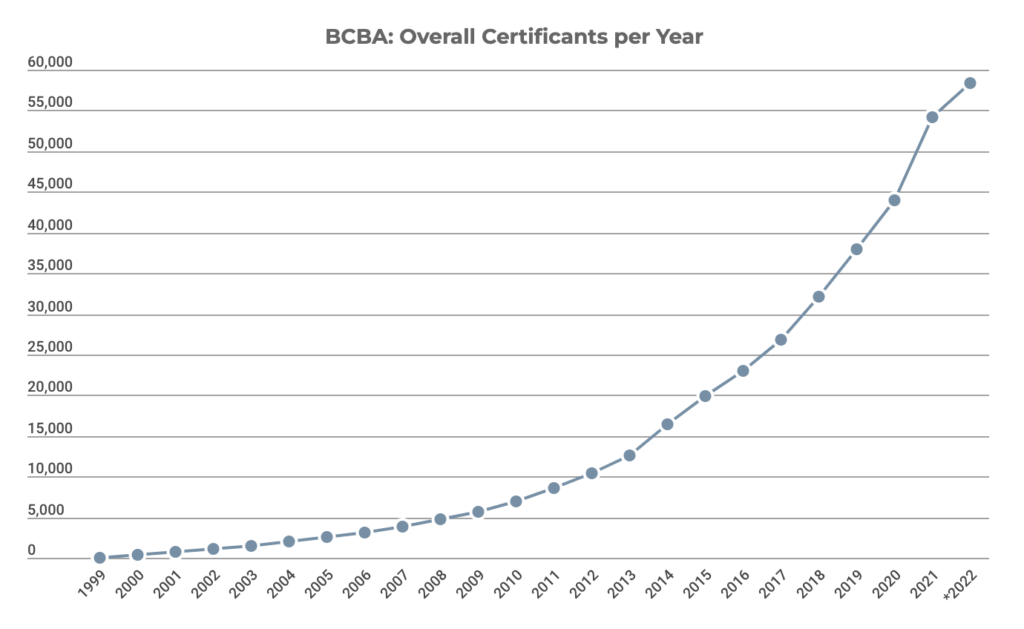
Demand for ABA practioners, including Board Certified Behavior Analysts, soared after 2014; more than 70 percent work with the autistic. From thetreetop.com/statistics/aba-therapist-demographics
Driving through north Champaign last winter I noticed a new business in a strip mall near Denny’s. At first, I assumed it was some sort of sports store due to the all-caps signage: “TOTAL SPECTRUM.” But this was not a purveyor of football helmets and jockstraps, but one of many licensed providers of Applied Behavior Analysis (ABA), the only state-approved “treatment” for those on the autism spectrum. As it turns out, jockstraps may be more strictly regulated than this rapidly expanding industry built upon the needs of vulnerable clients. My brief employment as an ABA “clinician” convinced me that more transparency is needed both on this industry and the therapy it markets.
Autism Speaks and the ABA Endorsement
Parents often hear about ABA through the well-known advocacy organization Autism Speaks. Their website explains ABA almost as a form of positive reinforcement: “when a behavior is followed by something that is valued (a reward), a person is more likely to repeat that behavior.” ABA proponents claim their Pavlovian approach is the only way for an autistic person to make “progress” in socialization, life skills (tying shoes, brushing teeth, etc), or academics. Continue reading